Page 228 of 411
You can cancel cruise control in any
of these ways:Push the CANCEL button on the
steering wheel.
Push the CRUISE button on the
steering wheel. Tap the brake pedal. Pressing the CRUISE button turns
the system off and erases the
previous cruising speed. When you push the CANCEL button,
or tap the brake pedal, the system
will remember the previously-set
cruising speed. To return to that
speed, accelerate to above 25 mph
(40 km/h) and then press and
release the RES/ACCEL button. The
CRUISE CONTROL indicator comes
on. The vehicle will accelerate to the
same cruising speed as bef ore.
Tapping either of the paddle shif ters
shif ts the speed up or down, but does
not cancel the cruise control. For
more inf ormation on driving with
paddle shif ters, see page .
276
EX models onlyCanceling Cruise Control Resuming the Set Speed
Cruise Control
224
CRUISE BUTTON
CANCEL
BUTTON
RES/ACCEL
BUTTON
SET/DECEL
BUTTON
Page 230 of 411
�Ì�Ì�Ì�Ì
Try to reduce all background
noise. If the microphone picks up
voices other than yours,
commands may be misinterpreted. Many commands can be spoken
together. For example, you can
say ‘‘Call 123-456- ’’ or
‘‘Dial Peter.’’
Press and release the HFL Talk
button each time you want to
make a command. Af ter the beep,
speak in a clear, natural tone.
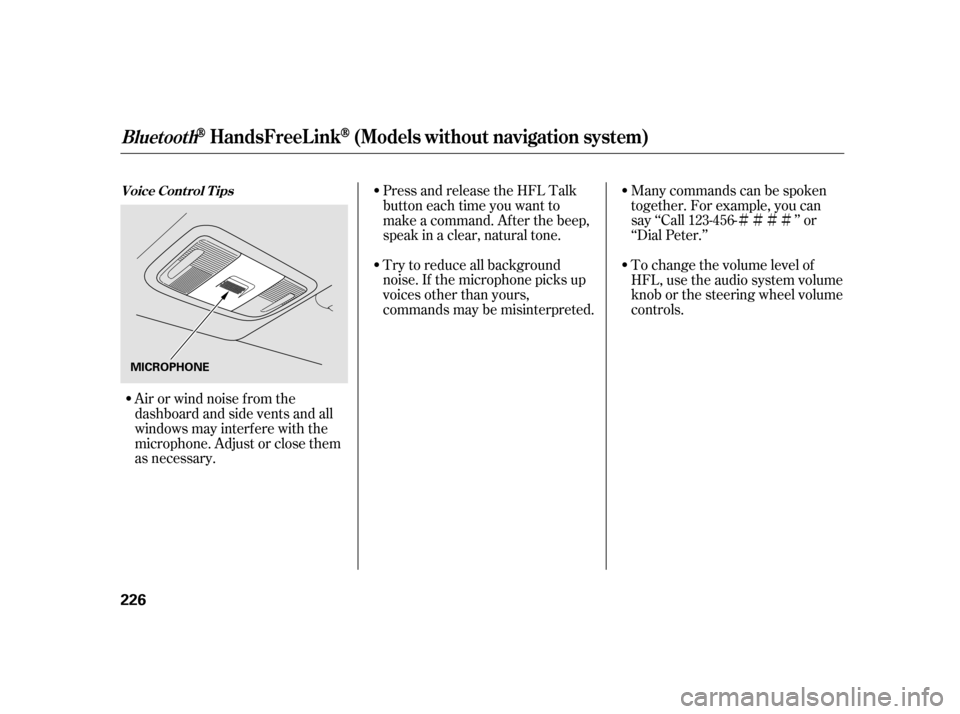
Airorwindnoisefromthe
dashboard and side vents and all
windows may interfere with the
microphone. Adjust or close them
as necessary. To change the volume level of
HFL, use the audio system volume
knob or the steering wheel volume
controls.
Voice Cont rol T ips
BluetoothHandsFreeL ink(Models wit hout navigat ion syst em)
226
MICROPHONE
Page 259 of 411

�Î
�Î
Some examples are: Removing parts f rom your vehicle,
or replacing components with
non-Honda components could
seriously af f ect your vehicle’s
handling, stability, and reliability.
If you plan to modif y your vehicle,
consult your dealer.Modif ying your steering wheel or
any other part of your vehicle’s
safety features can make the
systems inef f ective. Larger or smaller wheels and tires
can interf ere with the operation of
your vehicle’s anti-lock brakes and
other systems. Non-Honda wheels, because they
are a universal design, can cause
excessive stress on suspension
components and will not be
compatible with the tire pressure
monitoring system (TPMS) .
Raising your vehicle with a
non-Honda suspension kit can
af f ect the handling, stability, and
reliability. Lowering your vehicle with a
non-Honda suspension kit that
signif icantly reduces ground
clearance can allow the
undercarriage to hit speed bumps
or other raised objects, which
could cause the airbags to deploy. : U.S. models
Modif ying Your Vehicle
A ccessories and Modif ications
Bef ore Driving
255
Page 266 of 411
Make sure all windows, mirrors,
and outside lights are clean and
unobstructed. Remove f rost, snow,
or ice.Check that any items you may be
carrying are stored properly or
f astened down securely.
Check the seat adjustment (see
page ).
Check the adjustment of the
inside and outside mirrors (see
page ).
Check the steering wheel
adjustment (see page ).
Make sure the doors are securely
closed and locked.Fasten your seat belt. Check that
your passengers have f astened
their seat belts (see page ).
Youshoulddothefollowingchecks
and adjustments bef ore you drive
your vehicle.
Visually check the tires. If a tire
looks low, use a gauge to check its
pressure (see page ). Check that the hood and hatch are
f ully closed. When you start the engine, check
the gauges and indicators in the
instrument panel, and the
messages on the multi-inf ormation
display (see pages , and
).
1.
2.
3.
8. 7. 6.9.
4.
5.
61 7217
10.
141
147
128 89
338
Preparing to Drive
262
Page 280 of 411
�´
�µ
�´ �µ
To shif t up or down, use the
(right) or (lef t) paddle shif ter on
either side of the steering wheel.
Pull the (right) paddle shifter to
upshift. Pull (left) to downshift. When you pull either paddle shif ter,
the shif t indicator shows you the
selected speed number.
WhenyouaredrivingintheD
position, pulling either paddle shif ter
switches f rom the D-normal shif t
mode to the D-paddle shif t mode.
You can shif t the transmission up or
down through seven-stages manually
with the paddle shifters.
When the transmission returns to
ordinary automatic transmission
(CVT), the displayed shif t indicator
disappears.
Downshif ting gives you more power
when climbing, and provides engine
braking when going down a steep hill.
On EX models
Driving with the Paddle Shif ters
Using the Paddle Shif ters in the
D position (D-Paddle Shif t Mode)
276
SHIFT INDICATOR
Page 288 of 411

If the vehicle is f acing downhill,
turn the front wheels toward the
curb.
Make sure the parking brake is
f ully released bef ore driving away.
Driving with the parking brake
partially set can overheat or
damage the rear brakes.
Set the parking brake bef ore you put
the transmission in Park. This keeps
the vehicle from moving and putting
pressure on the parking mechanism
in the transmission. Always use the parking brake when
you park your vehicle. Make sure
the parking brake is set f irmly, or
your vehicle may roll if it is parked
on an incline.
Place any packages, valuables, etc.
in the cargo area or take them
with you. Turn of f the lights. Make sure the windows are closed.
Lock the doors and the hatch.
If the vehicle is f acing uphill, turn
the f ront wheels away f rom the
curb. Never park over dry leaves, tall
grass, or other f lammable
materials. The hot three way
catalytic converter could cause
these materials to catch on fire. Check the indicator on the
instrument panel to verif y that the
security system is set.
LX and EX models
Parking T ips
Parking
284
Page 289 of 411
Your vehicle is equipped with f ront
disc brakes. The brakes on the rear
wheels are drum. A power assist
helps reduce the ef f ort needed on
thebrakepedal.TheABShelpsyou
retain steering control when braking
very hard.
Resting your f oot on the pedal keeps
the brakes applied lightly, builds up
heat, reduces their ef f ectiveness and
reduces brake pad lif e. In addition,
f uel economy can be reduced. It also
keeps your brake lights on all the
time, conf using drivers behind you.Check the brakes after driving
through deep water. Apply the
brakes moderately to see if they f eel
normal. If not, apply them gently and
f requently until they do. Be extra
cautious in your driving.
Constant application of the brakes
when going down a long hill builds
up heat and reduces their
ef f ectiveness. Use the engine to
assist the brakes by taking your f oot
of f the accelerator and downshif ting
to a lower speed.
Braking System
Driving
285
Page 290 of 411
The hydraulic system that operates
the brakes has two separate circuits.
Each circuit works diagonally across
the vehicle (the lef t-f ront brake is
connected with the right-rear brake,
etc.). If one circuit should develop a
problem, you will still have braking
at two wheels.If the brake pads need replacing, you
will hear a distinctive, metallic
screeching sound when you apply
the brake pedal. If you do not have
the brake pads replaced, they will
screech all the time. It is normal f or
the brakes to occasionally squeal or
squeak when you apply them.
The f ollowing f eatures are also
equipped:
With the shift lever in D, S or L, this
f eature applies brake pressure
brief ly as you release the brake
pedal to prevent the vehicle f rom
moving unexpectedly.
This f eature helps you apply the
brakes with less f orce during an
emergency braking situation.
Creep Aid System
Brake-Assist
Braking System Design Brake Pad Wear Indicators
Braking System
286