Page 216 of 374
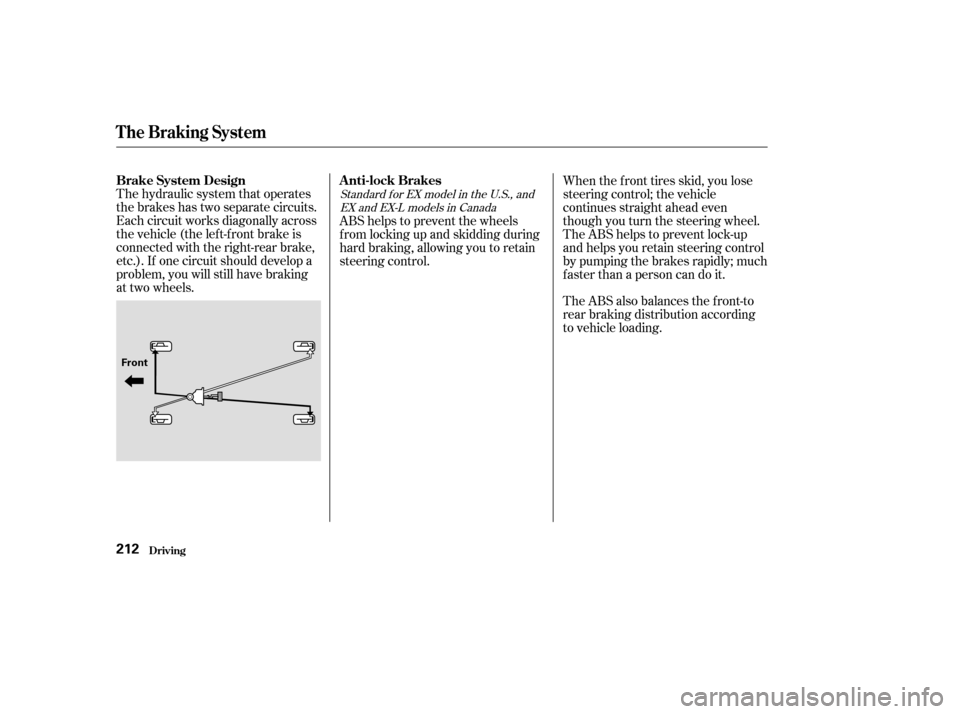
The hydraulic system that operates
the brakes has two separate circuits.
Each circuit works diagonally across
the vehicle (the lef t-f ront brake is
connected with the right-rear brake,
etc.). If one circuit should develop a
problem, you will still have braking
at two wheels.When the f ront tires skid, you lose
steering control; the vehicle
continues straight ahead even
though you turn the steering wheel.
The ABS helps to prevent lock-up
and helps you retain steering control
by pumping the brakes rapidly; much
f aster than a person can do it.
ABS helps to prevent the wheels
f rom locking up and skidding during
hard braking, allowing you to retain
steering control.
The ABS also balances the f ront-to
rear braking distribution according
to vehicle loading.Standard f or EX model in the U.S., andEX and EX-L models in Canada
Brake System Design A nti-lock Brakes
The Braking System
Driving212
Front
Page 217 of 374

this defeats the
purpose of the ABS. Let the ABS
work f or you by always keeping f irm,
steady pressure on the brake pedal
as you steer away from the hazard.
This is sometimes ref erred to as
You will f eel a pulsation in the brake
pedal when the ABS activates, and
you may hear some noise. This is
normal; it is the ABS rapidly
pumping the brakes.
Activation varies with the amount of
traction your tires have. On dry
pavement, you will need to press on
thebrakepedalveryhardbeforeyou
activate the ABS. However, you may
feel the ABS activate immediately if
you are trying to stop on snow or ice. it only helps with steering
control during braking. You should
always maintain a saf e f ollowing
distance f rom other vehicles.
such as trying to take a
corner too f ast or making a sudden
lane change. Always drive at a safe,
prudent speed f or the road and
weather conditions.
Always steer moderately
when you are braking hard. Severe
or sharp steering wheel movement
can still cause your vehicle to veer
into oncoming traffic or off the road. on loose or
uneven surf aces, such as gravel or
snow, than a vehicle without anti-
lock. Slow down and allow a greater
distance between vehicles under
those conditions.
‘‘stomp and steer.’’
CONT INUED
You should never pump the
brake pedal; A BS does not reduce the time or
distance it takes to stop the
vehicle,
A BS will not prevent a skid that
results f rom changing direction
abruptly,
A BS cannot prevent a loss of
stability.A vehicle with A BS may require a
longer distance to stopImport ant Saf et y Reminders
The Braking System
Driving213
Page 218 of 374
�Î
�Î
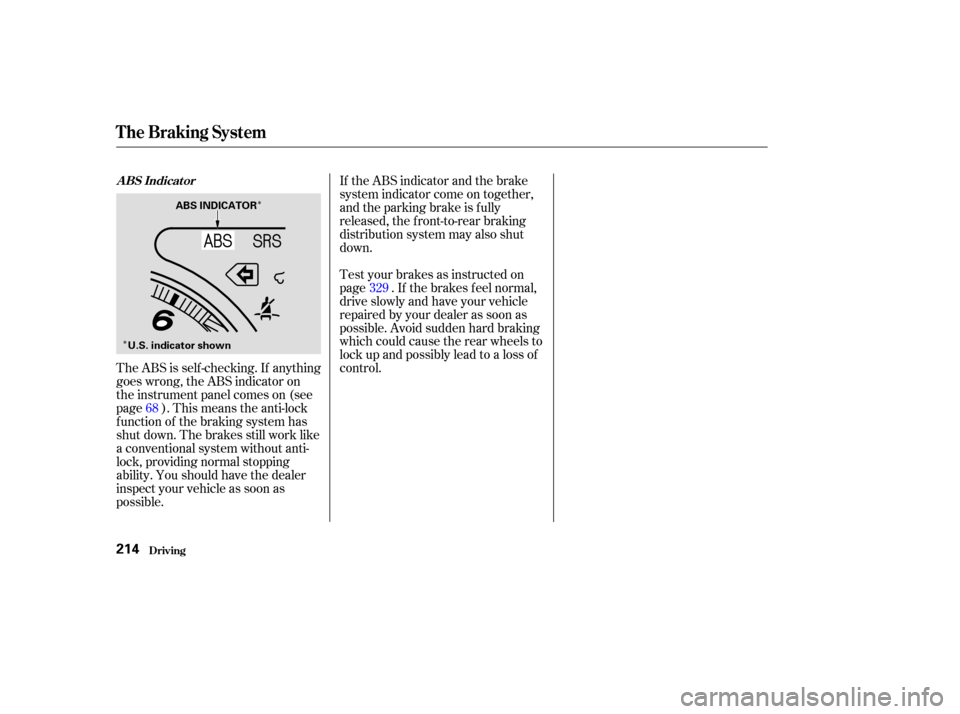
The ABS is self -checking. If anything
goes wrong, the ABS indicator on
the instrument panel comes on (see
page ). This means the anti-lock
f unction of the braking system has
shut down. The brakes still work like
a conventional system without anti-
lock, providing normal stopping
ability. You should have the dealer
inspect your vehicle as soon as
possible. If the ABS indicator and the brake
system indicator come on together,
and the parking brake is f ully
released, the front-to-rear braking
distribution system may also shut
down.
Test your brakes as instructed on
page . If the brakes f eel normal,
drive slowly and have your vehicle
repaired by your dealer as soon as
possible. Avoid sudden hard braking
which could cause the rear wheels to
lock up and possibly lead to a loss of
control.
68 329
A BS Indicat or
The Braking System
Driving214
ABS INDICATOR
U.S. indicator shown
Page 220 of 374
�µCheck your tires
f requently f or wear and proper
pressure. Both are important in
preventing ‘‘hydroplaning’’ (loss of
traction on a wet surface). In the
winter, mount snow tires on all f our
wheels f or the best handling.
Watch road conditions caref ully,
they can change f rom moment to
moment. Wet leaves can be as slip-
pery as ice. ‘‘Clear’’ roads can have
patches of ice. Driving conditions
can be very hazardous when the
outside temperature is near f reezing.
The road surf ace can become
covered with areas of water puddles
mixed with areas of ice, so your
traction can change without warning.
Be caref ul when downshif ting. If
traction is low, you can lock up the
drive wheels f or a moment and cause
askid. Be very cautious when passing, or
beingpassedbyothervehicles.The
spray f rom large vehicles reduces
your visibility, and the wind buf f eting
can cause you to lose control.
Traction
Driving in Bad Weather
Driving216
Page 228 of 374

When preparing to tow your CR-V,
make sure the transmission is
f illed to the correct level (see page). Do not overf ill.
Leave the key in the ignition
switch and the ignition switch in
ACCESSORY (I) so the steering
wheel does not lock. Make sure
the radio and any items plugged
into the accessory power sockets
are turned of f so you do not run
down the battery. Shif t the transmission to Neutral. Release the parking brake.
After attaching the tow bar to your
motorhome, do the following to
prepare your CR-V f or ‘‘f lat towing’’: When purchasing a tow bar, make
sure you select a reputable
manuf acturer and installer. Follow
the manufacturer’s attachment
instructions caref ully. Your CR-V can be towed behind a
motorhome at legal highway speeds
up to 65 mph(100 km/h). Do not
exceed 65 mph(100km/h).
Otherwise, severe transmission
damage will occur. To avoid damage
to the 4WD system, it must be towed
with all f our wheels on the ground
(f lat towing). When preparing to tow your CR-V,
make sure the transmission is f ull of
fluid (see page ). Maintaining
the correct level is very important.
Do not overf ill. Do the f ollowing
Follow the procedure exactly.
Otherwise, severe automatic
transmission damage will occur.
261
260
every day immediately bef ore you begin
towing.
5-speed Manual T ransmission A ut omat ic T ransmission
Towing Your Vehicle Behind a Motorhome
Driving224
Page 229 of 374

Start the engine.
Press on the brake pedal. Shif t the
lever through all the positions (P,
R, N, D, 2, 1)
ShifttoD,thentoN.Letthe
engine run f or three minutes, then
turn of f the engine.
Release the parking brake.
Leave the ignition switch in
ACCESSORY (I) so the steering
wheel does not lock. Make sure
the radio and any items plugged
into the accessory power sockets
are turned of f so you do not run
down the battery.If you tow more than 8 hours in one
day, you should repeat the above
procedure at least every 8 hours.
(when you stop f or f uel, etc.)
If youtowaCR-Vwithanautomatic
transmission, the transmission f luid
must be changed every two years or
30,000 miles (48,000 km), whichever
comes f irst.Ext ended T owing
Towing Your Vehicle Behind a Motorhome
Driving225
Failure to f ollow the above instructions
exactly will result in severe automatic
transmission damage. If you cannot
shif t the transmission or start the
engine, your vehicle must be
transported on a f lat-bed truck or
trailer. The steering system can be damaged if
the steering wheel is locked. Leave the
ignition switch in Accessory (I), and
make sure the steering wheel turns
f reely bef ore you begin towing.Severe automatic transmission damage
will occur if the vehicle is shif ted f rom
reverse to neutral and then towed with
the drive wheels on the ground.
Page 232 of 374

After you return to the pavement,
caref ully inspect your vehicle to
make sure there is no damage that
could make driving it unsaf e. Check
the tires for damage and for proper
pressure. Driving of f -highway can be hard on a
vehicle. Bef ore you leave the
pavement, be sure all scheduled
maintenance and service has been
done, and that you have inspected
your vehicle. Pay special attention to
the condition of the tires, and use a
gauge to check the tire pressures. The f ollowing pages contain practical
tips on basic of f -highway operation.Of f -highway, the general rule is to
keep your speed low. Of course,
you’ll need enough speed to keep
moving forward. But at higher
speeds, you have less time to assess
conditions and make good decisions.
There’s also a greater chance of
sliding if you brake or turn too
quickly on wet soil, gravel, or ice. In
any situation, never go f aster than
conditions allow.
Forbettertractiononallsurfaces,
accelerate slowly and gradually build
up speed. If you try to start too fast
on wet soil, mud, snow, or ice, you
might not have enough traction to
get underway. You may even dig
yourself into a hole. Starting with the
shif t lever in second gear (2) will
help get you to a smooth start on
snow and ice.Generally, the best of f -pavement
braking technique is to gently
depress the brake pedal, then
increase pressure as more braking is
needed. Avoid hard braking. Keep in
mind that you will usually need more
time and distance to brake to a stop
on unpaved surf aces.
If you need to brake hard because of
an emergency, apply steady, even
pressure to the brake pedal. Do not
pump the brakes; let the anti-lock
braking system pump them f or you.
If you pump the brakes, the anti-lock
cannot work as ef f iciently, and your
stopping distance may be increased.
With ABS
Driving T ips
Check Out Your Vehicle
Cont rolling Speed
A ccelerat ing and Braking
Off-Highway Guidelines
Driving228
Page 256 of 374
The coolant level should be up to
the base of the f iller neck. Add
coolant if it is low.
Turn the radiator cap counter-
clockwise, without pressing down
on it, until it stops. This relieves
any pressure remaining in the
cooling system.
Remove the radiator cap by
pushing down and turning
counterclockwise. Pour coolant into the reserve tank.
Fill it to half way between the MAX
and MIN marks. Put the cap back
on the reserve tank.
Do not add any rust inhibitors or
other additives to your vehicle’s
cooling system. They may not be
compatible with the coolant or
engine components.
Put the radiator cap back on.
Tighten it f ully. Pourthecoolantslowlyand
caref ully so you do not spill. Clean
up any spills immediately. Spilled
coolant could damage components
in the engine compartment.
2.
3.
4.
5. 6.
Cooling Syst em
Maint enance252
RADIATOR CAP
RESERVE TANK