Page 299 of 374

If you need to park your vehicle f or
an extended period (more than one
month), there are several things you
should do to prepare it f or storage.
Proper preparation helps prevent
deterioration and makes it easier to
get your vehicle back on the road. If
possible, store your vehicle indoors.Block the rear wheels.
If the vehicle is to be stored f or a
longer period, it should be
supported on jackstands so the
tires are of f the ground.
Leave one window open slightly (if
the vehicle is being stored
indoors).Cover the vehicle with a
‘‘breathable’’ cover, one made
f rom a porous material such as
cotton. Nonporous materials, such
as plastic sheeting, trap moisture,
which can damage the paint.
Fill the f uel tank.
Change the engine oil and f ilter
(see page ).
Wash and dry the exterior
completely.
Cleantheinterior.Makesurethe
carpeting, floor mats, etc. are
completely dry. To minimize sticking, apply a
silicone spray lubricant to all door
and tailgate seals. Also, apply a
vehiclebodywaxtothepainted
surfaces that mate with the door
and tailgate seals. Support the f ront and rear wiper
blade arms with a f olded towel or
ragsotheydonottouchthe
windshield. Disconnect the battery.
Leave the parking brake off. Put
the transmission in Reverse
(5-speed manual) or Park
(automatic). If possible, run the engine f or a
while periodically (pref erably once
amonth).
If you store your vehicle f or 12
months or longer, have your Honda
dealer perf orm the inspections called
f or in the 24 months maintenance
schedule (Normal Conditions) as
soon as you take it out of storage
(see page ). The replacements
called f or in the maintenance
schedule are not needed unless the
vehicle has actually reached that
time or mileage.
249
238
Maint enance
St oring Your Vehicle
295
Page 304 of 374
Your dealer has touch-up paint to
match your vehicle’s color. The color
code is printed on a sticker on the
driver’s doorjamb. Take this code to
your dealer so you are sure to get
the correct color.Inspect your vehicle f requently f or
chips or scratches in the paint.
Repair them right away to prevent
corrosion of the metal underneath.
Use the touch-up paint only on small
chips and scratches. More extensive
paint damage should be repaired by
a prof essional.
Appearance Care
Exterior Care
Paint T ouch-up
300
Page 308 of 374

Use a high-pressure spray to clean
the underside of your vehicle. This
is especially important in areas
that use road salt in winter. It is
also a good idea in humid climates
and areas subject to salt air.
Vehicles equipped with ABS have
a sensor and wiring at each wheel.
Be careful not to damage them.
Many corrosion-preventive measures
are built into your Honda. You can
help keep your vehicle f rom
corroding by perf orming some
simple periodic maintenance:
Repair chips and scratches in the
paint as soon as you discover them.
Two f actors normally contribute to
causing corrosion in your vehicle:
Moisture trapped in body cavities.
Dirtandroadsaltthatcollectsin
hollows on the underside of the
vehicle stays damp, promoting
corrosion in that area.
Removal of paint and protective
coatings f rom the exterior and
underside of the vehicle. Inspect and clean out the drain
holes in the bottom of the doors
and body.
Check the f loor coverings f or
dampness. Carpeting and f loor
mats may remain damp f or a long
time, especially in winter. This
dampness can eventually cause
the f loor panels to corrode.Have the corrosion-preventive
coatings on the underside of your
vehicle inspected and repaired
periodically.
1.
2.
Corrosion Prot ect ion
Appearance Care304
Page 313 of 374
CONT INUED
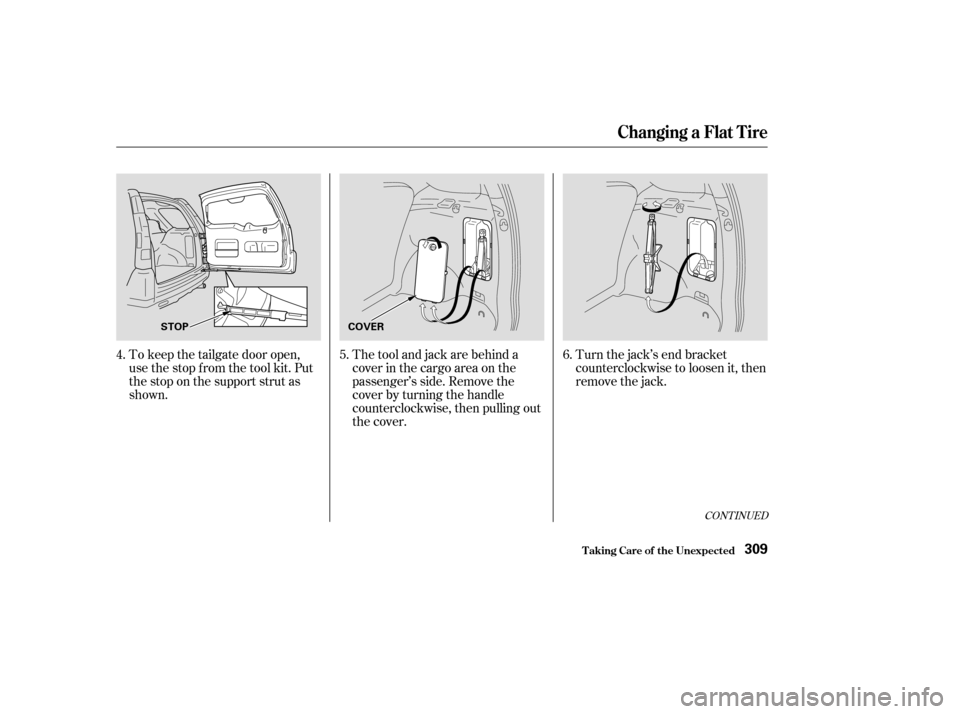
Turn the jack’s end bracket
counterclockwise to loosen it, then
remove the jack.
To keep the tailgate door open,
use the stop f rom the tool kit. Put
the stop on the support strut as
shown. The tool and jack are behind a
cover in the cargo area on the
passenger’s side. Remove the
cover by turning the handle
counterclockwise, then pulling out
the cover.6.
5.
4.
T aking Care of t he Unexpect ed
Changing a Flat T ire
309
STOP COVER
Page 340 of 374
�µ
�µ
�µ
No. Amps. Circuits Protected
1
2
3
4
5
6
7
8
9
10
11
12
13
14
15
16
17
18
19
20 20 A
15 A
15 A
20 A
15 A
15 A
15 A
10 A
30 A
20 A
40 A
40 A
40 A
15 A
20 A
15 A
30 A
100 A 50 A Condenser Fan
Small Light
Interior Light
Cooling Fan
Hazard
FI ECU
Horn, Stop
Not Used
Back Up
ABS Motor
Rear Defroster
Heater Motor
Power Window
Option
Lef t Headlight
Door Lock
Right Headlight
ABS F/S
Battery
Ignition 1
Spare Fuses
21 257.5A 30A
T aking Care of t he Unexpect ed
Fuses
336
UNDER-HOOD FUSE BOX
Page 344 of 374
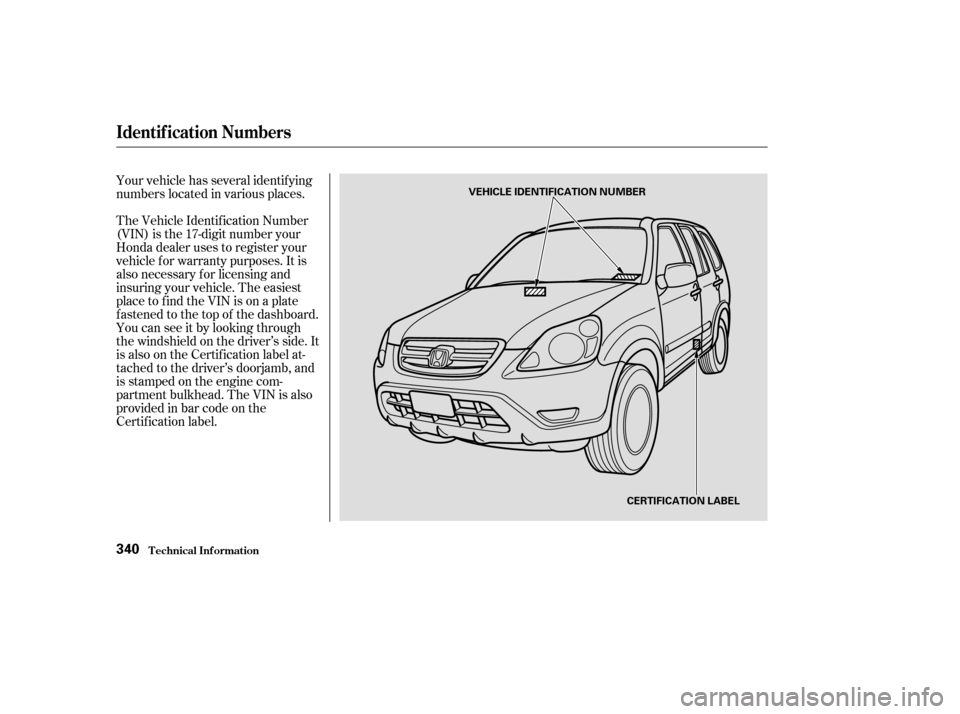
Your vehicle has several identif ying
numbers located in various places.
The Vehicle Identif ication Number
(VIN) is the 17-digit number your
Honda dealer uses to register your
vehicle f or warranty purposes. It is
also necessary f or licensing and
insuring your vehicle. The easiest
placetofindtheVINisonaplate
fastened to the top of the dashboard.
Youcanseeitbylookingthrough
the windshield on the driver’s side. It
is also on the Certification label at-
tached to the driver’s doorjamb, and
is stamped on the engine com-
partment bulkhead. The VIN is also
provided in bar code on the
Certif ication label.
Identif ication Numbers
T echnical Inf ormation340
VEHICLE IDENTIFICATION NUMBERCERTIFICATION LABEL
Page 346 of 374

�Î�Î
�Î�Î
�Î
Specif ications
T echnical Inf ormation342
Dimensions
Weights
Engine
Capacities
178.6 in (4,537 mm)
70.2 in (1,782 mm)
66.2 in (1,682 mm)
103.1 in (2,620 mm)
60.4 in (1,533 mm)
60.6 in (1,538 mm)
3.43 x 3.90 in (87.0 x 99.0 mm) 144 cu-in (2,354 cm
)
9.6 : 1
15.3 US gal (58
)
4.4 US qt (4.2
)
4.2 US qt (4.0)
5.6 US qt (5.3) 1.43 US gal (5.4
)
1.88 US gal (7.1)
1.45 US gal (5.5
)
1.90 US gal (7.2)
3.3 US qt (3.1
)
3.1 US qt (2.9)
7.6 US qt (7.2
)
6.9 US qt (6.5)
2.0 US qt (1.9)
2.4 US qt (2.3)
1.1 US qt (1.0
)
1.3 US qt (1.2)
Length
Width
Height
Wheelbase
Track
Gross vehicle weight rating See the certification label attached
to the driver’s doorjamb.
Type
BorexStroke
Displacement
Compression ratio
Spark plugs
Fuel tank
Engine oil Water cooled 4-stroke DOHC
VTEC 4-cylinder gasoline engine
4.8 US qt (4.5
)
2.6 US qt (2.5)
2.2 US qt (2.1
)
Engine
coolant
Automatic
transmission
fluid
Manual
transmission
fluid
Rear
differential
fluid (4WD)
Windshield
washer
reservoir
Excluding the oil remaining in the engine.
Including the coolant in the reserve tank and that remaining in the
engine.
Reserve tank capacity:
0.16 US gal (0.6
)
See spark plug maintenance
section page 269 .
Approx.
Front
Rear
Change
Without filter
Total 1:
2:Change
Total
Change
Total
Change
4WD
2WD
Total 4WD
2WD
Change
Total
Change
Total
U.S. Vehicles
Canada
Vehicles 4WD
2WD
Automatic Transmission
Manual Transmission
1 2
2
Including filter
Page 347 of 374

�µ�µ�µ
�µ
�µ
�µ
�µ
�µ
�µ
�µ
�µ
�µ
�µ
�µ
�µ
�µ
�µ
Specif ications
T echnical Inf ormation343
Air Conditioning
Battery
Tires Alignment Fuses
Lights HFC-134a (R-134a)
17.0 18.7 oz (480 530 g) SP-10
12 V
12 V 60/55 W
21/5 W
36 AH/5 HR
12 V 12 V
12 V
12 V
12 V
12 V
12 V
12 V
12 V
21 W
3CP
8W
4CP
8W
5W
21 W
21/5 W
21 W
12 V 3 CP
Refrigerant type
Charge quantity
Lubricant type
Capacity
12 V See page
335or the fuse label
attached to the inside of the fuse
box door under the steering
column.
45 AH/20 HR 26 psi (180 kPa , 1.8 kgf/cm
)
26 psi (180 kPa , 1.8 kgf/cm)
P205/70R15 95S
Size
Pressure Toe-in
Camber
Caster 1°45’1°
0°
0.08 in (2.0 mm) 0.0in(0mm)
See page
336or the fuse box
cover.
Interior
Under-hood
Headlights
Front turn signal/side marker
lights
Parking lights
Rear turn signal lights
Stop/Taillights
Back-up lights
License plate light
Ceiling light
Spotlights
Cargo area Light
Rear side marker lights
High-mount brake light
12 V Front
Rear
Front
Rear
Front
Front/Rear
Front
Rear
(H4/HB2)