Page 32 of 374

Many parents say they pref er to put
an inf ant or small child in the f ront
passenger seat so they can watch the
child, or because the child requires
attention.
Your vehicle has three seating
positions in the back seat where
children can be properly restrained.
If you ever have to carry more than
three children in your vehicle:
Place the largest child in the f ront
seat, provided the child is large
enough to wear a seat belt
properly (see page ).
Move the vehicle seat as far to the
rear as possible (see page ).
Have the child sit upright and well
backintheseat(seepage ).
Make sure the seat belt is properly
positioned and secured (see page ). Using
this f eature will prevent children
f rom playing with the windows,
which could expose them to
hazards or distract the driver (see
page ). Using this f eature will
prevent children f rom opening the
doors and accidentally f alling out
(see page ).
Placing a child in the f ront seat
exposes the child to hazards f rom
the passenger’s f ront airbag, and
paying close attention to a child
distracts the driver f rom the
important tasks of driving, placing
both of you at risk.
If a child requires physical attention
or f requent visual contact, we
strongly recommend that another
adult ride with the child in the back
seat. The back seat is far safer for a
child than the front.
42
1320
17 93
110
Driver and Passenger Saf ety
Protecting Children
If a Child Requires Close
Attention
If You Must Drive with Several
Children Additional Saf ety Precautions
Use t he main power window
swit ch t o prevent children f romopening t he rear windows.
Use childproof door locks t o
prevent children f rom opening t hedoors.
28
Page 33 of 374

CONT INUED
Leaving children without
adult supervision is illegal in most
states and Canadian provinces,
and can be very hazardous. For
example, inf ants and small
childrenleftinavehicleonahot
day can die f rom heatstroke. And
children lef t alone with the key in
the ignition can accidentally set
the vehicle in motion, possibly
injuring themselves or others. The f ollowing pages give general
guidelines f or selecting and installing
child seats f or inf ants and small
children.
Children who play in vehicles can
accidentally get trapped inside the
vehicle. Teach your children not to
play in or around vehicles.
Even very young
children learn how to unlock
vehicle doors, turn on the ignition,
and open the tailgate or hatch
glass, which can lead to accidental
injury or death.
Driver and Passenger Saf ety
Protecting Children
Do not leave children alone in your
vehicle. Lock all doors and the tailgate
when your vehicle is not in use.
K eep vehicle keys and remot etransmitters out of the reach ofchildren.General Guidelines f or Using
Child Seats
29
Page 39 of 374

With the child seat in the desired
back seating position, route the
belt through the child seat
according to the seat maker’s
instructions, then insert the latch
plate into the buckle.
The lap/shoulder belts in the back
seats have a locking mechanism that
must be activated to secure a child
seat.
The f ollowing pages provide
instructions and tips on how to
secure a rear-f acing child seat with
this type of seat belt.
When properly installed, a rear-
f acing child seat may prevent the
driver or a f ront-seat passenger f rom
moving the seat as far back as
recommended (see page ). Or it
may prevent them f rom locking the
seat-back in the desired upright
position (see page ).
In either case, we recommend that
you place the child seat directly
behind the f ront passenger seat,
move the front seat as far forward as
needed, and leave it unoccupied. Or
you may wish to get a smaller child
seat that allows you to safely carry a
f ront passenger.
If you have a child seat designed to
be attached to the vehicle’s LATCH
anchorage system, follow the
instructions on page .
Bef ore installing a child seat in the
center seating position of the rear
seat, make sure the seat belt
detachable anchor is securely
latched (see page ).
13
15
1. 2.
48
108
CONT INUED
Rear-Facing Child Seat Inst allat ion
Protecting Children
Driver and Passenger Saf ety35
Page 40 of 374

To activate the lockable retractor,
slowly pull the shoulder part of the
belt all the way out until it stops,
then let the belt f eed back into the
retractor (you might hear a
clicking noise as the belt retracts).
Af ter the belt has retracted, tug on
it. If the belt is locked, you will not
be able to pull it out. If you can pull
the belt out, it is not locked and
you will need to repeat these steps.Push and pull the child seat
f orward and f rom side to side to
verif y that it is secure enough to
stay upright during normal driving
maneuvers. If the child seat is not
secure, unlatch the belt, allow it to
retract f ully, then repeat these
steps.
Af ter conf irming that the belt is
locked, grab the shoulder part of
the belt near the buckle and pull
up to remove any slack from the
lap part of the belt. Remember, if
the lap part of the belt is not tight,
the child seat will not be secure.
To remove slack, it may help to
putweightonthechildseat,or
push on the back of the seat, while
pulling up on the belt.
3.
4.
5.
6.
Protecting Children
Driver and Passenger Saf ety36
Page 41 of 374
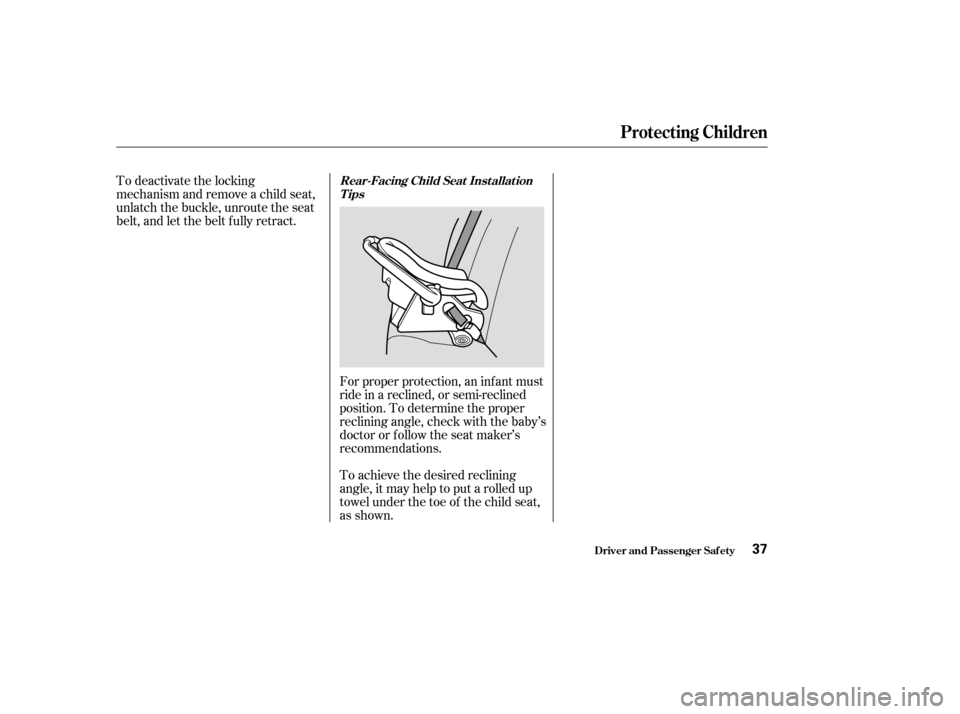
To achieve the desired reclining
angle, it may help to put a rolled up
towel under the toe of the child seat,
as shown. Forproperprotection,aninfantmust
ride in a reclined, or semi-reclined
position. To determine the proper
reclining angle, check with the baby’s
doctor or f ollow the seat maker’s
recommendations.
To deactivate the locking
mechanism and remove a child seat,
unlatch the buckle, unroute the seat
belt, and let the belt f ully retract.
Rear-Facing Child Seat Inst allat ion
Tips
Protecting Children
Driver and Passenger Saf ety37
Page 43 of 374
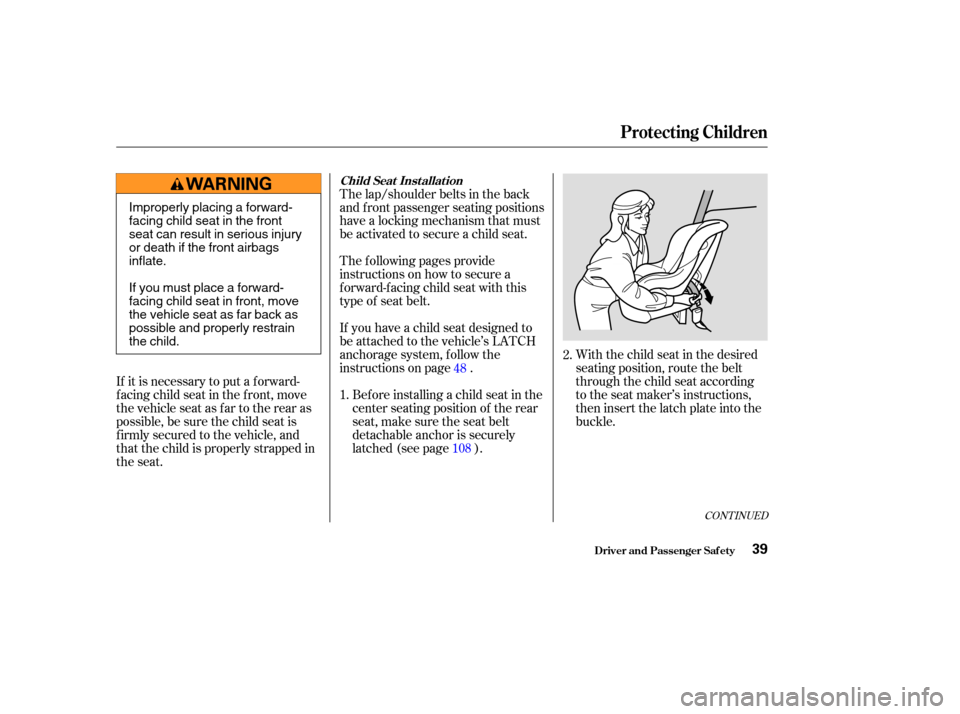
With the child seat in the desired
seating position, route the belt
through the child seat according
to the seat maker’s instructions,
then insert the latch plate into the
buckle.
The lap/shoulder belts in the back
and f ront passenger seating positions
have a locking mechanism that must
be activated to secure a child seat.
The f ollowing pages provide
instructions on how to secure a
f orward-f acing child seat with this
type of seat belt.
If you have a child seat designed to
be attached to the vehicle’s LATCH
anchorage system, follow the
instructions on page .
If it is necessary to put a f orward-
f acing child seat in the f ront, move
the vehicle seat as far to the rear as
possible, be sure the child seat is
f irmly secured to the vehicle, and
that the child is properly strapped in
the seat. Bef ore installing a child seat in the
center seating position of the rear
seat, make sure the seat belt
detachable anchor is securely
latched (see page ).48
2.
1.
108
CONT INUED
Protecting Children
Driver and Passenger Saf ety
Child Seat Inst allat ion
39
Improperly placing a forward-
facing child seat in the front
seat can result in serious injury
or death if the front airbags
inflate.
Ifyoumustplaceaforward-
facing child seat in front, move
the vehicle seat as far back as
possible and properly restrain
the child.
Page 44 of 374
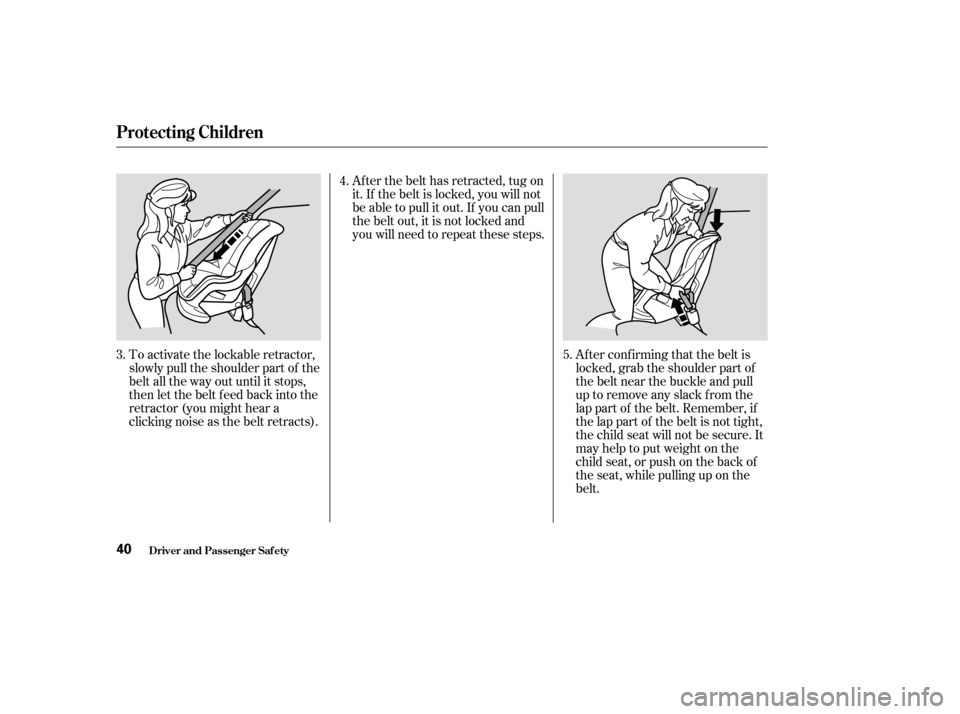
To activate the lockable retractor,
slowly pull the shoulder part of the
belt all the way out until it stops,
then let the belt f eed back into the
retractor (you might hear a
clicking noise as the belt retracts).Af ter conf irming that the belt is
locked, grab the shoulder part of
the belt near the buckle and pull
up to remove any slack from the
lap part of the belt. Remember, if
the lap part of the belt is not tight,
the child seat will not be secure. It
mayhelptoputweightonthe
child seat, or push on the back of
the seat, while pulling up on the
belt.
Af ter the belt has retracted, tug on
it. If the belt is locked, you will not
be able to pull it out. If you can pull
the belt out, it is not locked and
you will need to repeat these steps.
3. 4.
5.
Protecting Children
Driver and Passenger Saf ety40
Page 45 of 374
To deactivate the locking
mechanism in order to remove a
child seat, unlatch the buckle,
unroute the seat belt, and let the belt
fully retract.
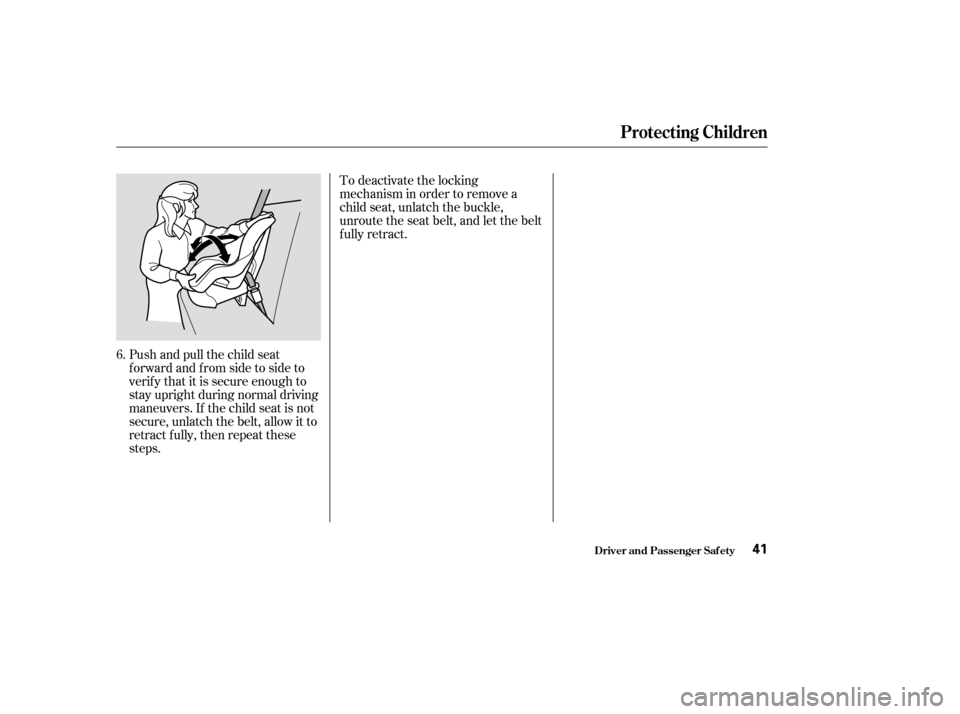
Push and pull the child seat
f orward and f rom side to side to
verif y that it is secure enough to
stay upright during normal driving
maneuvers. If the child seat is not
secure, unlatch the belt, allow it to
retract f ully, then repeat these
steps.
6.
Protecting Children
Driver and Passenger Saf ety41