2003 HONDA CIVIC ect
[x] Cancel search: ectPage 599 of 1139

Gonventional Brake Components
ComponentProcedureAlso check for:
l\4aster CylinderLook for damage or signs of fluid leakage at;. Reservoir or reservoir grommets
. Line joints
. Between master cvlinder and booster
Brake HosesLook for damage or signs of fluid leakage at:. Line joints and banjo bolt connections. Hoses and lines. also inspect for twisting or
damaqe
Bulging, twisted or bent lines.
CaliperLook for damage or signs of fluid leakage at:. Piston seal. Banjo bolt connections. Bleeder screw
Seized or sticking caliper pins.
ABS l\ilodulatorLook for damage or signs of fluid leakage at:. Line joints
. Modulator
Brake System Inspection and Tests
Brake System Test
Brake pedal sinks/fades when braking
1. Start the engine, and let it warm up to operating temperature.
2. Attach a 2-inch pieceof masking tape along the bottom of the steering wheel, and draw a horizontal reference
mark across it.
With the transmission in Neutral, press and hold the brake pedal lightly, then release the parking brake.
While still holding the brake pedal, hook the end of the tape measure behind it. Then pull the tape up to the
steering wheel, noting where the tape measure lines up with the reference mark you made on the masking tape.
Apply steady pressure to the brake pedal for 3 minutes.
Watch the tape measure.
. if it moves less than 10 mm, the master cylinder is OK.
. if it moves more than 10 mm replace the master cylinder.
t-
3.
5.
6.
19-4
Page 600 of 1139

Rapid brake pad wear. Vehicle vibration {after a long
drivel, or High, hard brake pedal
1. Drive the vehicle until the brakes drag or untilthe
pedal is high and hard. This can take 20 or more
brake pedal applications during an extended test
drive.
2. With the engine running, raise the vehicle on a lift,
and spin all four wheels by hand.
ls there btake drag at any of the wheels?
YES Go to step 3.
NO Look for other causes of the pad wear, high
pedal, or vehicle vibration.I
3. Turn the engine off, pump the brake pedal to
deplete the vacuum in the brake booster, and then
spin the wheels again to check for brake drag.
ls therc brake dtag at any ot the wheels?
YES-Go to step 4.
NO Replace the brake booster.I
4. Without removing the brake lines, unbolt and
separate the master cylinder from the booster, then
spin the wheels lo check for brake drag.
ls there btake drag at any of the wheels?
YES Go to step 5,
NO-Check the brake pedal position switch
adjustment and pedal free play.I
5. Loosen the hydraulic lines at the master cylinder,
then spin the wheels to check for brake drag.
ls there brake drag at any of the wheels?
YES Go to step 6.
NO- Replace the master cylinder.l
6. Loosen the bleeder screws at each caliper, then
spin the wheels to check for brake drag.
Is there brake drag at any of the wheels?
YES Disassemble and repair the caliper on the
wheel(s) with brake drag.l
NO Inspect brake hose (s)/line (s).
19-5
Page 601 of 1139

Conventional Brake Components
Brake Pedaland Brake PedalPosition Switch Adjustment
Pedal Height
1.Disconnect the brake pedal position switch
connector, turn the brake pedal position switch (A)
counterclockwise, and pull it back until it is no
longer touching the brake pedal.
Lift up the carpet and the insulator cutout (B).
l\4easure the pedal height (C) from the middle of
the left side of the pedal pad (D).
Standard Pedal Height (with carpet removed):
184 mm (7 4/16 in.)
Loosen the pushrod locknut (A), and screw the
pushrod in or out with pliers until the standard
pedal height from the floor is reached. After
adjustment, tighten the locknut firmly. Do not
adjust the pedal height with the pushrod pressed.
15 N.m(1.5 kgl m. 11 lbl ft)
19-6
7. Check the brake pedal free play as described below.
Pedal Free Play
4. With the engine off, inspect the play (A) on the
pedal pad (B) by pushing the pedal by hand.
Free Play: 0.4- 3.0 mm {0.016 0.'l18in.)
lf the pedal free play is out of specification, adjust
the brake pedal position switch (C). lf the pedal free
play is insufficient, it may result in brake drag.
Push in the brake oedal oosition switch until its
plunger is fully pressed (threaded end (A)touching
the pad (B) on the pedal arm). Then, turn the switch
45" clockwise to lock it. The gap between the brake
pedal position switch and the pad is automatically
adjusted to 0.4 to 3.0 mm (0.016 0.118 in.) by
locking the switch. Make sure the brake lights go
otf when the pedal is released.
t
6.
Page 605 of 1139

Conventional Brake Components
Parking Brake Switch Test
1. Remove the rear console, and disconnect theconnector (A)from the switch (B).
Check for continuity between the switch terminal
and body ground:
. With the brake lever up, there should be
continuity.. With the brake lever down, there should be no
continuity.
R
'dFu\!E!UF-
Y
19-10
Brake Fluid Level Switch Test
Check for continuity between the terminals (A) with thefloat in the down position and the up position.
. Remove the brake fluid completely from the reservoir.
With the float down, there should be continuity.. Fjllthe reservoir with brakefluidto MAX(upper) level(B). With the float up, there should be no continuity.
\
Page 606 of 1139

Frequent inhalation of brake pad dust, regardless of
material composition, could be hazardous to your
Front Brake Pads Inspection and Replacement
. Avoid breathing dust particles.
. Never use an air hose or brush to clean brake
assemblies. Use an OSHA-approved vacuum
cleaner.
lnspection
1. Raise the front of the vehicle, and support it with
safety stands in the proper location {see page 1'8).
Remove the front wheels.
2. Check the thickness of the inner pad iA) and outer
pad {B). Do not include the thickness of the brake
pad backing plate.
Brake pad thickness:
Standard: 9.5 10.5 mm (0.37 0.41 in.l
Service limit: 1.6 mm (0.06 in.)
Inner pad:
Outer pad:
lf the brake Dad thickness is less than the service
limit, replace allthe pads as a set.
Replacement
1. Remove the bolt (A), and pivot the caliper (B) upout
of the way. Check the hose and pin boots for
damage and deterioration.
'..'
, .a
&
\
A
2. Remove the pad shim iA) andpads{B).
.^h v/
\ tJ I
v ."r------B
(cont'd)
19-11
Page 607 of 1139

Conventional Brake Gomponents
Front Brake Pads Inspection and Replacement (cont'dl
3. Remove the pad retainers (A), and check the caliperpins for free movement.
/:-."
t-... .,.';-iri.: '1=' r
.. a.-
4. Clean the caliper thoroughly; remove any rust, andcheck for grooves and cracks.
5. Checkthe brake disc for damage and cracks.
6. Apply Dow Corning Molykote M77 grease to theretainers on their mating surfaces against thecaliper bracket.
7. Installthe pad retainers. Wipe excess grease offtheretainers. Contaminated brake discs and pads
reduce stopping ability. Keep grease off the discsand pads.
8. Apply Molykote l\477 grease to both sides of thepad shim {A), the back ofthe pads (B), and the other
areas indicated by the arrows.
Wipe excess grease off the shim. Contaminated
brake discs and pads reduce stopping ability. Keepgrease off the discs and pads.
Installthe brake pads and pad shim correctly.Install the pads with the wear indicators (C) on theinside.
lf you are reusing the pads, always reinstall thebrake pads in their original positions to prevent amomentary loss of braking efficiency.
, a .).
19-12
10. Push in the piston (A) so the caliper will fitoverthepads. Check the brake fluid level. The brake fluid
may overflow if the reservoir is too full. lvlake surethe piston boot is in position to prevent damaging itwhen pivoting the caliper down
8x1.0mm34 N.m3.5 kgt m.25 tbf.ft)
11. Pivot the caliper down into position. Being carefulnot to damage the pin boots, install the bolt (B), and
tighten it to the specified torque.
12. Press the brake pedal several timestomakesure
the brake works, then test drive.
NOTE: Engagement of the brake may require agreater pedal stroke immediately after the brakepads have been replaced as a set. Several
applications of lhe brake pedal will restore thenormal pedal stroke.
13. After installation, check for leaks at hose and linejoants or connections, and retighten if necessary.
\
Page 608 of 1139
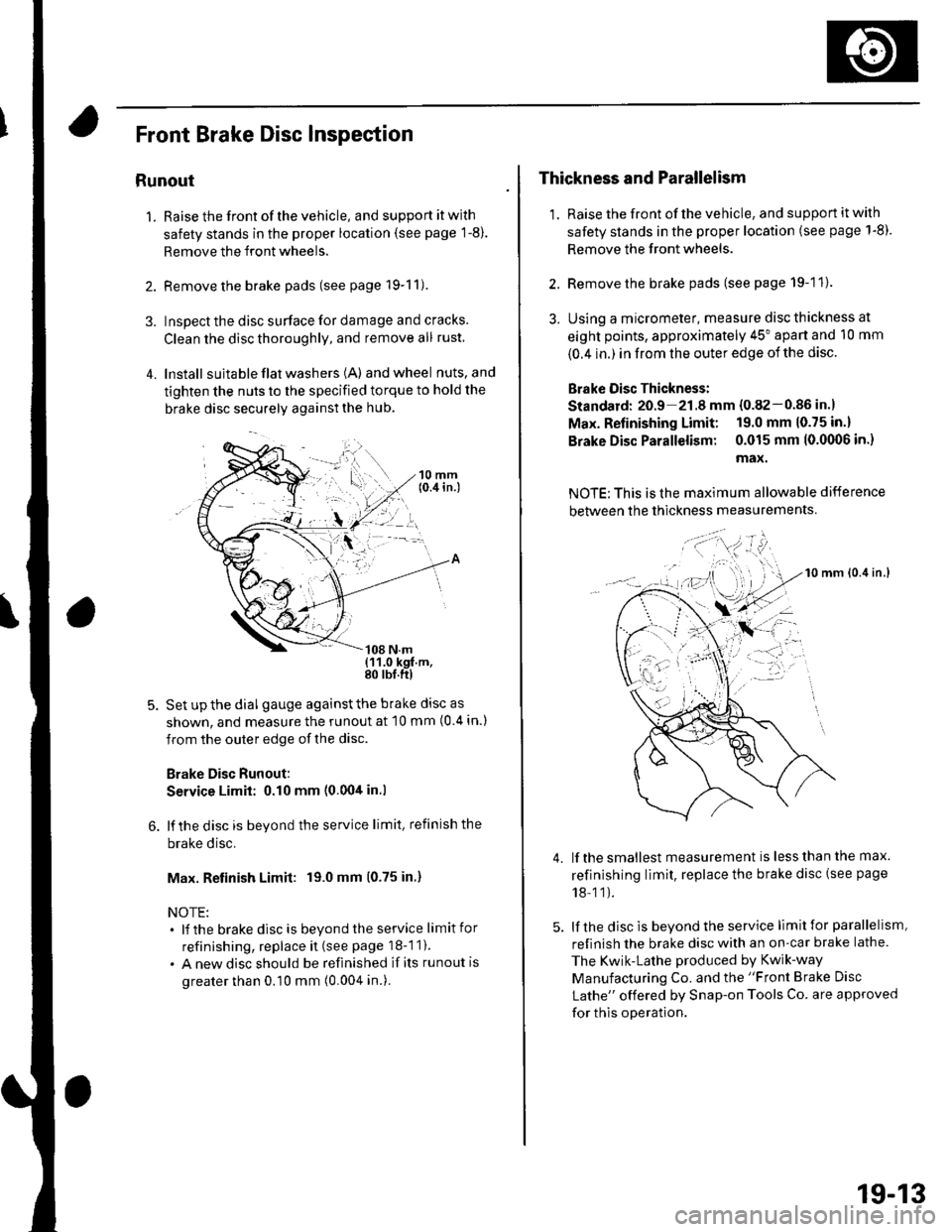
Front Brake Disc lnspection
Runout
1. Raise the front of the vehicle, and support it with
safety stands in the proper location (see page 1-8).
Remove the front wheels.
2. Remove the brake pads (see page 19-11).
3. Inspect the disc surface for damage and cracks.
Clean the disc thoroughly, and remove all rust
4. lnstall suita ble flat washers (A) andwheel nuts,and
tighten the nuts to the specified torque to hold the
brake disc securely against the hub.
Set up the dial gauge against the brake disc as
shown, and measure the runout at 10 mm (0 4 in.)
from the outer edge of the disc.
Brake Disc Runout:
Service Limit: 0.10 mm (0.00tt in.l
lf the disc is beyond the service limit, refinish the
brake disc.
Max. Retinish Limit: 19.0 mm (0.75 in.)
NOTE:. lf the brakedisc is beyondtheservice limitfor
refinishing, replace it (see page 18-1 1).
. A new disc should be refinished if its runout is
greater than 0.10 mm (0.004 in.).
Thickness and Parallelism
1. Raise the front of the vehicle, and support it with
safety stands in the proper location (see page 1-8).
Remove the front wheels.
2. Remove the brake pads (see page 19-11).
3. Using a micrometer, measure disc thickness at
eight points, approximately 45" apart and 10 mm
{0.4 in.) in from the outer edge of the disc.
Brake Oisc Thickness:
Standard: 20.9 21.8 mm {0.82-0.86 in.}
Max. Refinishing Limit: 19.0 mm 10.75 in.)
Brake Disc Parallelism: 0.015 mm 10.0(X)6 in.)
max.
NOTE: This is the maximum allowable difference
between the thickness measurements
10 mm lo.it in.l
lf the smallest measurement is less than the max.
refinishing limit, replace the brake disc (see page
18-11).
lf the disc is beyond the service limit for parallelism,
refinish the brake disc with an on-car brake lathe.
The Kwik-Lathe produced by Kwik-way
Manufacturing Co. and the "Front Brake Disc
Lathe" offered by Snap-on Tools Co. are approved
for this operation.
4.
': . --'t-'"'-
t,.
19-13
Page 609 of 1139

Conventional Brake Components
{Front Brake Caliper Overhaul
Frequent inhalation of brake pad dust, regardless of material composition, could be hazardous to your health.. Avoid breathing dust particles.' Never use an air hose or brush to clean brake assemblies. use an osHA-approved vacuum cleaner.
Remove, disassemble, inspect, reassemble, and install the caliper, and note these items:' Do not spill brake fluid on the vehicle; it may damage the paint; if brakefluidgetsonthepaint,washitoffimmediately with water.. To prevent dripping, cover disconnected hose joints with rags or shop towels.. Cleanall partsinbrakefluidandairdry;blowoutall passageswith compressed air.. Before reassembling, check that all parts are free of dust and other foreign particles.. Replace parts with new ones as specified in the illustration.. Make sure no dirt or other foreign matter is allowed to contaminate the brake fluid,' When reusing pads, always reinstallthem in their original pos itio ns to prevent loss of braking efficiency.. Do not reuse drained brake fluid.'AlwaysuseHondaDOT3brakefluid.Non'Hondabrakefluidcancausecorrosionandshortenthelifeofthesvstem.
. Do not mix different brands of brake fluid as they may not be compatible.. Coatthe piston, piston seal groove, and caliper borewithclean brakefluid.. Make sure no grease or oil gets on the brake discs or pads.. Replace all rubber parts with new ones whenever disassembled.. After installing the caliper, check the brake hose and line for leaks, interference, and twistinq.
>:@:Honda caliper sreaso tplN 08C30-80234M)
Boors 3i,l'1.'"
-ffiFA / isli\ii ^ zsw ttt
/paq\tl ll /
,\L,.'iE/ [
-ffi \--l u";;;lqEtCALIPER PIN A / 3.4N.m y' >vr / {3.5 kef m, / ,,' / 25 lbf ft) //'t / SEAL|NG)- I ---=-? WASHEaS
BRAKE HOSE / /8LEEO SCREW/ / /eNm/ / / (o.s kgr'm./ / | itbt.ftl,1(}', ^ l^ /caLl
-ffi \:7 "=;lGoX-
*fL-f
/) I .===? WAStrtXS \t9..- | #.'@ RepracF /7\- (hA PAD RETATNERS !s- / \
*d':ffi
^/rkr) ,-o/
vlJ ffi
Es,lry:' E*,e,a ["fif:i#l1t*"_,,. \.==f@ tz x t.zsmm ourEB paD sHrM
19-14
108 N.m 111.0 kgf.m,80 tbt.ft)