Page 192 of 317
�µ�µ
�Ø
�Ø
�Ø
�Ø �Ø
�Ø
�Ø
�Ø
�Ø
�Ø
�Ø
�Ø
�Ø
�Ø
�Ø
�Ø
�Ø
�Ø
�Ø
�Ø
�Ø
�Ø
�Ø
�Ì
�Ì
�Î
CONT INUED
Maint enance189
U.S. Owners
Canadian Owners A, B, C, D, E, F
A
B
C
D
E
F
Refer to page to determine which schedule to use.
Use the Maintenance Schedule for Severe Conditions.
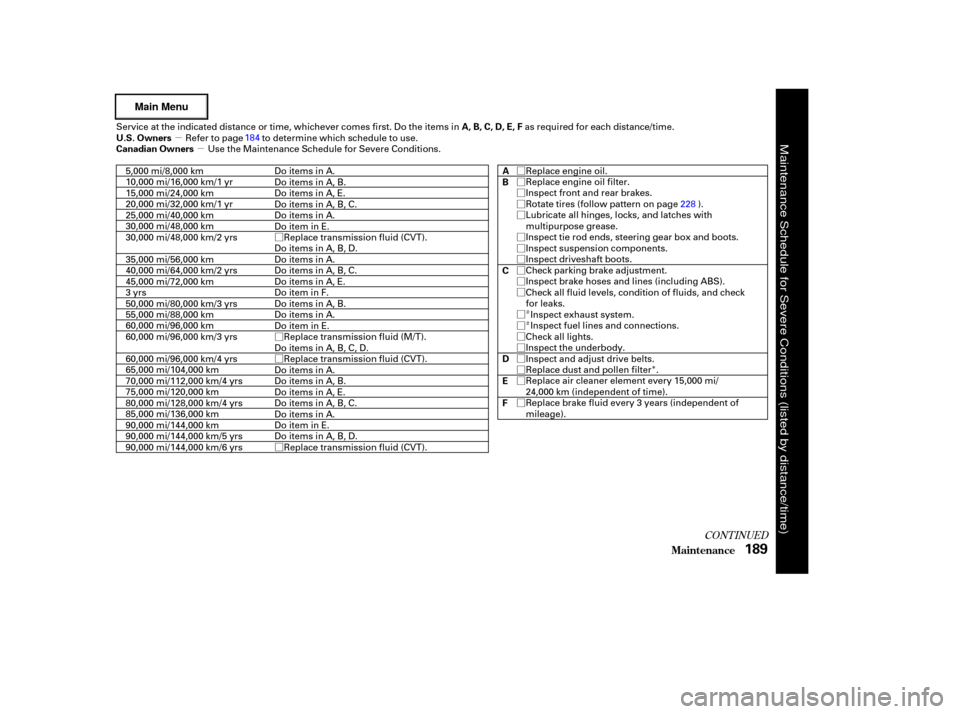
Service at the indicated distance or time, whichever comes first. Do the items in
as required for each distance/time.
Do items in A.
Do items in A, B.
Do items in A, E.
DoitemsinA,B,C.
Do items in A.
Do item in E. Replace transmission fluid (CVT).
DoitemsinA,B,D.
Do items in A.
DoitemsinA,B,C.
Do items in A, E.
Do item in F.
Do items in A, B.
Do items in A.
Do item in E. Replace transmission fluid (M/T).
DoitemsinA,B,C,D. Replace transmission fluid (CVT).
Do items in A.
Do items in A, B.
Do items in A, E.
DoitemsinA,B,C.
Do items in A.
Do item in E.
DoitemsinA,B,D. Replace transmission fluid (CVT).
5,000 mi/8,000 km
10,000 mi/16,000 km/1 yr
15,000 mi/24,000 km
20,000 mi/32,000 km/1 yr
25,000 mi/40,000 km
30,000 mi/48,000 km
30,000 mi/48,000 km/2 yrs
35,000 mi/56,000 km
40,000 mi/64,000 km/2 yrs
45,000 mi/72,000 km
3yrs
50,000 mi/80,000 km/3 yrs
55,000 mi/88,000 km
60,000 mi/96,000 km
60,000 mi/96,000 km/3 yrs
60,000 mi/96,000 km/4 yrs
65,000 mi/104,000 km
70,000 mi/112,000 km/4 yrs
75,000 mi/120,000 km
80,000 mi/128,000 km/4 yrs
85,000 mi/136,000 km
90,000 mi/144,000 km
90,000 mi/144,000 km/5 yrs
90,000 mi/144,000 km/6 yrs Replace engine oil.
Replace engine oil filter.
Inspect front and rear brakes.
Rotate tires (follow pattern on page
228).
Lubricate all hinges, locks, and latches with
multipurpose grease.
Inspect tie rod ends, steering gear box and boots.
Inspect suspension components.
Inspect driveshaft boots.
Check parking brake adjustment.
Inspect brake hoses and lines (including ABS).
Check all fluid levels, condition of fluids, and check
for leaks. Inspect exhaust system.
Inspect fuel lines and connections.
Check all lights.
Inspect the underbody.
Inspect and adjust drive belts.
Replace dust and pollen filter .
Replace air cleaner element every 15,000 mi/
24,000 km (independent of time).
Replace brake fluid every 3 years (independent of
mileage).
184Maintenance Schedule for Severe Conditions (listed by distance/time)
Page 193 of 317
�Ø
�Ø
�Ø
�Ø
�Ø
�Ø
�Ø
�Î
�Ì
Maint enance190
See dust and pollen filter on page for replacement information
under special driving conditions.
See information on maintenance and emissions warranty, last
column, page .
Check engine oil and coolant at each fuel stop.
Check and adjust valve clearance, cold engine, only if noisy.
NOTE: :
: 222
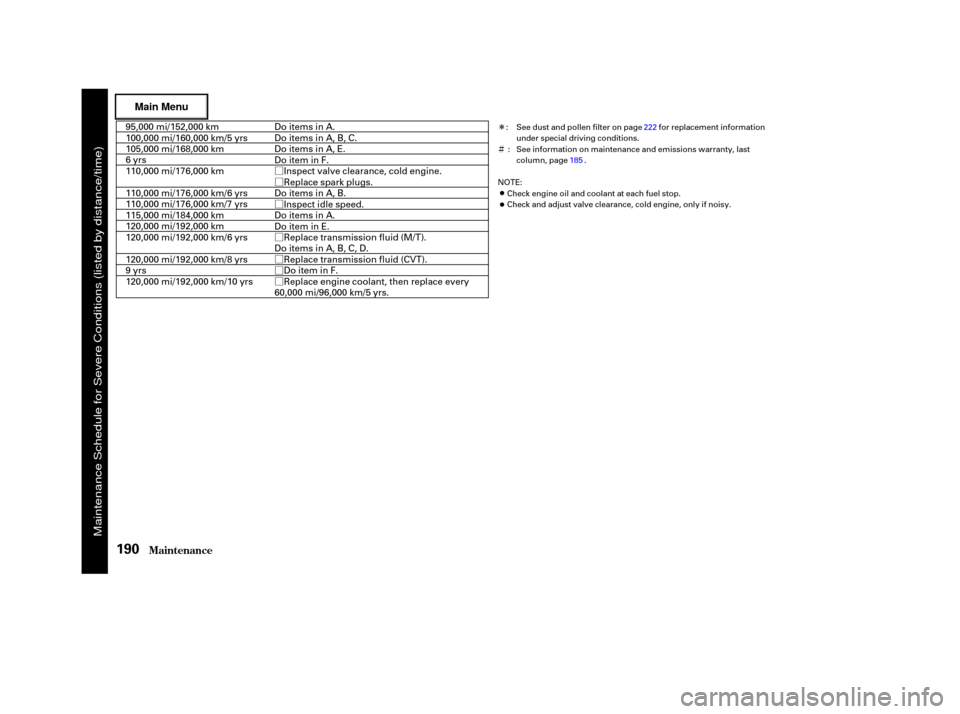
185Do items in A.
DoitemsinA,B,C.
Do items in A, E.
Do item in F. Inspect valve clearance, cold engine.
Replace spark plugs.
Do items in A, B. Inspect idle speed.
Do items in A.
Do item in E. Replace transmission fluid (M/T).
DoitemsinA,B,C,D. Replace transmission fluid (CVT).
Do item in F.
Replace engine coolant, then replace every
60,000 mi/96,000 km/5 yrs.
95,000 mi/152,000 km
100,000 mi/160,000 km/5 yrs
105,000 mi/168,000 km
6yrs
110,000 mi/176,000 km
110,000 mi/176,000 km/6 yrs
110,000 mi/176,000 km/7 yrs
115,000 mi/184,000 km
120,000 mi/192,000 km
120,000 mi/192,000 km/6 yrs
120,000 mi/192,000 km/8 yrs
9yrs
120,000 mi/192,000 km/10 yrs
Maintenance Schedule for Severe Conditions (listed by distance/time)
Page 196 of 317
�µ�µ�µ �µ
�µ
�µ �µ
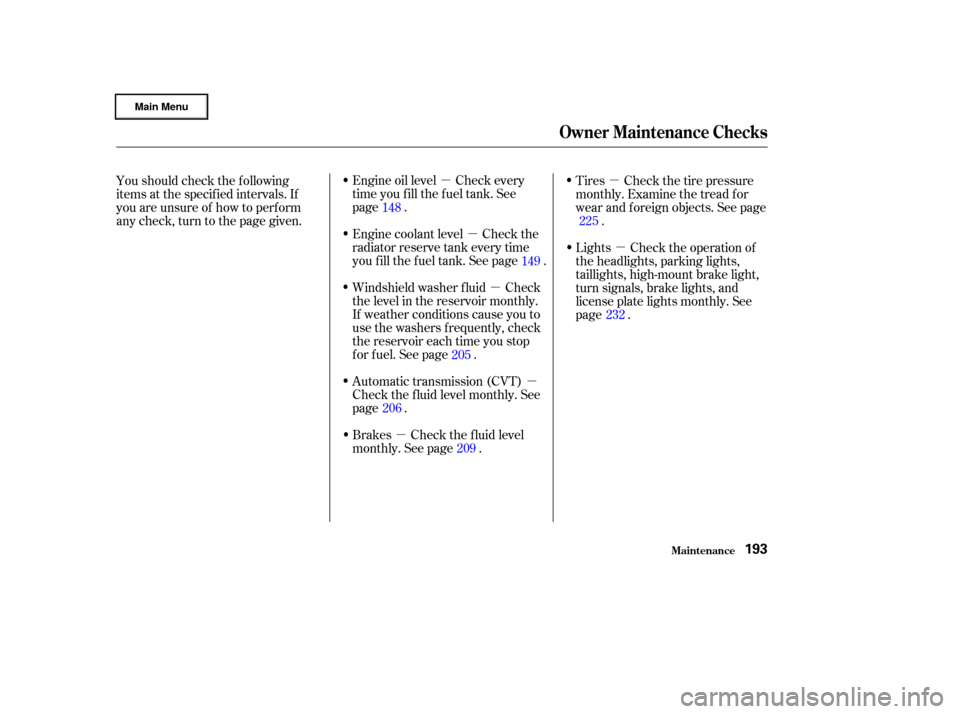
Engine oil level Check every
time you fill the fuel tank. See
page .
Engine coolant level Check the
radiator reserve tank every time
you f ill the f uel tank. See page .
Windshield washer f luid Check
the level in the reservoir monthly.
If weather conditions cause you to
use the washers f requently, check
the reservoir each time you stop
f or f uel. See page .
Youshouldcheckthefollowing
items at the specif ied intervals. If
you are unsure of how to perf orm
any check, turn to the page given.
Lights Check the operation of
the headlights, parking lights,
taillights, high-mount brake light,
turn signals, brake lights, and
license plate lights monthly. See
page . Tires Check the tire pressure
monthly. Examine the tread f or
wear and foreign objects. See page.
Brakes Check the f luid level
monthly. See page . Automatic transmission (CVT)
Check the f luid level monthly. See
page . 148
149
205 209
206 225
232
Owner Maintenance Checks
Maint enance193
Page 198 of 317
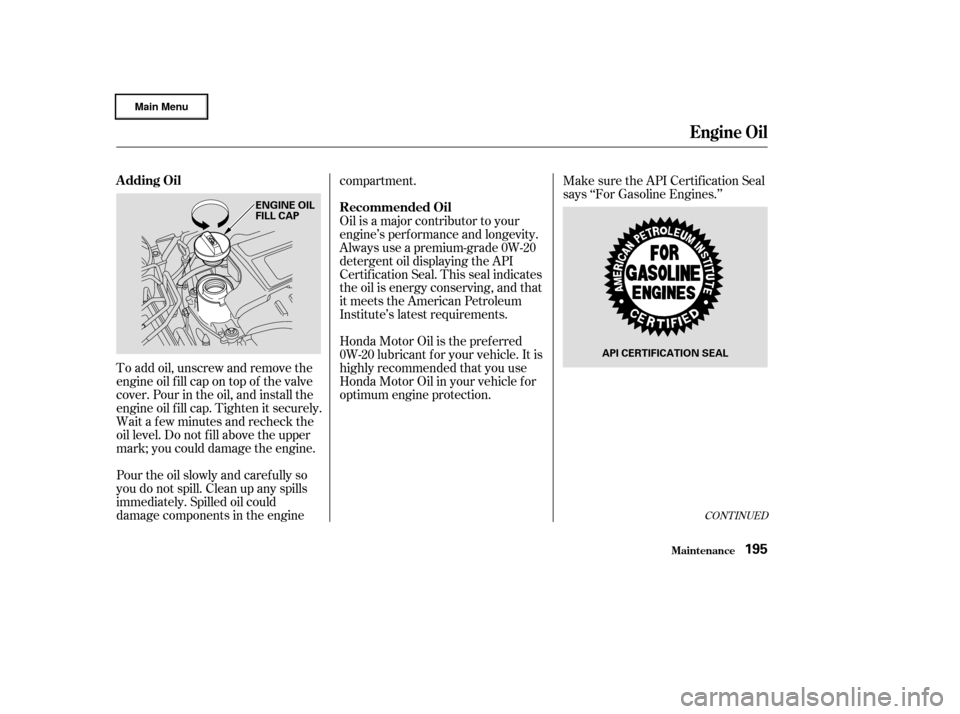
To add oil, unscrew and remove the
engine oil f ill cap on top of the valve
cover. Pour in the oil, and install the
engine oil f ill cap. Tighten it securely.
Wait a f ew minutes and recheck the
oil level. Do not f ill above the upper
mark; you could damage the engine.Make sure the API Certif ication Seal
says ‘‘For Gasoline Engines.’’
Pour the oil slowly and caref ully so
you do not spill. Clean up any spills
immediately. Spilled oil could
damage components in the engine compartment.
Oil is a major contributor to your
engine’s perf ormance and longevity.
Always use a premium-grade 0W-20
detergent oil displaying the API
Certif ication Seal. This seal indicates
the oil is energy conserving, and that
it meets the American Petroleum
Institute’s latest requirements.
Honda Motor Oil is the pref erred
0W-20 lubricant f or your vehicle. It is
highly recommended that you use
Honda Motor Oil in your vehicle f or
optimum engine protection.
CONT INUED
A dding Oil
Recommended Oil
Engine Oil
Maint enance195
ENGINE OIL
FILL CAP
API CERTIFICATION SEAL
Page 201 of 317
Turn of f the engine, let it sit f or
several minutes, then check the oil
level. If necessary, add oil to bring
the level to the upper mark on the
dipstick.
Put the under cover back in place
and reinstall the nine holding clips.
Lock the clips securely by pushing
on the center of each clip.
Put a new washer on the drain bolt,
then reinstall the drain bolt.
Tighten it to:
Refill the engine with the recom-
mended oil.
Engine oil change capacity
(including f ilter):
Replace the engine oil f ill cap.
Start the engine. The oil pressure
indicator light should go out within
f ive seconds. If it does not, turn of f
the engine and reinspect your
work.
Let the engine run f or several
minutes and check the drain bolt
and oil f ilter f or leaks.
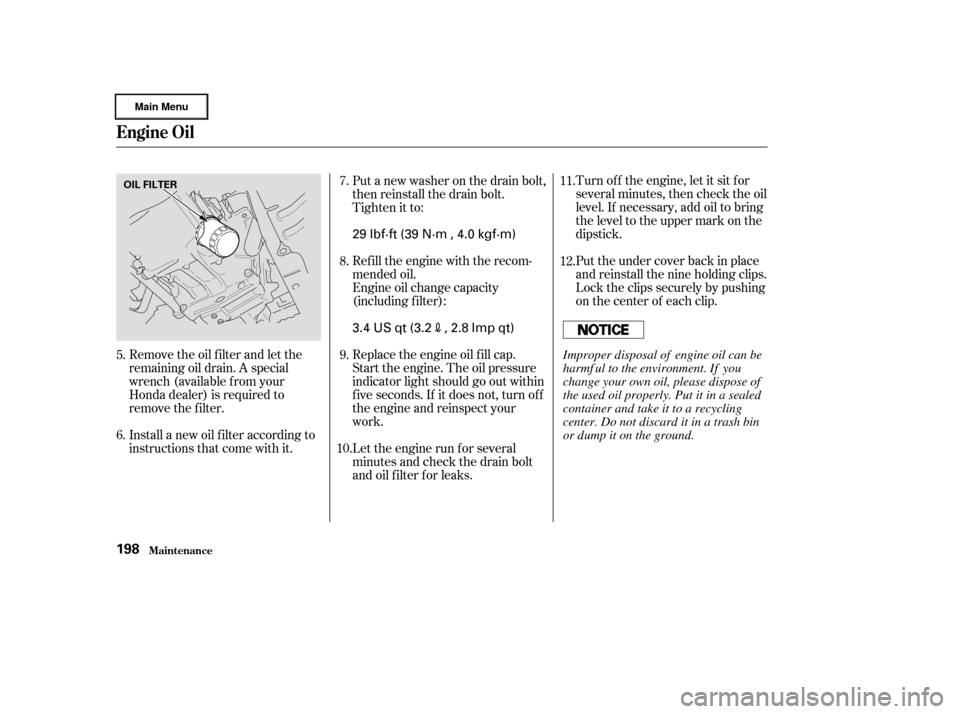
Remove the oil f ilter and let the
remaining oil drain. A special
wrench (available from your
Honda dealer) is required to
remove the f ilter.
Install a new oil f ilter according to
instructions that come with it. 7.
8.
9.
10. 12. 11.
5.
6.
Engine Oil
Maint enance198
OIL FILTER
29 lbf·ft (39 N·m , 4.0 kgf·m)
3.4 US qt (3.2
, 2.8 Imp qt) Improper disposal of engine oil can be
harmf ul to the environment. If you
change your own oil, please dispose of
the used oil properly. Put it in a sealed
container and take it to a recycling
center. Do not discard it in a trash bin
or dump it on the ground.
Page 202 of 317
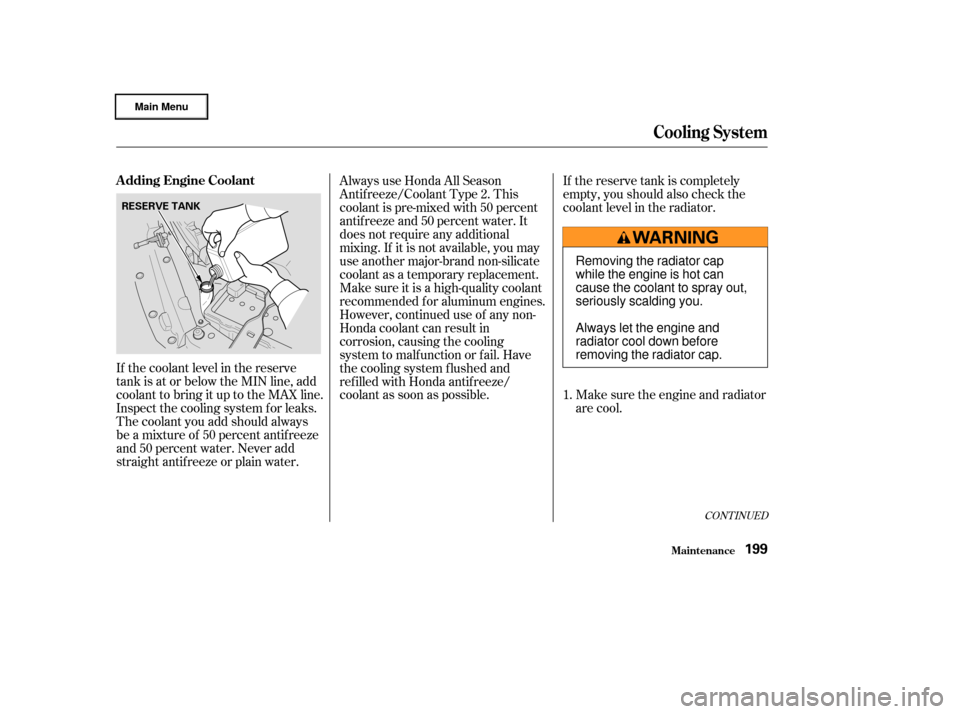
If the coolant level in the reserve
tank is at or below the MIN line, add
coolant to bring it up to the MAX line.
Inspect the cooling system f or leaks.
The coolant you add should always
be a mixture of 50 percent antif reeze
and 50 percent water. Never add
straight antif reeze or plain water.If the reserve tank is completely
empty, you should also check the
coolant level in the radiator.
Make sure the engine and radiator
are cool.
Always use Honda All Season
Antif reeze/Coolant Type 2. This
coolant is pre-mixed with 50 percent
antif reeze and 50 percent water. It
does not require any additional
mixing. If it is not available, you may
use another major-brand non-silicate
coolant as a temporary replacement.
Make sure it is a high-quality coolant
recommended f or aluminum engines.
However, continued use of any non-
Honda coolant can result in
corrosion, causing the cooling
system to malf unction or f ail. Have
the cooling system f lushed and
ref illed with Honda antif reeze/
coolant as soon as possible.
1.
CONT INUED
A dding Engine Coolant
Cooling Syst em
Maint enance199
RESERVE TANK
Removing the radiator cap
while the engine is hot can
cause the coolant to spray out,
seriously scalding you.
Always let the engine and
radiator cool down before
removing the radiator cap.
Page 207 of 317
Start the engine and let it run until
the radiator cooling f an comes on
at least twice. Then stop the
engine.
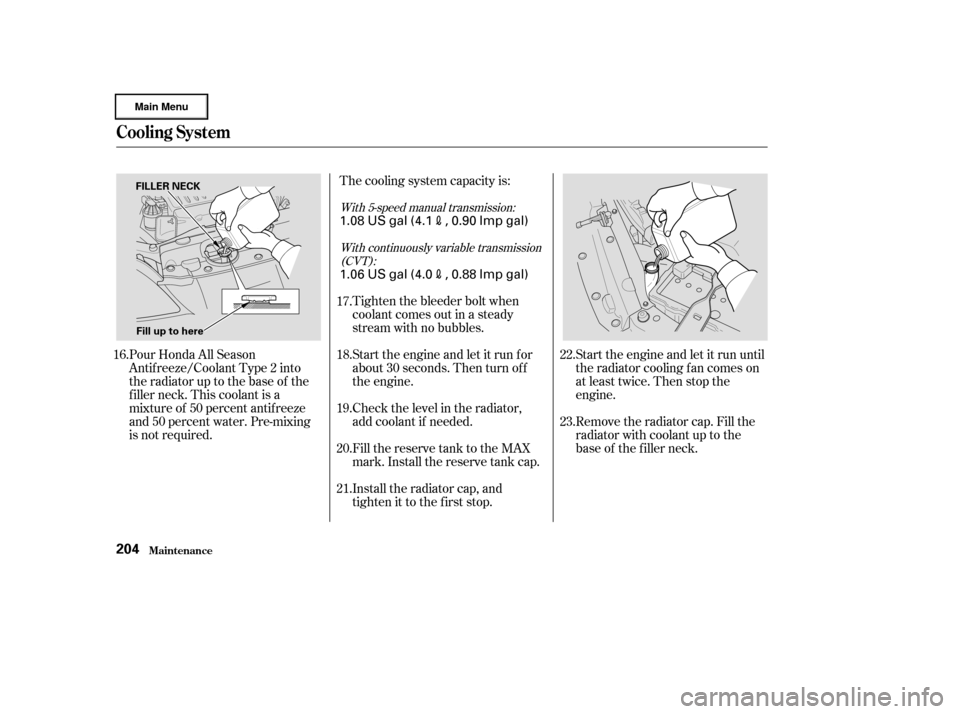
Remove the radiator cap. Fill the
radiator with coolant up to the
base of the f iller neck.
The cooling system capacity is:
Tighten the bleeder bolt when
coolant comes out in a steady
stream with no bubbles.
Start the engine and let it run f or
about 30 seconds. Then turn of f
the engine.
Check the level in the radiator,
add coolant if needed.
Fill the reserve tank to the MAX
mark. Install the reserve tank cap.
Install the radiator cap, and
tighten it to the first stop.
Pour Honda All Season
Antif reeze/Coolant Type 2 into
the radiator up to the base of the
f iller neck. This coolant is a
mixture of 50 percent antif reeze
and 50 percent water. Pre-mixing
is not required.
16.
17.
18.
19.
20.
21.22.
23.
With 5-speed manual transmission:
With continuously variable transmission(CVT):
Cooling Syst em
Maint enance204
FILLER NECK
Fill up to here
1.08 US gal (4.1, 0.90 Imp gal)
1.06 US gal (4.0
, 0.88 Imp gal)
Page 208 of 317
Fill the reservoir with a good-quality
windshield washer f luid. This
increases the cleaning capability and
prevents f reezing in cold weather.
Check the level in the windshield
washer reservoir at least monthly
during normal usage. In bad weather,
when you use the washers of ten,
check the level every time you stop
for fuel.
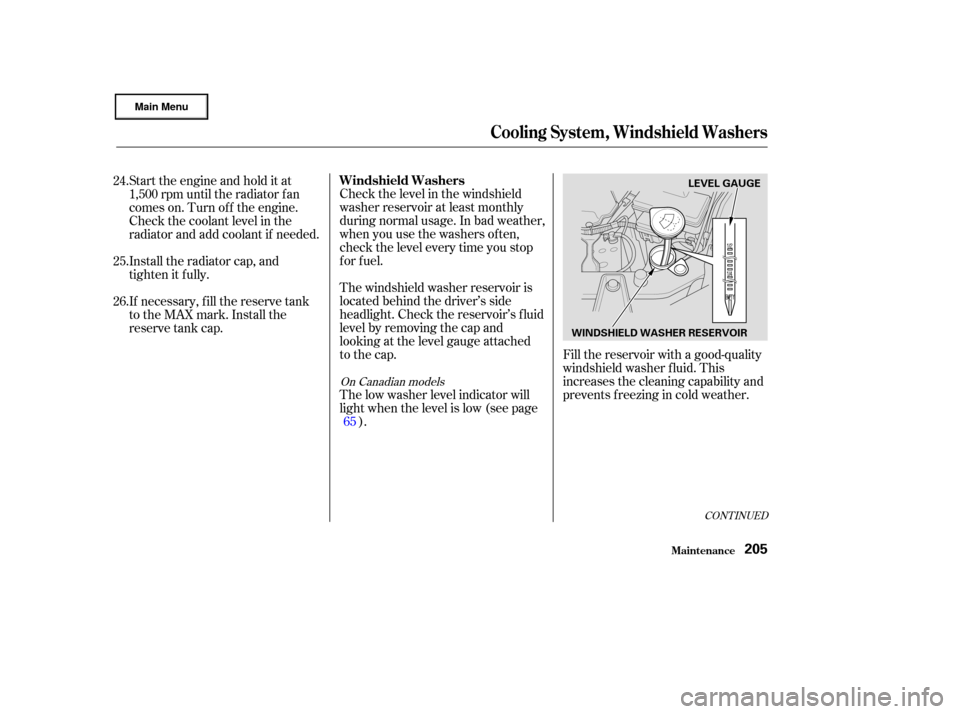
The windshield washer reservoir is
located behind the driver’s side
headlight. Check the reservoir’s f luid
level by removing the cap and
looking at the level gauge attached
to the cap.
The low washer level indicator will
light when the level is low (see page
).
Start the engine and hold it at
1,500 rpm until the radiator f an
comes on. Turn of f the engine.
Check the coolant level in the
radiator and add coolant if needed.
Install the radiator cap, and
tighten it fully.
If necessary, f ill the reserve tank
to the MAX mark. Install the
reserve tank cap.
65
24.
25.
26.
On Canadian models
CONT INUED
Maint enance
Cooling System, Windshield Washers
Windshield Washers
205
LEVEL GAUGE
WINDSHIELD WASHER RESERVOIR