Page 213 of 380

Push the clutch pedal down all the
way. START (III) does not
f unction unless the clutch pedal is
depressed.
Apply the parking brake.
In cold weather, turn of f all
electrical accessories to reduce
the drain on the battery.
Make sure the shif t lever is in
Park. Press on the brake pedal. If the engine still does not start,
press the accelerator pedal all the
way down and hold it there while
starting in order to clear f looding.
As bef ore, keep the ignition key in
the START (III) position f or no
more than 15 seconds. Return to
step 5 if the engine does not start.
If it starts, lif t your f oot of f the
accelerator pedal so the engine
does not race.
Without touching the accelerator
pedal, turn the ignition key to the
START (III) position. If the engine
does not start right away, do not
hold the key in START (III) f or
more than 15 seconds at a time.
Pause f or at least 10 seconds
bef ore trying again.
If the engine does not start within
15 seconds, or starts but stalls
right away, repeat step 4 with the
accelerator pedal pressed half-way
down. If the engine starts, release
pressure on the accelerator pedal
so the engine does not race.
1. 2. 3.
4. 5.6.
Automatic Transmission:
Manual Transmission:
Starting the Engine
Driving219
�����—�����—�����y���������������y���
�(�����������y���������y
Page 214 of 380
Use the f ollowing procedure:Turn of f all electrical accessories
to reduce the drain on the battery.
Push the accelerator pedal half-
way to the f loor and hold it there
while starting the engine. Do not
hold the ignition key in START
(III) f or more than 15 seconds.
When the engine starts, release
the accelerator pedal gradually as
the engine speeds up and smooths
out.
An engine is harder to start in cold
weather. The thinner air f ound at
high altitude above 8,000 f eet
(2,400 meters) adds to the problem.
If the engine fails to start in step 2,
push the accelerator pedal to the
f loor and hold it there while you
try to start the engine for no more
than 15 seconds. If the engine
does not start, return to step 2.
1. 2. 3.
Driving
Starting in Cold Weather at High
A ltitude (A bove 8,000 f eet/
2,400 meters)
Starting the Engine
220
�����—�����—�����y���������������y���
�(�����������y���������y
Page 218 of 380

�µ�µ�µ
�µ
This position mechani-
cally locks the transmission. Use
Park whenever you are turning of f or
starting the engine. To shif t out of
Park, you must press on the brake
pedal and have your f oot of f the
accelerator pedal. Press the release
button on the side of the shift lever
to move it.
To shif t to Reverse
f rom Park, see the explanation under
Park. To shif t to Reverse f rom
Neutral, come to a complete stop and
then shift. Press the release button
bef ore shif ting into Reverse f rom
Neutral.
If you have done all of the above and
still cannot move the lever out of
Park, see Shif t Lock Release on page
.
You must also press the release
button to shift into Park. To avoid
transmission damage, come to a
complete stop bef ore shif ting into
Park. The shif t lever must be in Park
bef ore you can remove the key f rom
the ignition switch. Use Neutral if you
need to restart a stalled engine, or if
it is necessary to stop brief ly with
the engine idling. Shif t to Park posi-
tion if you need to leave the car for
any reason. Press on the brake pedal
when you are moving the shif t lever
f rom Neutral to another gear.
Use this position f or
your normal driving. The transmis-
sion automatically selects a suitable
gear (1 through 5) f or your speed
and acceleration. You may notice the
transmission shif ting up at higher
speeds when the engine is cold. This
helps the engine warm up f aster.
226
Driving
Automatic Transmission
Park (P)
Reverse (R)Neutral (N)
Drive (D)
224
�����—�����—�����y���������������y���
�(�����������y���������y
Page 220 of 380
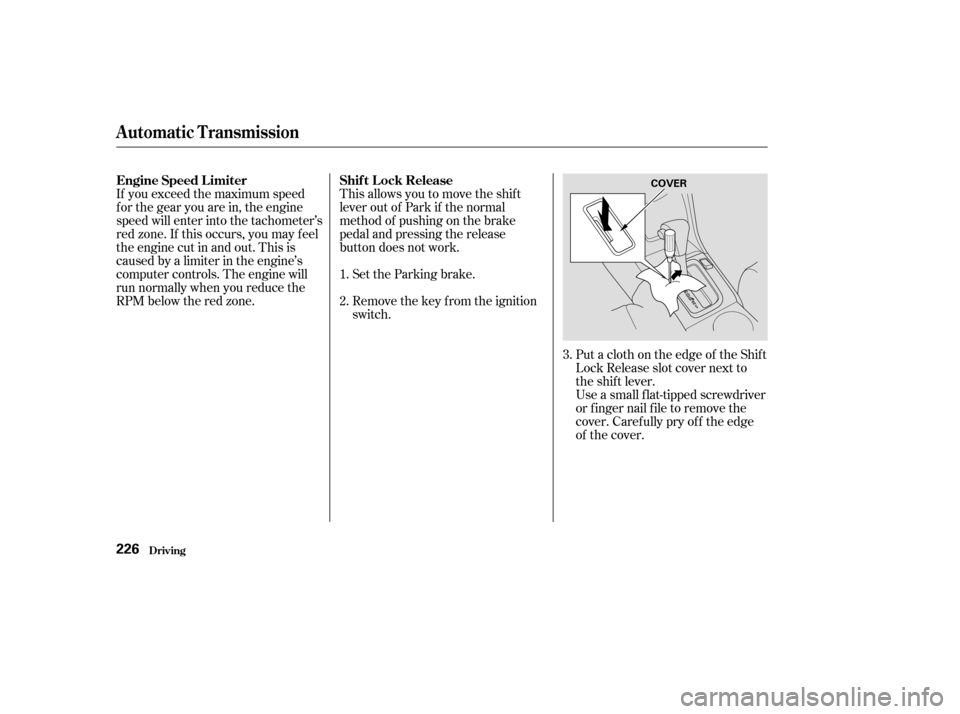
This allows you to move the shif t
lever out of Park if the normal
method of pushing on the brake
pedal and pressing the release
button does not work.Set the Parking brake.
Remove the key from the ignition
switch.
If you exceed the maximum speed
f or the gear you are in, the engine
speed will enter into the tachometer’s
red zone. If this occurs, you may f eel
the engine cut in and out. This is
caused by a limiter in the engine’s
computer controls. The engine will
run normally when you reduce the
RPM below the red zone.
Put a cloth on the edge of the Shif t
Lock Release slot cover next to
the shift lever.
Use a small flat-tipped screwdriver
or finger nail file to remove the
cover. Caref ully pry of f the edge
of the cover.
1. 2.
3.
Automatic Transmission
Driving
Shif t L ock Release
Engine Speed L imiter
226
COVER
�����—�����—�����y���������������y���
�(�����������y���������y
Page 221 of 380
If you need to use the Shif t Lock
Release, it means your car is
developing a problem. Have the car
checked by your Honda dealer.
Push down on the key while you
pressthereleasebuttononthe
shif t lever and move the shif t lever
out of Park to Neutral.
Remove the key from the Shift
Lock Release slot, then reinstall
thecover.Makesurethenotchon
the cover is on the lef t side.
Depress the brake pedal and
restart the engine.
Insert the key in the Shift Lock
Release slot.
5. 6.
4.
Automatic Transmission
Driving227
RELEASE
BUTTON
SHIFT LOCK RELEASE SLOT
�����—�����—�����y�������������
�y���
�(�����������y���������y
Page 222 of 380

�µMake sure the parking brake is f ully
released bef ore driving away.
Driving with the parking brake
partially set can overheat or damage
the rear brakes.
Always use the parking brake when
you park your car. The indicator on
the instrument panel shows that the
parking brake is not f ully released; it
does not indicate that the parking
brakeisfirmlyset.Makesurethe
parking brake is set f irmly or your
car may roll if it is parked on an
incline.
If your car has an automatic
transmission, set the parking brake
bef ore you put the transmission in
Park.Thiskeepsthecarfrom
moving and putting pressure on the
parking mechanism in the
transmission making it easier to
move the shift lever out of Park
when you want to drive away. If the car is f acing uphill, turn the
f ront wheels away f rom the curb. If
you have a manual transmission, put
it in f irst gear.
If the car is f acing downhill, turn the
f ront wheels toward the curb. If you
have a manual transmission, put it in
reverse gear.
Make sure the moonroof (if
equipped) and the windows are
closed.
Lockthedoorswiththekeyorthe
remote transmitter.
Place any packages, valuables, etc.,
in the trunk or take them with you.
Turn of f the lights.
Never park over dry leaves, tall
grass, or other f lammable
materials. The three way catalytic
converter gets very hot, and could
cause these materials to catch on
fire.
Check the indicator on the
instrument panel to verif y that the
security system is set.
On EX, LX-V6, and Canadian LX-G
models
Parking T ips
Driving
Parking
228
�����—�����—�����y�������������
�y���
�(�����������y�������
�y
Page 268 of 380
Thecoolingsystemshouldbe
completely drained and ref illed with
new coolant according to the time
and distance recommendations in
the maintenance schedule. Only use
Honda All Season Antif reeze/
Coolant Type 2. Use of any non-
Honda coolant or plain water can
result in corrosion and deposits in
the cooling system.
Draining the coolant requires access
to the underside of the car. Unless
you have the tools and knowledge,
you should have this maintenance
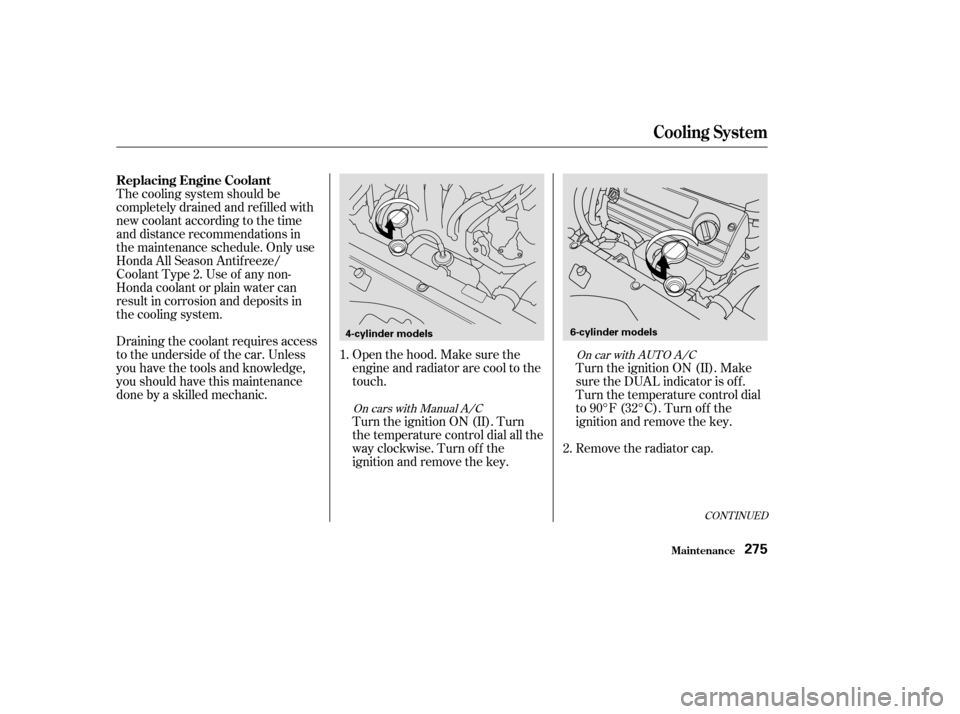
done by a skilled mechanic.Openthehood.Makesurethe
engine and radiator are cool to the
touch.
Turn the ignition ON (II). Turn
the temperature control dial all the
way clockwise. Turn off the
ignition and remove the key.Turn the ignition ON (II). Make
sure the DUAL indicator is off.
Turn the temperature control dial
to 90°F (32°C). Turn of f the
ignition and remove the key.
Remove the radiator cap.
1.
2.
CONT INUED
On cars with Manual A/COn car with AUTO A/C
Replacing Engine Coolant
Cooling Syst em
Maint enance275
4-cylinder models
6-cylinder models
�����—�����—�����y���������������y���
�(�����������y���������y
Page 324 of 380

Make sure the repair f acility uses
genuine Honda replacement body
parts. Some companies make sheet
metal pieces that seem to duplicate
the original Honda body parts, but
are actually inf erior in f it, f inish, and
corrosion resistance. Once installed,
they do not give the same high-
quality appearance.When reporting your collision to the
insurance company, tell them you
want genuine Honda parts used in
the repair. Although most insurers
recognize the quality of original
parts, some may try to specif y that
the repairs be done with other
available parts. You should investi-
gate this before any repairs have
begun.
Body repairs can af f ect your car’s
resistance to corrosion. If your car
needs repairs af ter a collision, pay
close attention to the parts used in
the repair and the quality of the
work.
Takeyourcartoyourauthorized
Honda dealer f or inspection af ter the
repairs are completed. Your dealer
can make sure that quality materials
were used, and that corrosion-
preventive coatings were applied to
all repaired and replaced parts.
Body Repairs
Appearance Care332
�����—�����—�����y���������������y���
�(�����������y���������y