Page 239 of 429

Distribute cargo evenly on the
f loor of the trunk, placing the
heaviest items on the bottom and
as f ar f orward as possible.
If youfolddownthebackseat,tie
down items that could be thrown
about the car during a crash or
sudden stop.
If you carry large items that
prevent you f rom closing the trunk
lid, exhaust gas can enter the
passenger area. To avoid the
possibility of, f ollow the instructions
on page .
Do not put any items on top of the
rear shelf . They can block your
view and be thrown around the car
during a crash.
If you can carry any items on a
roof rack, be sure the total weight
of the rack and the items does not
exceed the maximum allowable
weight. Please contact your Honda
dealer f or f urther inf ormation.
Be sure items placed on the f loor
behind the f ront seats cannot roll
under the seats and interf ere with
the driver’s ability to operate the
pedals, or with the proper
operation of the seats.
Keep the glove box closed while
driving. If it is open, a passenger
could injure their knees during a
crash or sudden stop. Store or secure all items that could
be thrown around and hurt
someone during a crash.
56
Carrying Cargo in the Trunk or on
a Roof T op Carrier
carbon monoxide
poisoning
Carrying Items in the Passenger
Compartment
Carrying Cargo
Bef ore Driving236
Page 242 of 429

This section gives you tips on
starting the engine under various
conditions, and how to operate the
5-speed/6-speed manual and
automatic transmissions. It also
includes important inf ormation on
parking your car, the braking system,
the Traction Control System, and
f acts you need if you are planning to
tow a trailer.........................
Preparing to Drive .240
.......................
Starting the Engine .241
Starting in Cold Weather ....................
at High Altitude .242
....
5-speed Manual Transmission . 243
.....
Recommended Shif t Points . 244
..............
Engine Speed Limiter . 244
....
6-speed Manual Transmission . 245
.....
Recommended Shif t Points . 246
..............
Engine Speed Limiter . 246
.......................
Reverse Lockout .246
..............
Automatic Transmission . 248
.
Shif t Lever Position Indicator . 248
................
Shif t Lever Positions . 248
..............
Engine Speed Limiter . 251
....................
Shif t Lock Release . 251
...........................................
Parking .253
..............................
Parking Tips .253
.....................
The Braking System .254
.............
Brake Wear Indicators . 254
...............
Brake System Design . 255
.......................
Anti-lock Brakes .255
Important Saf ety .........................
Reminders .256
........................
ABS Indicator .256 ..............
Traction Control System . 258
...............
TCS ON/OFF Switch . 259
.........
TCSActivationIndicator . 259
...............
Driving in Bad Weather . 261
...........................
Towing a Trailer .263
Driving
Driving239
Page 243 of 429

Make sure all windows, mirrors,
and outside lights are clean and
unobstructed. Remove f rost, snow,
or ice.
Check that the hood and trunk are
f ully closed.Check the adjustment of the seat
(see page ).
Check the adjustment of the
inside and outside mirrors (see
page ).
Check the adjustment of the
steering wheel (see page ).
Make sure the doors are securely
closed and locked.
Fasten your seat belt. Check that
your passengers have f astened
their seat belts (see page ).Turn the ignition switch ON (II).
Check the indicator lights in the
instrument panel.
Start the engine (see page ).
Check the gauges and indicator
lights in the instrument panel (see
page ).
Check that any items you may be
carrying with you inside are stored
properly or f astened down
securely. Visually check the tires. If a tire
looks low, use a gauge to check its
pressure.
Youshoulddothefollowingchecks
and adjustments every day bef ore
you drive your car.
3.2.
1.
4. 5.
6.
7.
8.
9. 11.
12. 10.
16 61
94
108 80 241
Preparing to Drive
Driving240
Page 246 of 429

Come to a full stop before you shift
into Reverse. You can damage the
transmission by trying to shif t into
Reverse with the car moving. Push
down the clutch pedal, and pause f or
a f ew seconds bef ore shif ting into
Reverse, or shif t into one of the
f orward gears f or a moment. This
stops the gears so they won’t ‘‘grind.’’
When slowing down, you can get
extra braking f rom the engine by
shifting to a lower gear. This extra
braking can help you maintain a safe
speed and prevent your brakes f rom
overheating while going down a
steep hill. Bef ore downshif ting,
make sure engine speed will not go
into the tachometer’s red zone in the
lower gear.
The manual transmission is syn-
chronizedinallforwardgearsfor
smooth operation. It has a lockout so
you cannot shift directly from Fifth
to Reverse. When shif ting up or
down,makesureyoupushtheclutch
pedal down all the way, shift to the
next gear, and let the pedal up
gradually. When you are not shif ting,
do not rest your f oot on the clutch
pedal. This can cause your clutch to
wear out faster.
On all 4-cylinder models
Driving
5-speed Manual T ransmission
243
Rapid slowing or speeding-up
can cause loss of control on
slippery surfaces. If you crash,
you can be injured.
Use extra care when driving on
slippery surfaces.
Page 248 of 429

The manual transmission is synchro-
nizedinallforwardgearsforsmooth
operation. It has a lockout so you
cannot shift directly from Fifth to
Reverse instead of Sixth (see page). When shif ting up or down,
make sure you push the clutch pedal
down all the way, shift to the next
gear, and let the pedal up gradually.
When you are not shif ting, do not
rest your f oot on the clutch pedal.
This can cause your clutch to wear out f aster.
Come to a full stop before you shift
into Reverse. You can damage the
transmission by trying to shif t into
Reverse with the car moving. Push
down the clutch pedal, and pause f or
a f ew seconds bef ore shif ting into
Reverse, or shif t into one of the
f orward gears f or a moment. This
stops the gears so they won’t ‘‘grind.’’
When slowing down, you can get
extra braking f rom the engine by
shifting to a lower gear. This extra
braking can help you maintain a safe
speed and prevent your brakes f rom
overheating while going down a
steep hill. Bef ore downshif ting,
make sure engine speed will not go
into the tachometer’s red zone in the
lower gear.
Your car is equipped with an
aluminum shif t lever. If you leave the
car parked outside f or a long time on
a hot day, be caref ul bef ore moving
the shif t lever. Because of the heat,
the shif t lever may be extremely hot.
If the outside temperature is low, the
shif t lever f eels cold.
246
On EX-V6 model
6-speed Manual T ransmission
Driving245
Rapid slowing or speeding-up
can cause loss of control on
slippery surfaces. If you crash,
you can be injured.
Use extra care when driving on
slippery surfaces.
Page 249 of 429

Drive in the highest gear that lets
the engine run and accelerate
smoothly. This will give you the best
f uel economy and ef f ective emis-
sions control. The f ollowing shif t
points are recommended:If you exceed the maximum speed
f or the gear you are in, the engine
speed will enter into the tachometer’s
red zone. If this occurs, you may f eel
the engine cut in and out. This is
caused by a limiter in the engine’s
computer controls. The engine will
run normally when you reduce the
RPM below the red zone.
Shif t up
1st to 2nd
2nd to 3rd 3rd to 4th4th to 5th
5th to 6th Normal acceleration
15 mph (24 km/h)
25 mph (40 km/h)
40 mph (64 km/h)
47 mph (75 km/h)
52 mph (83 km/h) Bef ore downshif ting, make sure the
engine will not go into the
tachometer’s red zone. The 6-speed manual transmission
has an electric lockout so you cannot
accidentally shif t f rom Fif th to
Reverse instead of Sixth while the
car is moving. If you cannot shif t to
Reverse when the car is stopped:
Recommended Shif t Points Engine Speed L imiter
Reverse L ockout
6-speed Manual T ransmission
Driving246
Page 250 of 429
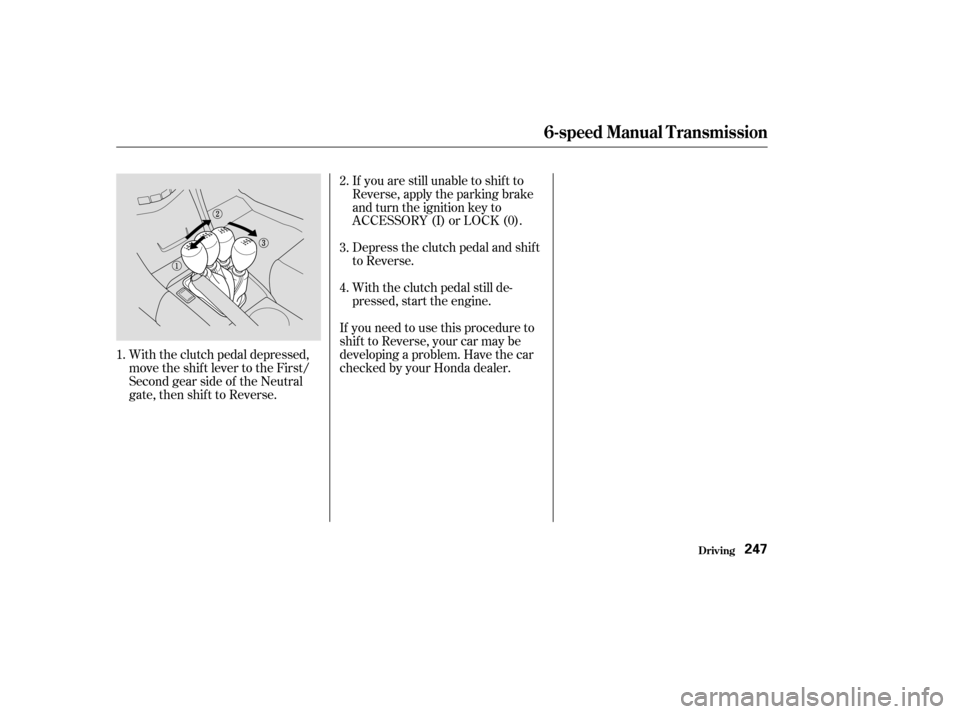
With the clutch pedal depressed,
move the shift lever to the First/
Second gear side of the Neutral
gate, then shif t to Reverse.If you are still unable to shif t to
Reverse, apply the parking brake
and turn the ignition key to
ACCESSORY (I) or LOCK (0).
Depress the clutch pedal and shif t
to Reverse.
With the clutch pedal still de-
pressed, start the engine.
If you need to use this procedure to
shif t to Reverse, your car may be
developing a problem. Have the car
checked by your Honda dealer.
1. 2.
3.
4.
6-speed Manual T ransmission
Driving247
Page 251 of 429

The shift lever has seven positions.
It must be in Park or Neutral to start
the engine. When you are stopped in
D, D , 2, 1, N or R, press f irmly on
the brake pedal, and keep your f oot
of f the accelerator pedal.
The ‘‘D’’ indicator comes on f or a
f ew seconds when you turn the
ignition switch to ON (II). If it
f lashes while driving (in any shif t
position), it indicates a possible
problem in the transmission. Avoid
rapid acceleration and have the trans-
mission checked by an authorized
Honda dealer as soon as possible.
The malf unction indicator lamp may
come on along with the ‘‘D’’ indicator
if there is a problem in the automatic
transmission control system.
This indicator between the tacho-
meter and speedometer shows which
position the shif t lever is in. Your Honda’s transmission has f ive
f orward speeds, and is electronically
controlled f or smoother shif ting. It
also has a ‘‘lock-up’’ torque converter
forbetterfueleconomy.Youmay
f eel what seems like another shif t
when the converter locks.
3
Shif t L ever Positions
Shif t L ever Position Indicator
Automatic Transmission
Driving248
SHIFT LEVER
RELEASE BUTTON