Page 406 of 520
Front Axle
When to Check Lubricant
Refer to the Maintenance Schedule to determine how
often to check the lubricant. See Part A:Part A:
Scheduled Maintenance Services on page 6-4.
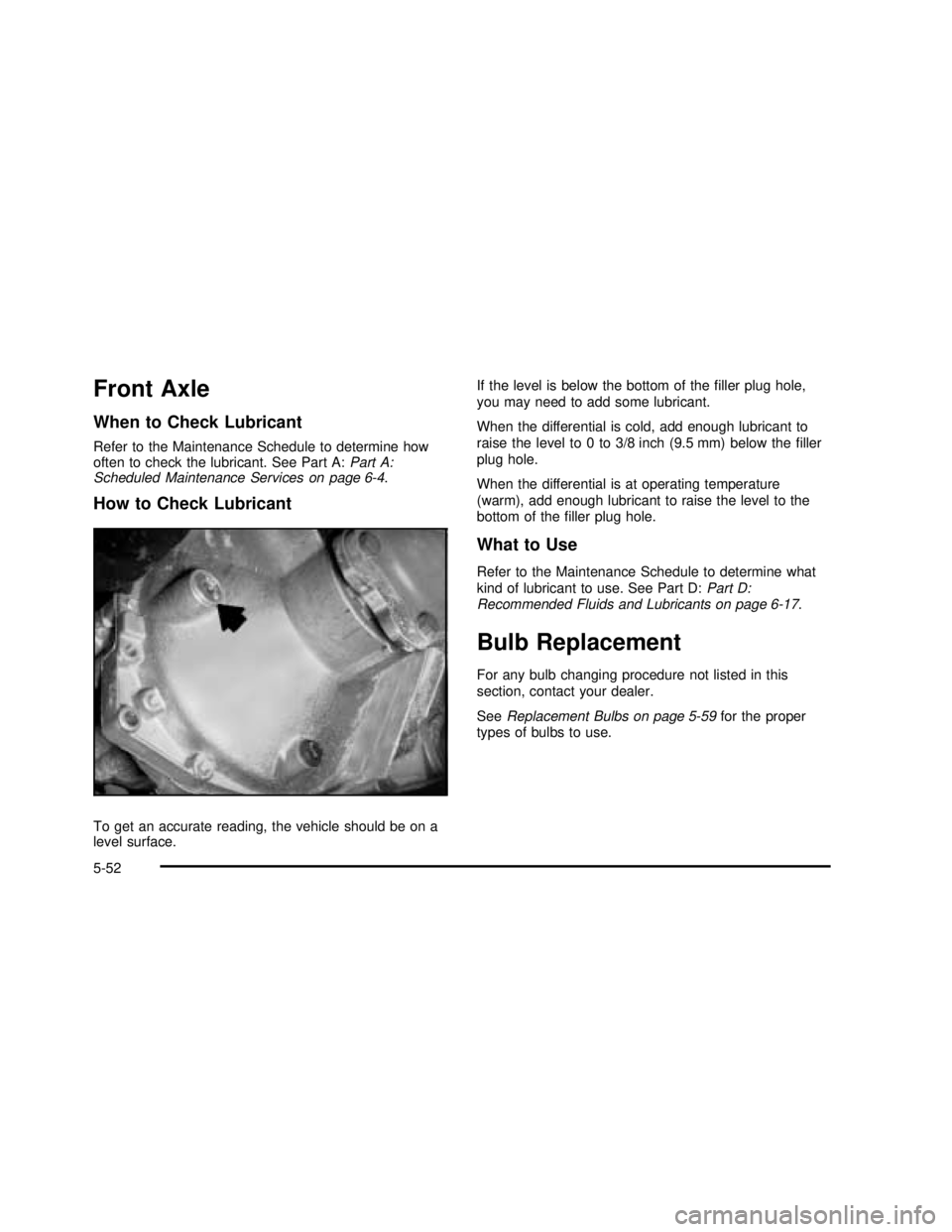
How to Check Lubricant
To get an accurate reading, the vehicle should be on a
level surface.If the level is below the bottom of thefiller plug hole,
you may need to add some lubricant.
When the differential is cold, add enough lubricant to
raise the level to 0 to 3/8 inch (9.5 mm) below thefiller
plug hole.
When the differential is at operating temperature
(warm), add enough lubricant to raise the level to the
bottom of thefiller plug hole.
What to Use
Refer to the Maintenance Schedule to determine what
kind of lubricant to use. See Part D:Part D:
Recommended Fluids and Lubricants on page 6-17.
Bulb Replacement
For any bulb changing procedure not listed in this
section, contact your dealer.
SeeReplacement Bulbs on page 5-59for the proper
types of bulbs to use.
5-52
2003 - Yukon/Yukon XL
Page 409 of 520

5. Remove the old bulb from the bulb socket.
6. Put the new bulb into the bulb socket. Use care not
to touch the bulb with yourfingers or hands.
7. Put the bulb socket into the turn signal housing and
turn it clockwise until it locks.
8. Put the turn signal housing back onto the vehicle
placing the hook and posts on the inner side into
the alignment holesfirst and then the outer side into
the retainer bracket. Push until you hear a click.
9. Put the headlamp assembly back into the vehicle.
Side Identication Marker Lamps
1. To expose the service slot, locate the lamp gasket
near the rear wheel, and pull back the edge.
2. Using aflat tool, push into the slot to release the
lamp housing.
3. Pull the housing out to expose the wiring harness
and connector.4. Unplug the lamp assembly harness from the
housing.
5. Unplug the lamp.
6. Put in a new lamp and snap it into the housing.
7. Reinstall the lamp housing.
Roof Marker Lamps
1. Remove the
two screws and
lift off the lens.
5-55
2003 - Yukon/Yukon XL
Page 414 of 520
Tires
Your new vehicle comes with high-quality tires made by
a leading tire manufacturer. If you ever have questions
about your tire warranty and where to obtain service,
see your GMC Warranty booklet for details.{CAUTION:
Poorly maintained and improperly used tires
are dangerous.
Overloading your tires can cause
overheating as a result of too much
friction. You could have an air-out and a
serious accident. See“Loading Your
Vehicle”in the Index.
Underinated tires pose the same danger
as overloaded tires. The resulting accident
could cause serious injury. Check all tires
frequently to maintain the recommended
pressure. Tire pressure should be checked
when your tires are cold.
Overinated tires are more likely to be
cut, punctured or broken by a sudden
impact—such as when you hit a pothole.
Keep tires at the recommended pressure.
Worn, old tires can cause accidents. If
your tread is badly worn, or if your tires
have been damaged, replace them.
5-60
2003 - Yukon/Yukon XL
Page 416 of 520

The purpose of regular rotation is to achieve more
uniform wear for all tires on the vehicle. Thefirst rotation
is the most important. See“Part A: Scheduled
Maintenance Services,”in Section 6, for scheduled
rotation intervals.
When rotating your tires, always use the correct rotation
pattern shown here.
After the tires have been rotated, adjust the front and
rear inflation pressures as shown on the
Certification/Tire label. Make certain that all wheel nuts
are properly tightened. See“Wheel Nut Torque”
underCapacities and Specifications on page 5-106.
{CAUTION:
Rust or dirt on a wheel, or on the parts to
which it is fastened, can make wheel nuts
become loose after a time. The wheel could
come off and cause an accident. When you
change a wheel, remove any rust or dirt from
places where the wheel attaches to the vehicle.
In an emergency, you can use a cloth or a
paper towel to do this; but be sure to use a
scraper or wire brush later, if you need to, to
get all the rust or dirt off. See“Changing a Flat
Tire”in the Index.
5-62
2003 - Yukon/Yukon XL
Page 418 of 520

Buying New Tires
Tofind out what kind and size of tires you need, look at
the Certification/Tire label.
The tires installed on your vehicle when it was new had
a Tire Performance Criteria Specifications (TPC
Spec) number on each tire’s sidewall. When you get
new tires, get ones with that same TPC Spec number.
That way your vehicle will continue to have tires
that are designed to give proper endurance, handling,
speed rating, traction, ride and other things during
normal service on your vehicle. If your tires have an
all-season tread design, the TPC number will be
followed by an“MS”(for mud and snow).
If you ever replace your tires with those not having a
TPC Spec number, make sure they are the same size,
load range, speed rating and construction type (bias,
bias-belted or radial) as your original tires.{CAUTION:
Mixing tires could cause you to lose control
while driving. If you mix tires of different sizes
or types (radial and bias-belted tires), the
vehicle may not handle properly, and you
could have a crash. Using tires of different
sizes may also cause damage to your vehicle.
Be sure to use the same size and type tires on
all wheels. If your vehicle has 17 inch road
tires (those originally installed on your vehicle)
it is all right to drive with the 16 inch spare tire
that came with your vehicle. When new, your
vehicle included a spare tire and wheel
assembly with the same overall diameter as
your vehicle’s road tires and wheels. Because
this spare tire was developed for use on your
vehicle, it will not affect vehicle handling or
cause damage to your vehicle.
5-64
2003 - Yukon/Yukon XL
Page 419 of 520

{CAUTION:
If you use bias-ply tires on your vehicle, the
wheel rimanges could develop cracks after
many miles of driving. A tire and/or wheel
could fail suddenly, causing a crash. Use only
radial-ply tires with the wheels on your vehicle.
Uniform Tire Quality Grading
Quality grades can be found where applicable on the
tire sidewall between tread shoulder and maximum
section width. For example:
Treadwear 200 Traction AA Temperature A
The following information relates to the system
developed by the United States National Highway
Traffic Safety Administration, which grades tires by
treadwear, traction and temperature performance. (This
applies only to vehicles sold in the United States.)
The grades are molded on the sidewalls of most
passenger car tires. The Uniform Tire Quality Grading
system does not apply to deep tread, winter-type
snow tires, space-saver or temporary use spare tires,
tires with nominal rim diameters of 10 to 12 inches
(25 to 30 cm), or to some limited-production tires.While the tires available on General Motors passenger
cars and light trucks may vary with respect to these
grades, they must also conform to federal safety
requirements and additional General Motors Tire
Performance Criteria (TPC) standards.
Treadwear
The treadwear grade is a comparative rating based on
the wear rate of the tire when tested under controlled
conditions on a specified government test course.
For example, a tire graded 150 would wear one and
a half (1.5) times as well on the government course as
a tire graded 100. The relative performance of tires
depends upon the actual conditions of their use,
however, and may depart significantly from the norm
due to variations in driving habits, service practices and
differences in road characteristics and climate.
Traction–AA, A, B, C
The traction grades, from highest to lowest, are AA, A,
B, and C. Those grades represent the tire’s ability
to stop on wet pavement as measured under controlled
conditions on specified government test surfaces of
asphalt and concrete. A tire marked C may have poor
traction performance. Warning: The traction grade
assigned to this tire is based on straight-ahead braking
traction tests, and does not include acceleration,
cornering, hydroplaning, or peak traction characteristics.
5-65
2003 - Yukon/Yukon XL
Page 450 of 520

GM Vehicle Care/Appearance Materials
(cont’d)
Description Usage
Wash Wax ConcentrateMedium foaming
shampoo. Cleans and
lightly waxes.
Biodegradable and
phosphate free.
Spot LifterQuickly and easily
removes spots and stains
from carpets, vinyl and
cloth upholstery.
Odor EliminatorOdorless spray odor
eliminator used on
fabrics, vinyl, leather and
carpet.
See your General Motors parts department for these
products. SeePart D: Recommended Fluids and
Lubricants on page 6-17.
Vehicle Identication
Vehicle Identication Number (VIN)
This is the legal identifier for your vehicle. It appears on
a plate in the front corner of the instrument panel, on
the driver’s side. You can see it if you look through the
windshield from outside your vehicle. The VIN also
appears on the Vehicle Certification and Service Parts
labels and the certificates of title and registration.
Engine Identication
The 8th character in your VIN is the engine code. This
code will help you identify your engine, specifications
and replacement parts.
5-96
2003 - Yukon/Yukon XL
Page 451 of 520

Service Parts Identication Label
You’llfind this label located in the glove box. It’s very
helpful if you ever need to order parts. On this label is:
•your VIN,
•the model designation,
•paint information and
•a list of all production options and special
equipment.
Be sure that this label is not removed from the vehicle.
Electrical System
Add-On Electrical Equipment
Notice:Don’t add anything electrical to your vehicle
unless you check with your dealerrst. Some
electrical equipment can damage your vehicle and
the damage wouldn’t be covered by your warranty.
Some add-on electrical equipment can keep other
components from working as they should.Your vehicle has an air bag system. Before attempting
to add anything electrical to your vehicle, see
Servicing Your Air Bag-Equipped Vehicle on page 1-85.
Windshield Wiper Fuses
The windshield wiper motor is protected by an internal
circuit breaker and a fuse. If the motor overheats due to
heavy snow, etc., the wiper will stop until the motor
cools. If the overload is caused by some electrical
problem and not snow, etc., be sure to get itfixed.
Power Windows and Other Power
Options
Circuit breakers protect the power windows and other
power accessories. When the current load is too heavy,
the circuit breaker opens and closes, protecting the
circuit until the problem isfixed or goes away.
5-97
2003 - Yukon/Yukon XL