2003 GMC SIERRA DENALI seats
[x] Cancel search: seatsPage 146 of 428
(ri (Floor): This mode directs most of the air to the
floor vents. Some air also comes out of the defroster and
side window vents. Use this mode to send air to the
rear of the vehicle. Keep the area under the front seats
free of objects that could obstruct airflow to the rear
of the vehicle. The recirculation button cannot be
selected in the floor mode.
(Recirculation): Press this button to turn the
recirculation mode on or
off. The recirculation mode is
used to limit the amount of outside air entering your
vehicle. This is helpful when you are trying to prevent
outside odors and/or dust from entering your vehicle, or
to help cool the air inside of your vehicle more quickly.
When this mode is on, inside air will recirculate
throughout your vehicle. When this button is pressed,
an indicator light in the button will also come on to
let you know that it is activated.
If you select recirculation while in defrost, defog, or
floor, the light on the button will flash and go out to let
you know this is not allowed. This is to prevent
windshield fogging.
If the weather is cold and damp, the system may cause
the windows to fog while using the recirculation
mode.
If the windows do start to fog, select defog or
front defrost mode
a NC (Air Conditioning): Press this button to
manually turn the air-conditioning system on or
off.
When the system is selected, or in AUTO mode
the system will automatically begin to cool and
dehumidify the air inside
of your vehicle.
If you select air conditioning off while in front defrost, or
defog mode the air conditioning
off symbol will flash
to let you know this is not allowed.
You may notice a slight change in engine performance
when the air-conditioning compressor shuts
off and
turns
on again. This is normal.
%k (Air Conditioning Off): When you turn the air
conditioning
off, this symbol will appear on the display.
When the air conditioning is selected or in AUTO
mode, the system will run the air conditioning
automatically.
3-2 1
Page 148 of 428
Outlet Adjustment Operation Tips
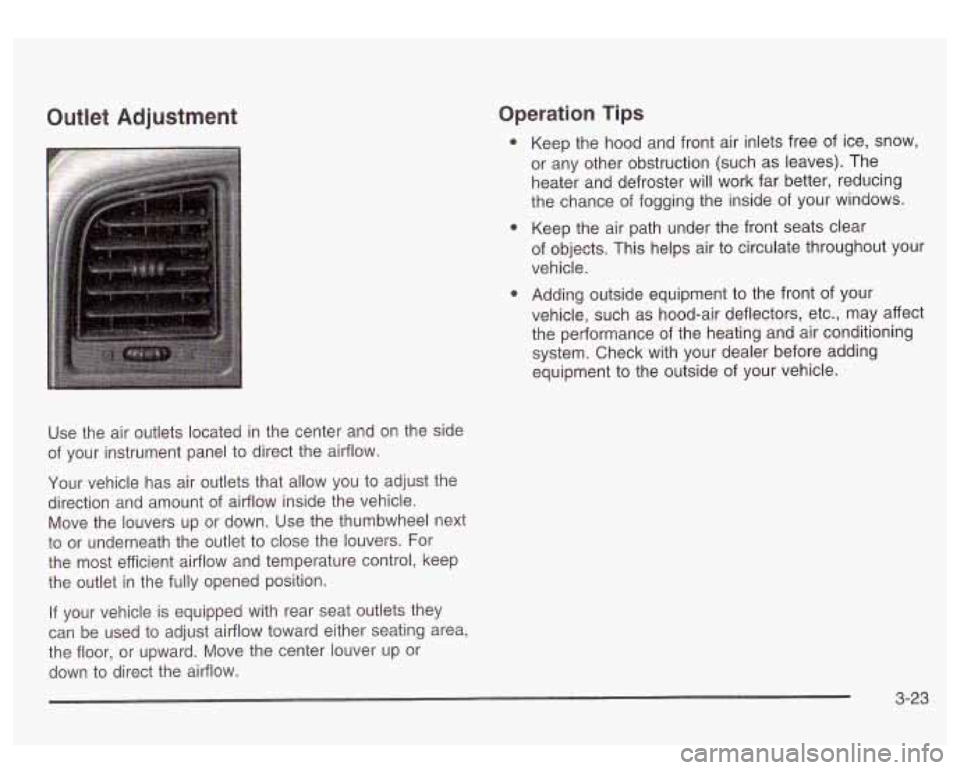
Use the air outlets located in the center and on the side
of your instrument panel to direct the airflow.
Your vehicle has air outlets that allow you to adjust the
direction and amount of airflow inside the vehicle.
Move the louvers up or down. Use the thumbwheel next
to or underneath the outlet to close the louvers. For
the most efficient airflow and temperature control, keep
the outlet in the fully opened position.
If your vehicle is equipped with rear seat outlets they
can be used
to adjust airflow toward either seating area,
the floor, or upward. Move the center louver up or
down
to direct the airflow. Keep
the hood and front air inlets free
of ice, snow,
or any other obstruction (such as leaves). The
heater and defroster will work far better, reducing
the chance of fogging the inside of your windows.
Keep the air path under the front seats clear
of objects. This helps air
to circulate throughout your
vehicle.
Adding outside equipment
to the front of your
vehicle, such as hood-air deflectors, etc., may affect
the performance
of the heating and air conditioning
system. Check with your dealer before adding
equipment
to the outside of your vehicle.
3-23
Page 256 of 428

Th.,,ds yo^ pur inside your vehicle can strike
and injure people in a sudden stop or turn, or
in a crash.
Put things in the trunk of your vehicle. In a
trunk, put them
as far forward as you can.
Try to spread the weight evenly.
Never stack heavier things, like suitcases,
inside the vehicle
so that some of them
are above the tops of the seats.
Don’t leave an unsecured child restraint in
your vehicle.
When you carry something inside the
vehicle, secure it whenever you can.
There’s also important loading information for off-road
driving in this manual. See “Loading Your Vehicle
for Off-Road Driving“ under
Operating Your
All- Wheel-Drive Vehicle Off Paved Roads on page 4- 16.
Payload
Payload capacity is the maximum load capacity that your
vehicle can carry. Be sure to include the weight of the
occupants as part of your load.
If you added any accessories or
equipment after your vehicle left the
factory, remember to subtract the weight of these things
from the payload. Your dealer can help you with this.
Remember not to exceed the Gross Axle Weight Rating
(GAWR) of the front or rear axle.
Two-Tiered Loading
By positioning four 2’’ x 6’’ wooden planks across the
width of the pickup box, you can create an upper
load platform. The planks must be inserted in the pickup
box depressions. The length of the planks must allow
for at least a
3/4 inch (2 cm) bearing surface on
each end of the plank.
When using this upper load platform, be sure the load is
securely tied down to prevent it from shifting. The
load’s center of gravity should be positioned in a zone
over the rear axle. The zone is located in the area
between the front of each wheel well and the rear of
each wheel well. The center of gravity height must not
extend above the top of the pickup box flareboard.
Any load that extends beyond the vehicle’s taillamp area
must be properly marked according to local laws and
regulations.
Remember not to exceed the Gross Axle Weight Rating
(GAWR) of the front or rear axle.
4-47
Page 351 of 428
1 in a crisscross
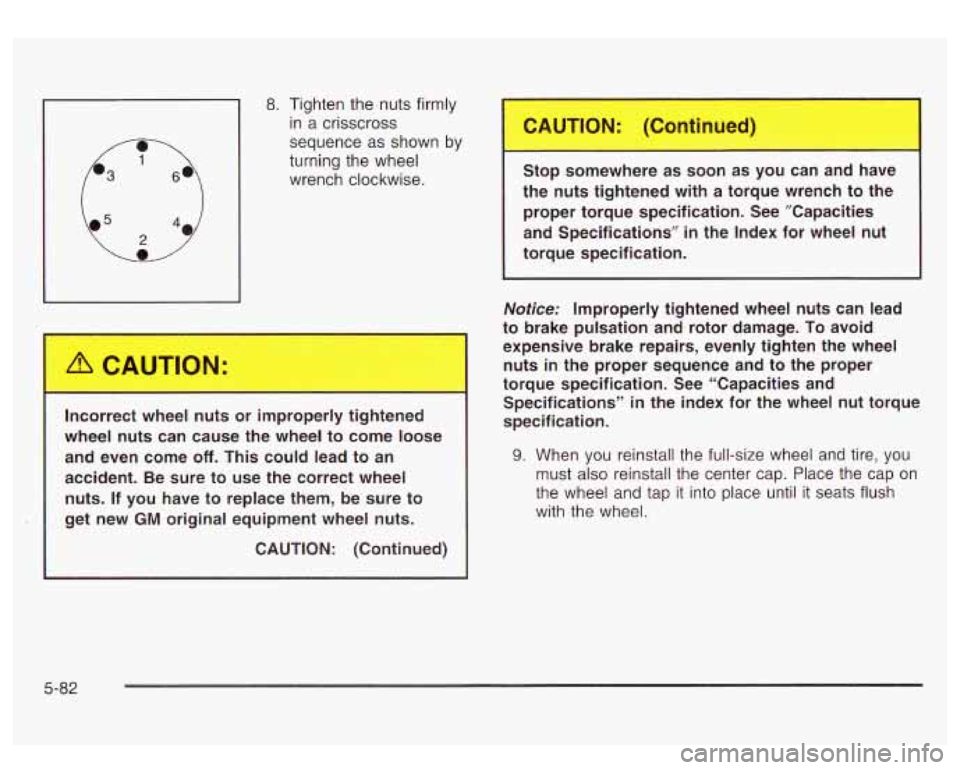
8.
Tighten the nuts firmly
sequence as shown by
turning the wheel
wrench clockwise.
Incorrect wheel
nuts or improperly tightened
wheel nuts can cause the wheel to come loose and even come
off. This could lead to an
accident. Be sure to use the correct wheel
nuts. If you have to replace them, be sure to
get new
GM original equipment wheel nuts.
CAUTION: (Continued) Stop somewhere
as soon as you can and have
the nuts tightened with a torque wrench to the
proper torque specification. See ”Capacities
and Specifications” in the Index for wheel nut
torque specification.
Notice: Improperly tightened wheel nuts can lead
to brake pulsation and rotor damage. To avoid
expensive brake repairs, evenly tighten the wheel
nuts in the proper sequence and to the proper
torque specification. See “Capacities and
Specifications”
in the index for the wheel nut torque
specification.
9. When you reinstall the full-size wheel and tire, you
must
also reinstall the center cap. Place the cap on
the wheel and tap it into place until it seats flush
with the wheel.
5-82
Page 365 of 428
Instrument Panel Fuse Block
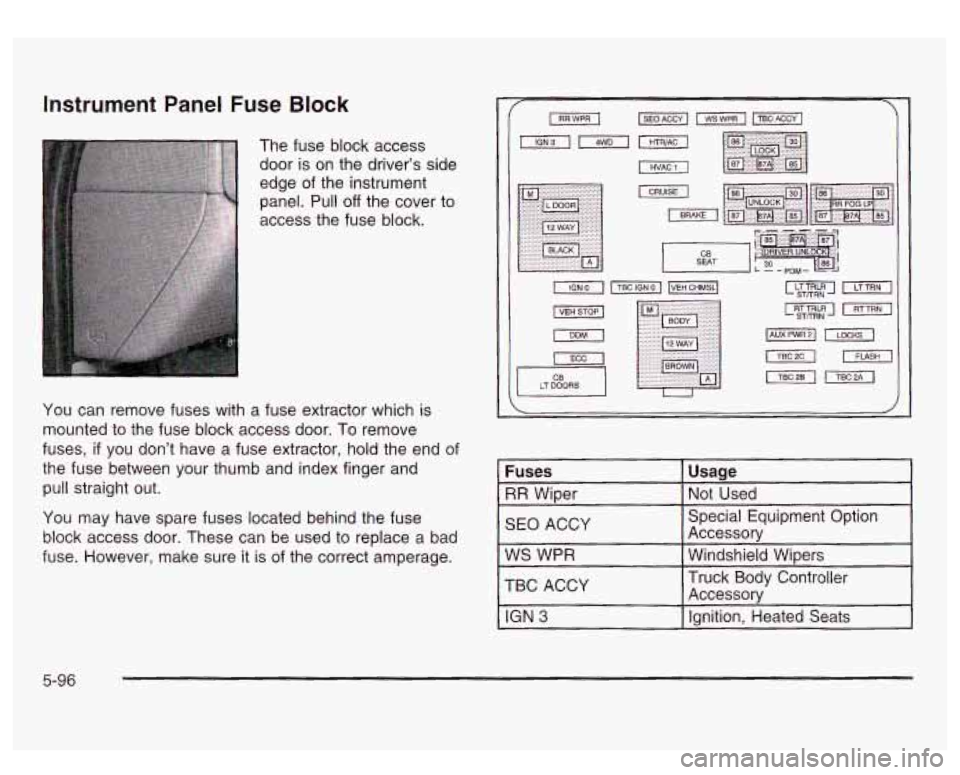
The fuse block access
door is on the driver's side
edge of the instrument
panel. Pull
off the cover to
access the fuse block.
You can remove fuses with a fuse extractor which
is
mounted to the fuse block access door. To remove
fuses,
if you don't have a fuse extractor, hold the end of
the fuse between your thumb and index finger and
pull straight out.
You may have spare fuses located behind the fuse
block access door. These can be used to replace
a bad
fuse. However, make sure it is of the correct amperage.
II
LT DOORS U
Fuses
SEO ACCY Not
Used
RR Wiper
Usage
TBC
ACCY Windshield Wipers
WS
WPR Accessory
Special Equipment Option
Ignition, Heated Seats
IGN 3
Accessory Truck Body Controller
5-96
Page 370 of 428
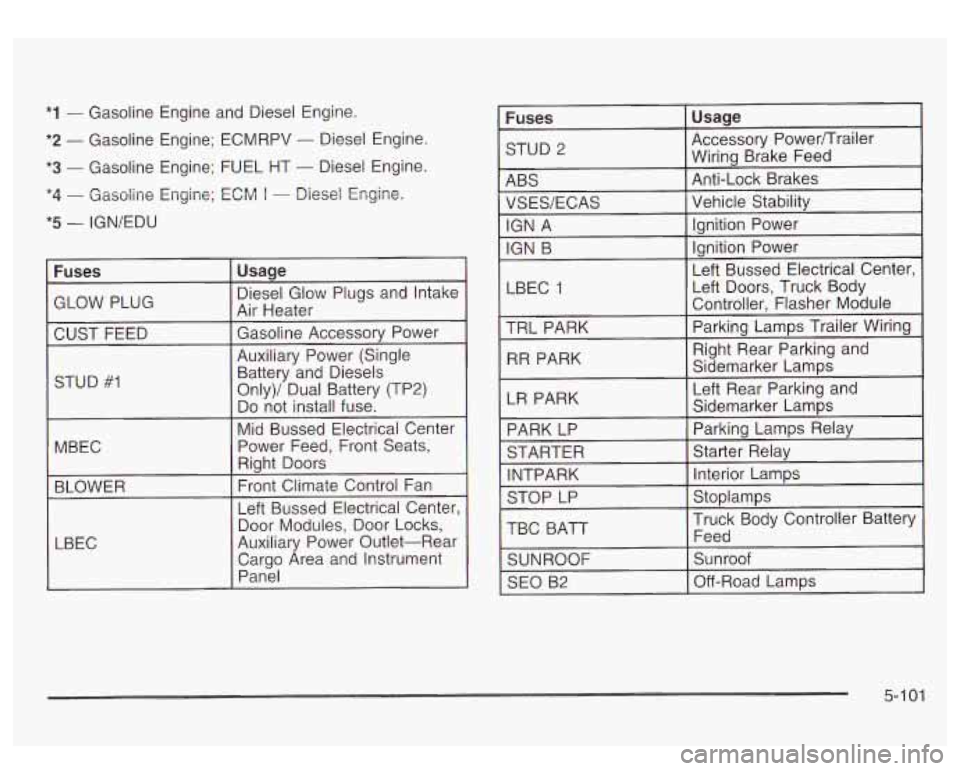
*I - Gasoline Engine and Diesel Engine.
*2 - Gasoline Engine; ECMRPV - Diesel Engine.
*3 - Gasoline Engine; FUEL HT - Diesel Engine.
*4 - Gasoline Engine; ECM f - Diesel Engine.
*5 - IGN/EDU
r Fuses
GLOW PLUG
CUST FEED
STUD
#I
MBEC
BLOWER
LBEC Only)/ Dual Battery
(TP2)
Do not install fuse.
Mid Bussed Electrical Center
Power Feed, Front Seats,
Riaht Doors TRL
PARK Parking Lamps Trailer Wiring
RR PARK Right
Rear Parking and
Sidemarker LamDs
TBC BATT Truck Body
Controller Battery
I Feed
5-1 01
Page 416 of 428
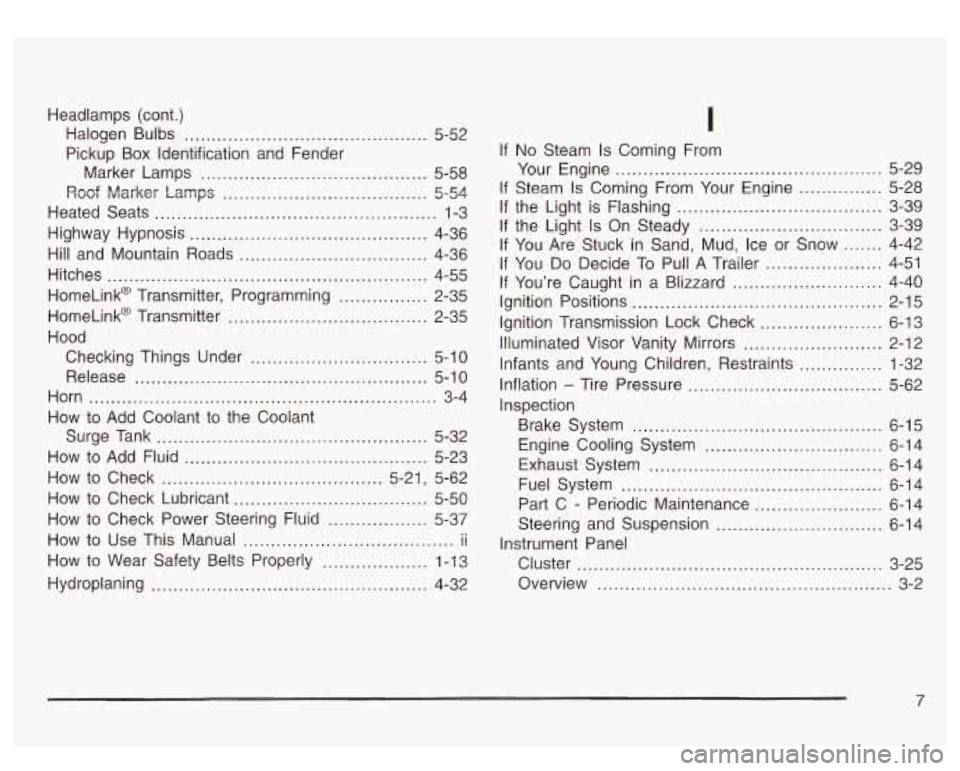
Headlamps (cont.) Halogen Bulbs
............................................ 5-52
Pickup Box Identification and Fender
Marker Lamps
......................................... 5-58
Roof Marker Lamps
..................................... 5-54
Heated Seats
................................................... 1-3
Highway Hypnosis
........................................... 4-36
Hill and Mountain Roads
.................................. 4-36
Hitches
.......................................................... 4-55
HomeLink@ Transmitter
.................................... 2-35
Hood Checking Things Under
................................ 5-10
Release
..................................................... 5-1 0
Horn ............................................................... 3-4
How to Add Coolant
to the Coolant
Surge Tank
................................................. 5-32
How
to Add Fluid ............................................ 5-23
How
to Check ........................................ 5-21, 5-62
How to Check Lubricant
................................... 5-50
How to Use This Manual
.............. ......... ii
How to Wear Safety Belts Properly ................... 1-1 3
HomeLink@ Transmitter, Programming
................ 2-35
How to Check Power Steering Fluid
.................. 5-37
Hydroplaning
.................................................. 4-32
I
if No Steam Is Coming From
Your Engine
................................................ 5-29
If Steam
Is Coming From Your Engine ............... 5-28
If the Light is Flashing ..................................... 3-39
If the Light is On Steady
................................. 3-39
If You Are Stuck in Sand, Mud, Ice or Snow
....... 4-42
If You Do Decide To Pull A Trailer ..................... 4-51
If You’re Caught in a Blizzard ........................... 4-40
Ignition Transmission Lock Check
...................... 6-13
Illuminated Visor Vanity Mirrors
......................... 2-12
infants and Young Children, Restraints
............... 1-32
Inflation
- Tire Pressure ................................... 5-62
inspection Ignition Positions
............................................. 2-15
Brake System
............................................. 6-15
Exhaust System
.......................................... 6-14
Fuel System
............................................... 6-14
Engine Cooling System
................................ 6-14
Part
C - Periodic Maintenance ....................... 6-14
Steering and Suspension
.............................. 6-14
Cluster
....................................................... 3-25
Overview
..................................................... 3-2
Instrument Panel
7
Page 421 of 428
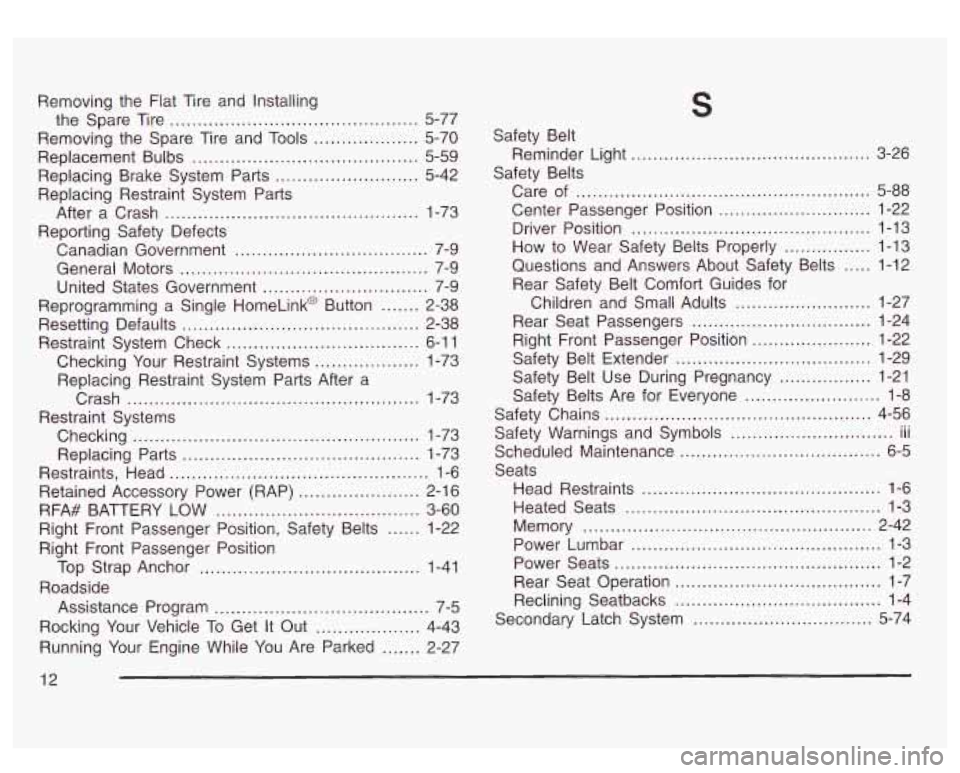
Removing the Flat Tire and Installing
the Spare Tire
............................................. 5-77
Replacement Bulbs
......................................... 5-59
Replacing Brake System Parts
.......................... 5-42
Replacing Restraint System Parts
After a Crash
.............................................. 1-73
Reporting Safety Defects
Canadian Government
................................... 7-9
General Motors
............................................. 7-9
United States Government
.............................. 7-9
Resetting Defaults
........................................... 2-38
Restraint System Check
................................... 6-1 1
Removing
the Spare Tire and Tools
................... 5-70
Reprogramming a Single HomeLink@ Button
....... 2-38
Checking Your Restraint Systems
................... 1-73
Replacing Restraint System Parts After
a
Crash ..................................................... 1 -73
Checking
.................................................... 1-73
Replacing Parts
........................................... 1-73
Retained Accessory Power (RAP)
...................... 2-1 6
Right Front Passenger Position, Safety Belts
...... 1-22
Right Front Passenger Position
Top Strap Anchor
........................................ 1-41
Roadside
Assistance Program
....................................... 7-5
Running Your Engine While You Are Parked
....... 2-27
Restraint
Systems
Restraints, Head
............................................... 1-6
RFA# BATTERY LOW
..................................... 3-60
Rocking Your Vehicle To Get It Out
................... 4-43
S
Safety Belt
Safety Belts Reminder
Light
........................................ 3-26
Care of
.................................................. 5-88
Center Passenger Position
............................ 1-22
Driver Position
............................................ 1-13
How to Wear Safety Belts Properly
................ 1-13
Questions and Answers About Safety Belts
..... 1-12
Rear Safety Belt Comfort Guides for
Children and Small Adults
......................... 1-27
Rear Seat Passengers
................................. 1-24
Right Front Passenger Position
...................... 1-22
Safety Belts Are for Everyone
......................... 1-8
Safety Warnings and Symbols
.............................. iii
Safety Belt Extender .................................... 1-29
Safety Belt Use During Pregnancy
................. 1-21
Safety Chains
................................................. 4-56
Scheduled Maintenance
.................................. 6-5
Seats
Head Restraints
....................... , ................. 1-6
Heated Seats
............................................... 1-3
Memory
..................................................... 2-42
Power Lumbar
.............................................. 1-3
Power Seats
................................................. 1-2
Rear Seat Operation
...................................... 1-7
Reclining Seatbacks
...................................... 1-4
Secondary Latch System
................................. 5-74
12