2003 GMC SAFARI height
[x] Cancel search: heightPage 26 of 376
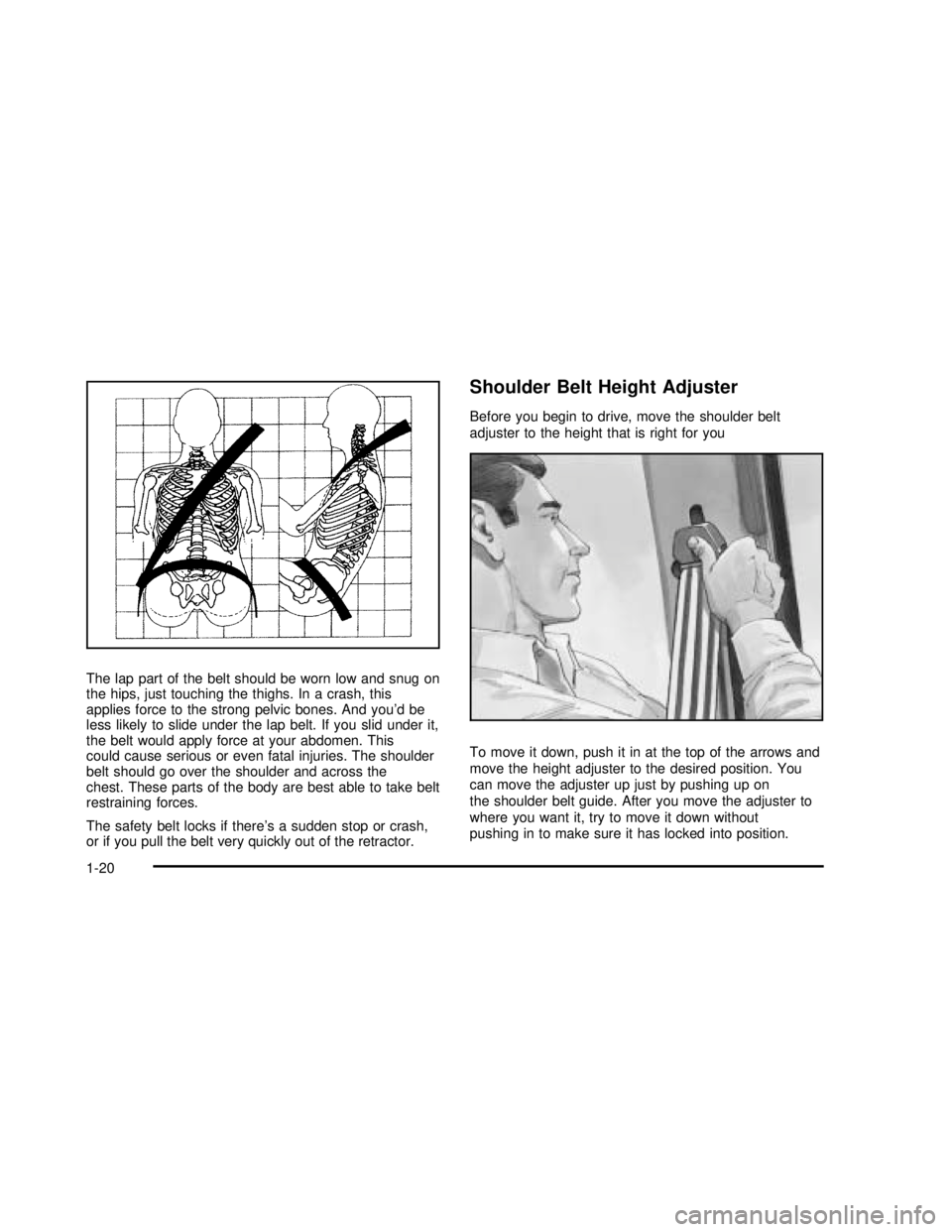
The lap part of the belt should be worn low and snug on
the hips, just touching the thighs. In a crash, this
applies force to the strong pelvic bones. And you’dbe
less likely to slide under the lap belt. If you slid under it,
the belt would apply force at your abdomen. This
could cause serious or even fatal injuries. The shoulder
belt should go over the shoulder and across the
chest. These parts of the body are best able to take belt
restraining forces.
The safety belt locks if there’s a sudden stop or crash,
or if you pull the belt very quickly out of the retractor.
Shoulder Belt Height Adjuster
Before you begin to drive, move the shoulder belt
adjuster to the height that is right for you
To move it down, push it in at the top of the arrows and
move the height adjuster to the desired position. You
can move the adjuster up just by pushing up on
the shoulder belt guide. After you move the adjuster to
where you want it, try to move it down without
pushing in to make sure it has locked into position.
1-20
2003 - Safari OM
Page 27 of 376

Adjust the height so that the shoulder portion of the belt is
centered on your shoulder. The belt should be away from
your face and neck, but not falling off your shoulder.
Q:What’s wrong with this?
A:The shoulder belt is too loose. It won’t give nearly
as much protection this way.
{CAUTION:
You can be seriously hurt if your shoulder belt
is too loose. In a crash, you would move
forward too much, which could increase injury.
The shoulder belt should fit against your body.
1-21
2003 - Safari OM
Page 46 of 376
Q:What are the different types of add-on child
restraints?
A:Add-on child restraints, which are purchased by
the vehicle’s owner, are available in four basic
types. Selection of a particular restraint should take
into consideration not only the child’s weight,
height and age but also whether or not the restraint
will be compatible with the motor vehicle in
which it will be used.
For most basic types of child restraints, there are
many different models available. When purchasing a
child restraint, be sure it is designed to be used
in a motor vehicle. If it is, the restraint will have a
label saying that it meets federal motor vehicle
safety standards.
The restraint manufacturer’s instructions that come
with the restraint state the weight and height
limitations for a particular child restraint. In addition,
there are many kinds of restraints available for
children with special needs.
{CAUTION:
Newborn infants need complete support,
including support for the head and neck. This
is necessary because a newborn infant’s neck
is weak and its head weighs so much
compared with the rest of its body. In a crash,
an infant in a rear-facing seat settles into the
restraint, so the crash forces can be
distributed across the strongest part of an
infant’s body, the back and shoulders. Infants
always should be secured in appropriate infant
restraints.
1-40
2003 - Safari OM
Page 74 of 376

Adding Equipment to Your Air
Bag-Equipped Vehicle
Q:If I add a push bumper or a bicycle rack to the
front of my vehicle, will it keep the air bags
from working properly?
A:As long as the push bumper or bicycle rack is
attached to your vehicle so that the vehicle’s
basic structure isn’t changed, it’s not likely to keep
the air bags from working properly in a crash.
Q:Is there anything I might add to the front of the
vehicle that could keep the air bags from
working properly?
A:Yes. If you add things that change your vehicle’s
frame, bumper system, front end sheet metal or
height, they may keep the air bag system
from working properly. Also, the air bag system
may not work properly if you relocate any of the air
bag sensors. If you have any questions about
this, you should contact Customer Assistance
before you modify your vehicle. The phone
numbers and addresses for Customer Assistance
are in Step Two of theCustomer Satisfaction
Procedure on page 7-2.
Restraint System Check
Checking Your Restraint Systems
Now and then, make sure the safety belt reminder light
and all your belts, buckles, latch plates, retractors
and anchorages are working properly. Look for any other
loose or damaged safety belt system parts. If you see
anything that might keep a safety belt system from doing
its job, have it repaired.
Torn or frayed safety belts may not protect you in a
crash. They can rip apart under impact forces. If a belt
is torn or frayed, get a new one right away.
Also look for any opened or broken air bag covers, and
have them repaired or replaced. (The air bag system
does not need regular maintenance.)
1-68
2003 - Safari OM
Page 254 of 376

Brake Pedal Travel
See your dealer if the brake pedal does not return to
normal height, or if there is a rapid increase in
pedal travel. This could be a sign of brake trouble.
Brake Adjustment
Every time you make a brake stop, your disc brakes
adjust for wear.
Replacing Brake System Parts
The braking system on a vehicle is complex. Its many
parts have to be of top quality and work well together if
the vehicle is to have really good braking. Your
vehicle was designed and tested with top-quality GM
brake parts. When you replace parts of your braking
system–for example, when your brake linings
wear down and you need new ones put in–be sure
you get new approved GM replacement parts. If
you don’t, your brakes may no longer work properly. For
example, if someone puts in brake linings that are
wrong for your vehicle, the balance between your front
and rear brakes can change–for the worse. The
braking performance you’ve come to expect can change
in many other ways if someone puts in the wrong
replacement brake parts.
Battery
Your new vehicle comes with a maintenance free
ACDelco®battery. When it’s time for a new battery, get
one that has the replacement number shown on the
original battery’s label. We recommend an ACDelco
®
battery. SeeEngine Compartment Overview on
page 5-12for battery location.
Warning:Battery posts, terminals and related
accessories contain lead and lead compounds,
chemicals known to the State of California to cause
cancer and reproductive harm. Wash hands after
handling.
Vehicle Storage
If you’re not going to drive your vehicle for 25 days or
more, remove the black, negative (−) cable from
the battery. This will help keep your battery from
running down.
5-42
2003 - Safari OM
Page 275 of 376

Wheel Alignment and Tire Balance
The wheels on your vehicle were aligned and balanced
carefully at the factory to give you the longest tire life
and best overall performance.
Scheduled wheel alignment and wheel balancing are
not needed. However, if you notice unusual tire wear or
your vehicle pulling one way or the other, the alignment
may need to be reset. If you notice your vehicle
vibrating when driving on a smooth road, your wheels
may need to be rebalanced.
Wheel Replacement
Replace any wheel that is bent, cracked or badly rusted
or corroded. If wheel nuts keep coming loose, the
wheel, wheel bolts and wheel nuts should be replaced.
If the wheel leaks air, replace it (except some
aluminum wheels, which can sometimes be repaired).
See your dealer if any of these conditions exist.
Your dealer will know the kind of wheel you need.
Each new wheel should have the same load-carrying
capacity, diameter, width, offset and be mounted
the same way as the one it replaces.
If you need to replace any of your wheels, wheel bolts
or wheel nuts, replace them only with new GM
original equipment parts. This way, you will be sure to
have the right wheel, wheel bolts and wheel nuts
for your vehicle.
{CAUTION:
Using the wrong replacement wheels, wheel
bolts or wheel nuts on your vehicle can be
dangerous. It could affect the braking and
handling of your vehicle, make your tires lose
air and make you lose control. You could have
a collision in which you or others could be
injured. Always use the correct wheel, wheel
bolts and wheel nuts for replacement.
Notice:The wrong wheel can also cause problems
with bearing life, brake cooling, speedometer or
odometer calibration, headlamp aim, bumper height,
vehicle ground clearance and tire or tire chain
clearance to the body and chassis.
SeeChanging a Flat Tire on page 5-65for more
information.
5-63
2003 - Safari OM
Page 369 of 376

Service........................................................... 5-3
Adding Equipment to the Outside of Your
Vehicle..................................................... 5-4
All-Wheel-Drive Light....................................3-34
Doing Your Own Work................................... 5-3
Engine Soon Light.......................................3-30
Publications Ordering Information...................7-10
Service Bulletins.............................................7-10
Service Engine Soon Light in the United States
or Check Engine Light
in Canada..................................................3-30
Service Manuals.............................................7-10
Servicing Your Air Bag-Equipped Vehicle............1-67
Setting Preset Stations............................3-38, 3-41
Setting the Temperature...................................3-20
Setting the Time
Radios with HR and MN Buttons...................3-37
Radios with the Set Button...........................3-37
Setting the Tone (Bass/Treble)..................3-39, 3-42
Sheet Metal Damage.......................................5-82
Shifting Into Park (P).......................................2-27
Shifting Out of Park (P)...................................2-29
Short Trip/City Definition.................................... 6-5
Short Trip/City Intervals..................................... 6-5
Short Trip/City Scheduled Maintenance................ 6-7Shoulder Belt Height Adjuster...........................1-20
Skidding........................................................4-13
Sliding Door Security Lock...............................2-11
Sliding Side Door............................................2-10
Some Other Rainy Weather Tips.......................4-18
Spare Tire Check............................................6-28
Special Fabric Cleaning Problems.....................5-77
Specifications, Capacities.................................5-92
Speedometer..................................................3-25
Starter Switch Check.......................................6-29
Starting Your Engine.......................................2-20
Steering
.......................................................... 4-9
Steering in Emergencies
..................................4-10
Steering, Suspension and Front Drive Axle Boot
and Seal Inspection
.....................................6-32
Steering Tips
................................................... 4-9
Storage Areas
................................................2-38
Convenience Net
.........................................2-45
Luggage Carrier
..........................................2-45
Overhead Console
.......................................2-39
Storing a Flat or Spare Tire and Tools
...............5-75
Stuck in Sand, Mud, Ice or Snow
......................4-28
Sun Visors
.....................................................2-17
Sunglasses Storage Compartment
.....................2-44
13
2003 - Safari OM