2003 FORD WINDSTAR maintenance reset
[x] Cancel search: maintenance resetPage 14 of 240
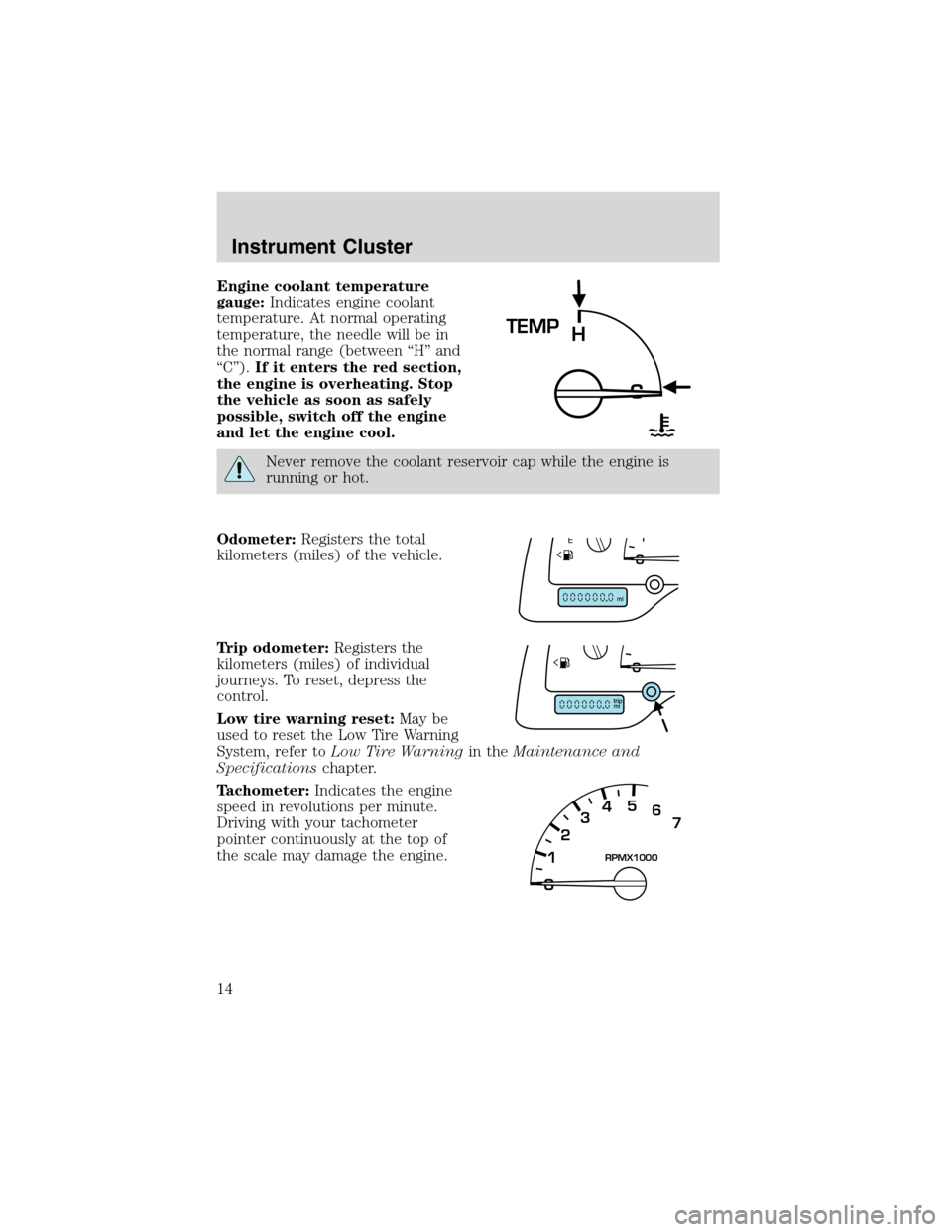
Engine coolant temperature
gauge:Indicates engine coolant
temperature. At normal operating
temperature, the needle will be in
the normal range (between“H”and
“C”).If it enters the red section,
the engine is overheating. Stop
the vehicle as soon as safely
possible, switch off the engine
and let the engine cool.
Never remove the coolant reservoir cap while the engine is
running or hot.
Odometer:Registers the total
kilometers (miles) of the vehicle.
Trip odometer:Registers the
kilometers (miles) of individual
journeys. To reset, depress the
control.
Low tire warning reset:May be
used to reset the Low Tire Warning
System, refer toLow Tire Warningin theMaintenance and
Specificationschapter.
Tachometer:Indicates the engine
speed in revolutions per minute.
Driving with your tachometer
pointer continuously at the top of
the scale may damage the engine.
TEMP
H
12345
6
7RPMX1000
Instrument Cluster
14
Page 196 of 240
7. Drive the vehicle to complete the relearning process.
•The vehicle may need to be driven 16 km (10 miles) or more to
relearn the idle and fuel trim strategy.
•If you do not allow the engine to relearn its idle trim, the idle
quality of your vehicle may be adversely affected until the idle
trim is eventually relearned.
If the battery has been disconnected or a new battery has been installed,
the clock and the preset radio stations must be reset once the battery is
reconnected.
If the battery has been discharged, disconnected or a new battery has
been installed, the power sliding door may need to be reset. Refer to
Power Sliding Door-Resetting the PSDin theControls and Features
chapter.
•Always dispose of automotive
batteries in a responsible manner.
Follow your local authorized
standards for disposal. Call your
local authorized recycling center
to find out more about recycling
automotive batteries.
ENGINE COOLANT
Checking engine coolant
The concentration and level of engine coolant should be checked at the
mileage intervals listed in the scheduled maintenance guide. The coolant
concentration should be maintained at 50/50 coolant and distilled water,
which equates to a freeze point of -36°C (-34°F). Coolant concentration
testing is possible with a hydrometer or antifreeze tester (such as the
Rotunda Battery and Antifreeze Tester, 014–R1060). The level of coolant
should be maintained at the“cold full”of“cold fill range”level in the
coolant reservoir. If the level falls below, add coolant per the instructions
in theAdding engine coolantsection.
Your vehicle was factory-filled with a 50/50 engine coolant and water
concentration. If the concentration of coolant falls below 40% or above
60%, the engine parts could become damaged or not work properly.A
50–50 mixture of coolant and water provides the following:
LEAD
RETURN
RECYCLE
Maintenance and Specifications
196
Page 210 of 240
Exhaust leaks may result in entry of harmful and potentially
lethal fumes into the passenger compartment.
Do not make any unauthorized changes to your vehicle or engine. By
law, vehicle owners and anyone who manufactures, repairs, services,
sells, leases, trades vehicles, or supervises a fleet of vehicles are not
permitted to intentionally remove an emission control device or prevent
it from working. Information about your vehicle’s emission system is on
the Vehicle Emission Control Information Decal located on or near the
engine. This decal identifies engine displacement and gives some tune up
specifications.
Please consult yourWarranty Guidefor complete emission warranty
information.
Readiness for Inspection/Maintenance (I/M) testing
In some localities, it may be a legal requirement to pass an I/M test of
the on-board diagnostics system. If your“Check Engine/Service Engine
Soon”light is on, refer to the description in theWarning lights and
chimessection of theInstrument clusterchapter. Your vehicle may not
pass the I/M test with the“Check Engine/Service Engine Soon”light on.
If the vehicle’s powertrain system or its battery has just been serviced,
the on-board diagnostics system is reset to a“not ready for I/M test”
condition. To ready the on-board diagnostics system for I/M testing, a
minimum of 30 minutes of city and highway driving is necessary as
described below:
•First, at least 10 minutes of driving on an expressway or highway.
•Next, at least 20 minutes driving in stop-and-go, city-type traffic with
at least four idle periods.
Allow the vehicle to sit for at least eight hours without starting the
engine. Then, start the engine and complete the above driving cycle. The
engine must warm up to its normal operating temperature. Once started,
do not turn off the engine until the above driving cycle is complete.
Maintenance and Specifications
210
Page 215 of 240
which all passenger car tires must meet under the Federal Motor Vehicle
Safety Standard No. 109. Grades B and A represent higher levels of
performance on the laboratory test wheel than the minimum required by
law.
The temperature grade for this tire is established for a tire that
is properly inflated and not overloaded. Excessive speed,
underinflation, or excessive loading, either separately or in
combination, can cause heat buildup and possible tire failure.
SERVICING YOUR TIRES
Low tire warning
The low tire warning system is designed to detect a significant loss of
inflation inany one of your tireson your vehicle. The system uses the
Anti-lock brake wheel speed sensors to detect a change in wheel speed
due to tire deflation.
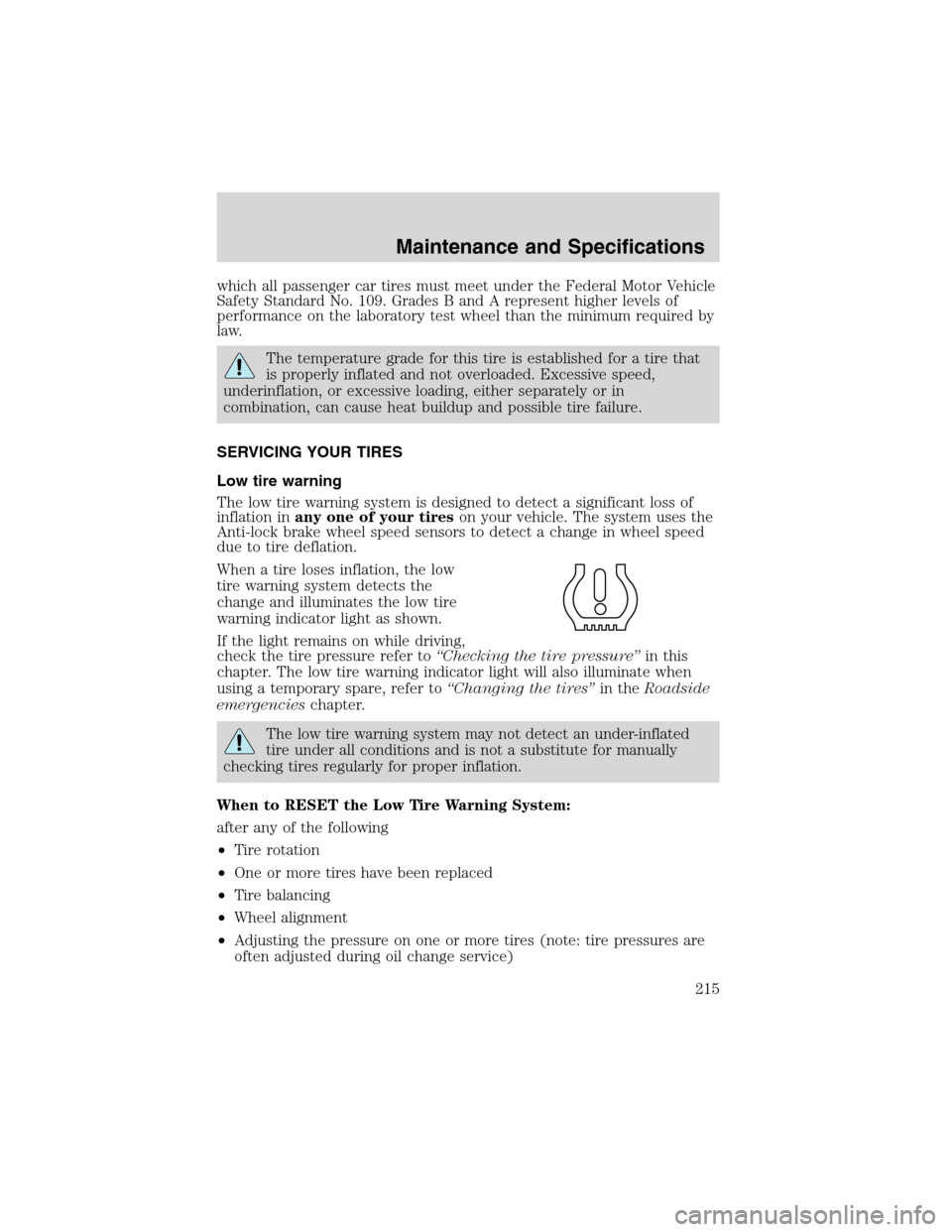
When a tire loses inflation, the low
tire warning system detects the
change and illuminates the low tire
warning indicator light as shown.
If the light remains on while driving,
check the tire pressure refer to“Checking the tire pressure”in this
chapter. The low tire warning indicator light will also illuminate when
using a temporary spare, refer to“Changing the tires”in theRoadside
emergencieschapter.
The low tire warning system may not detect an under-inflated
tire under all conditions and is not a substitute for manually
checking tires regularly for proper inflation.
When to RESET the Low Tire Warning System:
after any of the following
•Tire rotation
•One or more tires have been replaced
•Tire balancing
•Wheel alignment
•Adjusting the pressure on one or more tires (note: tire pressures are
often adjusted during oil change service)
Maintenance and Specifications
215
Page 216 of 240
•Inflating a low tire will not clear the Low Tire Warning indicator light.
Only reseting the system will clear the light.
•The system will not detect a pressure loss without driving the vehicle
for at least 0.8 km (0.5 mile) at speeds greater than 40 km/h
(25 mph).
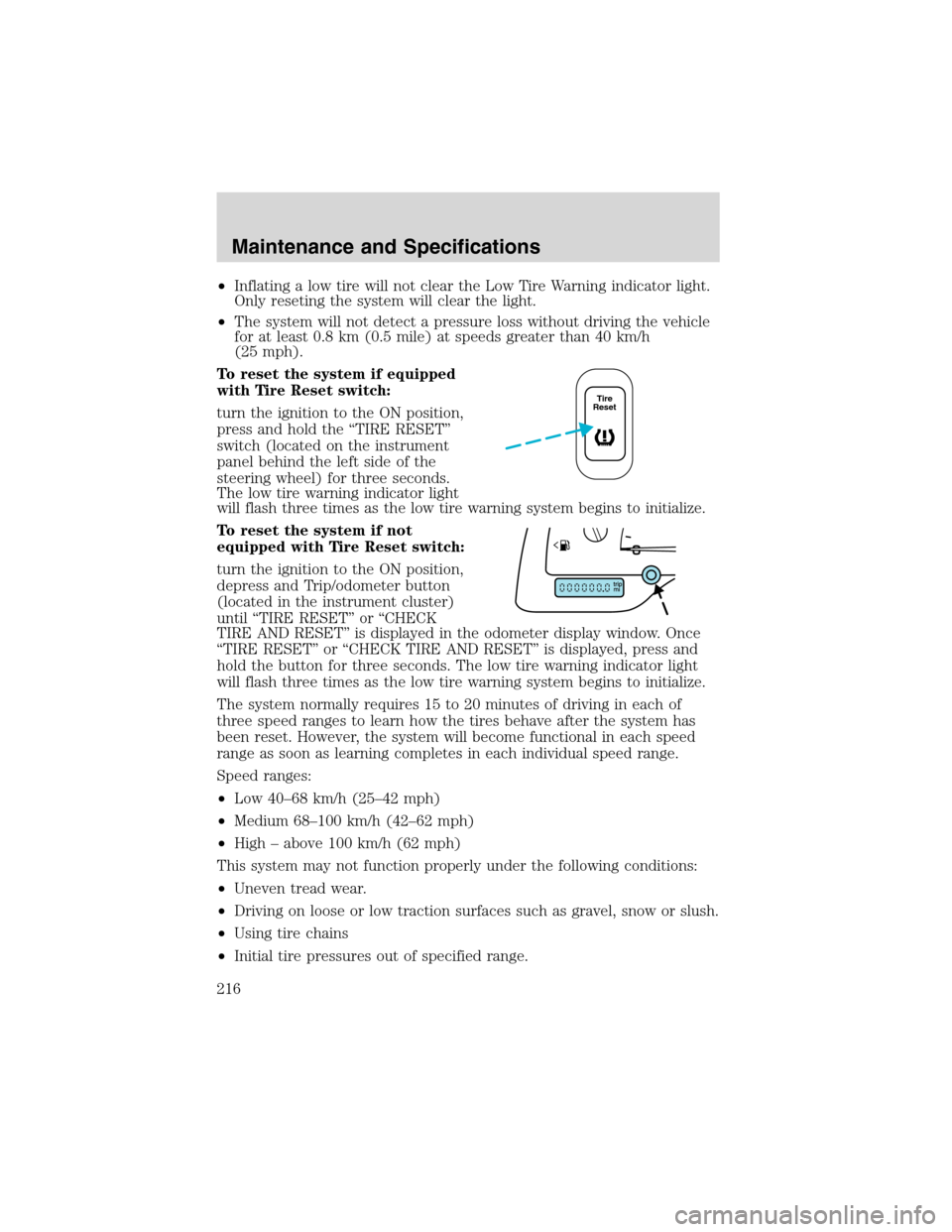
To reset the system if equipped
with Tire Reset switch:
turn the ignition to the ON position,
press and hold the“TIRE RESET”
switch (located on the instrument
panel behind the left side of the
steering wheel) for three seconds.
The low tire warning indicator light
will flash three times as the low tire warning system begins to initialize.
To reset the system if not
equipped with Tire Reset switch:
turn the ignition to the ON position,
depress and Trip/odometer button
(located in the instrument cluster)
until“TIRE RESET”or“CHECK
TIRE AND RESET”is displayed in the odometer display window. Once
“TIRE RESET”or“CHECK TIRE AND RESET”is displayed, press and
hold the button for three seconds. The low tire warning indicator light
will flash three times as the low tire warning system begins to initialize.
The system normally requires 15 to 20 minutes of driving in each of
three speed ranges to learn how the tires behave after the system has
been reset. However, the system will become functional in each speed
range as soon as learning completes in each individual speed range.
Speed ranges:
•Low 40–68 km/h (25–42 mph)
•Medium 68–100 km/h (42–62 mph)
•High–above 100 km/h (62 mph)
This system may not function properly under the following conditions:
•Uneven tread wear.
•Driving on loose or low traction surfaces such as gravel, snow or slush.
•Using tire chains
•Initial tire pressures out of specified range.
Tire
Reset
Maintenance and Specifications
216
Page 217 of 240
•Two or more under inflated tires.
•Sudden loss of tire pressure.
•Vehicle speeds less than 30 km/h (20 mph), greater than 120 km/h
(70 mph) or driving duration less than 10 miles.
•Transporting a heavy load or towing a trailer.
•A different tire was replaced and was not the same brand, type, size,
speed rating, load carrying capacity and DOT code as the other tire on
the same axle.
•System was not reset after tire rotation, air pressure adjustment, a tire
change, wheel alignment or tire balancing.
•System was not reset after the ABS warning lamp illuminates.
The low tire warning feature can be turned off by your dealer.
Checking the tire pressure
•Use an accurate tire pressure gauge.
•Check the tire pressure when tires are cold, after the vehicle has been
parked for at least one hour or has been driven less than 5 km
(3 miles).
•Adjust tire pressure to recommended specifications found on the
Certification Label.
•Reset low tire warning system
Improperly inflated tires can affect vehicle handling and can fail
suddenly, possibly resulting in loss of vehicle control.
Tire rotation
Because your vehicle’s tires perform different jobs, they often wear
differently. To make sure your tires wear evenly and last longer, rotate
them as indicated in the scheduled maintenance guide. If you notice that
the tires wear unevenly, have them checked.
Maintenance and Specifications
217
Page 218 of 240
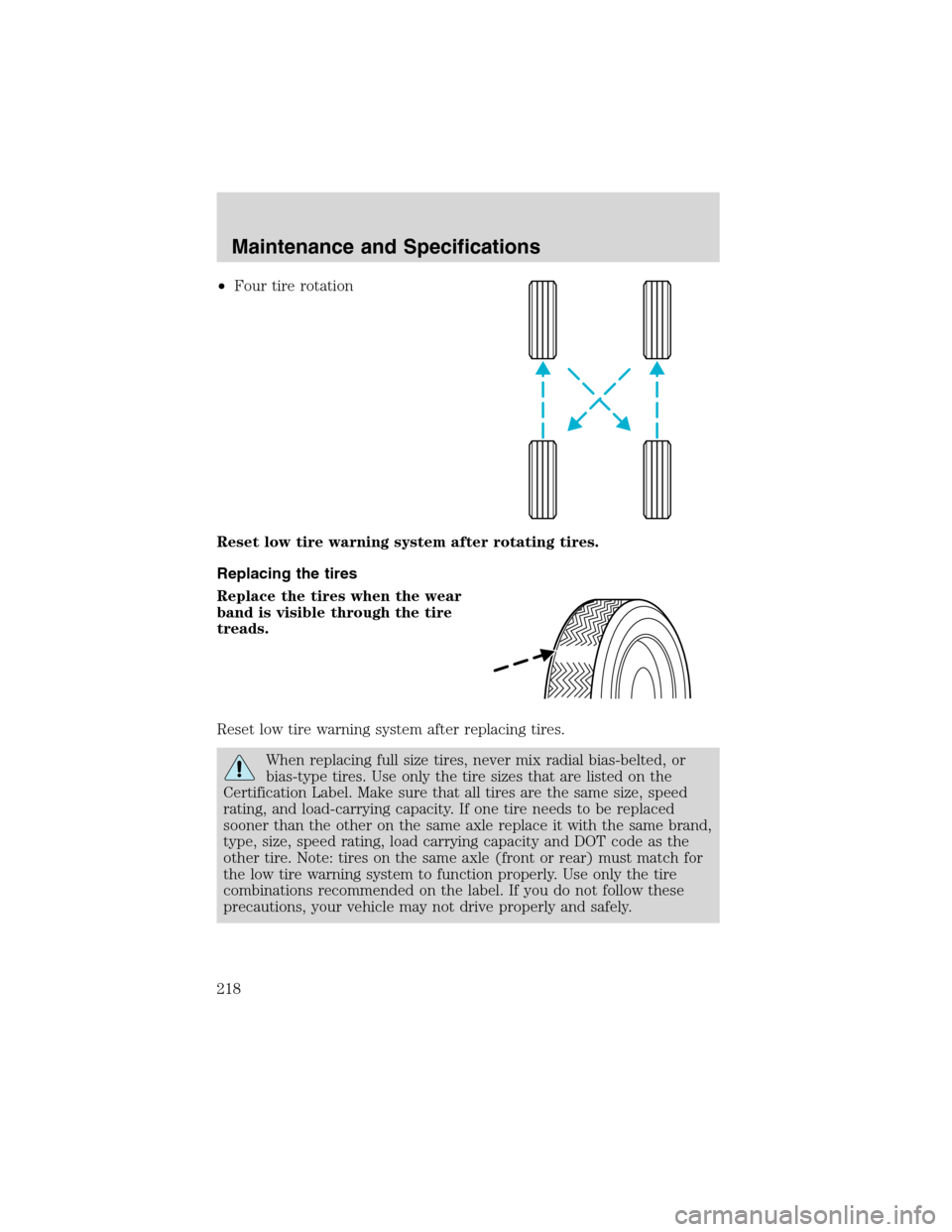
•Four tire rotation
Reset low tire warning system after rotating tires.
Replacing the tires
Replace the tires when the wear
band is visible through the tire
treads.
Reset low tire warning system after replacing tires.
When replacing full size tires, never mix radial bias-belted, or
bias-type tires. Use only the tire sizes that are listed on the
Certification Label. Make sure that all tires are the same size, speed
rating, and load-carrying capacity. If one tire needs to be replaced
sooner than the other on the same axle replace it with the same brand,
type, size, speed rating, load carrying capacity and DOT code as the
other tire. Note: tires on the same axle (front or rear) must match for
the low tire warning system to function properly. Use only the tire
combinations recommended on the label. If you do not follow these
precautions, your vehicle may not drive properly and safely.
Maintenance and Specifications
218