Page 204 of 240
be void for any damage to the fuel tank or fuel system if the
correct genuine Ford or Motorcraft fuel filler cap is not used.
The fuel system may be under pressure. If the fuel filler cap is
venting vapor or if you hear a hissing sound, wait until it stops
before completely removing the fuel filler cap. Otherwise, fuel may
spray out and injure you or others.
If you do not use the proper fuel filler cap, excessive pressure or
vacuum in the fuel tank may damage the fuel system or cause
the fuel cap to disengage in a collision, which may result in possible
personal injury.
Choosing the right fuel
Use only UNLEADED FUEL. The use of leaded fuel is prohibited by law
and could damage your vehicle.
Do not use fuel containing methanol. It can damage critical fuel system
components.
Your vehicle was not designed to use fuel or fuel additives with metallic
compounds, including manganese-based compounds containing MMT.
Repairs to correct the effects of using a fuel for which your vehicle was
not designed may not be covered by your warranty.
Octane recommendations
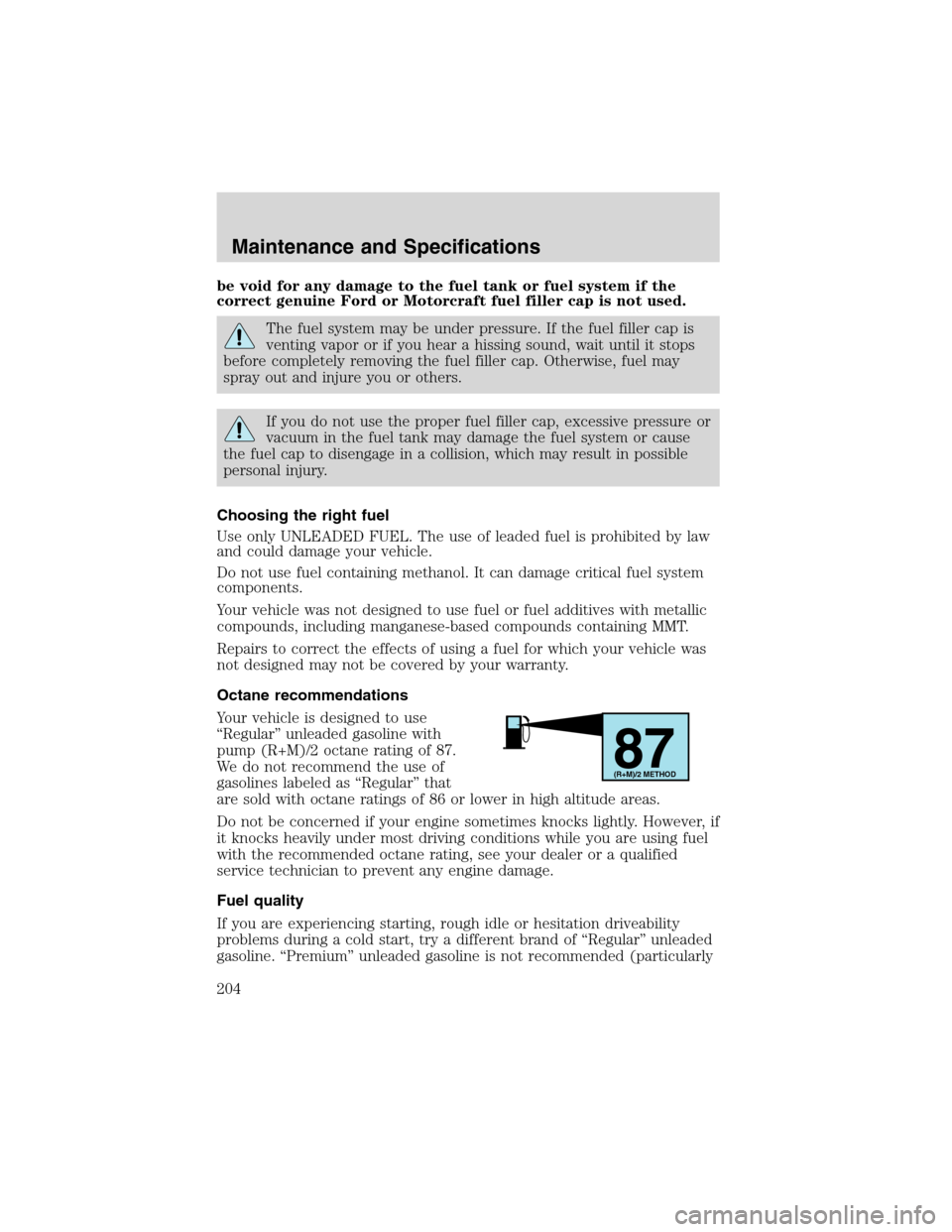
Your vehicle is designed to use
“Regular”unleaded gasoline with
pump (R+M)/2 octane rating of 87.
We do not recommend the use of
gasolines labeled as“Regular”that
are sold with octane ratings of 86 or lower in high altitude areas.
Do not be concerned if your engine sometimes knocks lightly. However, if
it knocks heavily under most driving conditions while you are using fuel
with the recommended octane rating, see your dealer or a qualified
service technician to prevent any engine damage.
Fuel quality
If you are experiencing starting, rough idle or hesitation driveability
problems during a cold start, try a different brand of“Regular”unleaded
gasoline.“Premium”unleaded gasoline is not recommended (particularly
87(R+M)/2 METHOD
Maintenance and Specifications
204
Page 208 of 240
•Revving the engine before turning it off may reduce fuel economy.
•Using the air conditioner or defroster may reduce fuel economy.
•You may want to turn off the speed control in hilly terrain if
unnecessary shifting between third and fourth gear occurs.
Unnecessary shifting of this type could result in reduced fuel
economy.
•Warming up a vehicle on cold mornings is not required and may
reduce fuel economy.
•Resting your foot on the brake pedal while driving may reduce fuel
economy.
•Combine errands and minimize stop-and-go driving.
Maintenance
•Keep tires properly inflated and use only recommended size.
•Operating a vehicle with the wheels out of alignment will reduce fuel
economy.
•Use recommended engine oil. Refer toLubricant specificationsin
this chapter.
•Perform all regularly scheduled maintenance items. Follow the
recommended maintenance schedule and owner maintenance checks
found in your vehicle scheduled maintenance guide.
Conditions
•Heavily loading a vehicle or towing a trailer may reduce fuel economy
at any speed.
•Carrying unnecessary weight may reduce fuel economy (approximately
0.4 km/L [1 mpg] is lost for every 180 kg [400 lb] of weight carried).
•Adding certain accessories to your vehicle (for example bug
deflectors, rollbars/light bars, running boards, ski/luggage racks) may
reduce fuel economy.
•Using fuel blended with alcohol may lower fuel economy.
•Fuel economy may decrease with lower temperatures during the first
12–16 km (8–10 miles) of driving.
•Driving on flat terrain offers improved fuel economy as compared to
driving on hilly terrain.
•Transmissions give their best fuel economy when operated in the top
cruise gear and with steady pressure on the gas pedal.
Maintenance and Specifications
208
Page 210 of 240
Exhaust leaks may result in entry of harmful and potentially
lethal fumes into the passenger compartment.
Do not make any unauthorized changes to your vehicle or engine. By
law, vehicle owners and anyone who manufactures, repairs, services,
sells, leases, trades vehicles, or supervises a fleet of vehicles are not
permitted to intentionally remove an emission control device or prevent
it from working. Information about your vehicle’s emission system is on
the Vehicle Emission Control Information Decal located on or near the
engine. This decal identifies engine displacement and gives some tune up
specifications.
Please consult yourWarranty Guidefor complete emission warranty
information.
Readiness for Inspection/Maintenance (I/M) testing
In some localities, it may be a legal requirement to pass an I/M test of
the on-board diagnostics system. If your“Check Engine/Service Engine
Soon”light is on, refer to the description in theWarning lights and
chimessection of theInstrument clusterchapter. Your vehicle may not
pass the I/M test with the“Check Engine/Service Engine Soon”light on.
If the vehicle’s powertrain system or its battery has just been serviced,
the on-board diagnostics system is reset to a“not ready for I/M test”
condition. To ready the on-board diagnostics system for I/M testing, a
minimum of 30 minutes of city and highway driving is necessary as
described below:
•First, at least 10 minutes of driving on an expressway or highway.
•Next, at least 20 minutes driving in stop-and-go, city-type traffic with
at least four idle periods.
Allow the vehicle to sit for at least eight hours without starting the
engine. Then, start the engine and complete the above driving cycle. The
engine must warm up to its normal operating temperature. Once started,
do not turn off the engine until the above driving cycle is complete.
Maintenance and Specifications
210
Page 232 of 240
F
Floor mats ...................................57
Fluid capacities .........................220
Fuel ............................................201
calculating fuel economy .......206
cap ...........................................203
capacity ...................................220
choosing the right fuel ...........204
comparisons with EPA fuel
economy estimates .................209
detergent in fuel .....................205
filling your vehicle
with fuel ..................201, 203, 206
filter, specifications ........205, 220
fuel pump shut-off switch .....151
improving fuel economy ........206
octane rating ...................204, 224
quality ......................................204
running out of fuel .................205
safety information relating to
automotive fuels .....................201
Fuses ..................................152–153
G
Garage door opener ..............46, 58
Gas cap (see Fuel cap) ............203
Gas mileage
(see Fuel economy) .................206
Gauges .........................................13
GAWR (Gross Axle Weight
Rating) .......................................144
calculating ...............................145
definition .................................144
driving with a heavy load ......144
location ....................................144
GVWR (Gross Vehicle Weight
Rating) .......................................144
calculating .......................144–145definition .................................144
driving with a heavy load ......144
location ....................................144
H
Head restraints .....................87, 90
Headlamps ...................................35
aiming ........................................37
autolamp system .......................35
bulb specifications ....................40
daytime running lights .............35
flash to pass ..............................36
high beam .................................36
replacing bulbs .........................40
turning on and off ....................35
Heating
heating and air
conditioning system .....30–31, 33
HomeLink universal
transceiver (see Garage
door opener) .........................58, 61
Hood ..........................................189
I
Ignition ...............................131, 224
Infant seats
(see Safety seats) .....................121
Inspection/maintenance (I/M)
testing ........................................210
Instrument panel
cleaning ...................................185
cluster ........................................10
lighting up panel and
interior .......................................36
J
Jump-starting your vehicle ......167
Index
232
Page:
< prev 1-8 9-16 17-24