2003 FORD SUPER DUTY relay
[x] Cancel search: relayPage 2 of 256
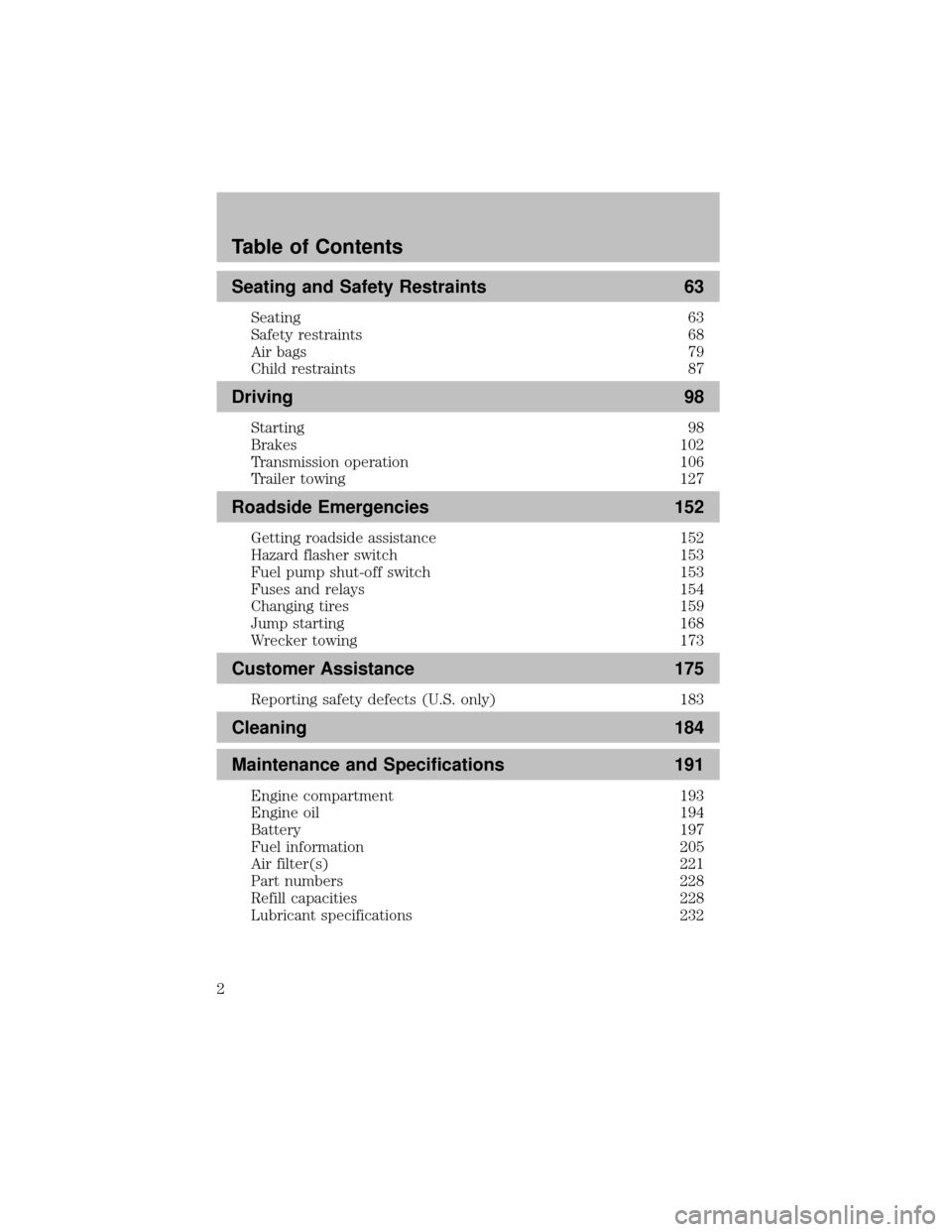
Seating and Safety Restraints 63
Seating 63
Safetyrestraints 68
Air bags 79
Child restraints 87
Driving 98
Starting 98
Brakes 102
Transmission operation 106
Trailer towing 127
Roadside Emergencies 152
Getting roadside assistance 152
Hazard flasher switch 153
Fuel pump shut-off switch 153
Fuses and relays 154
Changing tires 159
Jump starting 168
Wrecker towing 173
Customer Assistance 175
Reporting safetydefects (U.S. only) 183
Cleaning 184
Maintenance and Specifications 191
Engine compartment 193
Engine oil 194
Battery197
Fuel information 205
Air filter(s) 221
Part numbers 228
Refill capacities 228
Lubricant specifications 232
Table of Contents
2
Page 106 of 256
Vehicles with a higher center of gravitysuch as utilityand
four-wheel drive vehicles handle differentlythan vehicles with a
lower center of gravity. Utility and four-wheel drive vehicles arenot
designed for cornering at speeds as high as passenger cars anymore
than low-slung sports cars are designed to perform satisfactorilyunder
off-road conditions. Avoid sharp turns, excessive speed and abrupt
maneuvers in these vehicles. Failure to drive cautiouslycould result in
an increased risk of loss of vehicle control, vehicle rollover, personal
injuryand death.
Loaded vehicles, with a higher center of gravity, may handle
differentlythan unloaded vehicles. Extra precautions, such as
slower speeds and increased stopping distance, should be taken when
driving a heavilyloaded vehicle.
AUTOMATIC TRANSMISSION OPERATION (IF EQUIPPED)
Brake-shift interlock
This vehicle is equipped with a brake-shift interlock feature that prevents
the gearshift lever from being moved from P (Park) when the ignition is
in the ON position unless brake pedal is depressed.
If you cannot move the gearshift lever out of P (Park) with ignition in
the ON position and the brake pedal depressed:
1. Applythe parking brake, turn ignition keyto LOCK, then remove the
key.
2. Insert the keyand turn it to OFF.Apply the brake pedal and shift
to N (Neutral).
In the ignition OFF position, the automatic transmission shift
lever can be moved from the P (Park) position without the brake
pedal depressed. To avoid unwanted vehicle movement, always set the
parking brake.
3. Start the vehicle.
If it is necessaryto use the above procedure to move the gearshift lever,
it is possible that a fuse has blown or the vehicle’s brakelamps are not
operating properly. Refer toFuses and relaysin theRoadside
emergencieschapter.
Driving
106
Page 154 of 256

This switch is located in the front
passenger’s footwell, bythe kick
panel access cover.
To reset the switch:
1. Turn the ignition OFF.
2. Check the fuel system for leaks.
3. If no leaks are apparent, reset the
switch bypushing in on the reset
button.
4. Turn the ignition ON.
5. Wait a few seconds and return
the keyto OFF.
6. Make another check of leaks.
FUSES AND RELAYS
Fuses
If electrical components in the
vehicle are not working, a fuse may
have blown. Blown fuses are
identified bya broken wire within
the fuse. Check the appropriate
fuses before replacing anyelectrical
components.
Note:Always replace a fuse with one that has the specified amperage
rating. Using a fuse with a higher amperage rating can cause severe wire
damage and could start a fire.
15
Roadside Emergencies
154
Page 156 of 256
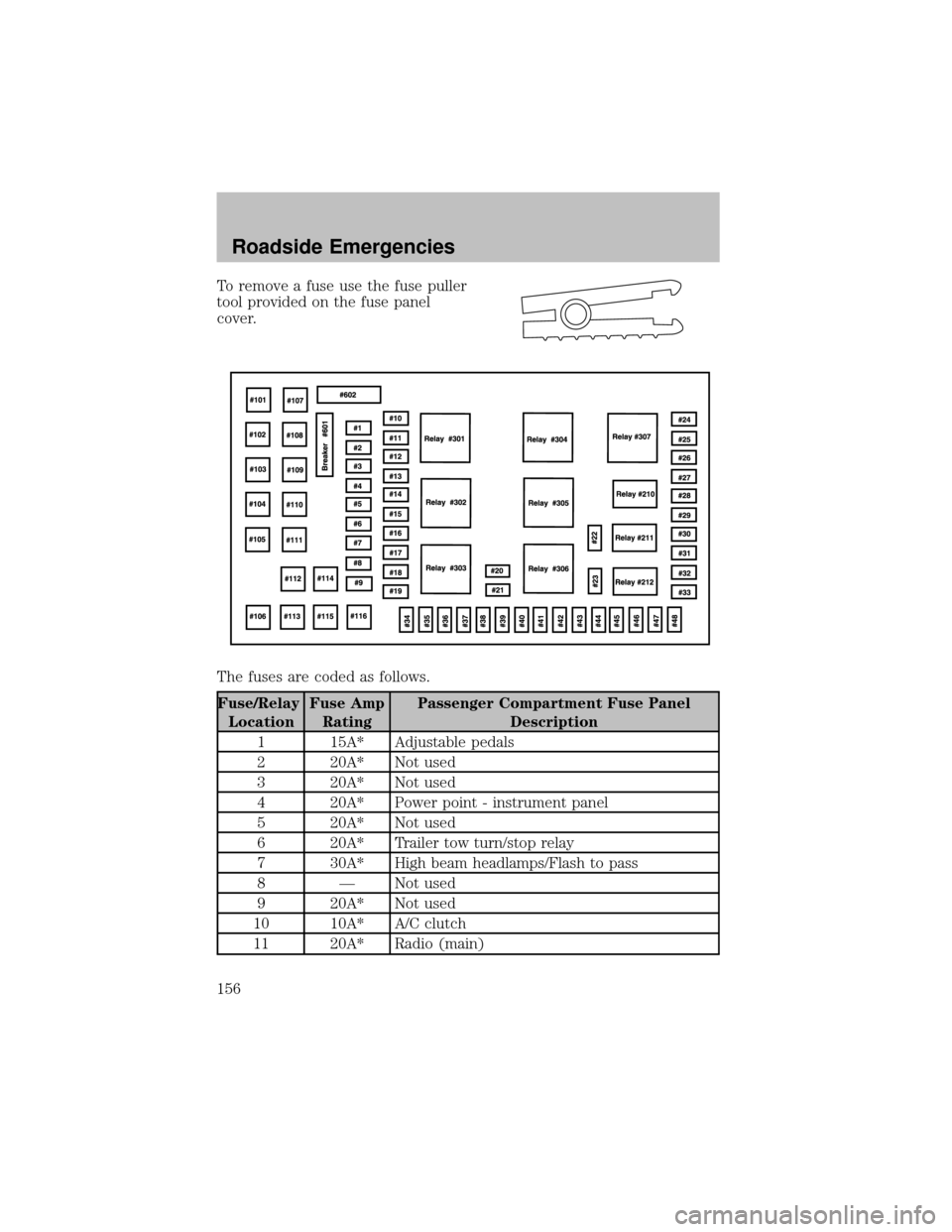
To remove a fuse use the fuse puller
tool provided on the fuse panel
cover.
The fuses are coded as follows.
Fuse/Relay
LocationFuse Amp
RatingPassenger Compartment Fuse Panel
Description
1 15A* Adjustable pedals
2 20A* Not used
3 20A* Not used
4 20A* Power point - instrument panel
5 20A* Not used
6 20A* Trailer tow turn/stop relay
7 30A* High beam headlamps/Flash to pass
8 — Not used
9 20A* Not used
10 10A* A/C clutch
11 20A* Radio (main)
Roadside Emergencies
156
Page 157 of 256
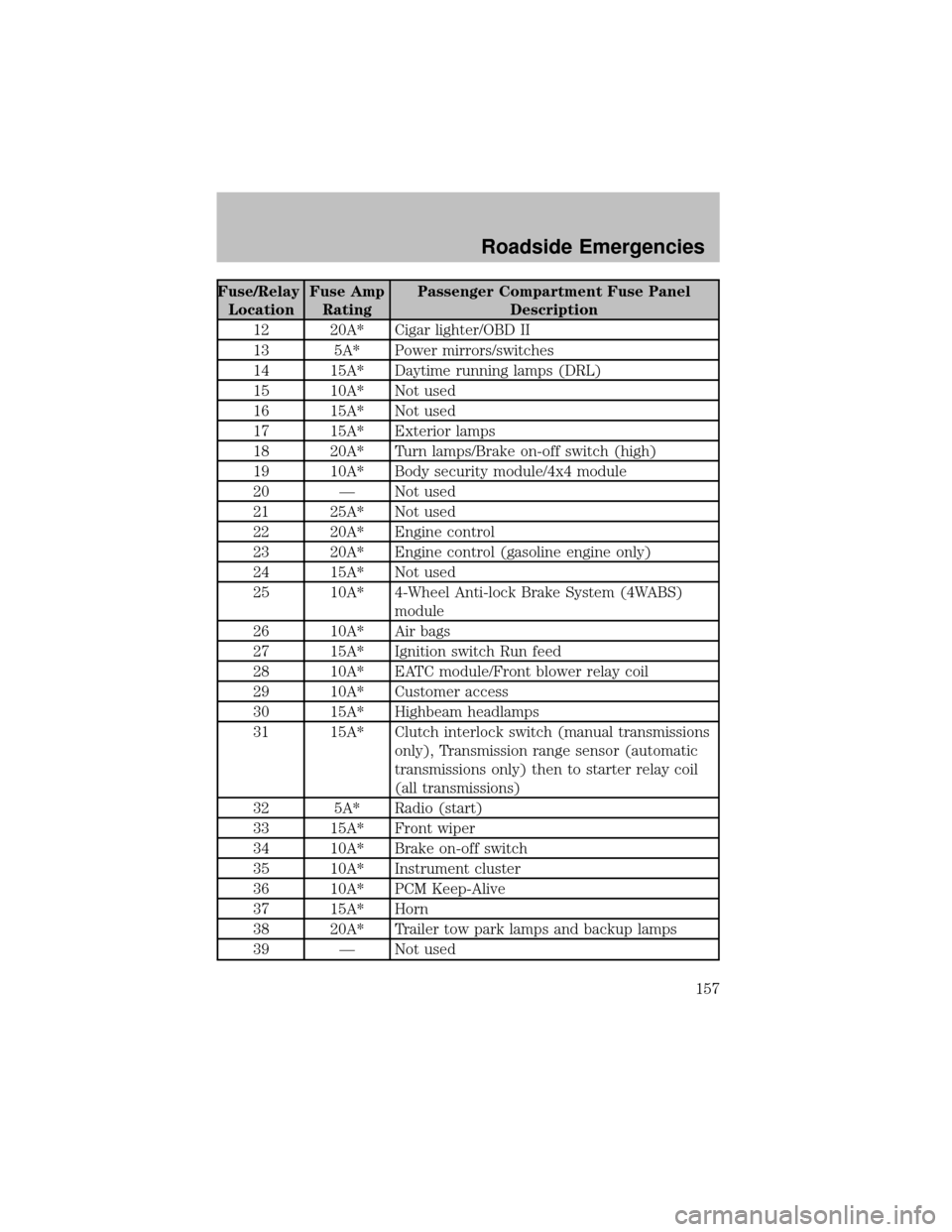
Fuse/Relay
LocationFuse Amp
RatingPassenger Compartment Fuse Panel
Description
12 20A* Cigar lighter/OBD II
13 5A* Power mirrors/switches
14 15A* Daytime running lamps (DRL)
15 10A* Not used
16 15A* Not used
17 15A* Exterior lamps
18 20A* Turn lamps/Brake on-off switch (high)
19 10A* Bodysecuritymodule/4x4 module
20 — Not used
21 25A* Not used
22 20A* Engine control
23 20A* Engine control (gasoline engine only)
24 15A* Not used
25 10A* 4-Wheel Anti-lock Brake System (4WABS)
module
26 10A* Air bags
27 15A* Ignition switch Run feed
28 10A* EATC module/Front blower relaycoil
29 10A* Customer access
30 15A* Highbeam headlamps
31 15A* Clutch interlock switch (manual transmissions
only), Transmission range sensor (automatic
transmissions only) then to starter relay coil
(all transmissions)
32 5A* Radio (start)
33 15A* Front wiper
34 10A* Brake on-off switch
35 10A* Instrument cluster
36 10A* PCM Keep-Alive
37 15A* Horn
38 20A* Trailer tow park lamps and backup lamps
39 — Not used
Roadside Emergencies
157
Page 158 of 256
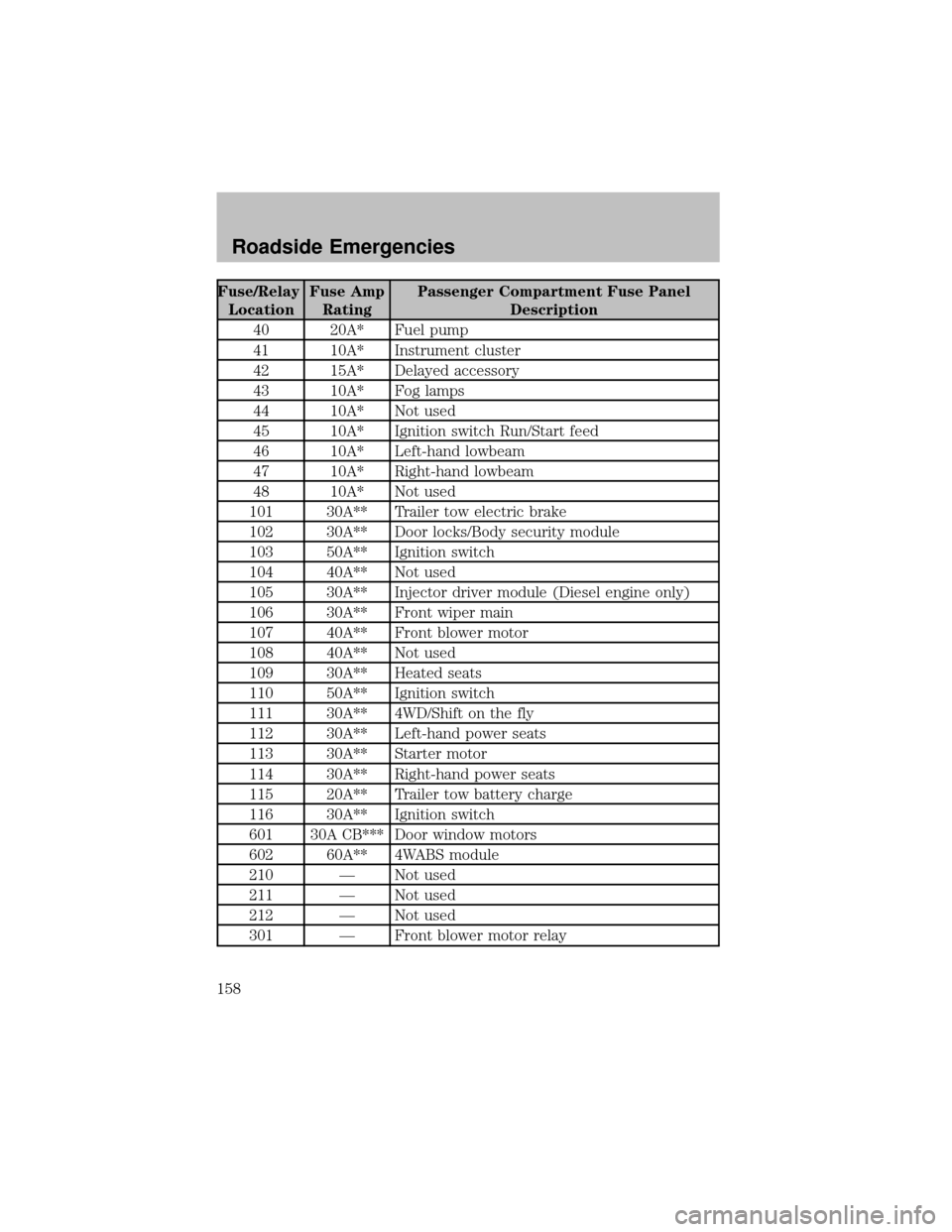
Fuse/Relay
LocationFuse Amp
RatingPassenger Compartment Fuse Panel
Description
40 20A* Fuel pump
41 10A* Instrument cluster
42 15A* Delayed accessory
43 10A* Fog lamps
44 10A* Not used
45 10A* Ignition switch Run/Start feed
46 10A* Left-hand lowbeam
47 10A* Right-hand lowbeam
48 10A* Not used
101 30A** Trailer tow electric brake
102 30A** Door locks/Bodysecuritymodule
103 50A** Ignition switch
104 40A** Not used
105 30A** Injector driver module (Diesel engine only)
106 30A** Front wiper main
107 40A** Front blower motor
108 40A** Not used
109 30A** Heated seats
110 50A** Ignition switch
111 30A** 4WD/Shift on the fly
112 30A** Left-hand power seats
113 30A** Starter motor
114 30A** Right-hand power seats
115 20A** Trailer tow batterycharge
116 30A** Ignition switch
601 30A CB*** Door window motors
602 60A** 4WABS module
210 — Not used
211 — Not used
212 — Not used
301 — Front blower motor relay
Roadside Emergencies
158
Page 159 of 256
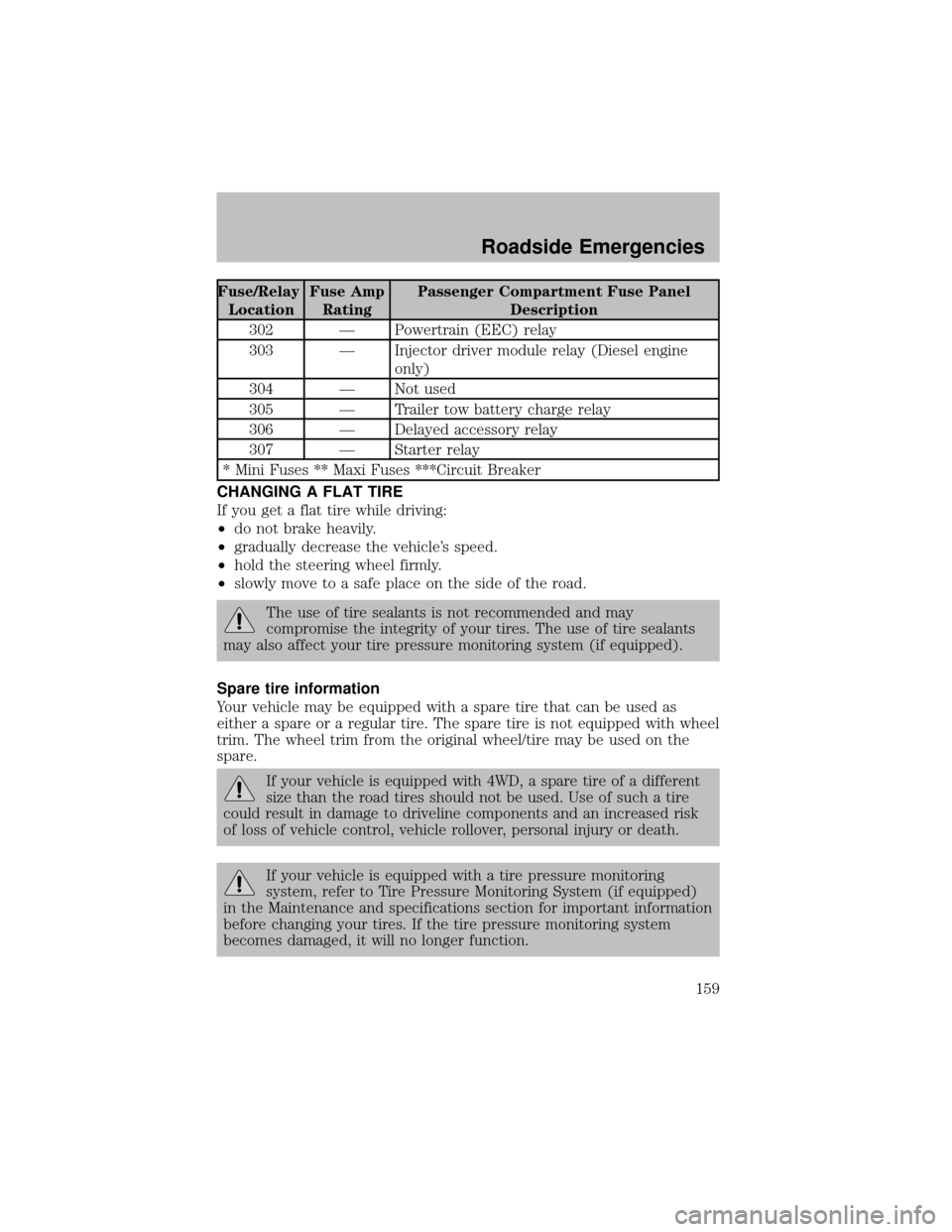
Fuse/Relay
LocationFuse Amp
RatingPassenger Compartment Fuse Panel
Description
302 — Powertrain (EEC) relay
303 — Injector driver module relay(Diesel engine
only)
304 — Not used
305 — Trailer tow batterycharge relay
306 — Delayed accessory relay
307 — Starter relay
* Mini Fuses ** Maxi Fuses ***Circuit Breaker
CHANGING A FLAT TIRE
If you get a flat tire while driving:
•do not brake heavily.
•graduallydecrease the vehicle’s speed.
•hold the steering wheel firmly.
•slowlymove to a safe place on the side of the road.
The use of tire sealants is not recommended and may
compromise the integrityof your tires. The use of tire sealants
may also affect your tire pressure monitoring system (if equipped).
Spare tire information
Your vehicle maybe equipped with a spare tire that can be used as
either a spare or a regular tire. The spare tire is not equipped with wheel
trim. The wheel trim from the original wheel/tire maybe used on the
spare.
If your vehicle is equipped with 4WD, a spare tire of a different
size than the road tires should not be used. Use of such a tire
could result in damage to driveline components and an increased risk
of loss of vehicle control, vehicle rollover, personal injuryor death.
If your vehicle is equipped with a tire pressure monitoring
system, refer to Tire Pressure Monitoring System (if equipped)
in the Maintenance and specifications section for important information
before changing your tires. If the tire pressure monitoring system
becomes damaged, it will no longer function.
Roadside Emergencies
159
Page 253 of 256

fluid, refill capacity................228
fluid, specifications .........232, 235
Power Windows ...........................47
Preparing to drive your
vehicle ........................................105
R
Radio ..........................17–18, 21, 25
Relays ........................................154
Remote entrysystem .................58
illuminated entry......................60
locking/unlocking doors ...........56
Reverse sensing system ...........111
Roadside assistance ..................152
S
Safetybelts (see Safety
restraints) ........................68–71, 73
Safetydefects, reporting ..........183
Safetyrestraints ....................68–73
belt minder ...............................74
cleaning the safetybelts ..........78
extension assembly..................78
for adults .............................69–71
for children .........................87–88
warning light and chime ..........74
Safetyseats for children ............90
Seat belts (see Safety
restraints) ....................................68
Seats ............................................63
child safetyseats ......................90
cleaning ...................................188
Servicing your vehicle ..............191
Snowplowing .................6, 148–150Spare tire
(see Changing the Tire) ...........159
Spark plugs,
specifications .....................228, 235
Special notice ................................7
ambulance conversions ..............6
diesel-powered vehicles .............6
four-wheel drive vehicles .......151
utility-type vehicles ....................6
Specification chart,
lubricants ...........................232, 235
Speed control ..............................48
Starting your vehicle ....98–99, 101
jump starting ..........................168
Steering wheel
tilting .........................................45
T
Tailgate ........................................55
Tires ...................................221–223
changing ..........................159, 161
checking the pressure ............223
replacing ..................................226
rotating ....................................224
snow tires and chains ............227
tire grades ...............................222
treadwear ................................222
Towing .......................................127
trailer towing ..........................127
wrecker ....................................173
Traction-lok rear axle ...............105
Transfer case
fluid checking .........................220
Transmission
automatic operation ...............106
fluid, checking and adding
(automatic) .............................216
Index
253