Page 23 of 64
SCHEDULED MAINTENANCE
The scheduled maintenance services in theScheduled maintenance
guidesection are required because they are considered essential to the
life and performance of your vehicle.
Use only recommended fuel, lubricants, fluids and service parts
conforming to Ford specifications. Motorcraft parts are designed and
built for best performance in your vehicle.
CLEANING THE ENGINE
Engines are more efficient when they are clean because grease and dirt
buildup keep the engine warmer than normal. When washing:
•The engine must be cool to the touch before spraying with water.
•Never spray a hot engine with cold water, as damage to the
engine block or engine components may occur.
•Use caution when using a self-serve power washer (1,000 psi
maximum pressure) to clean the engine, as the high-pressure fluid
could penetrate the sealed parts and cause damage.
•Never apply anything to any exposed belts in the engine
compartment, including the belt dressing.
For general cleaning of the engine and engine compartment, spray
Engine Shampoo (ZC-20) on all parts that require cleaning and pressure
rinse the area with cool water.
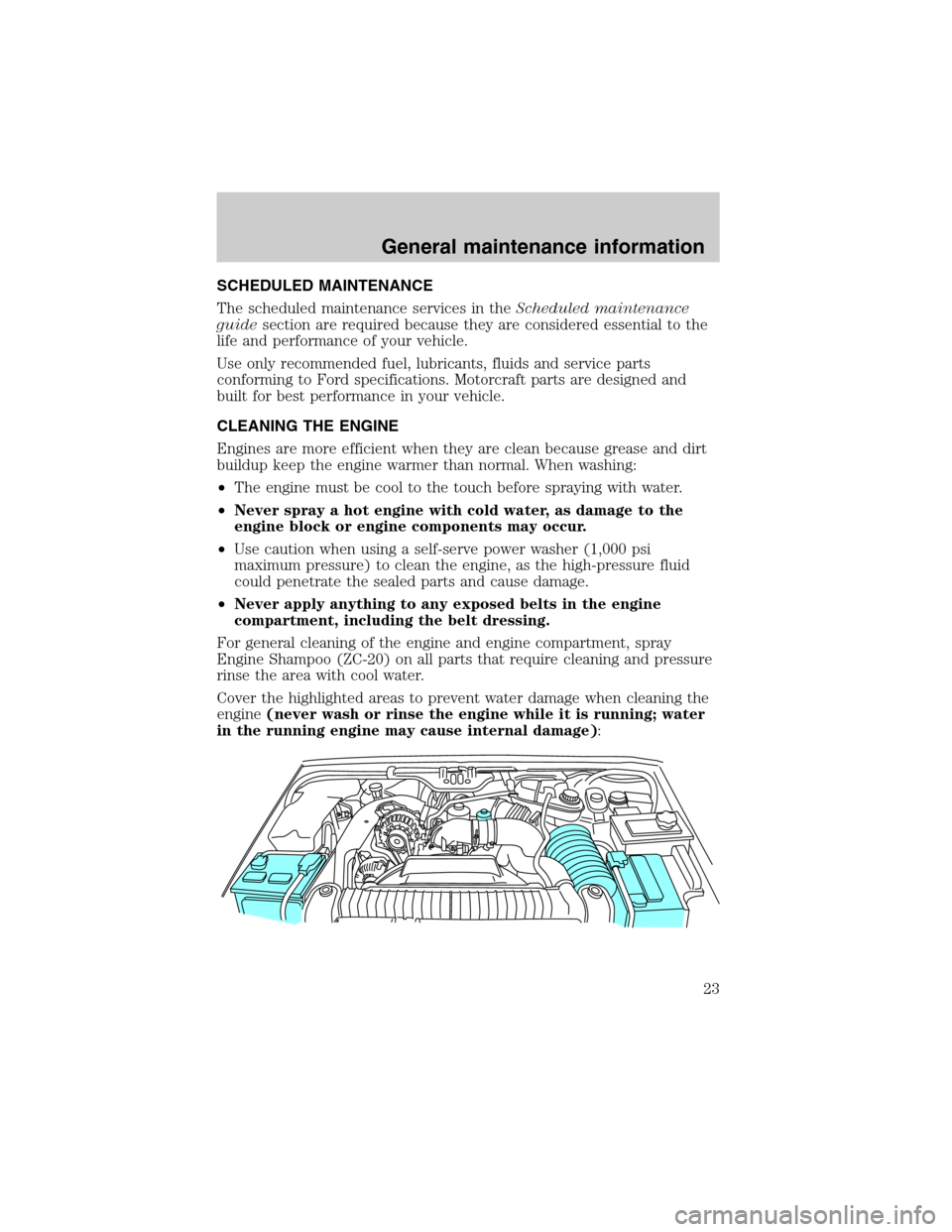
Cover the highlighted areas to prevent water damage when cleaning the
engine(never wash or rinse the engine while it is running; water
in the running engine may cause internal damage):
General maintenance information
23
Page 32 of 64
When the engine is cold, check the level of the engine coolant in the
reservoir.
•The engine coolant should be at the“cold fill level”or within the“cold
fill range”as listed on the engine coolant reservoir (depending upon
application).
•Refer to the scheduled maintenance guide for service interval
schedules.
•Be sure to read and understandPrecautions when servicing your
vehiclein your owner guide.
If the engine coolant has not been checked at the recommended interval,
the engine coolant reservoir may become low or empty. If the reservoir is
low or empty, add engine coolant to the reservoir. Refer toAdding
engine coolantin this chapter.
Note:Automotive fluids are not interchangeable; do not use engine
coolant or windshield washer fluid outside of its specified function and
vehicle location.
Vehicles with Diesel engines typically are used to carry heavy loads and
accumulate mileage rapidly. These two factors cause the additives in the
coolant to“wear out”in a shorter time. Replace the engine coolant
initially after five years or 100,000 miles and three years or 50,000 miles
thereafter. Vehicles equipped with the yellow coolant do not require any
additives.
Adding engine coolant
When adding coolant, make sure it is a 50/50 mixture of engine coolant
and distilled water. Add the mixture to the coolant reservoir,when the
engine is cool, until the appropriate fill level is obtained.
Do not add engine coolant when the engine is hot. Steam and
scalding liquids released from a hot cooling system can burn you
badly. Also, you can be burned if you spill coolant on hot engine parts.
Do not put engine coolant in the windshield washer fluid
container. If sprayed on the windshield, engine coolant could
make it difficult to see through the windshield.
General maintenance information
32
Page 49 of 64
Any adverse condition should be brought to the attention of your dealer
or qualified service technician as soon as possible for the proper service
advice. The owner maintenance service checks are generally not covered
by warranties so you may be charged for labor, parts or lubricants used.
Maximum Oil Change Interval:
Normal Schedule: 7,500 miles or 6 months, whichever occurs first.
Special Operating Conditions: 5,000 miles or 6 months, see appropriate
schedule.
Check every month:
•Check function of all interior and exterior lights
•Check tires for wear and proper air pressure
•Check engine oil fluid level
•Check windshield washer solvent fluid level
•Check and drain fuel filter/water separator
Check every six months:
•Check lap/shoulder belts and seat latches for wear and function
•Check air pressure in spare tire
•Check that externally-mounted spare tire is tight (see Owner’s Guide)
•Check power steering fluid level
•Check washer spray, wiper operation and clean all wiper blades
•Check parking brake for proper operation
•Check and lubricate all hinges, latches and outside locks
•Check and lubricate door rubber weatherstrips
•Check and clean body and door drain holes
•Check safety warning lamps (brake, ABS, air bag, safety belt) for
operation
•Check cooling system fluid level and coolant strength
•Check battery connections and clean if necessary
•Check clutch fluid level, if equipped
General Owner’s Information
49