2003 FORD SUPER DUTY check engine
[x] Cancel search: check enginePage 6 of 64
Air filter restriction gauge
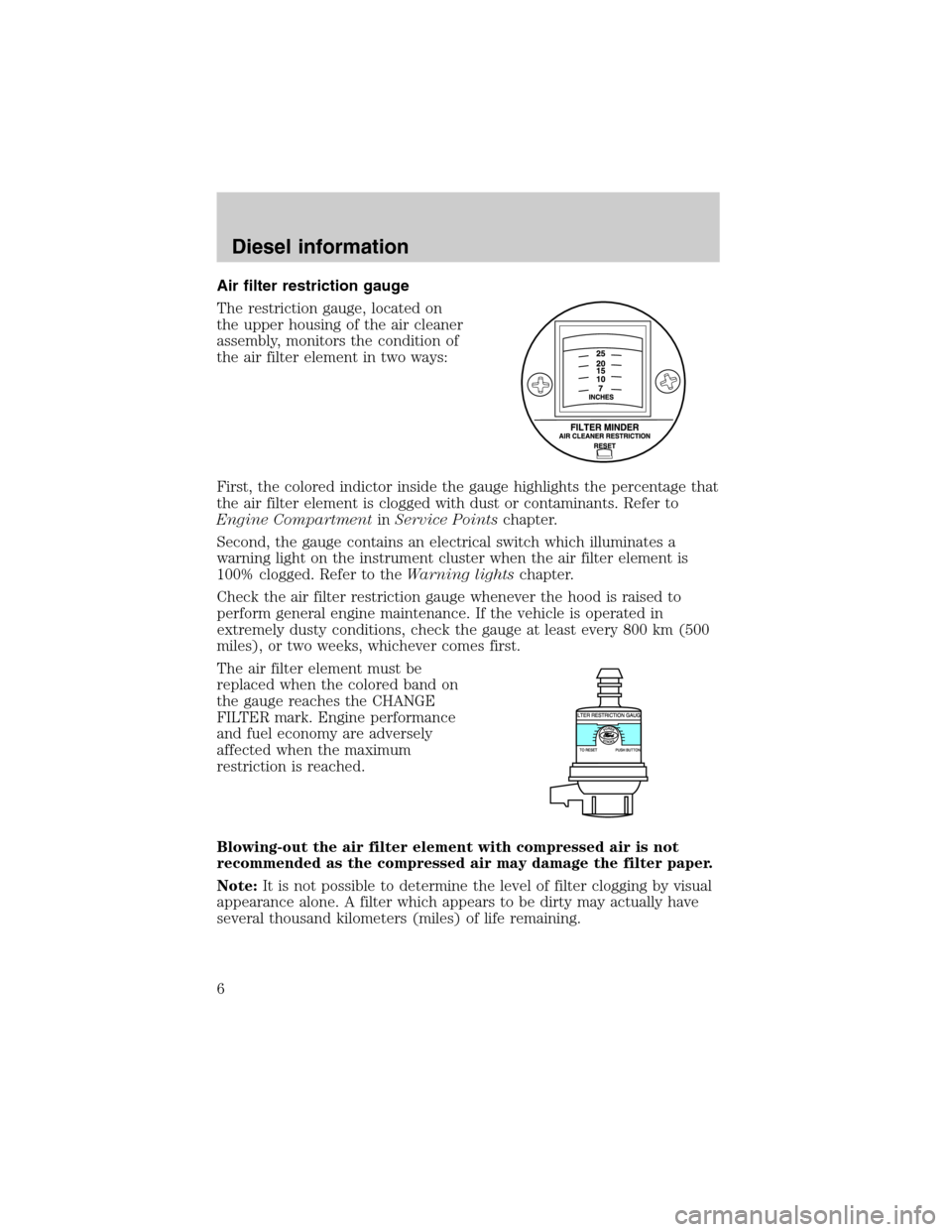
The restriction gauge, located on
the upper housing of the air cleaner
assembly, monitors the condition of
the air filter element in two ways:
First, the colored indictor inside the gauge highlights the percentage that
the air filter element is clogged with dust or contaminants. Refer to
Engine CompartmentinService Pointschapter.
Second, the gauge contains an electrical switch which illuminates a
warning light on the instrument cluster when the air filter element is
100% clogged. Refer to theWarning lightschapter.
Check the air filter restriction gauge whenever the hood is raised to
perform general engine maintenance. If the vehicle is operated in
extremely dusty conditions, check the gauge at least every 800 km (500
miles), or two weeks, whichever comes first.
The air filter element must be
replaced when the colored band on
the gauge reaches the CHANGE
FILTER mark. Engine performance
and fuel economy are adversely
affected when the maximum
restriction is reached.
Blowing-out the air filter element with compressed air is not
recommended as the compressed air may damage the filter paper.
Note:It is not possible to determine the level of filter clogging by visual
appearance alone. A filter which appears to be dirty may actually have
several thousand kilometers (miles) of life remaining.
Diesel information
6
Page 8 of 64
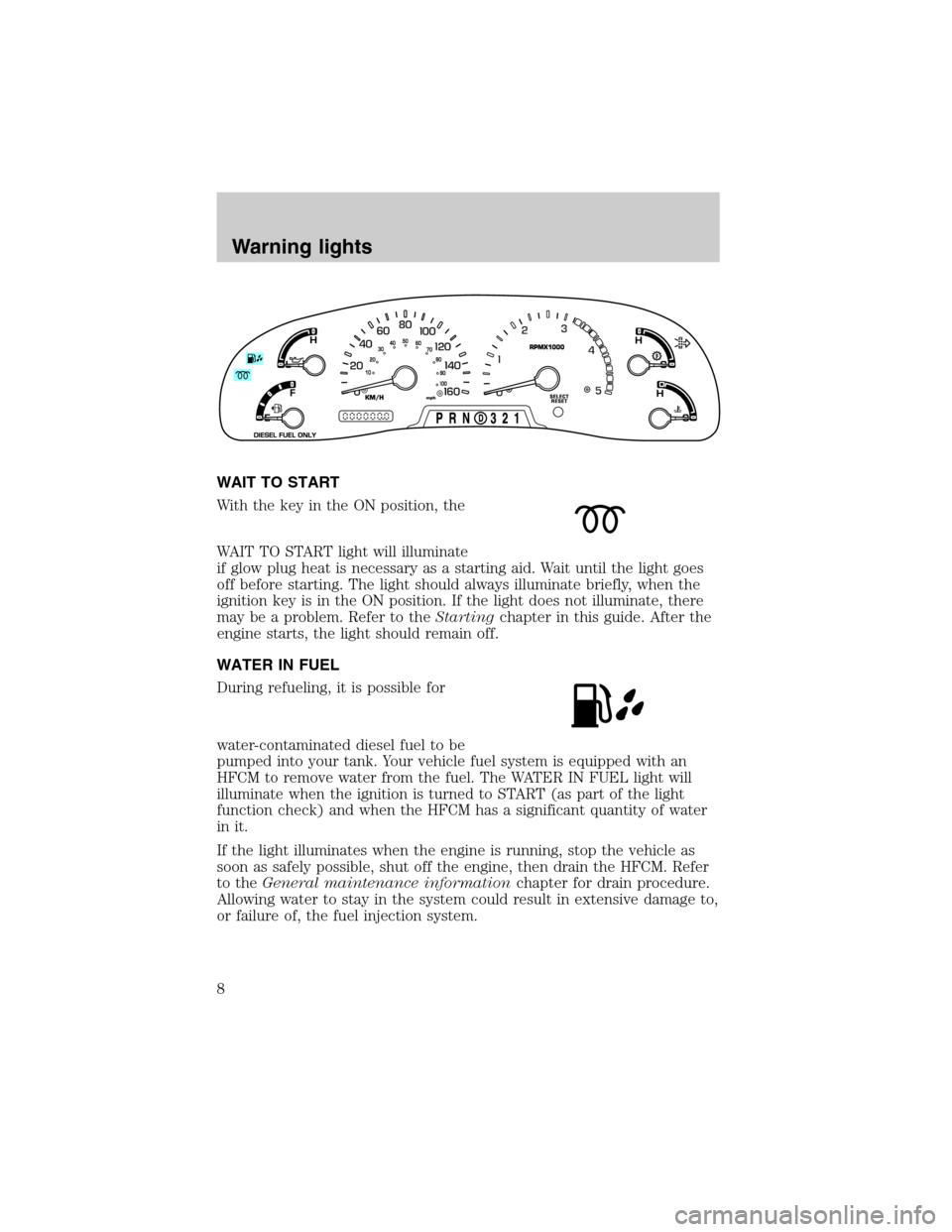
WAIT TO START
With the key in the ON position, the
WAIT TO START light will illuminate
if glow plug heat is necessary as a starting aid. Wait until the light goes
off before starting. The light should always illuminate briefly, when the
ignition key is in the ON position. If the light does not illuminate, there
may be a problem. Refer to theStartingchapter in this guide. After the
engine starts, the light should remain off.
WATER IN FUEL
During refueling, it is possible for
water-contaminated diesel fuel to be
pumped into your tank. Your vehicle fuel system is equipped with an
HFCM to remove water from the fuel. The WATER IN FUEL light will
illuminate when the ignition is turned to START (as part of the light
function check) and when the HFCM has a significant quantity of water
in it.
If the light illuminates when the engine is running, stop the vehicle as
soon as safely possible, shut off the engine, then drain the HFCM. Refer
to theGeneral maintenance informationchapter for drain procedure.
Allowing water to stay in the system could result in extensive damage to,
or failure of, the fuel injection system.
Warning lights
8
Page 26 of 64
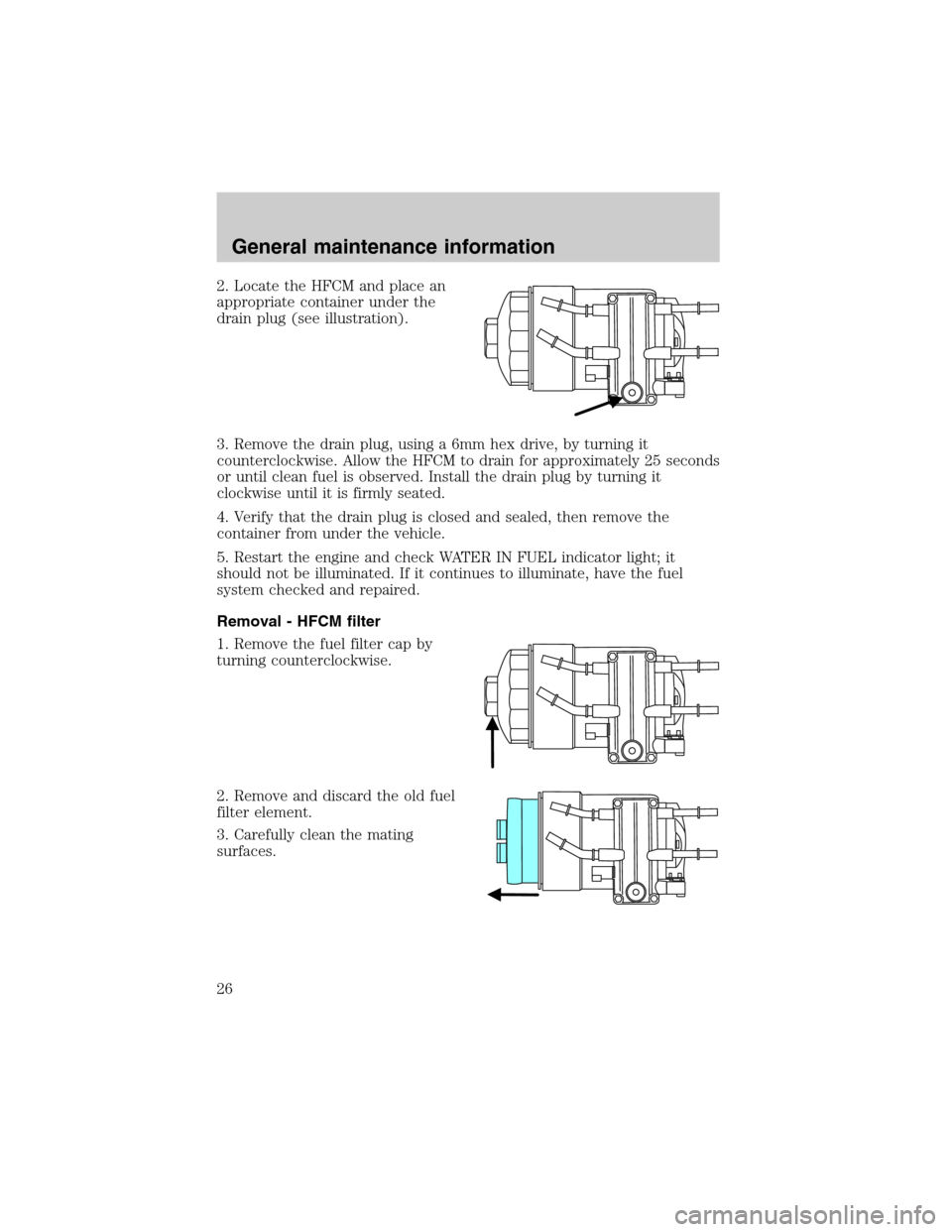
2. Locate the HFCM and place an
appropriate container under the
drain plug (see illustration).
3. Remove the drain plug, using a 6mm hex drive, by turning it
counterclockwise. Allow the HFCM to drain for approximately 25 seconds
or until clean fuel is observed. Install the drain plug by turning it
clockwise until it is firmly seated.
4. Verify that the drain plug is closed and sealed, then remove the
container from under the vehicle.
5. Restart the engine and check WATER IN FUEL indicator light; it
should not be illuminated. If it continues to illuminate, have the fuel
system checked and repaired.
Removal - HFCM filter
1. Remove the fuel filter cap by
turning counterclockwise.
2. Remove and discard the old fuel
filter element.
3. Carefully clean the mating
surfaces.
General maintenance information
26
Page 27 of 64
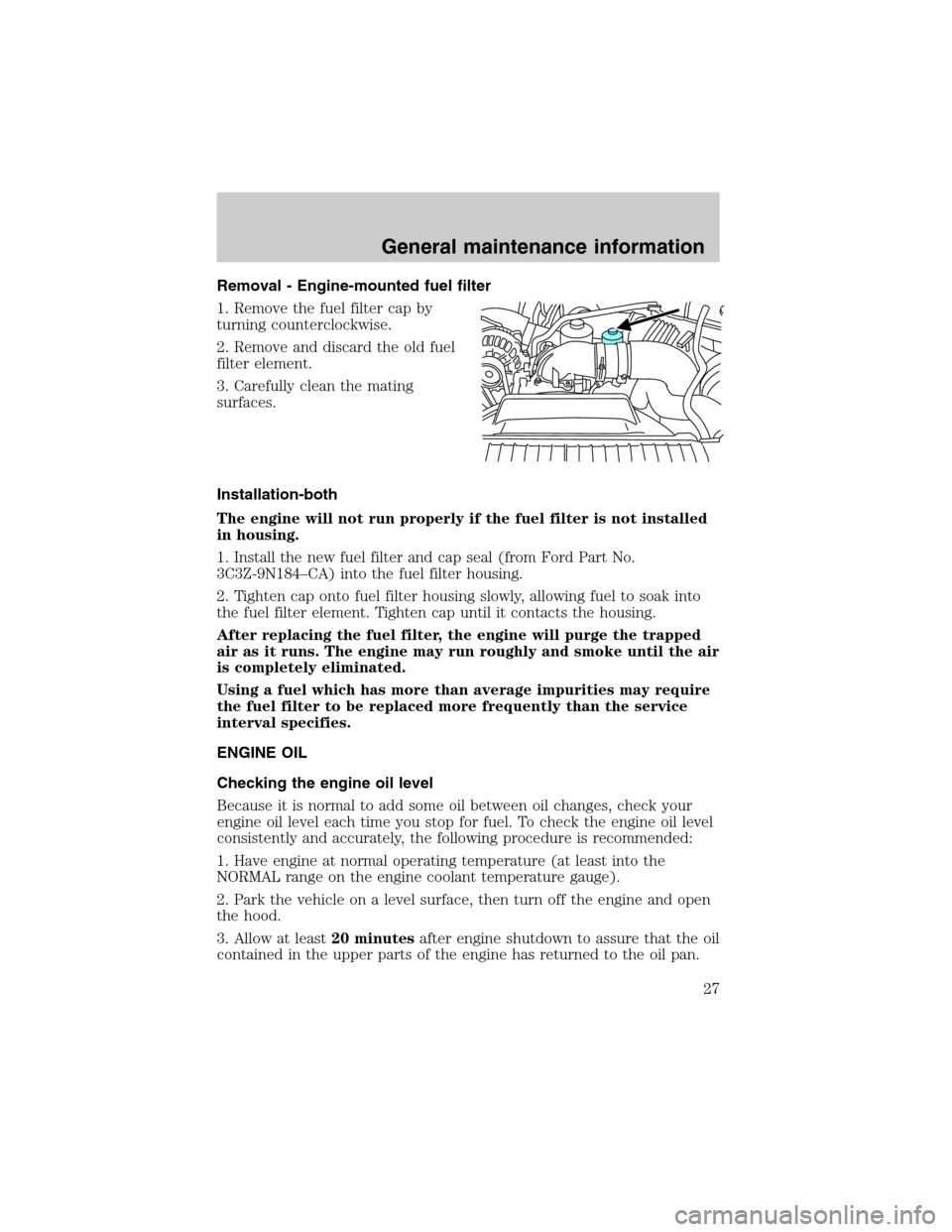
Removal - Engine-mounted fuel filter
1. Remove the fuel filter cap by
turning counterclockwise.
2. Remove and discard the old fuel
filter element.
3. Carefully clean the mating
surfaces.
Installation-both
The engine will not run properly if the fuel filter is not installed
in housing.
1. Install the new fuel filter and cap seal (from Ford Part No.
3C3Z-9N184–CA) into the fuel filter housing.
2. Tighten cap onto fuel filter housing slowly, allowing fuel to soak into
the fuel filter element. Tighten cap until it contacts the housing.
After replacing the fuel filter, the engine will purge the trapped
air as it runs. The engine may run roughly and smoke until the air
is completely eliminated.
Using a fuel which has more than average impurities may require
the fuel filter to be replaced more frequently than the service
interval specifies.
ENGINE OIL
Checking the engine oil level
Because it is normal to add some oil between oil changes, check your
engine oil level each time you stop for fuel. To check the engine oil level
consistently and accurately, the following procedure is recommended:
1. Have engine at normal operating temperature (at least into the
NORMAL range on the engine coolant temperature gauge).
2. Park the vehicle on a level surface, then turn off the engine and open
the hood.
3. Allow at least20 minutesafter engine shutdown to assure that the oil
contained in the upper parts of the engine has returned to the oil pan.
General maintenance information
27
Page 31 of 64
REPLACING THE AIR FILTER ELEMENT
When replacing the air filter element, use the Motorcraft air filter
element listed. Refer toLubricant and maintenance materials
specificationsin this supplement.
Failure to use the correct air filter element may result in severe
engine damage.
1. Remove air filter element from the housing, taking care to prevent dirt
from falling into the engine air intake.
2. Clean the air filter housing and cover to ensure good sealing.
3. Install a new air filter element. Be careful not to crimp the filter edges
between the air filter housing and cover. This could cause damage to the
air filter element and possible severe damage to the engine.
When servicing the air filter, always be sure that the auxiliary
hose is not kinked or obstructed. Failure to do so may result in
severe engine damage when driving through deep water and/or
encountering unusually heavy precipitation conditions.
ENGINE COOLANT
Checking engine coolant
The concentration and level of engine coolant should be checked at the
mileage intervals listed in the scheduled maintenance guide. The coolant
concentration should be maintained at 50/50 coolant and water, which
equates to a freeze point of -36°C (-34°F). Coolant concentration
testing is possible with a hydrometer or antifreeze tester (such as the
Rotunda Battery and Antifreeze Tester, 014–R1060). The level of coolant
should be maintained at the“cold full”of“cold fill range”level in the
coolant reservoir. If the level falls below, add coolant per the instructions
in theAdding engine coolantsection.
Your vehicle was factory-filled with a 50/50 engine coolant and water
concentration. If the concentration of coolant falls below 40% or above
60%, the engine parts could become damaged or not work properly.A
50/50 mixture of coolant and water provides the following:
•freeze protection down to -36°C (-34°F).
•boiling protection up to 129°C (265°F).
•protection against rust and other forms of corrosion.
•enables calibrated gauges to work properly.
General maintenance information
31
Page 32 of 64
When the engine is cold, check the level of the engine coolant in the
reservoir.
•The engine coolant should be at the“cold fill level”or within the“cold
fill range”as listed on the engine coolant reservoir (depending upon
application).
•Refer to the scheduled maintenance guide for service interval
schedules.
•Be sure to read and understandPrecautions when servicing your
vehiclein your owner guide.
If the engine coolant has not been checked at the recommended interval,
the engine coolant reservoir may become low or empty. If the reservoir is
low or empty, add engine coolant to the reservoir. Refer toAdding
engine coolantin this chapter.
Note:Automotive fluids are not interchangeable; do not use engine
coolant or windshield washer fluid outside of its specified function and
vehicle location.
Vehicles with Diesel engines typically are used to carry heavy loads and
accumulate mileage rapidly. These two factors cause the additives in the
coolant to“wear out”in a shorter time. Replace the engine coolant
initially after five years or 100,000 miles and three years or 50,000 miles
thereafter. Vehicles equipped with the yellow coolant do not require any
additives.
Adding engine coolant
When adding coolant, make sure it is a 50/50 mixture of engine coolant
and distilled water. Add the mixture to the coolant reservoir,when the
engine is cool, until the appropriate fill level is obtained.
Do not add engine coolant when the engine is hot. Steam and
scalding liquids released from a hot cooling system can burn you
badly. Also, you can be burned if you spill coolant on hot engine parts.
Do not put engine coolant in the windshield washer fluid
container. If sprayed on the windshield, engine coolant could
make it difficult to see through the windshield.
General maintenance information
32
Page 34 of 64
To reduce the risk of personal injury, make sure the engine is
cool before unscrewing the coolant pressure relief cap. The
cooling system is under pressure; steam and hot liquid can come out
forcefully when the cap is loosened slightly.
1. Before you begin, turn the engine off and let it cool.
2. When the engine is cool, wrap a thick cloth around the coolant
pressure relief cap on the coolant reservoir (an semi-clear plastic bottle).
Slowly turn cap counterclockwise (left) until pressure begins to release.
3. Step back while the pressure releases.
4. When you are sure that all the pressure has been released, use the
cloth to turn it counterclockwise and remove the cap.
5. Fill the coolant reservoir slowly with the proper coolant mixture (see
above), to within the“cold fill range”or the“cold full”level on the
reservoir. If you removed the radiator cap in an overflow system, fill the
radiator until the coolant is visible and radiator is almost full.
6. Replace the cap. Turn until tightly installed. (Cap must be tightly
installed to prevent coolant loss.)
After any coolant has been added, check the coolant concentration see
Checking engine coolantsection). If the concentration is not 50/50
(protection to–34°F/–36°C), drain some coolant and adjust the
concentration. It may take several drains and additions to obtain a 50/50
coolant concentration.
Whenever coolant has been added, the coolant level in the coolant
reservoir should be checked the next few times you drive the vehicle. If
necessary, add enough 50/50 concentration of engine coolant and
distilled water to bring the liquid level to the proper level.
If you have to add more than 1.0 liter (1.0 quart) of engine coolant per
month, have your dealer check the engine cooling system. Your cooling
system may have a leak. Operating an engine with a low level of coolant
can result in engine overheating and possible engine damage.
General maintenance information
34
Page 39 of 64
The complexity of the Diesel engine makes it so the owner is
discouraged from attempting to perform maintenance other than the
services described in this supplement.
If you experience difficult starting, rough idling, excessive exhaust
smoke, a decrease in engine performance or excess fuel consumption,
perform the following checks:
•a plugged air inlet system or engine air filter element.
•water in the fuel filter/water separator.
•a clogged fuel filter.
•contaminated fuel.
•air in the fuel system, due to loose connections.
•an open or pinched sensor hose.
•low engine oil level.
•wrong fuel or oil viscosity for climactic conditions.
If these checks do not help you correct the engine performance problem
you are experiencing, consult an authorized dealer.
FUELING
Do not use starting fluid such as ether or gasoline in the Diesel
air intake system. Such fluids can cause immediate explosive
damage to the engine and possible personal injury.
If you fuel your vehicle at a truck stop, you may notice that the fuel
nozzle may shut off every 5–10 seconds. This is due to the flow rates
being designed for larger heavy duty trucks. You may have to fuel at a
slower rate (don’t depress the nozzle trigger fully).
Do not run your Diesel vehicle out of fuel as this will allow air to enter
the fuel system which will make restarting difficult. Longer engine
cranking time may be required once air is in the fuel system. If air enters
the fuel system (either through running the fuel tank(s) empty or during
a fuel filter change), the engine will self-purge the trapped air once it
starts running. The engine may run roughly and produce white smoke
while air is in the fuel system; this is normal and should stop after a
short time.
Minor troubleshooting guide
39