Page 29 of 64

* Heavy duty trailer towing with ambient temperatures above 10°C
(50°F) requires 15W-40 engine oil.
The use of correct oil viscosities for Diesel engines is important for
satisfactory operation. Determine which oil viscosity best suits the
temperature range you expect to encounter for the next service interval.
A symbol has been developed by the
American Petroleum Institute (API)
to help you select the proper engine
oil. It will be included on the oil
container you purchase. The top
section of the symbol shows the oil
performance by the API designation.
This should match the owner guide recommendation. The center section
will show the SAE viscosity grade. The lower section will state energy
conserving if the oil has proven fuel saving capabilities.
Changing engine oil and filter
Change your oil and filter according to the scheduled maintenance guide.
Change more frequently if your vehicle operation includes extended
periods of idling or low-speed operation, driving for a long time in cold
temperatures or driving short distances. See the following section
Engine lubrication for severe service operationfor all severe duty
restrictions.
Use Ford Engine Oil Filter Part No. 3C3Z-6731–AA (FL–2016) or
equivalent. These filters protect your engine by filtering harmful,
abrasive or sludge particles. The FL–2016 filters particles significantly
smaller than most available“will-fit”filters.
General maintenance information
29
Page 39 of 64
The complexity of the Diesel engine makes it so the owner is
discouraged from attempting to perform maintenance other than the
services described in this supplement.
If you experience difficult starting, rough idling, excessive exhaust
smoke, a decrease in engine performance or excess fuel consumption,
perform the following checks:
•a plugged air inlet system or engine air filter element.
•water in the fuel filter/water separator.
•a clogged fuel filter.
•contaminated fuel.
•air in the fuel system, due to loose connections.
•an open or pinched sensor hose.
•low engine oil level.
•wrong fuel or oil viscosity for climactic conditions.
If these checks do not help you correct the engine performance problem
you are experiencing, consult an authorized dealer.
FUELING
Do not use starting fluid such as ether or gasoline in the Diesel
air intake system. Such fluids can cause immediate explosive
damage to the engine and possible personal injury.
If you fuel your vehicle at a truck stop, you may notice that the fuel
nozzle may shut off every 5–10 seconds. This is due to the flow rates
being designed for larger heavy duty trucks. You may have to fuel at a
slower rate (don’t depress the nozzle trigger fully).
Do not run your Diesel vehicle out of fuel as this will allow air to enter
the fuel system which will make restarting difficult. Longer engine
cranking time may be required once air is in the fuel system. If air enters
the fuel system (either through running the fuel tank(s) empty or during
a fuel filter change), the engine will self-purge the trapped air once it
starts running. The engine may run roughly and produce white smoke
while air is in the fuel system; this is normal and should stop after a
short time.
Minor troubleshooting guide
39
Page 42 of 64
REFILL CAPACITIES
Component Capacity
Cooling system126.0L (27.5 quarts)
Engine oil214.2L (15.0 quarts)
Fuel tank (F-250/350/450/550) Refer to Owner Guide
Fuel tank (Excursion) 166.6L (44.0 gallons)
Radiator cap 110 kPa (16 psi)
Manual transmission
35.5L (5.8 quarts)
Automatic transmission Refer to Owner Guide
1Includes heater and 4.7L (5 quarts) in coolant recovery.
2Includes 1.0L (1 quart) in engine oil filter.
3Use Motorcraft MERCON�ATF, Motorcraft part number XT-2–QDX,
meeting Ford specification MERCON�.
BULB SPECIFICATIONS
Lamp descriptionNumber of bulbs
requiredTrade number
Wait to Start Light 1 194
Water-in-Fuel Light 1 194
Engine Temp. Light 1 194
Capacities and specifications
42
Page 44 of 64
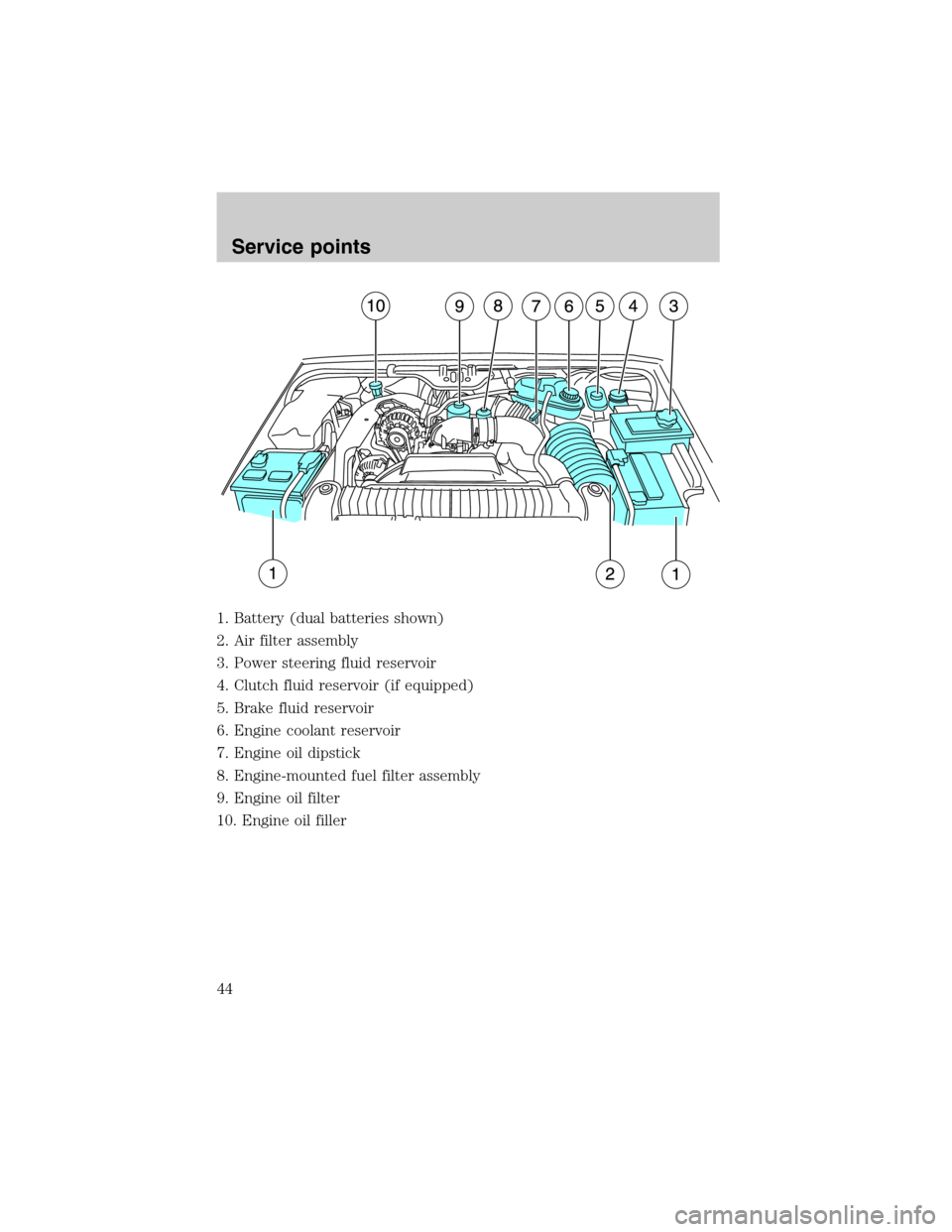
1. Battery (dual batteries shown)
2. Air filter assembly
3. Power steering fluid reservoir
4. Clutch fluid reservoir (if equipped)
5. Brake fluid reservoir
6. Engine coolant reservoir
7. Engine oil dipstick
8. Engine-mounted fuel filter assembly
9. Engine oil filter
10. Engine oil filler
Service points
44
Page 49 of 64
Any adverse condition should be brought to the attention of your dealer
or qualified service technician as soon as possible for the proper service
advice. The owner maintenance service checks are generally not covered
by warranties so you may be charged for labor, parts or lubricants used.
Maximum Oil Change Interval:
Normal Schedule: 7,500 miles or 6 months, whichever occurs first.
Special Operating Conditions: 5,000 miles or 6 months, see appropriate
schedule.
Check every month:
•Check function of all interior and exterior lights
•Check tires for wear and proper air pressure
•Check engine oil fluid level
•Check windshield washer solvent fluid level
•Check and drain fuel filter/water separator
Check every six months:
•Check lap/shoulder belts and seat latches for wear and function
•Check air pressure in spare tire
•Check that externally-mounted spare tire is tight (see Owner’s Guide)
•Check power steering fluid level
•Check washer spray, wiper operation and clean all wiper blades
•Check parking brake for proper operation
•Check and lubricate all hinges, latches and outside locks
•Check and lubricate door rubber weatherstrips
•Check and clean body and door drain holes
•Check safety warning lamps (brake, ABS, air bag, safety belt) for
operation
•Check cooling system fluid level and coolant strength
•Check battery connections and clean if necessary
•Check clutch fluid level, if equipped
General Owner’s Information
49
Page 50 of 64
NORMAL SCHEDULE
The following section contains the“Normal Schedule.”This schedule is
presented at specific mileage intervals with exceptions noted.
Additional information available on the Web
To learn more about the importance of routine and dealer-performed
maintenance on your vehicle, please visit the Ford Customer Service
website. You’ll also find important warranty information, customer
assistance, technical expertise, frequently asked questions and much
more. The website location is at: www.ford.com/
Then go to the service pick at the web site.
12,000 km (7,500 miles)
•Change engine oil and replace oil filter
•Inspect tires for wear and measure tread depth
•Rotate tires
•Inspect engine air filter
24,000 km (15,000 miles)
•Change engine oil and replace oil filter
•Inspect tires for wear and measure tread depth
•Rotate tires
•Inspect engine air filter
•Replace engine- and frame-mounted fuel filters
•Inspect steering linkage, suspension and, if equipped, driveshaft and
ball joints
•Inspect engine cooling system and hoses
•Inspect brake system
•Inspect exhaust system and heat shields
•Check wheels for end play and noise
•Inspect and lubricate 4x2 ball joints (except F-450/F-550)
•Inspect and lubricate steering idler arms
•Replace cabin air filter, if equipped
•Inspect half-shaft boots, if equipped
36,000 km (22,500 miles)
•Change engine oil and replace oil filter
•Inspect engine air filter
General Owner’s Information
50
Page 51 of 64
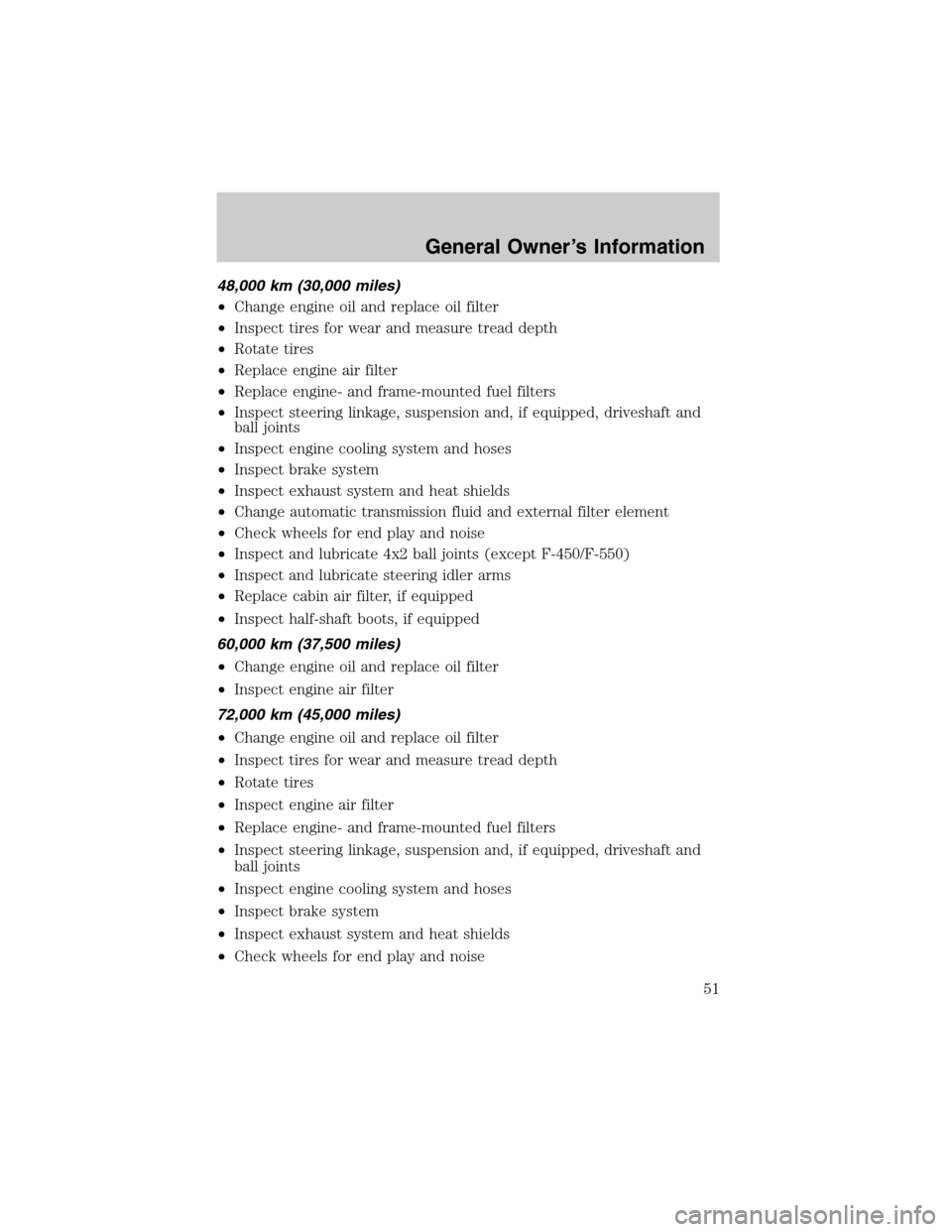
48,000 km (30,000 miles)
•Change engine oil and replace oil filter
•Inspect tires for wear and measure tread depth
•Rotate tires
•Replace engine air filter
•Replace engine- and frame-mounted fuel filters
•Inspect steering linkage, suspension and, if equipped, driveshaft and
ball joints
•Inspect engine cooling system and hoses
•Inspect brake system
•Inspect exhaust system and heat shields
•Change automatic transmission fluid and external filter element
•Check wheels for end play and noise
•Inspect and lubricate 4x2 ball joints (except F-450/F-550)
•Inspect and lubricate steering idler arms
•Replace cabin air filter, if equipped
•Inspect half-shaft boots, if equipped
60,000 km (37,500 miles)
•Change engine oil and replace oil filter
•Inspect engine air filter
72,000 km (45,000 miles)
•Change engine oil and replace oil filter
•Inspect tires for wear and measure tread depth
•Rotate tires
•Inspect engine air filter
•Replace engine- and frame-mounted fuel filters
•Inspect steering linkage, suspension and, if equipped, driveshaft and
ball joints
•Inspect engine cooling system and hoses
•Inspect brake system
•Inspect exhaust system and heat shields
•Check wheels for end play and noise
General Owner’s Information
51
Page 52 of 64
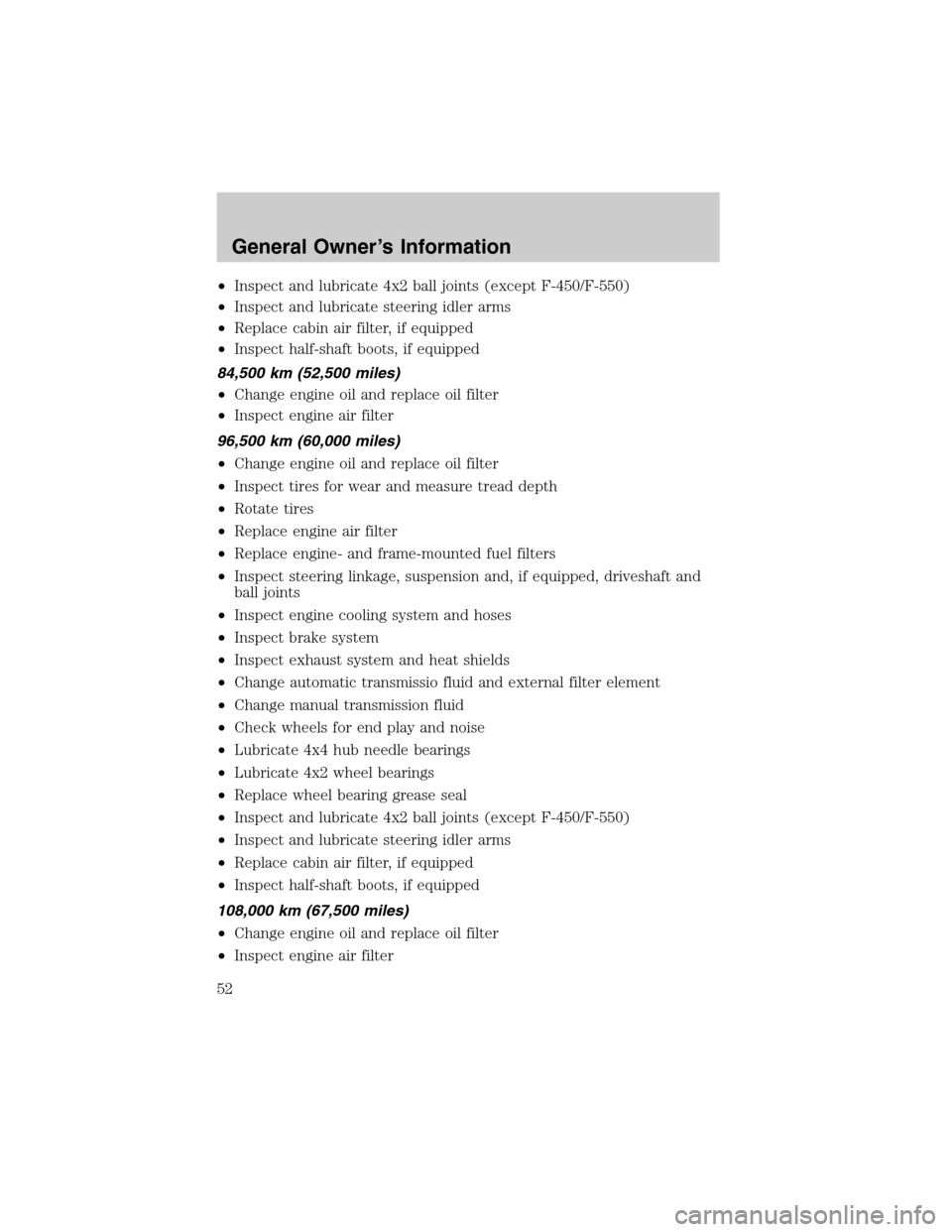
•Inspect and lubricate 4x2 ball joints (except F-450/F-550)
•Inspect and lubricate steering idler arms
•Replace cabin air filter, if equipped
•Inspect half-shaft boots, if equipped
84,500 km (52,500 miles)
•Change engine oil and replace oil filter
•Inspect engine air filter
96,500 km (60,000 miles)
•Change engine oil and replace oil filter
•Inspect tires for wear and measure tread depth
•Rotate tires
•Replace engine air filter
•Replace engine- and frame-mounted fuel filters
•Inspect steering linkage, suspension and, if equipped, driveshaft and
ball joints
•Inspect engine cooling system and hoses
•Inspect brake system
•Inspect exhaust system and heat shields
•Change automatic transmissio fluid and external filter element
•Change manual transmission fluid
•Check wheels for end play and noise
•Lubricate 4x4 hub needle bearings
•Lubricate 4x2 wheel bearings
•Replace wheel bearing grease seal
•Inspect and lubricate 4x2 ball joints (except F-450/F-550)
•Inspect and lubricate steering idler arms
•Replace cabin air filter, if equipped
•Inspect half-shaft boots, if equipped
108,000 km (67,500 miles)
•Change engine oil and replace oil filter
•Inspect engine air filter
General Owner’s Information
52