Page 1819 of 4378
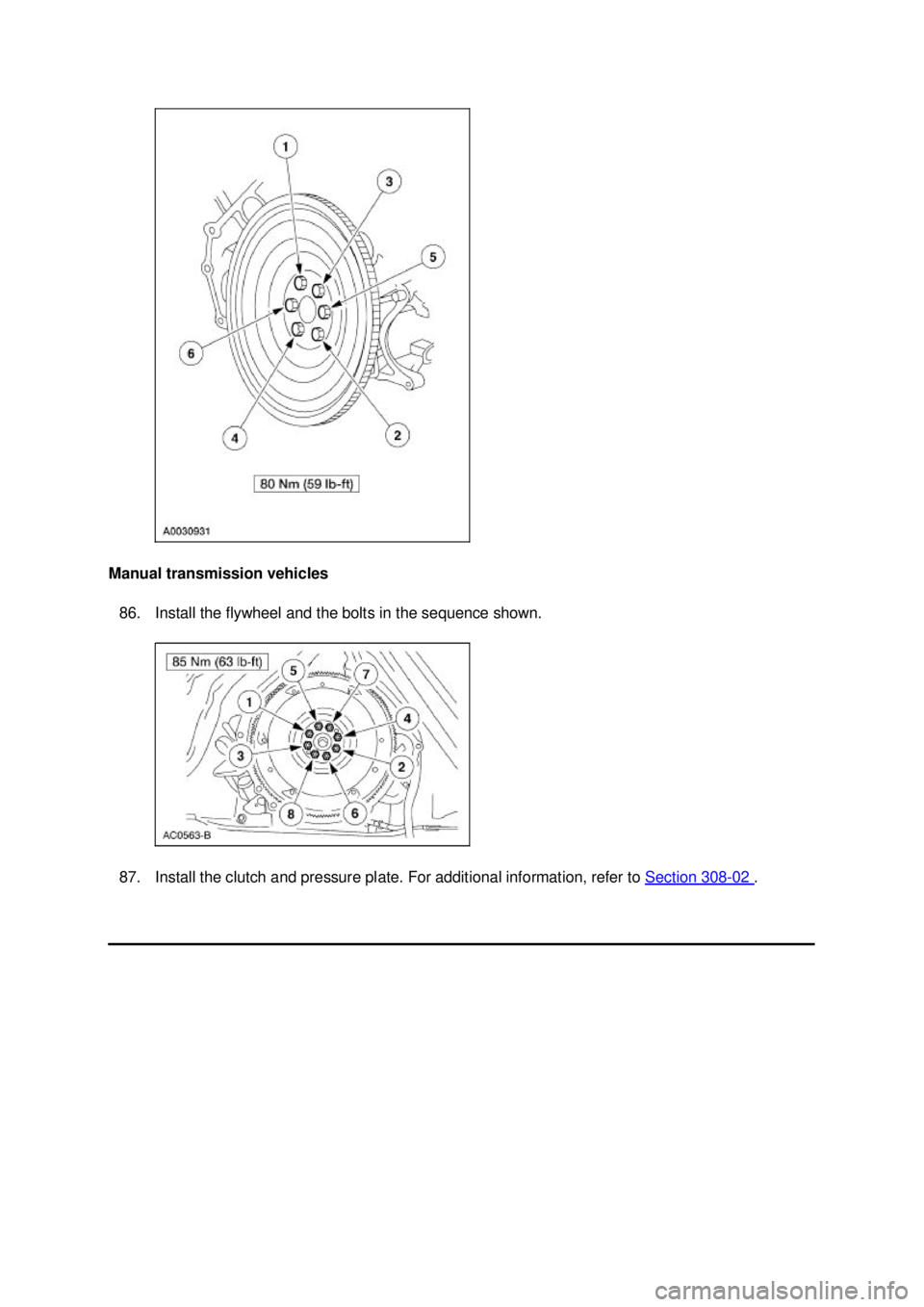
Manual transmission vehicles
86. Install the flywheel and the bolts in the sequence shown.
87. Install the clutch and pressure plate. For additional information, refer to Section 308 - 02 . �K�l�j . 29 �b�a
302003 Mustang Workshop Manual
17. 11. 2011file:///C:/Ford/2000 - 2004/tsocache/SHEF_4464/S3B~us~en~ ...
Page 1822 of 4378
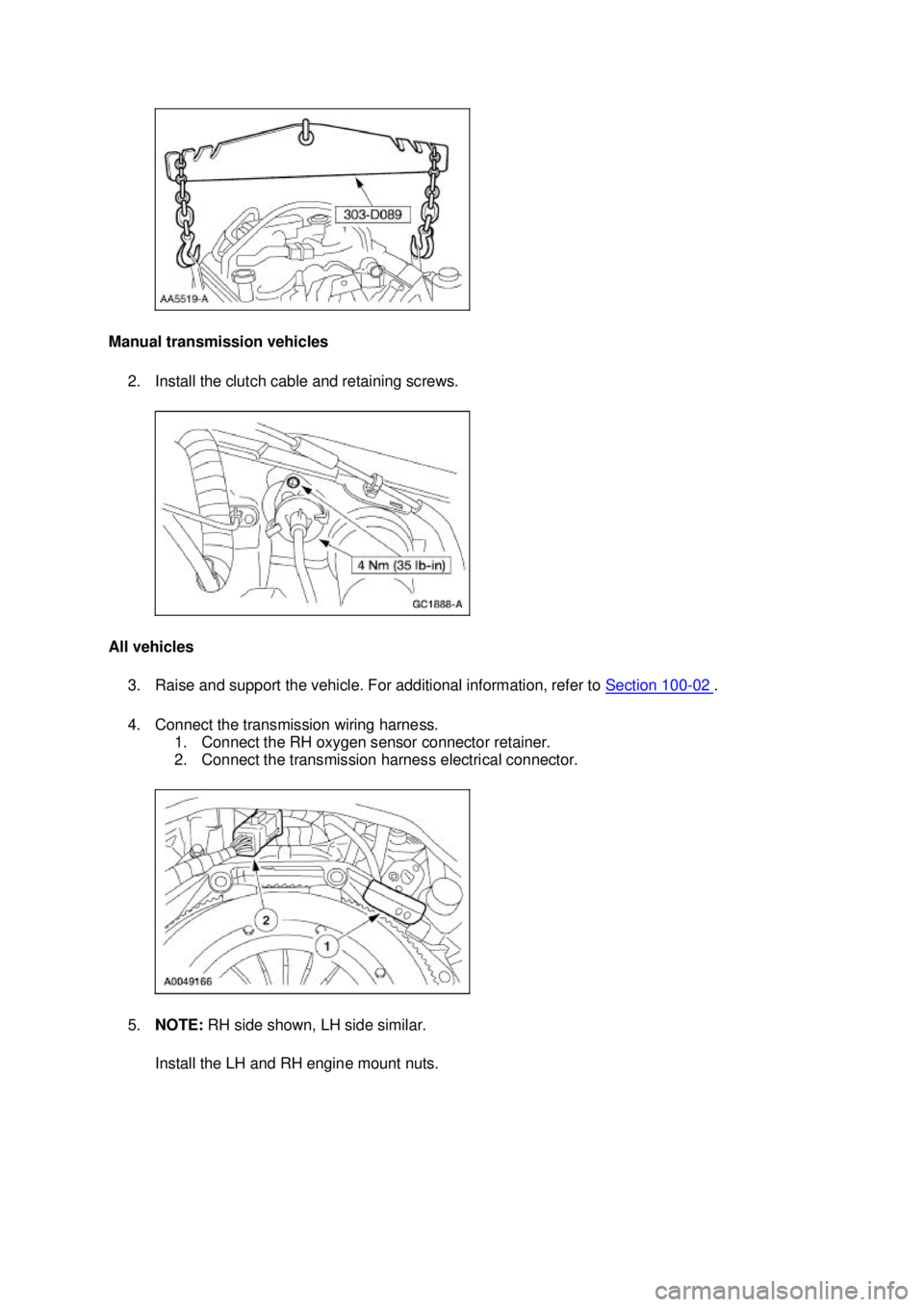
Manual transmission vehicles
2. Install the clutch cable and retaining screws.
All vehicles 3. Raise and support the vehicle. For additional information, refer to Section 100 - 02 .
4. Connect the transmission wiring harness. 1. Connect the RH oxygen sensor connector retainer.
2. Connect the transmission harness electrical connector.
5. NOTE: RH side shown, LH side similar.
Install the LH and RH engine mount nuts. �K�l�j . 2 �b�a
182003 Mustang Workshop Manual
17. 11. 2011file:///C:/Ford/2000 - 2004/tsocache/SHEF_4464/S3B~us~en~ ...
Page 1823 of 4378
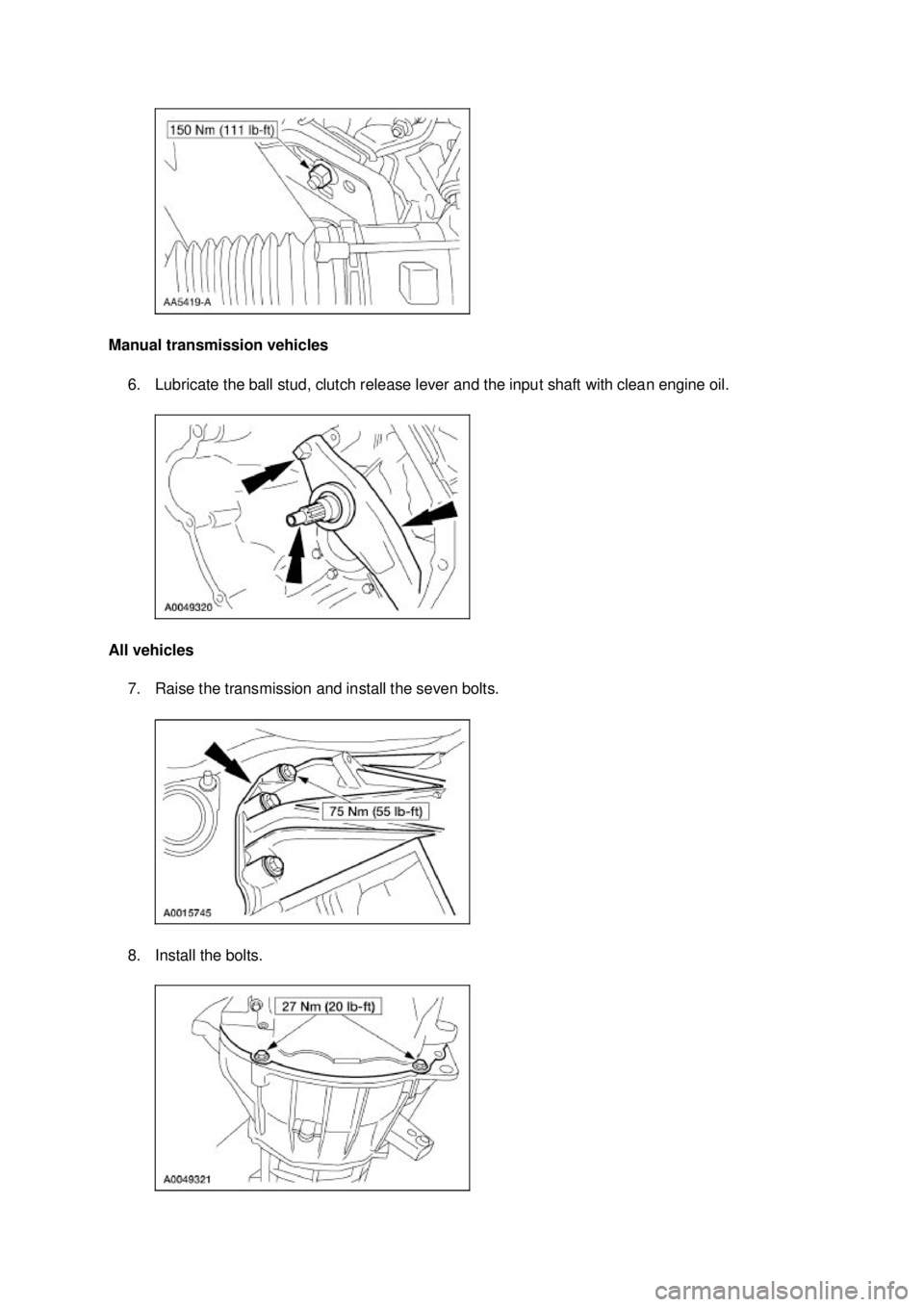
Manual transmission vehicles
6. Lubricate the ball stud, clutch release lever and the input shaft with clean engine oil.
All vehicles 7. Raise the transmission and install the seven bolts.
8. Install the bolts. �K�l�j . 3 �b�a
182003 Mustang Workshop Manual
17. 11. 2011file:///C:/Ford/2000 - 2004/tsocache/SHEF_4464/S3B~us~en~ ...
Page 1824 of 4378
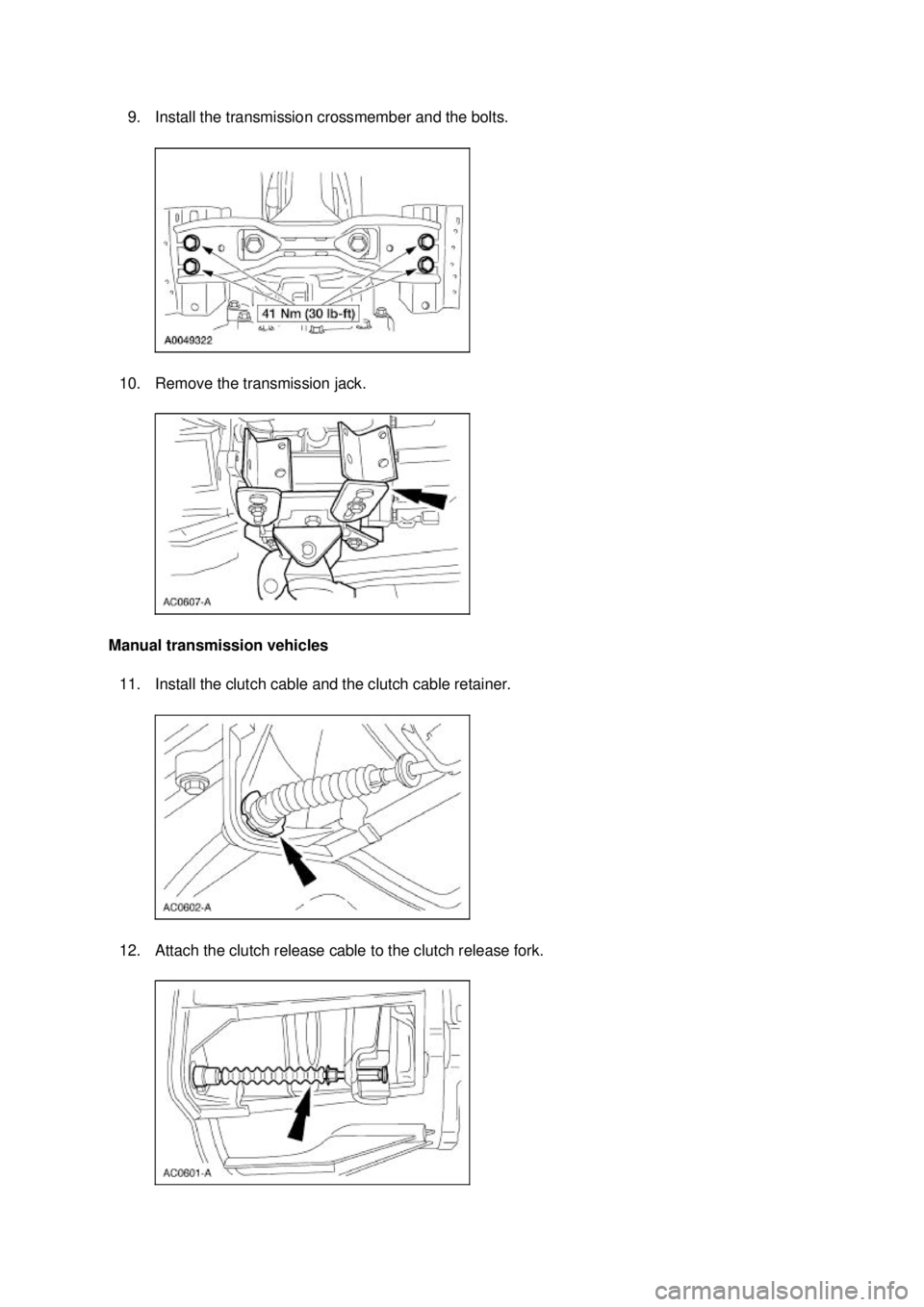
9. Install the transmission crossmember and the bolts.
10. Remove the transmission jack.
Manual transmission vehicles 11. Install the clutch cable and the clutch cable retainer.
12. Attach the clutch release cable to the clutch release fork. �K�l�j . 4 �b�a
182003 Mustang Workshop Manual
17. 11. 2011file:///C:/Ford/2000 - 2004/tsocache/SHEF_4464/S3B~us~en~ ...
Page 1825 of 4378
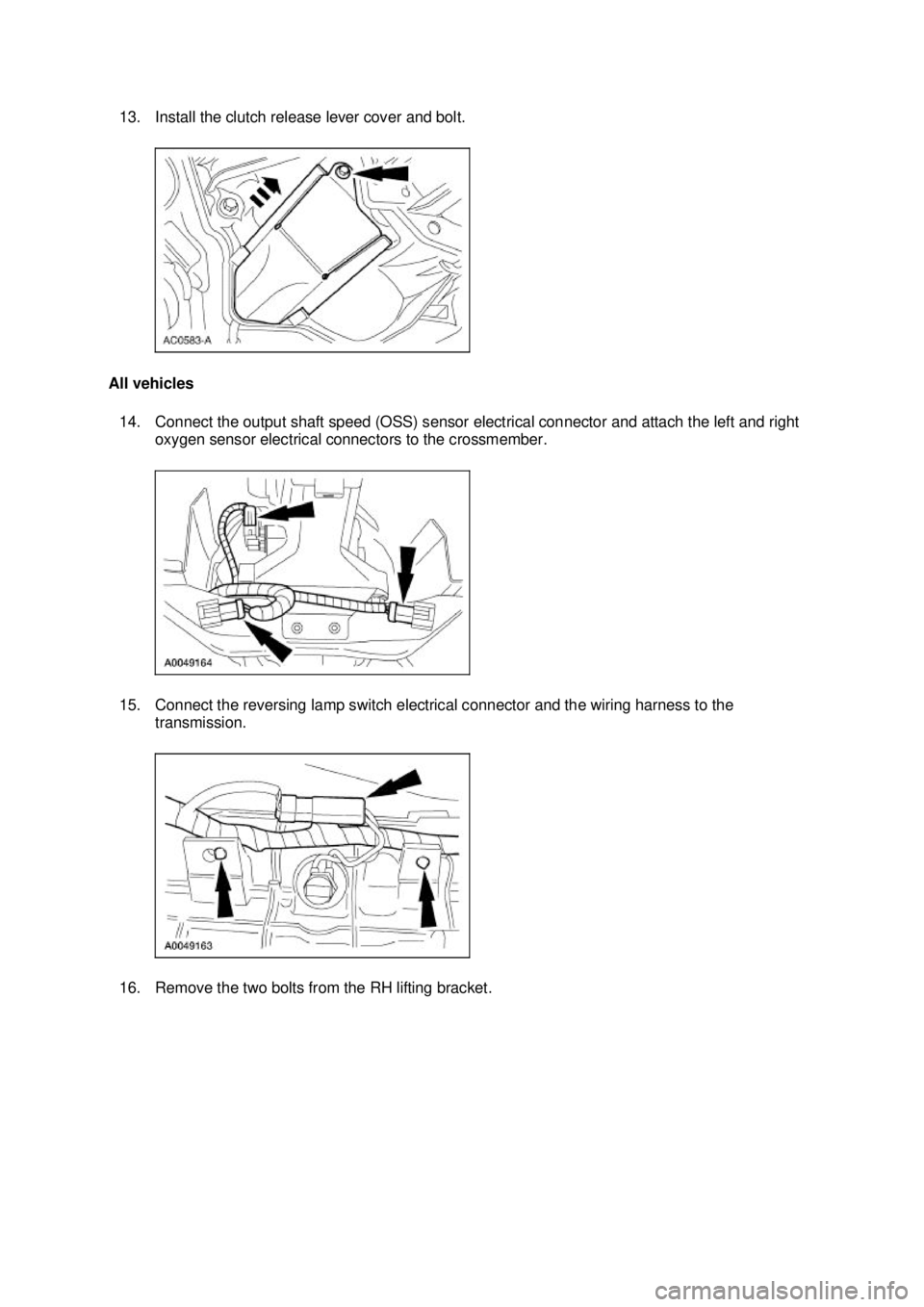
13. Install the clutch release lever cover and bolt.
All vehicles 14. Connect the output shaft speed (OSS) sensor electrical connector and attach the left and right oxygen sensor electrical connectors to the crossmember.
15. Connect the reversing lamp switch electrical connector and the wiring harness to the transmission.
16. Remove the two bolts from the RH lifting bracket. �K�l�j . 5 �b�a
182003 Mustang Workshop Manual
17. 11. 2011file:///C:/Ford/2000 - 2004/tsocache/SHEF_4464/S3B~us~en~ ...
Page 1845 of 4378
3. If the inspection reveals an obvious concern that can be readily identified, repair as necessary.
4.
CAUTION: Some vehicle cooling systems are filled with Motorcraft Premium Gold
Engine Coolant VC -7-A (in Oregon VC -7-B) or equivalent meeting Ford specification
WSS- M97B51- A1 (yellow color). Always fill the cooling system with the same coolant that
is present in the system. Do not mix coolant types.
NOTE: The addition of Motorcraft Cooling System Stop Leak Pellets, VC-6, darkens Motorcraft
Premium Gold Engine Coolant from yellow to golden tan.
Inspect the coolant condition. 1. Inspect the coolant color.
„If Motorcraft Premium Gold Engine Coolant (yellow color) VC-7- A (in Oregon VC-
7- B) or equivalent meeting Ford specification WSS-M97B51- A1 has a clear or
pale yellow color, this indicates higher water content than required.
„ Dark brown can indicate unauthorized stop leak may have been used. Use
Motorcraft Cooling System Stop Leak Pellets VC- 6 or equivalent meeting Ford
specification ESE-M99B37- 5 except as noted in ES-F6SE-19A511- AA only.
„ A light or reddish brown color indicates that rust may be present in the cooling
system. Flush the system and refill with the correct mixture of water and engine
coolant.
„ An iridescent sheen on top of the coolant can indicate a trace of oil is entering the
system. For additional information on engine diagnosis, refer to Section 303 - 00 .
„ A milky brown color may indicate that either engine oil or transmission fluid is
entering the cooling system. If transmission fluid is suspected, the cause may be a
leaky radiator. Pressure test the cooling system. For additional information, refer
to component tests in this section. If engine oil is suspected the cause of the leak
may be internal to the engine. For additional information, refer to Section 303 - 00 .
2. If the engine coolant appearance is acceptable, test the engine coolant freezing point
range with the battery and anti- freeze tester. The freezing point should be in the range -
40°C to - 20°C (-50°F to - 10°F). If the vehicle is driven in cold climates less than - 32°C (-
34°F), it may be necessary to increase the coolant concentration to get adequate freeze
protection.
„Maximum coolant concentration is 60% coolant/40% water.
„ Minimum coolant concentration is 40% coolant/60% water. 3. Adjust coolant range and level, if necessary: Visual Inspection Chart
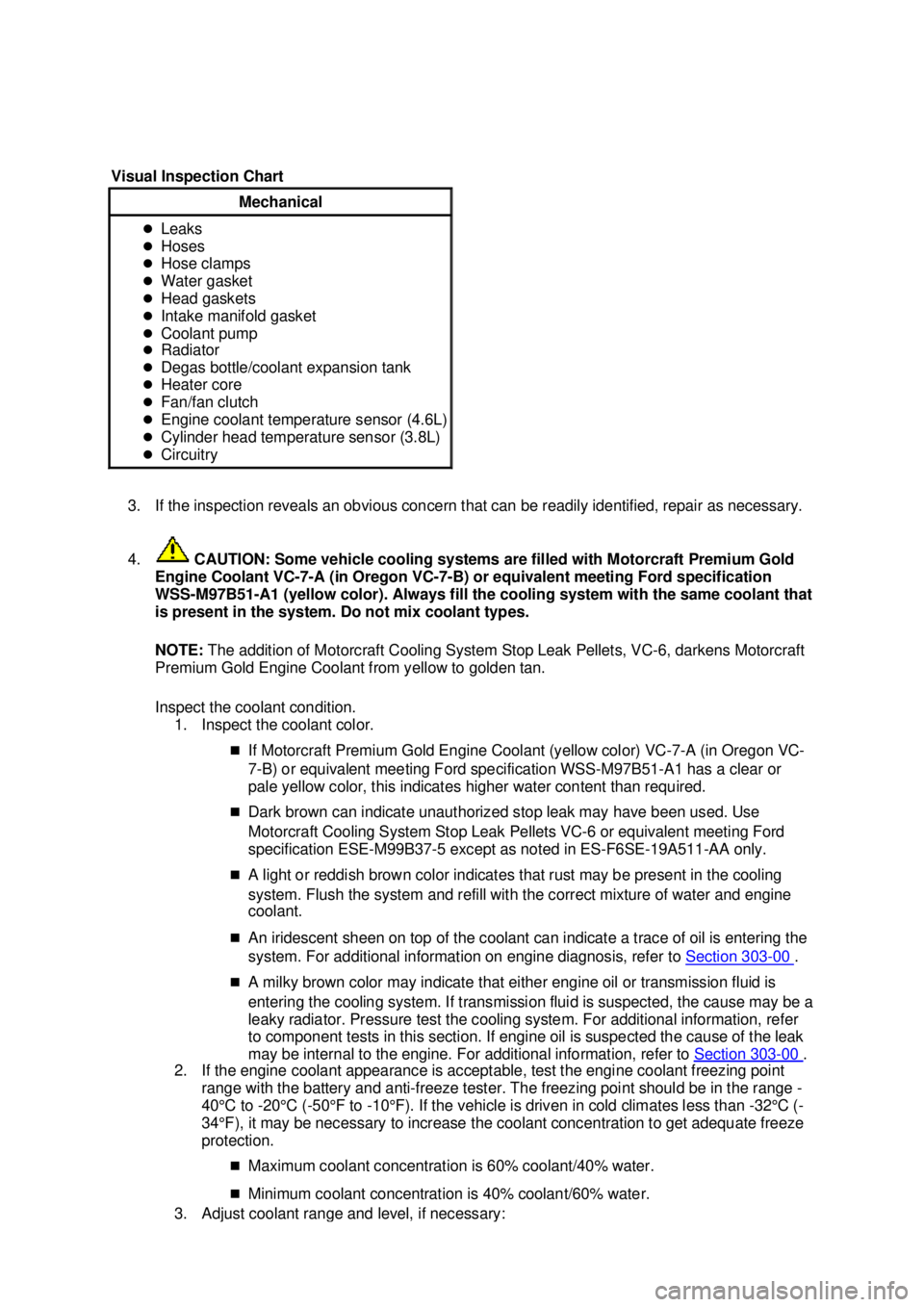
Mechanical
z
Leaks
z Hoses
z Hose clamps
z Water gasket
z Head gaskets
z Intake manifold gasket
z Coolant pump
z Radiator
z Degas bottle/coolant expansion tank
z Heater core
z Fan/fan clutch
z Engine coolant temperature sensor (4.6L)
z Cylinder head temperature sensor (3.8L)
z Circuitry �K�l�j . 2 �b�a
102003 Mustang Workshop Manual
17. 11. 2011file:///C:/Ford/2000 - 2004/tsocache/SHEF_4464/S3B~us~en~ ...
Page 1852 of 4378
3.
NOTE: Running this test with the vehicle in gear or with the A/C compressor clutch engaged
(running) will cause incorrect diagnosis.
Place the transmission in PARK (P) or NEUTRAL (N).
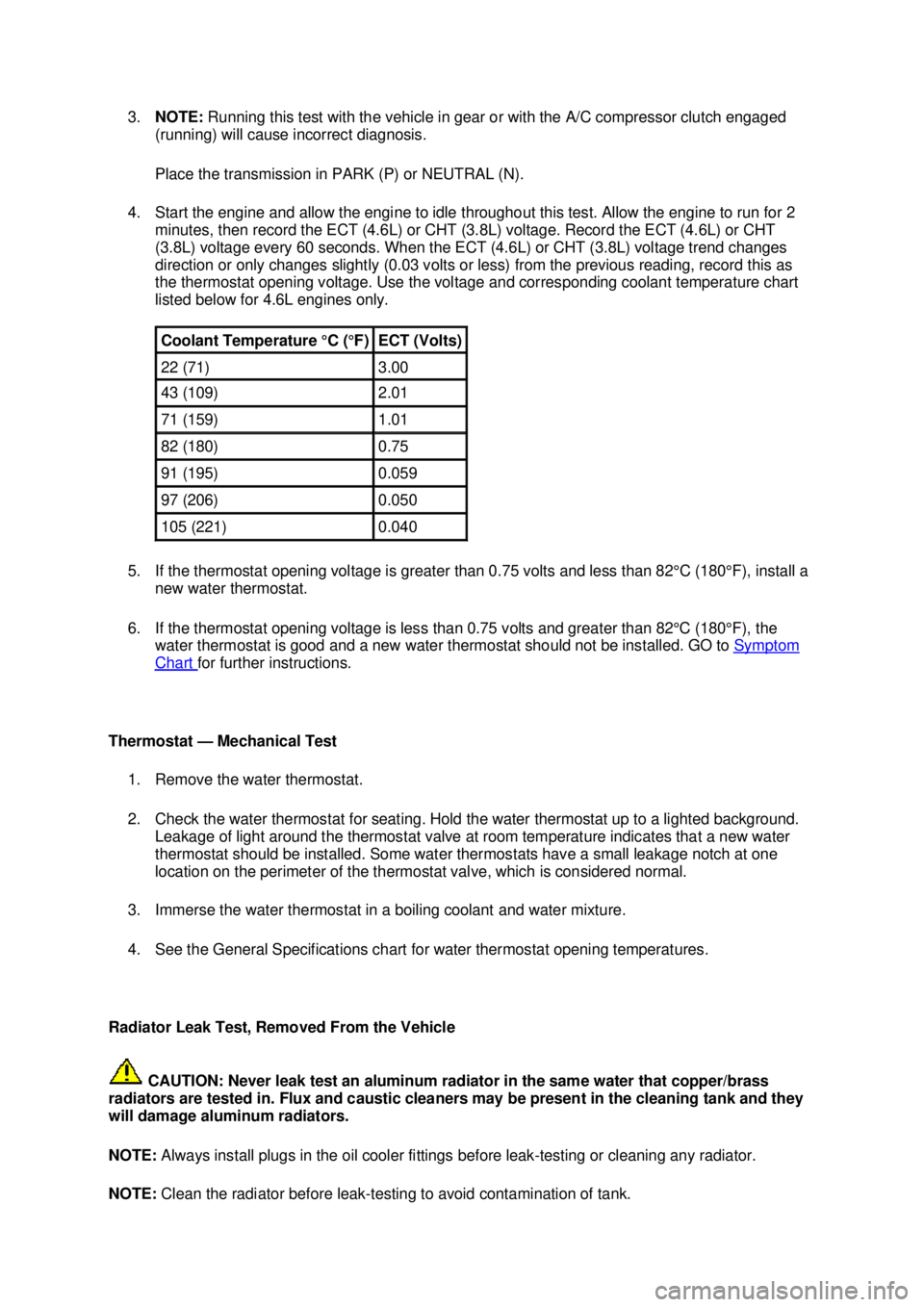
4. Start the engine and allow the engine to idle throughout this test. Allow the engine to run for 2 minutes, then record the ECT (4.6L) or CHT (3.8L) voltage. Record the ECT (4.6L) or CHT
(3.8L) voltage every 60 seconds. When the ECT (4.6L) or CHT (3.8L) voltage trend changes
direction or only changes slightly (0.03 volts or less) from the previous reading, record this as
the thermostat opening voltage. Use the voltage and corresponding coolant temperature chart
listed below for 4.6L engines only.
5. If the thermostat opening voltage is greater than 0.75 volts and less than 82°C (180°F), install a new water thermostat.
6. If the thermostat opening voltage is less than 0.75 volts and greater than 82°C (180°F), the water thermostat is good and a new water thermostat should not be installed. GO to Symptom Chart for further instructions.
Thermostat — Mechanical Test
1. Remove the water thermostat.
2. Check the water thermostat for seating. Hold the water thermostat up to a lighted background. Leakage of light around the thermostat valve at room temperature indicates that a new water
thermostat should be installed. Some water thermostats have a small leakage notch at one
location on the perimeter of the thermostat valve, which is considered normal.
3. Immerse the water thermostat in a boiling coolant and water mixture.
4. See the General Specifications chart for water thermostat opening temperatures.
Radiator Leak Test, Removed From the Vehicle CAUTION: Never leak test an aluminum radiator in the same water that copper/brass
radiators are tested in. Flux and caustic cleaners may be present in the cleaning tank and they
will damage aluminum radiators.
NOTE: Always install plugs in the oil cooler fittings before leak- testing or cleaning any radiator.
NOTE: Clean the radiator before leak- testing to avoid contamination of tank. Coolant Temperature °C (°F) ECT (Volts)
22 (71) 3.00
43 (109) 2.01
71 (159) 1.01
82 (180) 0.75
91 (195) 0.059
97 (206) 0.050
105 (221) 0.040 �K�l�j . 9 �b�a
102003 Mustang Workshop Manual
17. 11. 2011file:///C:/Ford/2000 - 2004/tsocache/SHEF_4464/S3B~us~en~ ...
Page 1936 of 4378
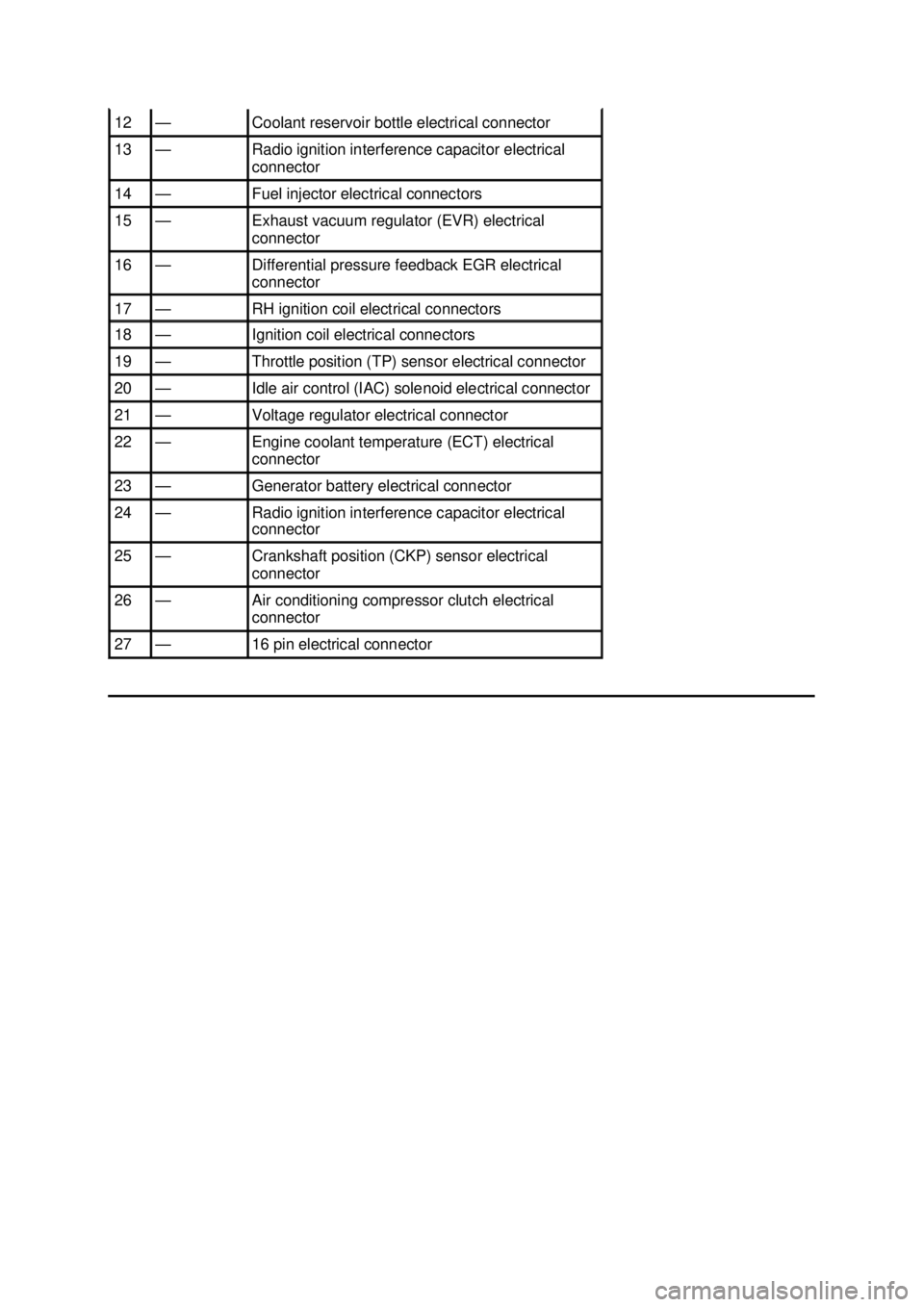
12 — Coolant reservoir bottle electrical connector
13 — Radio ignition interference capacitor electrical
connector
14 — Fuel injector electrical connectors
15 — Exhaust vacuum regulator (EVR) electrical
connector
16 — Differential pressure feedback EGR electrical
connector
17 — RH ignition coil electrical connectors
18 — Ignition coil electrical connectors
19 — Throttle position (TP) sensor electrical connector
20 — Idle air control (IAC) solenoid electrical connector
21 — Voltage regulator electrical connector
22 — Engine coolant temperature (ECT) electrical
connector
23 — Generator battery electrical connector
24 — Radio ignition interference capacitor electrical
connector
25 — Crankshaft position (CKP) sensor electrical
connector
26 — Air conditioning compressor clutch electrical
connector
27 — 16 pin electrical connector �K�l�j . 3 �b�a
32003 Mustang Workshop Manual
18. 11. 2011file:///C:/Ford/2000 - 2004/tsocache/SHEF_4464/S3B~us~en~ ...