Page 566 of 4378
REMOVAL AND INSTALLATION
Brake Caliper Anchor Plate
Removal
1. Remove the pads. For additional information, refer to Pads in this section.
2. Remove the anchor plate (2B292). 1. Remove and discard the anchor plate bolts.
2. Remove the anchor plate.
Installation 1. CAUTION: Use correct type and length bolts.
Follow the removal procedure in reverse order. zInstall new anchor plate bolts.
SECTION 206-
03: Front Disc Brake 2003 Mustang Workshop Manual �K�l�j . 1 �b�a
22003 Mustang Workshop Manual
17. 11. 2011file:///C:/Ford/2000 - 2004/tsocache/SHEF_4464/S3B~us~en~ ...
Page 583 of 4378
REMOVAL AND INSTALLATION
Pads
Removal
1. Use a suitable suction device to lower the brake fluid level in the master cylinder reservoir.
2. Raise and support the vehicle. For additional information, refer to Section 100 - 02 .
3. Remove the wheel and tire assembly. For additional information, refer to Section 204 - 04 .
4. Inspect the pads for wear or contamination, install new if worn to or past specification.
5. CAUTION: Do not allow the rear disc brake caliper (2552) to hang from the rear
wheel brake hose (2A442).
Remove the rear disc brake caliper bolts and position the caliper aside.
6. Remove the brake pads.
SECTION 206-
04: Rear Disc Brake 2003 Mustang Workshop Manual Special Tool(s)
Rear Caliper Piston Adjuster
206-
026 (T87P-2588- A) �K�l�j . 1 �b�a
42003 Mustang Workshop Manual
17. 11. 2011file:///C:/Ford/2000 - 2004/tsocache/SHEF_4464/S3B~us~en~ ...
Page 585 of 4378

1.
CAUTION: Install the brake pads in full axle sets. Do not install new brake pads on
only one side of vehicle.
Install the new slipper and brake pads.
2. Position the caliper on the anchor plate and install the bolts.
3. Install the wheel and tire assembly. For additional information, refer to Section 204 - 04 .
4. Lower the vehicle.
5. WARNING: Use of any other than approved DOT 3 or DOT 4 brake fluid will cause
permanent damage to components and will render the brakes inoperative.
WARNING: Brake fluid contains polyglycol ethers and polyglycols. Avoid contact
with eyes. Wash hands thoroughly after handling. If brake fluid contacts eyes, flush eyes
with running water for 15 minutes. Get medical attention if irritation persists. If taken
internally, drink water and induce vomiting. Get medical attention immediately.
CAUTION: Brake fluid is harmful to painted or plastic surfaces. If brake fluid is
spilled onto a painted or plastic surface, immediately wash it with water.
Check the fluid level at the master cylinder. Add fluid if necessary.
6. WARNING: Pump the brake pedal several times to make sure the caliper piston is
extended to its operating position. Failure to follow these instructions may result in
personal injury.
Verify correct brake operation. �K�l�j . 3 �b�a
42003 Mustang Workshop Manual
17. 11. 2011file:///C:/Ford/2000 - 2004/tsocache/SHEF_4464/S3B~us~en~ ...
Page 588 of 4378
REMOVAL AND INSTALLATION
Brake Caliper Support Bracket
Removal
1. Raise and support the vehicle. For additional information, refer to Section 100 - 02 .
2. Remove the tire and wheel assembly. For additional information, refer to Section 204 - 04 .
3. CAUTION: Do not allow the rear disc brake caliper (2552) to hang from the rear
wheel brake hose (2A442)
Remove the rear disc brake caliper bolts and position the caliper aside.
4. Remove the brake pads.
5. Remove the rear disc support bracket (2B511) bolts and bracket.
SECTION 206-
04: Rear Disc Brake 2003 Mustang Workshop Manual �K�l�j . 1 �b�a
22003 Mustang Workshop Manual
17. 11. 2011file:///C:/Ford/2000 - 2004/tsocache/SHEF_4464/S3B~us~en~ ...
Page 2645 of 4378
GENERAL PROCEDURES
Disc Check
WARNING: Dust and dirt present on wheel brake and clutch assemblies may contain
asbestos fibers that are hazardous to health when made airborne by cleaning with compressed
air or by dry brushing. Failure to follow these instructions may result in personal injury.
WARNING: Wheel brake assemblies and clutch facings should be cleaned using a vacuum
cleaner recommended for use with asbestos fibers such as the brake automobile brake drum
system with vacuum. Dust and dirt from the vacuum should be disposed of in a manner that
prevents dust exposure such as sealed bags. The bag must be labeled according to OSHA
instructions and the trash hauler notified as to the bag's contents. Failure to follow these
instructions may result in personal injury.
WARNING: If a vacuum suitable for asbestos is not available, cleaning should be done
wet. If dust generation is still possible, technicians should wear government- approved toxic
dust purifying respirators. Failure to follow these instructions may result in personal injury.
WARNING: Grinding or sanding on the brake linings, pads, rotors, drums or clutch
facings should be done only while using correct exhaust- ventilated equipment. Failure to
follow these instructions may result in personal injury.
WARNING: OSHA requires areas where asbestos dust generation is possible to be
isolated and posted with warning signs. Only technicians concerned with carrying out brake or
clutch service should be present in the area. Failure to follow these instructions may result in
personal injury.
1. Check the clutch disc lining surface for hardening or the presence of oil.
2. Check for a worn clutch disc lining. Measure the minimum allowable depth to the rivet heads with a slide caliper.
SECTION 308-
00: Manual Transaxle/Transmission and Clutch — General
Information 2003 Mustang Workshop
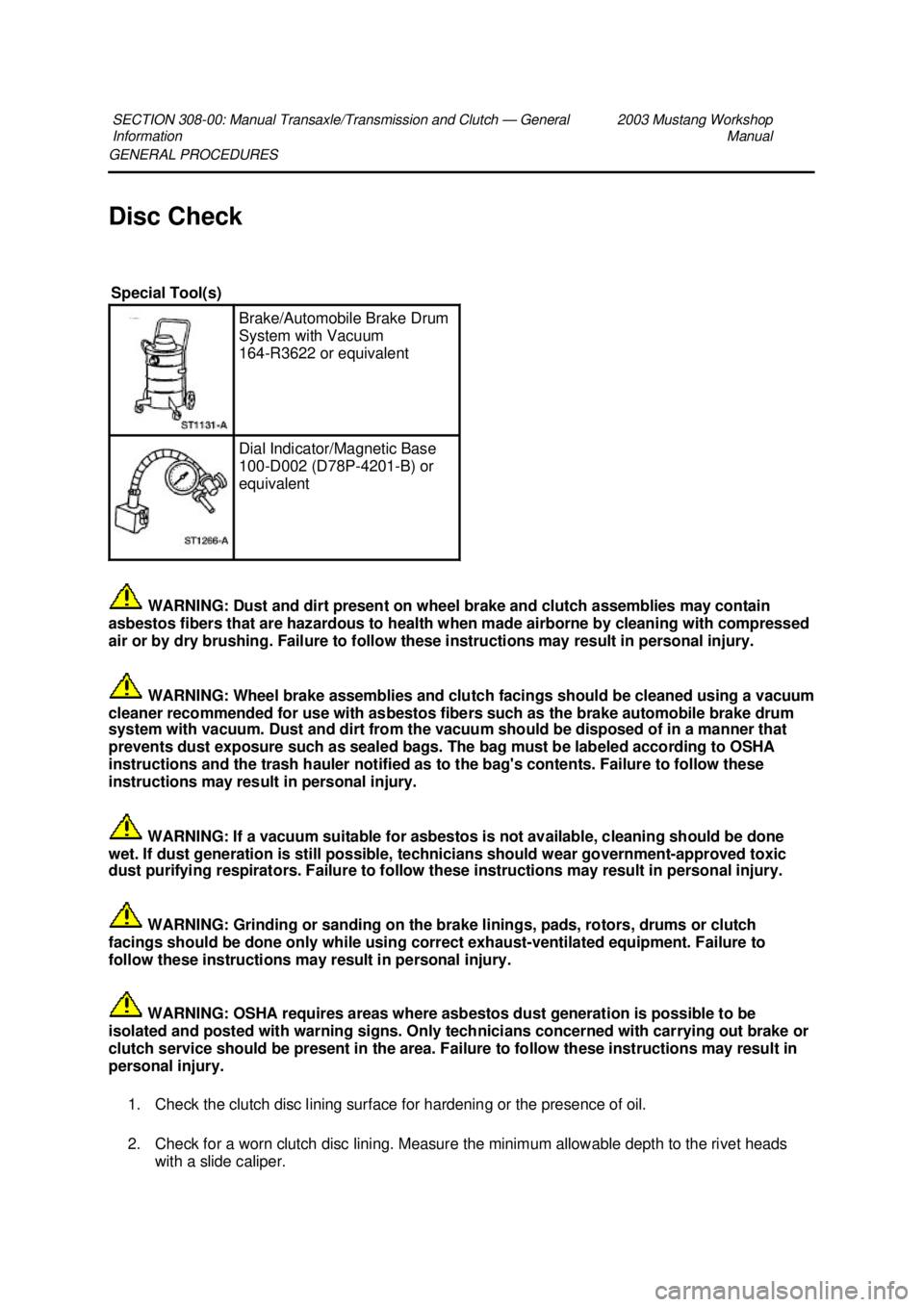
Manual Special Tool(s)
Brake/Automobile Brake Drum
System with Vacuum
164-
R3622 or equivalent Dial Indicator/Magnetic Base
100-
D002 (D78P-4201- B) or
equivalent �K�l�j . 1 �b�a
32003 Mustang Workshop Manual
18. 11. 2011file:///C:/Ford/2000 - 2004/tsocache/SHEF_2308/S3B~us~en~ ...


