2003 FORD F650 key
[x] Cancel search: keyPage 137 of 248

ignition key is turned to the OFF position. After the ignition is turned
off, the transmission will automatically shift to N (Neutral) and the
monitor on the shift pad will display N (Neutral) when the ignition key is
turned to the ON position.
Allison 2000 series
These transmissions have no P (Park) position. Before leaving
the driver’s seat, always shift into N (Neutral) and set the
parking brake. Shut off the engine and remove your ignition key.
Always use wheel chocks for hilly or off-road parking. Unexpected and
possibly sudden vehicle movement may occur if these precautions are
not taken.
This transmission provides five forward speeds in four ranges and one
reverse range.
R (Reverse)
Use this position to back the vehicle. Completely stop the vehicle before
shifting from R (Reverse) to any forward gear (1, 2, 4 or D). The reverse
warning signal will sound when the selector is in R (Reverse). Reverse
has only one gear and provides the greatest gear reduction.
N (Neutral)
Place the selector in N (Neutral) before starting the engine. Shift to N
(Neutral) and set the parking brake any time the engine is to be running
while the operator is not at the controls. The engine should be at idle
speed when any shift from N (Neutral) to a drive range is made.
Do not allow your vehicle to coast in N (Neutral). Engine
braking is not available in N (Neutral). Allowing your vehicle to
coast in N (Neutral) may result in loss of vehicle control and severe
internal transmission damage.
D (Drive-Normal driving position)
In this position, the transmission starts in first gear and automatically
shifts through second, third, fourth and fifth depending on load and
speed demands. When the vehicle is slowing down, the transmission will
automatically downshift. This range is used for highway driving under
normal conditions.
Driving
137
Page 145 of 248

Removing key from ignition
•Turn the ignition key to position
2.
•Push the release lever forward
and rotate the key towards you
and remove.
Power-take off operation (PTO) with a manual transmission
Transmission-mounted power take-off units are available for local
installation on Ford vehicles. See your Body Builder’s Layout Book for
restrictions on use and installation of power take-off units.
To engage the PTO unit, stop the vehicle and place the transmission
control in neutral. Depress the clutch and allow the gears to stop
rotating, then engage the PTO unit. The PTO can also be selected with
the transmission in gear as long as the clutch is depressed.
When operating the PTO unit with the vehicle stationary, first set the
parking brake (chock the wheels if the vehicle is on a hill or other
unlevel surface).
BACKING UP
To avoid the possibility of personal injury while backing the
vehicle, always be sure your vehicle’s path is clear.
Before backing your vehicle, be sure you can do so safely. If anything
behind the cab limits your view, do not rely on mirrors alone to assure
that your intended path is clear. If other persons are in the vicinity, have
someone standing well behind the vehicle and outside your intended
path - visible through an exterior mirror - guide you as you back up.
Although OSHA or other governmental regulations may require use of an
electrical or mechanical back-up alarm to warn bystanders, such an
alarm does not assure that the intended path is clear.
Driving
145
Page 155 of 248

Fuse/Relay
LocationFuse Amp
RatingPassenger Compartment Fuse
Panel Description
29 10A Cluster, GEM, 7.3L Power Stroke
PCM (clutch switch input), APCM
(7.3L Power Stroke only),
Overhead console (SuperCrewzer
only), Keyless entry module
(SuperCrewzer only), Traxx
(Fuel) module (SuperCrewzer
only)
30 30A 7.3L Power Stroke PCM diode,
7.3L Power Stroke fuel heater
31 15A Allison MD Transmission, Neutral
start relay and PCM (7.3L Power
Stroke only)
Relay 1—Interior lamps
Relay 2—Not used
Relay 3—Horn
Relay 4—One touch down power window
Relay 5—Not used
Power distribution box
The power distribution box is located in the engine compartment. The
power distribution box contains high-current fuses that protect your
vehicle’s main electrical systems from overloads.
Always disconnect the battery before servicing high current
fuses.
Always replace the cover to the power distribution box before
reconnecting the battery or refilling fluid reservoirs
If the battery has been disconnected and reconnected, refer to the
Batterysection of theMaintenance and specificationschapter.
Roadside Emergencies
155
Page 157 of 248
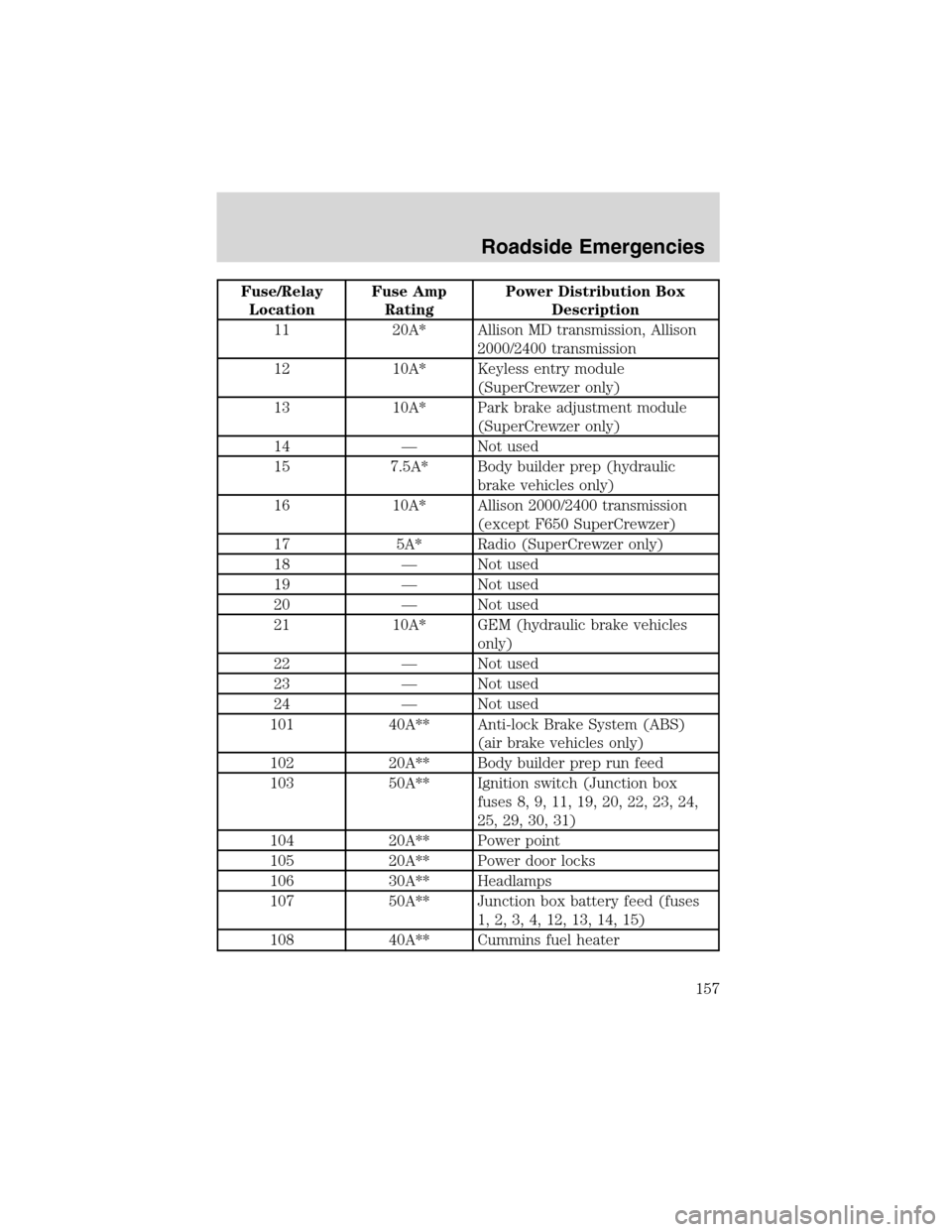
Fuse/Relay
LocationFuse Amp
RatingPower Distribution Box
Description
11 20A* Allison MD transmission, Allison
2000/2400 transmission
12 10A* Keyless entry module
(SuperCrewzer only)
13 10A* Park brake adjustment module
(SuperCrewzer only)
14—Not used
15 7.5A* Body builder prep (hydraulic
brake vehicles only)
16 10A* Allison 2000/2400 transmission
(except F650 SuperCrewzer)
17 5A* Radio (SuperCrewzer only)
18—Not used
19—Not used
20—Not used
21 10A* GEM (hydraulic brake vehicles
only)
22—Not used
23—Not used
24—Not used
101 40A** Anti-lock Brake System (ABS)
(air brake vehicles only)
102 20A** Body builder prep run feed
103 50A** Ignition switch (Junction box
fuses 8, 9, 11, 19, 20, 22, 23, 24,
25, 29, 30, 31)
104 20A** Power point
105 20A** Power door locks
106 30A** Headlamps
107 50A** Junction box battery feed (fuses
1, 2, 3, 4, 12, 13, 14, 15)
108 40A** Cummins fuel heater
Roadside Emergencies
157
Page 244 of 248

D
Daytime running lamps
(see Lamps) ................................61
Driving under special
conditions
through water .........................148
E
Emergencies, roadside
jump-starting ..........................165
Emission control system ..........226
Engine
check engine/service engine
soon light ....................................9
cleaning ...................................175
coolant .....................................186
Engine block heater .................110
Engine fan .................................192
Engine oil ..................................180
checking and adding ..............180
oil pressure gauge ....................17
recommendations ...................181
Exhaust fumes ..........................112
F
Foglamps .....................................62
Fuel ............................................192
calculating fuel
economy ..........................198, 200
choosing the right fuel ...........193
filling your vehicle
with fuel ..................................192
filter, specifications ........194–196
gauge .........................................18
improving fuel
economy ..........................198, 200safety information relating
to automotive fuels ................192
Fuses ..................................151–152
G
Gas mileage
(see Fuel economy) .........198, 200
Gauges .........................................15
battery voltage gauge ...............17
engine coolant temperature
gauge .........................................16
engine oil pressure gauge ........16
fuel gauge ..................................18
odometer ...................................18
speedometer .............................18
tachometer ................................19
trip odometer ............................19
H
Hazard flashers .........................150
Headlamps ...................................61
aiming ........................................62
daytime running lights .............61
flash to pass ..............................61
high beam ...........................14, 61
turning on and off ....................61
warning chime ..........................15
Heating
heater only system ...................56
heating and air conditioning
system .......................................57
I
Ignition
removing the key ....................145
Infant seats
(see Safety seats) .....................104
Index
244
Page 245 of 248

Instrument panel
cleaning ...................................176
lighting up panel
and interior ...............................62
J
Jump-starting your vehicle ......165
K
Keys
key in ignition chime ...............15
removing from the ignition ....145
L
Lamps ..........................................72
bulb replacement
specifications chart ..................64
cargo lamps ...............................62
daytime running light ...............61
fog lamps ...................................62
headlamps .................................61
headlamps, flash to pass ..........61
instrument panel, dimming .....62
interior lamps ...........................63
replacing bulbs ...................63–67
Lane change indicator
(see Turn signal) ........................63
Lights, warning and
indicator ..................................9, 14
anti-lock brakes
(ABS) ..........................11–12, 115
brake ....................................11–12
charging system ........................13
check coolant ......................12–13
high beam .................................14
safety belt .................................12
service engine soon ....................9
turn signal indicator .................14
Lubricant specifications ...........218M
Maintenance and Care ..............229
Manual transmission .................141
Mirrors .........................................75
heated ........................................73
side view mirrors (power) .......75
O
Odometer .....................................18
P
Panic alarm feature,
remote entry system ..................83
Parking brake ............116, 118, 122
Power distribution box
(see Fuses) ...............................155
Power door locks ........................82
Power mirrors .............................75
Power point .................................73
Power steering ..................130–131
fluid, checking and adding ....201
Power Windows ...........................74
R
Radio ..........................20, 25, 32, 40
Radio reception .....................54–55
Refill capacities for fluids ........215
Relays ................................151, 159
Remote entry system ...........82–83
illuminated entry ......................85
locking/unlocking doors .....82–83
panic alarm ...............................83
replacement/additional
transmitters ...............................84
Index
245