Page 110 of 248

•On some engines, theWait to
startlight should illuminate after
the engine starts. Allow the
engine to idle about three
minutes or until the engine
coolant temperature gauge begins to rise. Maintain idle speed until the
Wait to startlight cycles off to indicate the air intake heater has shut
off (approximately six minutes). Operating the engine at higher
speeds will reduce the effectiveness of the air inlet heater.
•Do not increase engine speed
until the oil pressure gauge
indicates normal pressure.
•Ensure engine oil pressure is
indicated on the gauge within 15
seconds after starting.
•Idle the engine for three to five
minutes before operating with a
full load.
•Try to limit engine idle to 10 minutes. Excessive idling reduces fuel
economy.
•When starting a cold engine, increase the engine speed (RPM) slowly
to make sure adequate lubrication is available to the bearings.
Restarting after running out of fuel
The fuel system may need to be purged of air, refer toRunning out of
fuelin theMaintenance and specificationschapter.
Cold weather starting
Perform the following to assure efficient starting in cold weather:
•Use the proper grade oil for your climate. Refer to your engine
operator’s manual for proper grade oil.
•Test the battery more frequently to assure ample power for starting.
•All electrical connections should be tight and in good condition to
prevent losses through loose or corroded connections.
Using the engine block heater (if equipped)
Use of an engine block heater is strongly recommended if you live in a
region where temperatures reach -23°C (-10°F) or below. For best
results, plug the heater in at least three hours before starting the vehicle.
The heater can be plugged in the night before starting the vehicle.WAIT
TO
START
L
H
Driving
110
Page 111 of 248

To prevent electrical shock, do not use your heater with
ungrounded electrical systems or two-pronged (cheater)
adapters.
Operating the engine
Do not operate the engine at full throttle below peak torque engine
speed (RPM) for more than one minute at a time (peak torque RPM
varies from 1200-1500 RPM depending on engine rated speed).
Monitor the oil pressure and coolant
temperature gauges frequently.
If the gauges indicate any reading is
not in the normal operating range,
stop your vehicle as soon as possible,
shut the engine off and check the
appropriate fluid level. If an
overheating condition starts to occur,
release the throttle pressure or shift
the transmission into a lower gear, or
both, until the temperature returns to normal operating range.
Continuous operation with low
coolant temperature, below 60°C
(140°F) or high coolant temperature
100°C (212°F) can damage the
engine.
Most failures give some kind of early
warning. Look and listen for changes
in performance, sound or engine
appearance that can indicate service
or engine repair is needed. Some
changes to look and/or listen for:
•Engine misfires
•Loss of power
•Sudden changes in engine operating temperature or oil pressure
•Excessive smoke
•Fuel, oil or coolant leaks
•Vibration
•Increased oil or fuel consumption
L
H
H
C
Driving
111
Page 113 of 248

•Set fan speed on high with function control to any position except
OFF or MAX A/C and the temperature control on any desired position.
•Adjust air control system to force outside air into the vehicle.
Winter fronts
If using an aftermarket winter front (not recommended), it must have a
permanent opening directly in line with the center of the fan drive. The
minimum opening size must be at least 774 square cm (120 square
inches).
The use of an aftermarket winter front or other air flow restriction
device mounted in front of the radiator is not recommended on this
vehicle. Air flow restriction will cause high exhaust temperatures, power
loss, excessive fan usage and a reduction in fuel economy.
HYDRAULIC BRAKES (IF EQUIPPED)
Your service brakes are self-adjusting. Refer to theGeneral
Maintenance Informationfor scheduled maintenance.
Occasional brake noise is normal and often does not indicate a
performance concern with the vehicle’s brake system. In normal
operation, automotive brake systems may emit occasional or intermittent
squeal or groan noises when the brakes are applied. Such noises are
usually heard during the first few brake applications in the morning;
however, they may be heard at any time while braking and can be
aggravated by environmental conditions such as cold, heat, moisture,
road dust, salt or mud. If a“metal-to-metal,”“continuous grinding”or
“continuous squeal”sound is present while braking, the brake linings
may be worn-out and should be inspected by a qualified service
technician.
If you are driving down a long or steep hill, shift to a lower gear.
Do not apply your brakes continuously, as they may overheat
and become less effective.
HYDRAULIC BRAKE BOOSTER SYSTEM (HYDROMAX)
The Hydromax systems receive fluid pressure from the power steering
pump to provide power assist during braking.
The Hydromax booster receives backup pressure from the reserve
system electric pump whenever the fluid in the power steering system is
not flowing. When the engine is OFF, the pump will turn on if the brake
pedal is applied, or if the ignition is turned to the ON position.
Driving
113
Page 117 of 248
The parking brake is not recommended to stop a moving vehicle.
However, if the normal brakes fail, the parking brake can be used to stop
your vehicle in an emergency. Since the parking brake only applies
retardation to the rear wheels, the vehicle’s stopping distance will
increase greatly and the handling of your vehicle will be adversely
affected.
Push the palm release lever on the
parking brake handle and push
down as far as possible to release
the brake. Driving with the parking
brake on will cause the brakes to
wear out quickly and reduce fuel
economy.
Parking brake—F650 SuperCrewzer only
Pull the parking brake knob out to
apply the parking brake. Push the
knob in to release the parking
brake.
PARKING
BRAKE
PULL TO
RELEASE
APPLY
PUSH TO
Driving
117
Page 134 of 248

The push button shifter has a R
(Reverse), N (Neutral) and D
(Drive) selections as well as a
MODE button, up arrow (for
upshifts) and a down arrow
(downshift) and a digital display.
When a range button is pressed, a
tone will sound, the SELECT
indicator displays a chosen
operation (if the electronic control
unit determines the shift is
acceptable) and the transmission
will shift to the starting range. In D
(Drive), selection of a specific gear
can be accomplished by pressing the
up or down arrow button. If the
CHECK TRANS light (located on the instrument panel) is illuminated,
the shifter control pad may be disabled, tones will not be heard, shifts
may not occur and directional shift changes will not be able to be
performed.
The MODE button may be used to
activate a second shift schedule
(this is typically programmed for
Economywhich will enable the
transmission to shift at a lower RPM
to conserve fuel).
These transmissions incorporate a hold feature to prohibit upshifting
above the gear selected during normal driving. During downhill
operation, the transmission may upshift from the selected gear if the
electronic control unit detects the possibility of engine damage from
exceeding the governed engine speed.
D N R
MODE
D N R
MODE
Driving
134
Page 136 of 248

D (Drive)- The vehicle will attain
first gear, and as the speed
increases, the transmission will
automatically upshift through each
gear. As the vehicle slows down, the
transmission will automatically
downshift. The Select indicator will
display the highest gear available.
5th or 4th- 2nd gears (depending on application)- Road conditions,
load or traffic can make it desirable to restrict the automatic shifting to a
lower gear. These positions also provide progressively greater engine
braking for descending grades (the lower the gear, the greater the
braking effect).
The push button selector uses up
and down arrow buttons to select
the desired gear. The select
indicator will display your choice
and the monitor will display the
gear selected.
1st gear- Use for pulling through mud or deep snow, when maneuvering
in tight spaces or when driving up or down steep grades. 1st gear
provides maximum driving power and engine braking.
In case of engine shutdown (i.e - running out of fuel), while the
transmission is in gear, the transmission will remain in gear until the
D N R
MODE
D N R
MODE
Driving
136
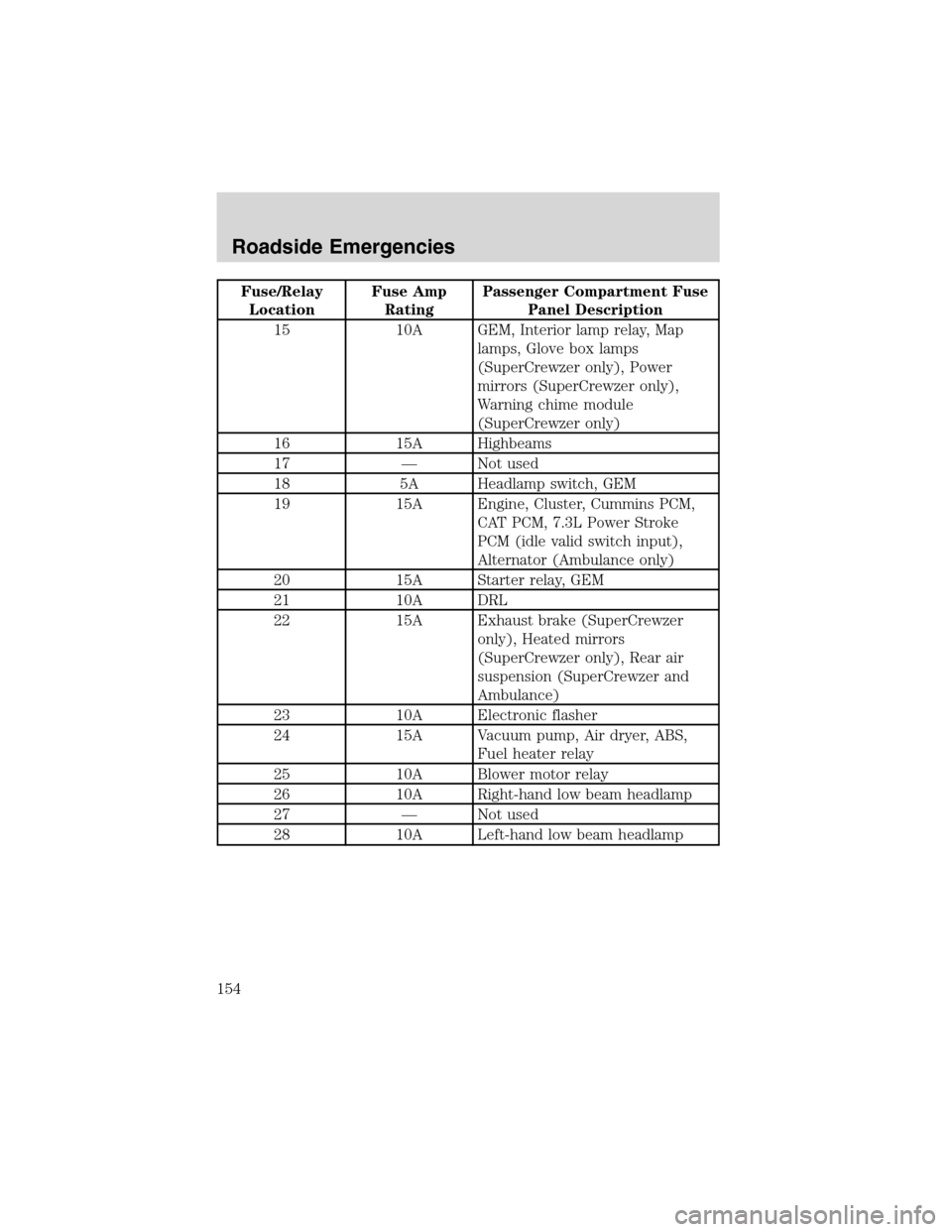
Page 154 of 248
Fuse/Relay
LocationFuse Amp
RatingPassenger Compartment Fuse
Panel Description
15 10A GEM, Interior lamp relay, Map
lamps, Glove box lamps
(SuperCrewzer only), Power
mirrors (SuperCrewzer only),
Warning chime module
(SuperCrewzer only)
16 15A Highbeams
17—Not used
18 5A Headlamp switch, GEM
19 15A Engine, Cluster, Cummins PCM,
CAT PCM, 7.3L Power Stroke
PCM (idle valid switch input),
Alternator (Ambulance only)
20 15A Starter relay, GEM
21 10A DRL
22 15A Exhaust brake (SuperCrewzer
only), Heated mirrors
(SuperCrewzer only), Rear air
suspension (SuperCrewzer and
Ambulance)
23 10A Electronic flasher
24 15A Vacuum pump, Air dryer, ABS,
Fuel heater relay
25 10A Blower motor relay
26 10A Right-hand low beam headlamp
27—Not used
28 10A Left-hand low beam headlamp
Roadside Emergencies
154
Page 155 of 248

Fuse/Relay
LocationFuse Amp
RatingPassenger Compartment Fuse
Panel Description
29 10A Cluster, GEM, 7.3L Power Stroke
PCM (clutch switch input), APCM
(7.3L Power Stroke only),
Overhead console (SuperCrewzer
only), Keyless entry module
(SuperCrewzer only), Traxx
(Fuel) module (SuperCrewzer
only)
30 30A 7.3L Power Stroke PCM diode,
7.3L Power Stroke fuel heater
31 15A Allison MD Transmission, Neutral
start relay and PCM (7.3L Power
Stroke only)
Relay 1—Interior lamps
Relay 2—Not used
Relay 3—Horn
Relay 4—One touch down power window
Relay 5—Not used
Power distribution box
The power distribution box is located in the engine compartment. The
power distribution box contains high-current fuses that protect your
vehicle’s main electrical systems from overloads.
Always disconnect the battery before servicing high current
fuses.
Always replace the cover to the power distribution box before
reconnecting the battery or refilling fluid reservoirs
If the battery has been disconnected and reconnected, refer to the
Batterysection of theMaintenance and specificationschapter.
Roadside Emergencies
155