2003 FORD F150 ESP
[x] Cancel search: ESPPage 2 of 72

ABOUT THIS SUPPLEMENT
This booklet supplements your Owner’s Guide and is part of the owner’s
portfolio. It describes the operation of yourBi-fuelvehicle and how it
differs from a standard gasoline powered vehicle. Therefore it is very
important that you read this guide and thoroughly familiarize yourself
and others operating the vehicle with this information.
Some of the information in this supplement replaces certain instructions
in the Owner’s Guide. Please read this supplement carefully and
completely. Refer to the Owner’s Guide for complete vehicle information.
WARNINGS
Warnings remind you to be especially careful in those areas of the
vehicle where carelessness can cause damage to your vehicle or possible
personal injury to yourself, your passengers or others. Please read all
warnings carefully.
•Warnings are identified by this symbol
ABOUT THE WARRANTIES
The normal vehicle warranties will apply to yourBi-fuelvehicle. For
further information, refer to your Warranty Information Booklet in the
owner’s portfolio.
Specified maintenance procedures must be followed. Repairs must be
made by trained personnel.
It is important that yourBi-fuelvehicle be properly maintained by
qualified Ford service technicians. If a concern occurs, it is important
that properly trained personnel diagnose and repair the cause. If the
concern relates to the fuel system, proper part replacement is imperative
to keep your vehicle operating correctly.Bi-fuelcomponents and
standard fuel components are not interchangeable. If yourBi-fuel
vehicle is not maintained in accordance with approved service
procedures, damage may occur and your warranty may be invalidated.
GASEOUS FUEL INJECTION
YourBi-fuelvehicle is equipped with two fuel injection systems, an
unleaded gasoline fuel system and a gaseous fuel injection system.
Two types of gaseous fuel injection systems are available:
•Compressed Natural Gas (CNG)
•Liquefied Petroleum Gas (LPG)
Introduction
2
Page 5 of 72
Use caution when servicing or maintaining any of the components of
your Gaseous Fuel Injection System.
Do not modify the gaseous fuel injection system configuration or
components. Do not replace the gaseous fuel injection system
components with parts not designed for use with your Bi-fuel vehicle.
Components designed for use in your CNG or LPG Bi-fuel vehicle
consist of special materials and are calibrated especially for your
vehicle. Failure to use the correct components may cause damage to
the engine and fuel system or possible personal injury.
Service to the gaseous fuel injection system components must be
conducted only at qualified dealerships by qualified service
technicians. Failure to do so may cause damage to the engine and fuel
system components or possible personal injury.
Any modification to your Gaseous Fuel Injection System voids the Ford
New Vehicle Limited Warranty.
Do not use liquefied natural gas (LNG) or a CNG that is derived
from a process such as flashing (heating LNG). Failure to use the
correct type of fuel may cause damage to the engine and fuel
system components.
If the vehicle is involved in an accident or fire that damages any
portion of the gaseous fuel injection system, the damaged
components MUST be replaced and the complete system tested by
a qualified service technician before the vehicle is operated
again.
If yourBi-fuelvehicle is to be painted, the CNG or propane fuel tank(s)
and fuel lines must be emptied before the vehicle is placed in a heated
room, known as a“paint oven”, for the new paint to cure. These“paint
ovens”typically operate at temperatures up to 60°C (140°F). The high
temperatures in the“paint oven”could cause the fuel in the fuel tanks to
expand, which may cause an overpressure condition within the fuel tanks
that can be hazardous to personal safety and property. Contact your
qualified Ford dealership for assistance.
Introduction
5
Page 10 of 72
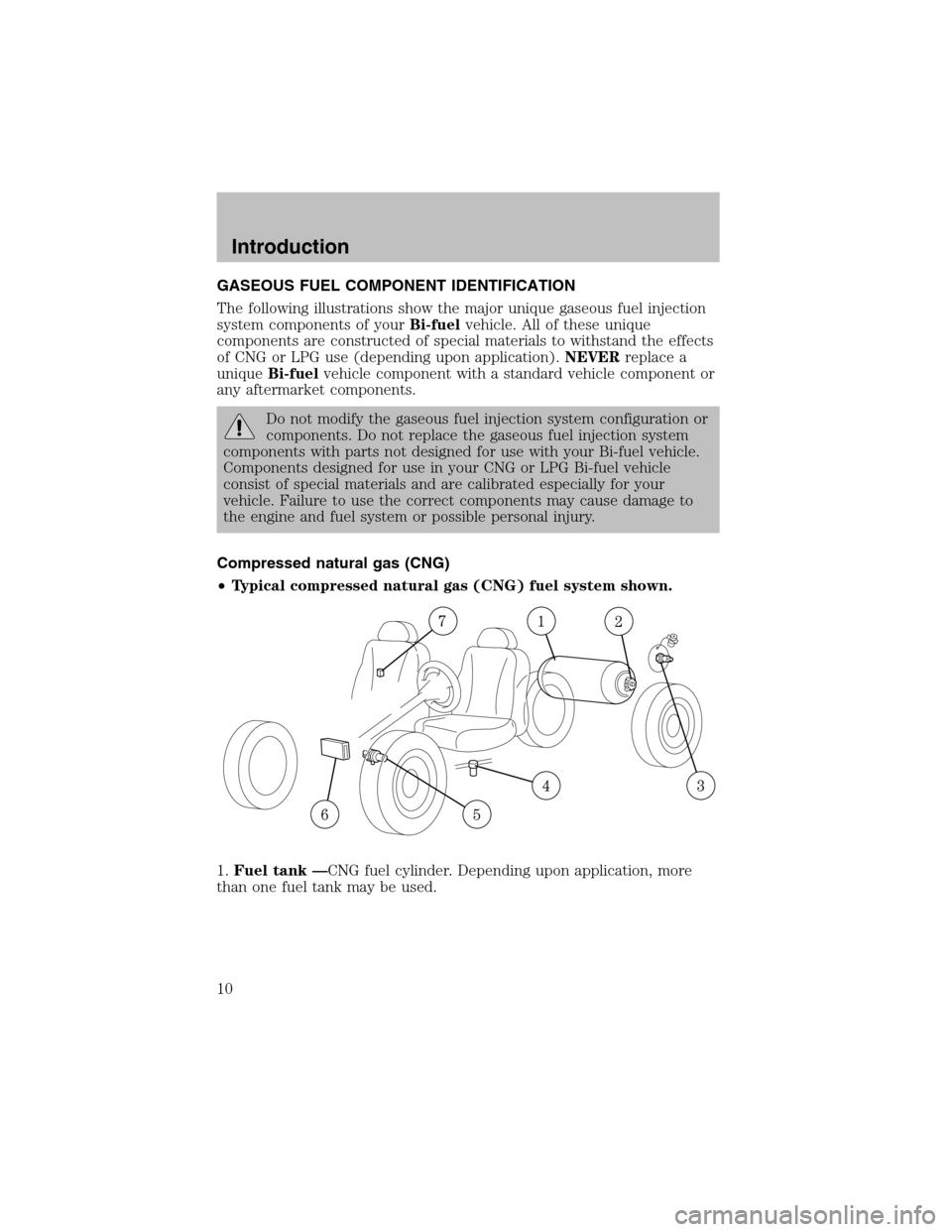
GASEOUS FUEL COMPONENT IDENTIFICATION
The following illustrations show the major unique gaseous fuel injection
system components of yourBi-fuelvehicle. All of these unique
components are constructed of special materials to withstand the effects
of CNG or LPG use (depending upon application).NEVERreplace a
uniqueBi-fuelvehicle component with a standard vehicle component or
any aftermarket components.
Do not modify the gaseous fuel injection system configuration or
components. Do not replace the gaseous fuel injection system
components with parts not designed for use with your Bi-fuel vehicle.
Components designed for use in your CNG or LPG Bi-fuel vehicle
consist of special materials and are calibrated especially for your
vehicle. Failure to use the correct components may cause damage to
the engine and fuel system or possible personal injury.
Compressed natural gas (CNG)
•Typical compressed natural gas (CNG) fuel system shown.
1.Fuel tank —CNG fuel cylinder. Depending upon application, more
than one fuel tank may be used.
Introduction
10
Page 19 of 72
EMERGENCY PROCEDURES
Be sure to read and understand all information found in theRoadside
emergencychapter of your Owner’s Guide and this supplement.
Do not modify the gaseous fuel injection system configuration or
components. Do not replace the gaseous fuel injection system
components with parts not designed for use with your Bi-fuel vehicle.
Components designed for use in your CNG or LPG Bi-fuel vehicle
consist of special materials and are calibrated especially for your
vehicle. Failure to use the correct components may cause damage to
the engine and fuel system or possible personal injury.
Service to gaseous fuel injection system components must be
conducted only at qualified dealerships by qualified service
technicians. Failure to do so may cause damage to the engine and fuel
system components or possible personal injury.
Any modification to your Gaseous Fuel Injection System voids
the Ford New Vehicle Limited Warranty.
If a CNG fuel leak is suspected or detected, switch operation to
the unleaded gasoline mode and have the complete gaseous fuel
injection system tested by a qualified service technician
immediately.
If the vehicle is involved in an accident or fire that damages any
portion of the gaseous fuel injection system, the damaged
components MUST be replaced and the complete system tested by
a qualified service technician before the vehicle is operated
again.
The fuel selector switch only operates when the vehicle is at a
stop with the ignition in the OFF position. If the fuel selector
switch is moved while the vehicle is running, the gaseous fuel
injection system will NOT automatically change fuel modes and
no damage to the vehicle will occur.
If the engine cranks but does not start after a collision. the fuel
pump shut-off switch may have been activated. Refer to the
Roadside emergencies section of the Owner Guide for
instructions on how to reset the switch.
Roadside emergencies
19
Page 21 of 72
SERVICE RECOMMENDATIONS
Before you service yourBi-fuelvehicle, read and understand all
information found in theMaintenance and carechapter of your
Owner’s Guide and this supplement.
Refer to your scheduled maintenance guide for service requirements and
intervals.
Do not modify the gaseous fuel injection system configuration or
components. Do not replace the gaseous fuel injection system
components with parts not designed for use with your Bi-fuel vehicle.
Components designed for use in your CNG or LPG Bi-fuel vehicle
consist of special materials and are calibrated especially for your
vehicle. Failure to use the correct components may cause damage to
the engine and fuel system or possible personal injury.
Service to gaseous fuel injection system components must be
conducted only at qualified dealerships by qualified service
technicians. Failure to do so may cause damage to the engine and fuel
system components or possible personal injury.
Any modification to your Gaseous Fuel Injection System voids
the Ford New Vehicle Limited Warranty.
GASEOUS FUEL INJECTION SYSTEM SHUTOFF
When in the gaseous fuel mode under normal operating procedures, the
flow of CNG or LPG (depending upon application) is stopped when the
ignition is turned to the OFF position. The electrically operated control
valve(s) only allow the flow of fuel when the ignition is in the ON
position, with the engine running.
Liquefied petroleum gas (LPG)
If equipped with the manually-actuated supply valve(s), the flow of LPG
to the engine can be stopped by closing the supply valve located on the
LPG fuel tank(s).
If equipped, the manually-actuated supply valve(s) must be in the full
OPEN position for the engine to run on LPG.
Depending upon application, it may be necessary to remove an access
panel to close or open the supply valve(s).
Maintenance and care
21
Page 24 of 72
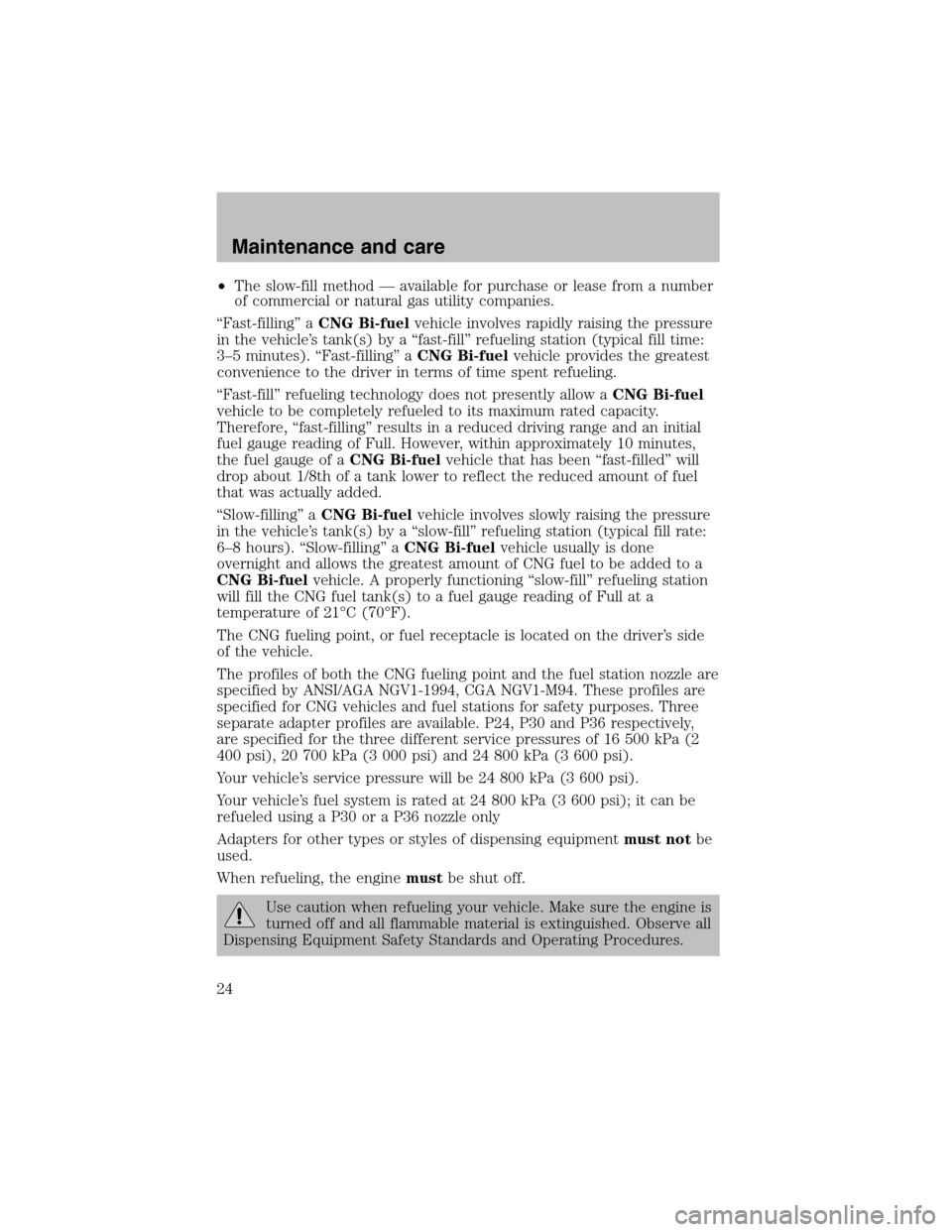
•The slow-fill method—available for purchase or lease from a number
of commercial or natural gas utility companies.
“Fast-filling”aCNG Bi-fuelvehicle involves rapidly raising the pressure
in the vehicle’s tank(s) by a“fast-fill”refueling station (typical fill time:
3–5 minutes).“Fast-filling”aCNG Bi-fuelvehicle provides the greatest
convenience to the driver in terms of time spent refueling.
“Fast-fill”refueling technology does not presently allow aCNG Bi-fuel
vehicle to be completely refueled to its maximum rated capacity.
Therefore,“fast-filling”results in a reduced driving range and an initial
fuel gauge reading of Full. However, within approximately 10 minutes,
the fuel gauge of aCNG Bi-fuelvehicle that has been“fast-filled”will
drop about 1/8th of a tank lower to reflect the reduced amount of fuel
that was actually added.
“Slow-filling”aCNG Bi-fuelvehicle involves slowly raising the pressure
in the vehicle’s tank(s) by a“slow-fill”refueling station (typical fill rate:
6–8 hours).“Slow-filling”aCNG Bi-fuelvehicle usually is done
overnight and allows the greatest amount of CNG fuel to be added to a
CNG Bi-fuelvehicle. A properly functioning“slow-fill”refueling station
will fill the CNG fuel tank(s) to a fuel gauge reading of Full at a
temperature of 21°C (70°F).
The CNG fueling point, or fuel receptacle is located on the driver’s side
of the vehicle.
The profiles of both the CNG fueling point and the fuel station nozzle are
specified by ANSI/AGA NGV1-1994, CGA NGV1-M94. These profiles are
specified for CNG vehicles and fuel stations for safety purposes. Three
separate adapter profiles are available. P24, P30 and P36 respectively,
are specified for the three different service pressures of 16 500 kPa (2
400 psi), 20 700 kPa (3 000 psi) and 24 800 kPa (3 600 psi).
Your vehicle’s service pressure will be 24 800 kPa (3 600 psi).
Your vehicle’s fuel system is rated at 24 800 kPa (3 600 psi); it can be
refueled using a P30 or a P36 nozzle only
Adapters for other types or styles of dispensing equipmentmust notbe
used.
When refueling, the enginemustbe shut off.
Use caution when refueling your vehicle. Make sure the engine is
turned off and all flammable material is extinguished. Observe all
Dispensing Equipment Safety Standards and Operating Procedures.
Maintenance and care
24
Page 31 of 72
Liquefied petroleum gas (LPG)
For your protection, the LPG fuel tanksshouldbe visually inspected
every three years or 48 000 kilometers (30 000 miles) whichever comes
first. The purpose of the inspection is to check the tank(s) for damage or
excessive corrosion which may shorten the tank(s) usable life span.
All LPG fuel tank(s) used in Canada may require visual inspection every
five years. Contact the local authority governing the enforcement of
gaseous fuel regulations in the jurisdiction of which you refuel.
LPG fuel tanks that leak, show serious damage or excessive corrosion
mustbe repaired or replaced.
FUEL FILTER
YourBi-fuelvehicle is equipped with a separate fuel filter for the
gaseous fuel injection system. Its primary function is to remove
contaminants from the CNG or LPG fuel and trap it in the filter.
The fuel filter must be drained and/or replaced on a regular basis. Refer
to your scheduled maintenance guide for service requirements and
intervals.
Do not modify the gaseous fuel injection system configuration or
components. Do not replace the gaseous fuel injection system
components with parts not designed for use with your Bi-fuel vehicle.
Components designed for use in your CNG or LPG Bi-fuel vehicle
consist of special materials and are calibrated especially for your
vehicle. Failure to use the correct components may cause damage to
the engine and fuel system or possible personal injury.
Service to the gaseous fuel injection system components must be
conducted only at qualified dealerships by qualified service
technicians. Failure to do so may cause damage to the engine and fuel
system components or possible personal injury.
Maintenance and care
31
Page 38 of 72
Le filtreàcarburant doitêtre nettoyéou remplacéde façon régulière.
Consultez le Calendrier d’entretien périodique pour connaître les
exigences et les intervalles d’entretien.
Ne modifiez pas la configuration ou les composants du circuit
d’injectionàcarburant gazeux. Ne remplacez pas les composants
du circuit d’injectionàcarburant gazeux par des pièces qui ne sont pas
conçues pourêtre utilisées dans votre véhicule bicarburant. Les
composants conçus pourêtre utilisés dans votre véhicule bicarburant
au GNC ou au GPL comprennent des pièces spéciales qui sont
calibrées spécifiquement pour votre véhicule. Le fait de ne pas utiliser
les composants adéquats peut endommager le moteur et le circuit
d’alimentation et provoquer des blessures.
L’entretien des composants d’un circuit d’injectionàcarburant
gazeux doitêtre effectuéuniquement chez les concessionnaires
autorisés et par des techniciens qualifiés. Le fait de ne pas respecter
ces directives peut endommager le moteur et le circuit d’alimentation
ou provoquer des blessures.
Entretien et soins
35