Page 23 of 96
Note:If the engine does not start within five seconds on the first try,
turn the key to 3 (OFF), wait 10 seconds and try again. If the engine still
fails to start, press the accelerator to the floor and try again; this will
allow the engine to crank with the fuel shut off in case the engine is
flooded with fuel.
Using the engine block heater (if equipped)
Use of an engine block heater is strongly recommended if you live in a
region where temperatures reach -23° C (-10° F) or below. For best
results, plug the heater in at least three hours before starting the vehicle.
The heater can be plugged in the night before starting the vehicle.
To prevent electrical shock, do not use your heater with
ungrounded electrical systems or two-pronged (cheater)
adapters.
Guarding against exhaust fumes
Carbon monoxide is present in exhaust fumes. Take precautions to avoid
its dangerous effects.
If you smell exhaust fumes inside your vehicle, have your dealer
inspect your vehicle immediately. Do not drive if you smell
exhaust fumes.
Important ventilating information
If the engine is idling while the vehicle is stopped in an open area for
long periods of time, open the windows at least 2.5 cm (one inch).
Adjust the heating or air conditioning (if equipped) to bring in fresh air.
Improve vehicle ventilation by keeping all air inlet vents clear of snow,
leaves and other debris.
BRAKES
Your service brakes are self-adjusting. Refer to the Scheduled
maintenance guide for scheduled maintenance.
Occasional brake noise is normal and often does not indicate a
performance concern with the vehicle’s brake system. In normal
operation, automotive brake systems may emit occasional or intermittent
squeal or groan noises when the brakes are applied. Such noises are
usually heard during the first few brake applications in the morning;
Driving
23
Page 49 of 96
1.Use only a 12–volt supply to start your vehicle.
2. Do not disconnect the battery of the disabled vehicle as this could
damage the vehicle’s electrical system.
3.
Park the booster vehicle close to the hood of the disabled vehicle making
sure the two vehiclesdo nottouch. Set the parking brake on both vehicles
and stay clear of the engine cooling fan and other moving parts.
4. Check all battery terminals and remove any excessive corrosion before
you attach the battery cables. Ensure that vent caps are tight and level.
5. Turn the heater fan on in both vehicles to protect any electrical
surges. Turn all other accessories off.
Connecting the jumper cables
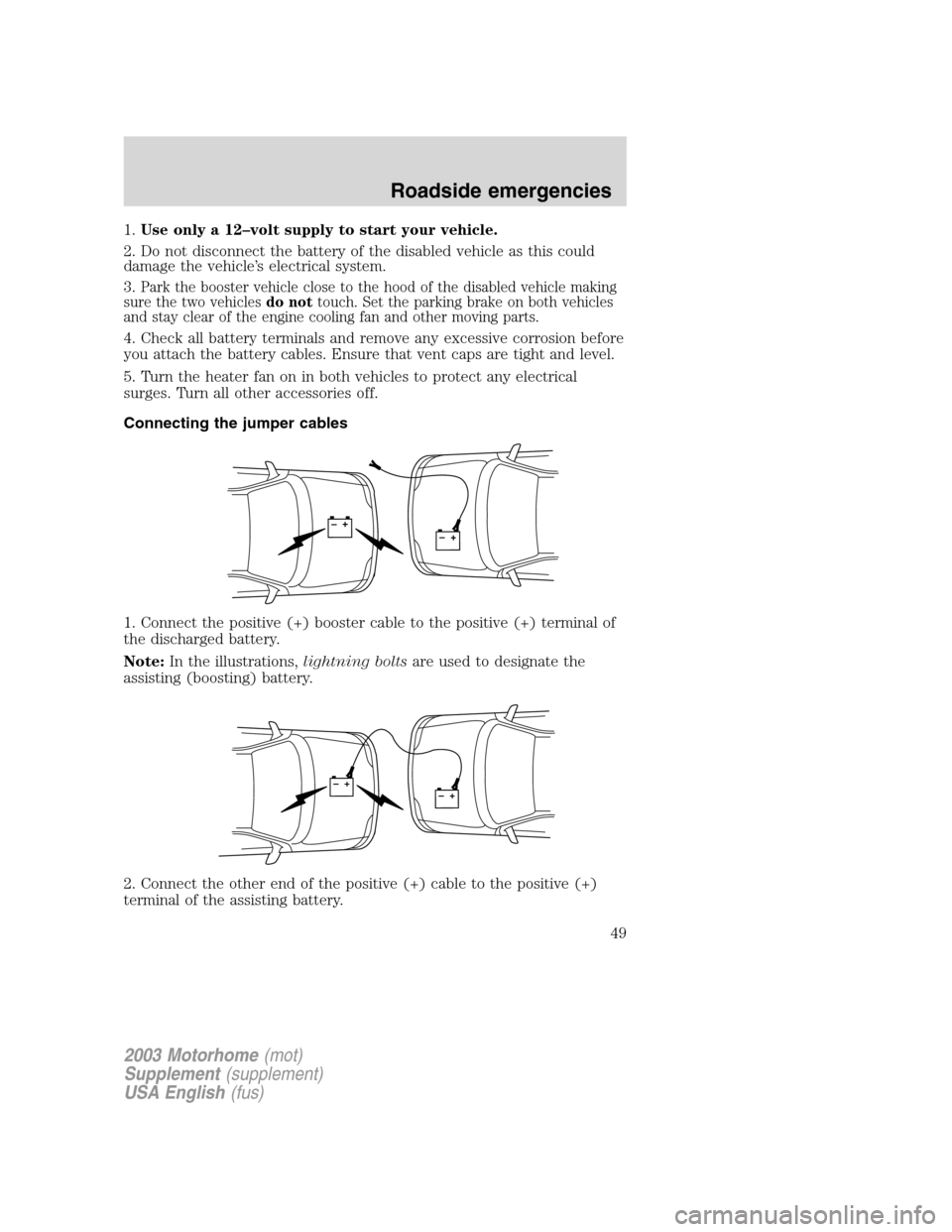
1. Connect the positive (+) booster cable to the positive (+) terminal of
the discharged battery.
Note:In the illustrations,lightning boltsare used to designate the
assisting (boosting) battery.
2. Connect the other end of the positive (+) cable to the positive (+)
terminal of the assisting battery.
+–+–
+–+–
2003 Motorhome(mot)
Supplement(supplement)
USA English(fus)
Roadside emergencies
49
Page 95 of 96
Engine block heater ...................23
Engine oil ....................................57
checking and adding ................57
dipstick ......................................57
filter, specifications ............58, 88
recommendations .....................58
refill capacities ..........................89
specifications ......................91–92
Exhaust fumes ............................23
F
Fail safe cooling ..........................66
Fluid capacities ...........................89
Fuel ..............................................67
calculating fuel economy .........73
capacity .....................................89
choosing the right fuel .............69
comparisons with EPA fuel
economy estimates ...................76
detergent in fuel .......................70
filling your vehicle
with fuel ..............................67, 73
filter, specifications ............71, 88
fuel pump shut-off switch .......36
improving fuel economy ..........73
octane rating .......................69, 92
quality ........................................70
running out of fuel ...................70
safety information relating to
automotive fuels .......................67
Fuses ............................................38
G
Gas mileage (see
Fuel economy) ............................73
Gauges .........................................11
GAWR (Gross Axle
Weight Rating) ............................31
calculating .................................32
definition ...................................31driving with a heavy load ........31
location ......................................31
GVWR (Gross Vehicle
Weight Rating) ............................31
calculating ...........................31–32
definition ...................................31
driving with a heavy load ........31
location ......................................31
H
Hazard flashers ...........................36
Headlamps ...................................14
daytime running lights .............14
flash to pass ..............................15
high beam .................................14
turning on and off ....................14
I
Ignition ...................................20, 92
Inspection/maintenance
(I/M) testing ................................77
Instrument panel
cluster ..........................................8
lighting up panel and
interior .......................................15
J
Jack ..............................................45
positioning .................................45
storage .......................................45
Jump-starting your vehicle ........48
K
Keys
positions of the ignition ...........20
L
Lamps
cargo lamps ...............................15
Index
95