2003 FORD EXPLORER SPORT automatic transmission
[x] Cancel search: automatic transmissionPage 107 of 200
4X4 HIGH- Used for extra traction such as in snow or icy roads or in
off-road situations. Not intended for use on dry pavement.
4X4 LOW- Uses extra gearing to provide maximum power to all four
wheels. Intended only for off-road applications such as deep sand, steep
grades or pulling heavy objects. 4X4 LOW will not engage while the
vehicle is moving; this is normal and should be no reason for concern.
Refer toShifting to/from 4X4 LOWfor proper operation.
Shifting between 2WD and 4X4 HIGH
•Move the 4WD control between 2WD and 4X4 HIGH at any forward
speed.
Note:Do not perform this operation if the rear wheels are slipping.
Shifting to/from 4X4 LOW
1. Bring the vehicle to a complete stop
2. Depress the brake
3. On vehicles equipped with an automatic transmission, place the
transmission in N (Neutral); on vehicles equipped with a manual
transmission, depress the clutch.
4. Move the 4WD control to the desired position.
•If shifting into 4WD LOW, wait for the 4X4 LOW light in the
instrument cluster to turnonindicating the shift is complete.
•If shifting out of 4WD LOW, wait for the 4X4 LOW light in the
instrument cluster turnoffindicating the shift is complete.
Driving off-road with truck and utility vehicles
How your vehicle differs from other vehicles
Truck and utility vehicles can differ from some other vehicles. Your
vehicle may be higher to allow it to travel over rough terrain without
getting hung up or damaging underbody components.
The differences that make your vehicle so versatile also make it handle
differently than an ordinary passenger car.
Maintain steering wheel control at all times, especially in rough terrain.
Since sudden changes in terrain can result in abrupt steering wheel
motion, make sure you grip the steering wheel from the outside. Do not
grip the spokes.
Drive cautiously to avoid vehicle damage from concealed objects such as
rocks and stumps.
2003 U207 Explorer Sport(u27)
Owners Guide (post-2002-fmt)
USA English(fus)
Driving
107
Page 110 of 200
Parking
On some 4WD vehicles, when the transfer case is in the N (Neutral)
position, the engine and transmission are disconnected from the rest of
the driveline. Therefore, the vehicle is free to roll even if the automatic
transmission is in P (Park) or the manual transmission is in gear. Do not
leave the vehicle unattended with the transfer case in N (Neutral)
position. Always set the parking brake fully and turn off the ignition
when leaving the vehicle.
Normal characteristics
On some 4WD vehicles, the initial shift from two-wheel drive to
four–wheel drive while the vehicle is moving can cause some momentary
clunk and ratcheting sounds. This is normal and should be no cause for
concern.
Driving on sand, mud and water
When driving over sand, avoid reducing the tire pressures; instead, shift
to a lower gear. Apply the accelerator slowly and avoid spinning the
wheels. If you must reduce the tire pressure, make sure you re-inflate
the tires as soon as possible. Avoid excessive speed because vehicle
momentum can work against your vehicle and cause it to become stuck.
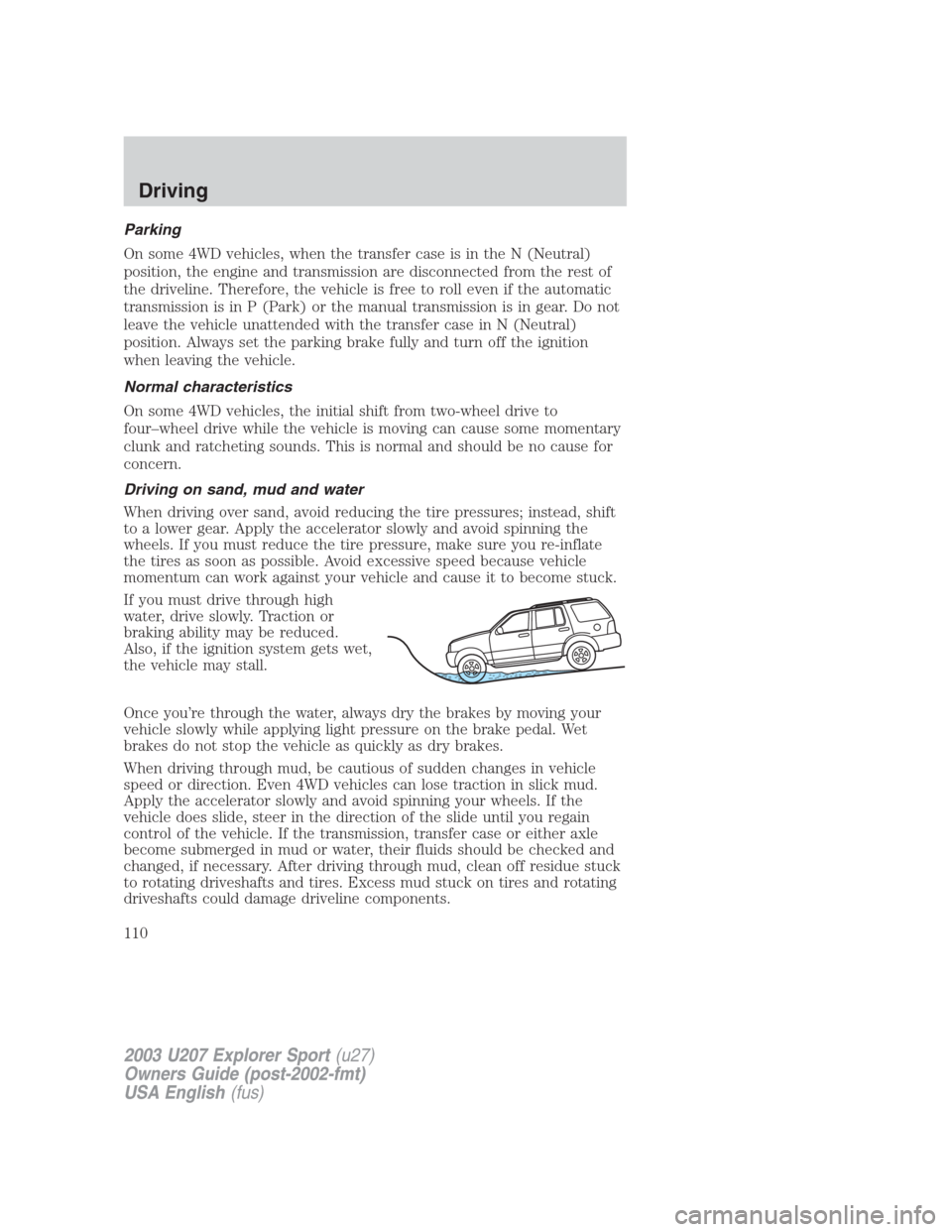
If you must drive through high
water, drive slowly. Traction or
braking ability may be reduced.
Also, if the ignition system gets wet,
the vehicle may stall.
Once you’re through the water, always dry the brakes by moving your
vehicle slowly while applying light pressure on the brake pedal. Wet
brakes do not stop the vehicle as quickly as dry brakes.
When driving through mud, be cautious of sudden changes in vehicle
speed or direction. Even 4WD vehicles can lose traction in slick mud.
Apply the accelerator slowly and avoid spinning your wheels. If the
vehicle does slide, steer in the direction of the slide until you regain
control of the vehicle. If the transmission, transfer case or either axle
become submerged in mud or water, their fluids should be checked and
changed, if necessary. After driving through mud, clean off residue stuck
to rotating driveshafts and tires. Excess mud stuck on tires and rotating
driveshafts could damage driveline components.
2003 U207 Explorer Sport(u27)
Owners Guide (post-2002-fmt)
USA English(fus)
Driving
110
Page 115 of 200
TRAILER TOWING
Trailer towing puts additional loads on your vehicle’s engine,
transmission, axle, brakes, tires and suspension. For your safety and to
maximize vehicle performance, be sure to use the proper equipment
while towing.
Follow these guidelines to ensure safe towing:
•Stay within your vehicle’s load limits.
•Thoroughly prepare your vehicle for towing. Refer toPreparing to
towin this chapter.
•Use extra caution when driving with a trailer. Refer toDriving while
you towin this chapter.
•Service your vehicle more frequently if you tow a trailer. Refer to the
severe duty schedule in the scheduled maintenance guide.
•Do not tow a trailer until your vehicle has been driven at least 800 km
(500 miles).
•Refer to the instructions included with towing accessories for the
proper installation and adjustment specifications.
Do not exceed the maximum loads listed on the Safety Compliance
Certification label. For load specification terms found on the label, refer
toVehicle loadingin this chapter. Remember to figure in the tongue
load of your loaded vehicle when figuring the total weight. Tongue load
should not exceed 10% of the loaded trailer.
4x2 w/automatic transmission
EngineRear
axle
ratioMaximum
GCWR - kg
(lbs.)Trailer Weight
Range
(0-Maximum)
- kg (lbs.)Maximum
frontal area of
trailer - m
2
(ft2)
4.0L
SOHCAll 4127 (9100) 0-2286
(0-5040)4.64 (50)
Notes:For high altitude operation, reduce GCW by 2% per 300 meters
(1000 ft) elevation. For definition of terms and instructions on
calculating your vehicle’s load, refer toVehicle loadingin this chapter.
Towing a trailer over 1588 kg (3500 lbs.) requires a weight distributing
hitch.
2003 U207 Explorer Sport(u27)
Owners Guide (post-2002-fmt)
USA English(fus)
Driving
115
Page 116 of 200
4x2 w/manual transmission
EngineRear
axle
ratioMaximum
GCWR - kg
(lbs.)Trailer Weight
Range
(0-Maximum)
- kg (lbs.)Maximum
frontal area of
trailer - m
2
(ft2)
4.0L
SOHCAll 3175 (7000) 0-1361
(0-3000)4.64 (50)
Notes:For high altitude operation, reduce GCW by 2% per 300 meters
(1000 ft) elevation. For definition of terms and instructions on
calculating your vehicle’s load, refer toVehicle loadingin this chapter.
4x4 w/automatic transmission
EngineRear
axle
ratioMaximum
GCWR - kg
(lbs.)Trailer Weight
Range
(0-Maximum_
- kg (lbs.)Maximum
frontal area of
trailer - m
2
(ft2)
4.0L
SOHCAll 4127 (9100) 0-2195
(0-4840)4.64 (50)
Notes:For high altitude operation, reduce GCW by 2% per 300 meters
(1000 ft) elevation. For definition of terms and instructions on
calculating your vehicle’s load, refer toVehicle loadingin this chapter.
Towing a trailer over 1588 kg (3500 lbs.) requires a weight distributing
hitch.
4x4 w/manual transmission
EngineRear
axle
ratioMaximum
GCWR - kg
(lbs.)Trailer Weight
Range
(0-Maximum_
- kg (lbs.)Maximum
frontal area of
trailer - m
2
(ft2)
4.0L
SOHCAll 3175 (7000) 0-1270
(0-2800)4.64 (50)
Notes:For high altitude operation, reduce GCW by 2% per 300 meters
(1000 ft) elevation. For definition of terms and instructions on
calculating your vehicle’s load, refer toVehicle loadingin this chapter.
2003 U207 Explorer Sport(u27)
Owners Guide (post-2002-fmt)
USA English(fus)
Driving
116
Page 117 of 200
Do not exceed the GVWR or the GAWR specified on the
certification label.
Towing trailers beyond the maximum recommended gross trailer
weight exceeds the limit of the vehicle and could result in
engine damage, transmission damage, structural damage, loss of vehicle
control, vehicle rollover and personal injury.
Preparing to tow
Use the proper equipment for towing a trailer and make sure it is
properly attached to your vehicle. See your dealer or a reliable trailer
dealer if you require assistance.
Hitches
Do not use hitches that clamp onto the vehicle bumper. Use a load
carrying hitch. You must distribute the load in your trailer so that 10% of
the total weight of the trailer is on the tongue.
Use a frame-mounted weight distributing hitch for trailers over
1,588 kg (3,500 lb).
Safety chains
Always connect the trailer’s safety chains to the frame or hook retainers
of the vehicle hitch. To connect the trailer’s safety chains, cross the
chains under the trailer tongue and allow slack for turning corners.Do
not attach safety chains to the bumper.
Trailer brakes
Electric brakes and manual, automatic or surge-type trailer brakes are
safe if installed properly and adjusted to the manufacturer’s
specifications.
Do not connect a trailer’s hydraulic brake system directly to your
vehicle’s brake system. Your vehicle may not have enough
braking power and your chances of having a collision greatly increase.
The braking system of the towing vehicle is rated for operation at the
GVWR not GCWR.
Trailer lamps
Make sure your trailer lamps conform to local and Federal regulations.
See your dealer or trailer rental agency for proper instructions and
equipment for hooking up trailer lamps.
2003 U207 Explorer Sport(u27)
Owners Guide (post-2002-fmt)
USA English(fus)
Driving
117
Page 118 of 200
Never connect any trailer lighting to the vehicle’s taillamp circuits,
because it may damage the electrical system resulting in fire.
Contact your local Ford dealership for assistance in proper trailer tow
wiring installation. Additional electrical equipment may be required.
Using a step bumper
The rear bumper is equipped with an integral hitch and requires only a
ball with a 19 mm (3/4 inch) shank diameter. The bumper has a 1,590 kg
(3,500 lb.) trailer weight and 159 kg (350 lb.) tongue weight capability.
Use a frame-mounted weight distributing hitch for trailers over 1,590 kg
(3,500 lb).
Driving while you tow
When towing a trailer:
•Turn off your speed control. The speed control may shut off
automatically when you are towing on long, steep grades.
•Consult your local motor vehicle speed regulations for towing a trailer.
•Use a lower gear when towing up or down steep hills.
•Anticipate stops and brake gradually.
Servicing after towing
If you tow a trailer for long distances, your vehicle will require more
frequent service intervals. Refer to your scheduled maintenance guide for
more information.
Trailer towing tips
•Practice turning, stopping and backing up before starting on a trip to
get the feel of the vehicle/trailer combination. When turning, make
wider turns so the trailer wheels will clear curbs and other obstacles.
•Allow more distance for stopping with a trailer attached.
•The trailer tongue weight should be no more than 10–15% of the
loaded trailer weight.
•After you have traveled 80 km (50 miles), thoroughly check your
hitch, electrical connections and trailer wheel lug nuts.
•When stopped in traffic for long periods of time in hot weather, place
the gearshift in P (Park) (automatic transmissions) or N (Neutral)
(manual transmissions). This aids engine cooling and air conditioner
efficiency.
2003 U207 Explorer Sport(u27)
Owners Guide (post-2002-fmt)
USA English(fus)
Driving
118
Page 119 of 200
•Vehicles with trailers should not be parked on a grade. If you must
park on a grade, place wheel chocks under the trailer’s wheels.
Launching or retrieving a boat
When backing down a ramp during boat launching or retrieval:
•do not allow the static water level to rise above the bottom edge of
the rear bumper.
•do not allow waves to break higher than 15 cm (6 inches) above the
bottom edge of the rear bumper.
Exceeding these limits may allow water to enter critical vehicle
components, adversely affecting driveability, emissions, reliability and
causing internal transmission damage. Replace the rear axle lubricant
any time the axle has been submerged in water.
Disconnect the wiring to the trailer before backing the trailer into the
water. Reconnect the wiring to the trailer after the trailer is removed
from the water.
RECREATIONAL TOWING (ALL WHEELS ON THE GROUND)
Follow these guidelines for your specific powertrain combination to tow
your vehicle with all four wheels on the ground (such as behind a
recreational vehicle).
These guidelines are designed to ensure that your transmission is not
damaged due to insufficient lubrication.
All vehicles equipped with a manual transmission:
Before you have your vehicle towed:
•Release the parking brake.
•Move the gearshift to the neutral position.
•Turn the key in the ignition to the OFF/UNLOCKED position.
•The maximum recommended speed is 88 km/h (55 mph).
•The maximum recommended distance is unlimited.
4x2 vehicles with an automatic transmission and 4x4 vehicles
with an automatic transmission but without the Neutral tow kit
accessory:
•Release parking brake.
•Place the transmission in N (Neutral).
•Maximum speed is 56 km/h (35 mph).
2003 U207 Explorer Sport(u27)
Owners Guide (post-2002-fmt)
USA English(fus)
Driving
119
Page 120 of 200
•Maximum distance is 80 km (50 miles).
If a distance of 80 km (50 miles) or a speed of 56 km/h (35 mph) must
be exceeded, you must disconnect the front (on 4x4 vehicles) and rear
driveshafts. Ford recommends the driveshaft(s) be removed/installed
only by a qualified technician. See your local dealer for driveshaft
removal/installation.
Improper removal/installation of the driveshaft can cause
transmission fluid loss, damage to the driveshaft and internal
transmission components.
4x4 vehicles with automatic transmission and the Neutral tow kit
accessory:
•Release the parking brake.
•Place transmission in N (Neutral).
•Engage the neutral tow.
On vehicles equipped with 4WD, an accessory is available that allows you
to tow your vehicle, with unlimited mileage (maximum speed of 88 km/h
[55 mph]) behind another vehicle, with all the wheels on the ground.
Contact your dealer for more details. Do not tow your vehicle with all
wheels on the ground more than 80 km (50 miles) (with a maximum
speed of 56 km/h [35 mph]) unless you install the neutral tow kit as
vehicle damage may occur.
2003 U207 Explorer Sport(u27)
Owners Guide (post-2002-fmt)
USA English(fus)
Driving
120