Page 244 of 272
![FORD EXPLORER 2003 3.G Owners Manual •Carrying unnecessary weight may reduce fuel economy (approximately
0.4 km/L [1 mpg] is lost for every 180 kg [400 lb] of weight carried).
•Adding certain accessories to your vehicle (for example](/manual-img/11/4961/w960_4961-243.png "FORD EXPLORER 2003 3.G Owners Manual •Carrying unnecessary weight may reduce fuel economy (approximately
0.4 km/L [1 mpg] is lost for every 180 kg [400 lb] of weight carried).
•Adding certain accessories to your vehicle (for example")
•Carrying unnecessary weight may reduce fuel economy (approximately
0.4 km/L [1 mpg] is lost for every 180 kg [400 lb] of weight carried).
•Adding certain accessories to your vehicle (for example bug
deflectors, rollbars/light bars, running boards, ski/luggage racks) may
reduce fuel economy.
•Fuel economy may decrease with lower temperatures during the first
12–16 km (8–10 miles) of driving.
•Driving on flat terrain offers improved fuel economy as compared to
driving on hilly terrain.
•Transmissions give their best fuel economy when operated in the top
cruise gear and with steady pressure on the gas pedal.
•Four-wheel-drive operation (if equipped) is less fuel efficient than
two-wheel-drive operation.
•Close windows for high speed driving.
Flex fuel (E-85) cruising range
Because E-85 fuel contains less energy per gallon than gasoline, you will
experience an increase in fuel consumption. You can expect your Miles
Per Gallon (MPG) and your driving range to decrease by about 30%
compared to gasoline operation.
EPA window sticker
Every new vehicle should have the EPA window sticker. Contact your
dealer if the window sticker is not supplied with your vehicle. The EPA
window sticker should be your guide for the fuel economy comparisons
with other vehicles.
It is important to note the box in the lower left corner of the window
sticker. These numbers represent the Range of L/100 km (MPG)
expected on the vehicle under optimum conditions. Your fuel economy
may vary depending upon the method of operation and conditions.
EMISSION CONTROL SYSTEM
Your vehicle is equipped with various emission control components and a
catalytic converter which will enable your vehicle to comply with
applicable exhaust emission standards. To make sure that the catalytic
converter and other emission control components continue to work
properly:
•Use only the specified fuel listed.
•Avoid running out of fuel.
Maintenance and Specifications
244
Page 262 of 272
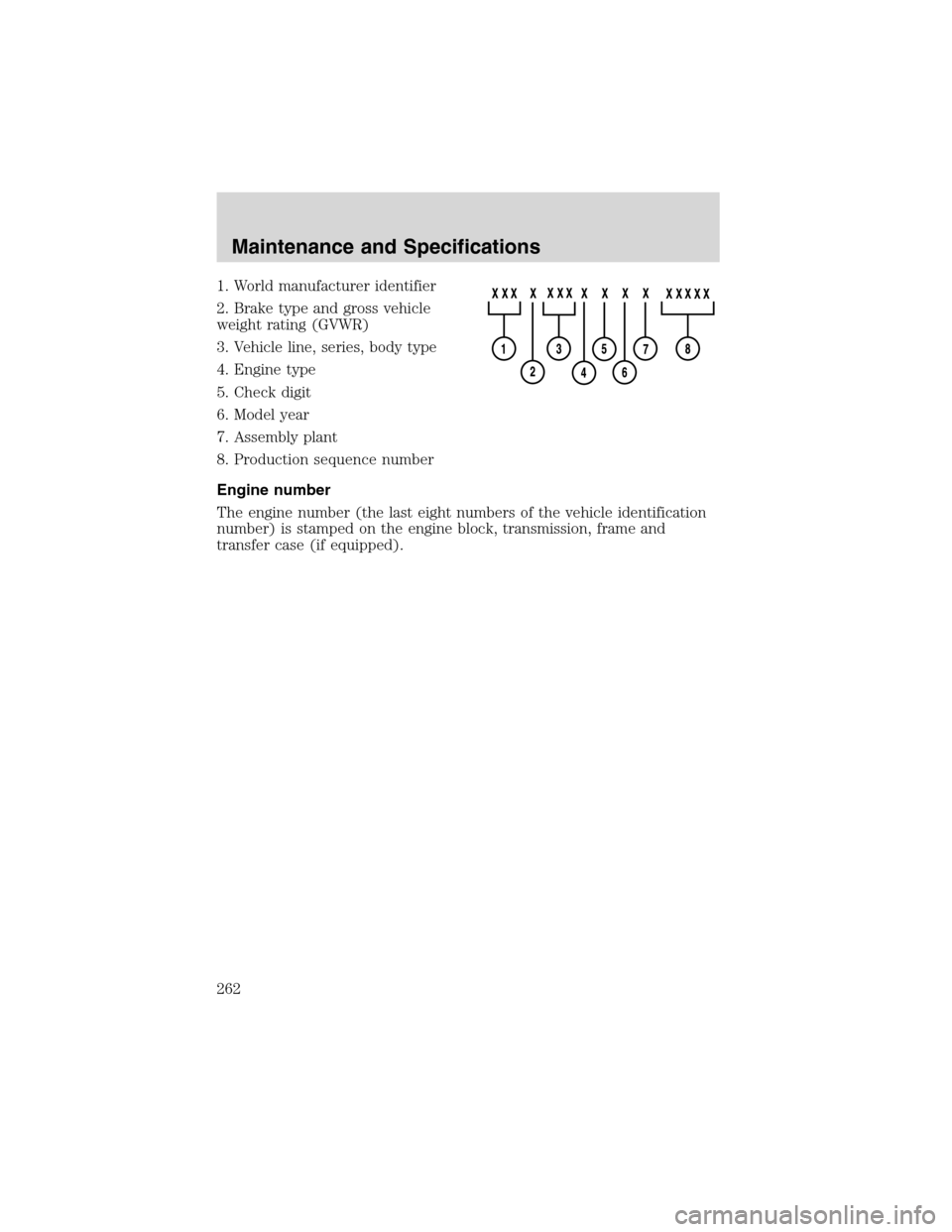
1. World manufacturer identifier
2. Brake type and gross vehicle
weight rating (GVWR)
3. Vehicle line, series, body type
4. Engine type
5. Check digit
6. Model year
7. Assembly plant
8. Production sequence number
Engine number
The engine number (the last eight numbers of the vehicle identification
number) is stamped on the engine block, transmission, frame and
transfer case (if equipped).
Maintenance and Specifications
262
Page 266 of 272
For maximum vehicle performance, keep the following information in
mind when adding accessories or equipment to your vehicle:
•When adding accessories, equipment, passengers and luggage to your
vehicle, do not exceed the total weight capacity of the vehicle or of
the front or rear axle (GVWR or GAWR as indicated on the Safety
compliance certification label). Consult your dealer for specific weight
information.
•The Federal Communications Commission (FCC) and Canadian Radio
Telecommunications Commission (CRTC) regulate the use of mobile
communications systems - such as two-way radios, telephones and
theft alarms - that are equipped with radio transmitters. Any such
equipment installed in your vehicle should comply with FCC or CRTC
regulations and should be installed only by a qualified service
technician.
•Mobile communications systems may harm the operation of your
vehicle, particularly if they are not properly designed for automotive
use or are not properly installed. When operated, such systems may
cause the engine to stumble or stall or cause the transmission to be
damaged or operate improperly. In addition, such systems may be
damaged or their performance may be affected by operating your
vehicle. (Citizens band [CB] transceivers, garage door openers and
other transmitters with outputs of five watts or less will not ordinarily
affect your vehicle’s operation.)
•Ford cannot assume responsibility for any adverse effects or damage
that may result from the use of such equipment.
Accessories
266
Page 269 of 272

Engine oil ..................................221
checking and adding ..............221
dipstick ....................................221
filter, specifications ........225, 254
recommendations ...................225
refill capacities ........................254
specifications ..................257, 259
Exhaust fumes ..........................137
F
Fail safe cooling ........................234
Flexible Fuel Vehicle (FFV) ....235
Floor mats ...................................73
Fluid capacities .........................254
Foglamps .....................................33
Four-Wheel Drive vehicles .......149
driving off road ...............151, 159
indicator light .........................150
preparing to drive your
vehicle .....................................142
Fuel ............................................235
calculating fuel
economy ............................64, 241
cap ...........................................240
capacity ...................................254
choosing the right fuel ...........238
comparisons with EPA fuel
economy estimates .................244
detergent in fuel .....................240
filling your vehicle
with fuel ..................235, 240–241
filter, specifications ........241, 254
fuel pump shut-off switch .....177
improving fuel economy ........241
octane rating ...................238, 259
quality ......................................239
running out of fuel .................240
safety information relating to
automotive fuels .....................235Fuel - flex fuel vehicle
(FFV) .................................235, 238
Fuses ..................................178, 180
G
Garage door opener ..............46, 56
Gas cap (see Fuel cap) ............240
Gas mileage
(see Fuel economy) .................241
Gauges .........................................14
GAWR (Gross Axle Weight
Rating) .......................................167
calculating ...............................169
definition .................................167
driving with a heavy load ......167
location ....................................167
GVWR (Gross Vehicle Weight
Rating) .......................................167
calculating .......................167, 169
definition .................................167
driving with a heavy load ......167
location ....................................167
H
Head restraints ...........................91
Headlamps
aiming ........................................35
bulb specifications ....................38
daytime running lights .............33
flash to pass ..............................34
high beam .................................34
Heating
heating and air
conditioning system ...........27–28
HomeLink universal
transceiver (see Garage
door opener) .........................56, 59
Index
269