CENTER CONSOLE (IF EQUIPPED)
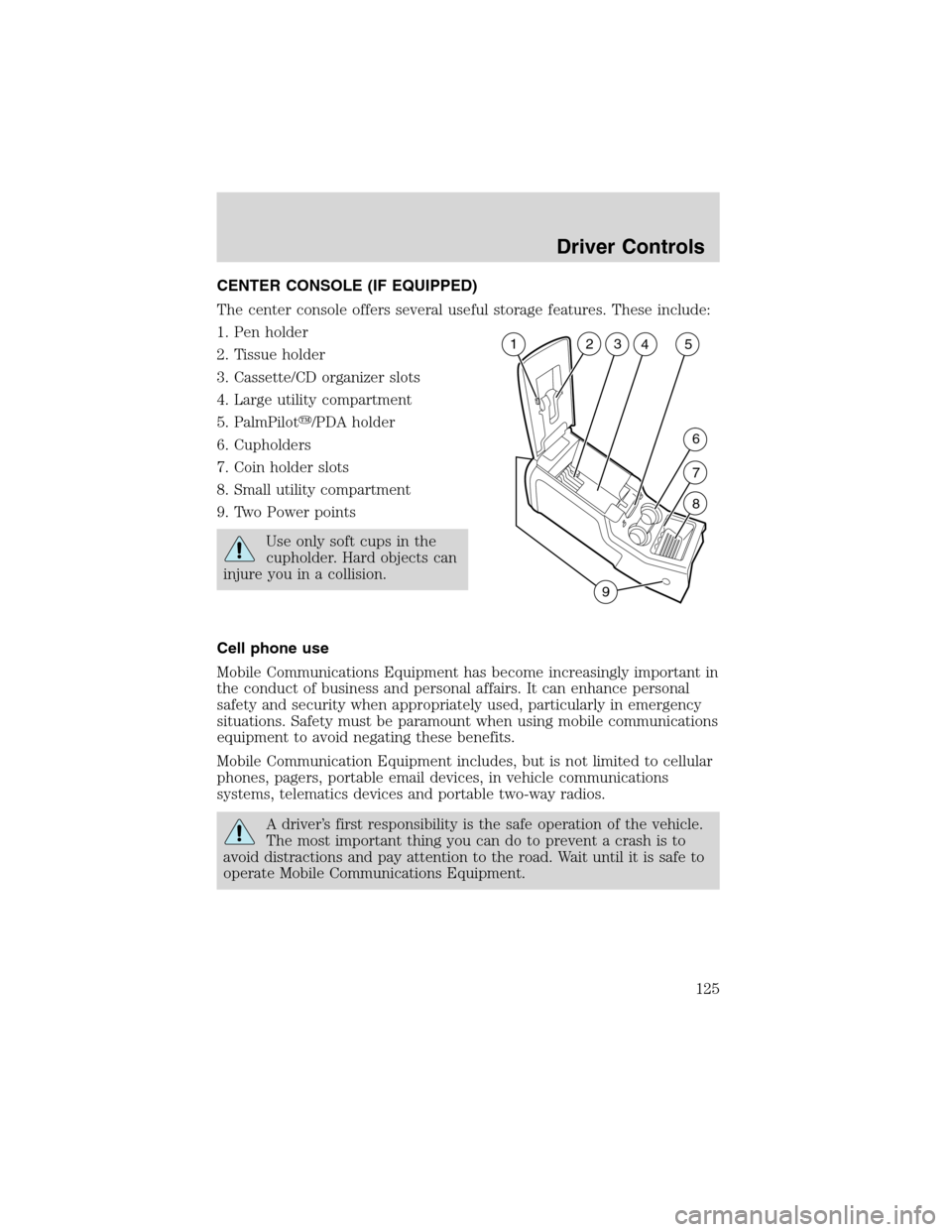
The center console offers several useful storage features. These include:
1. Pen holder
2. Tissue holder
3. Cassette/CD organizer slots
4. Large utility compartment
5. PalmPilot�/PDA holder
6. Cupholders
7. Coin holder slots
8. Small utility compartment
9. Two Power points
Use only soft cups in the
cupholder. Hard objects can
injure you in a collision.
Cell phone use
Mobile Communications Equipment has become increasingly important in
the conduct of business and personal affairs. It can enhance personal
safety and security when appropriately used, particularly in emergency
situations. Safety must be paramount when using mobile communications
equipment to avoid negating these benefits.
Mobile Communication Equipment includes, but is not limited to cellular
phones, pagers, portable email devices, in vehicle communications
systems, telematics devices and portable two-way radios.
A driver’s first responsibility is the safe operation of the vehicle.
The most important thing you can do to prevent a crash is to
avoid distractions and pay attention to the road. Wait until it is safe to
operate Mobile Communications Equipment.
23
5
6
7
8
94 1
Driver Controls
125
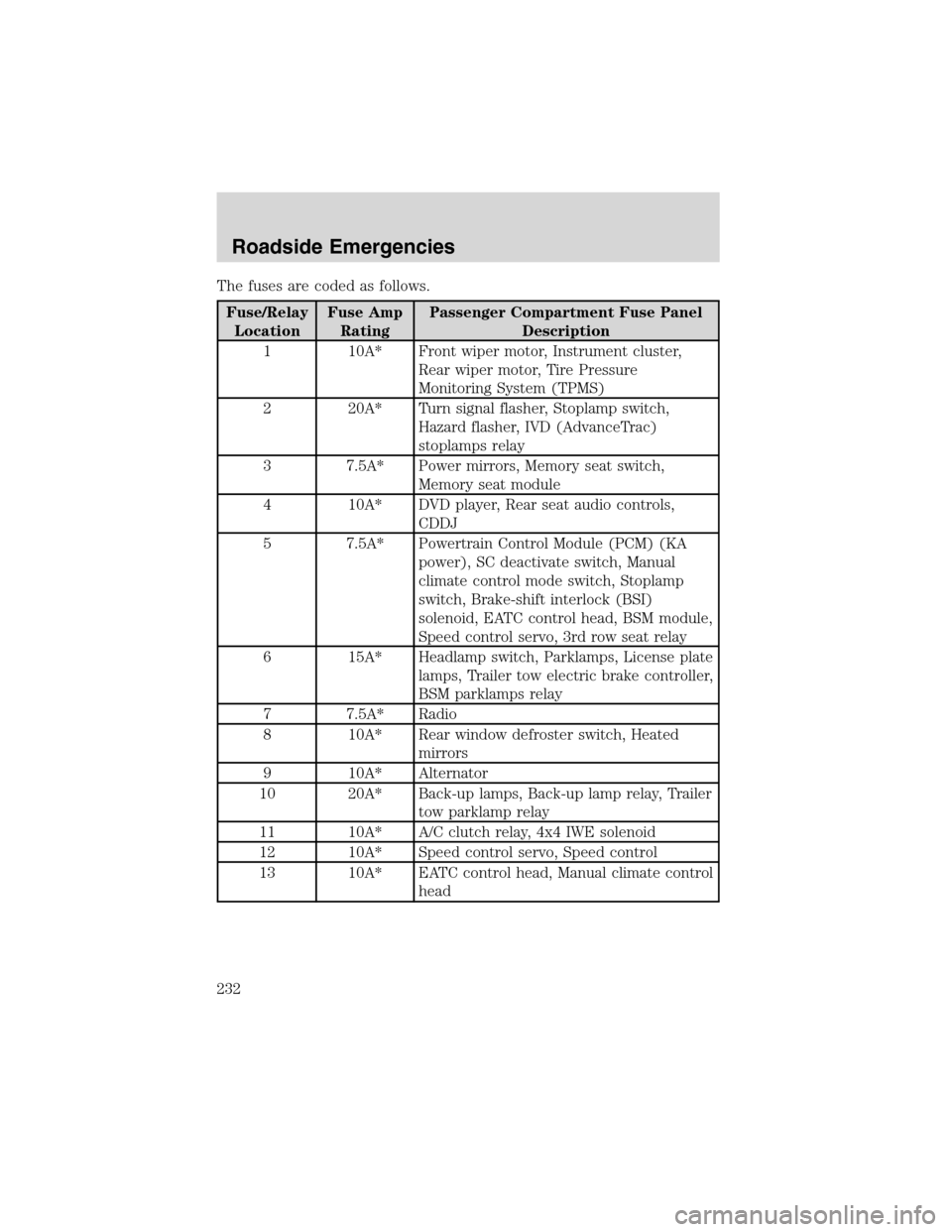
The fuses are coded as follows.
Fuse/Relay
LocationFuse Amp
RatingPassenger Compartment Fuse Panel
Description
1 10A* Front wiper motor, Instrument cluster,
Rear wiper motor, Tire Pressure
Monitoring System (TPMS)
2 20A* Turn signal flasher, Stoplamp switch,
Hazard flasher, IVD (AdvanceTrac)
stoplamps relay
3 7.5A* Power mirrors, Memory seat switch,
Memory seat module
4 10A* DVD player, Rear seat audio controls,
CDDJ
5 7.5A* Powertrain Control Module (PCM) (KA
power), SC deactivate switch, Manual
climate control mode switch, Stoplamp
switch, Brake-shift interlock (BSI)
solenoid, EATC control head, BSM module,
Speed control servo, 3rd row seat relay
6 15A* Headlamp switch, Parklamps, License plate
lamps, Trailer tow electric brake controller,
BSM parklamps relay
7 7.5A* Radio
8 10A* Rear window defroster switch, Heated
mirrors
9 10A* Alternator
10 20A* Back-up lamps, Back-up lamp relay, Trailer
tow parklamp relay
11 10A* A/C clutch relay, 4x4 IWE solenoid
12 10A* Speed control servo, Speed control
13 10A* EATC control head, Manual climate control
head
Roadside Emergencies
232
Make sure that all replacement tires are of the same size, type,
load-carrying capacity and tread design (e.g.,“All Terrain”,
“Touring”, etc.), as originally offered by Ford.
Do not replace your tires with“high performance”tires or larger
size tires.
Failure to follow these precautions may adversely affect the
handling of the vehicle and make it easier for the driver to lose
control and roll over.
Tires that are larger or smaller than your vehicle’s original tires may also
affect the accuracy of your speedometer.
Tire pressure monitoring system (TPMS) (if equipped)
The tire pressure monitoring system provides the driver with a warning
message indicating when tire pressure is severely low or high. This
system is a supplement to normal tire maintenance including regular
manual inspections. The device will inform the operator of severe low or
high inflation pressures, but may not illuminate for less severe
discrepancies in inflation pressure.
The system uses radio-frequency pressure sensors to monitor the tire
pressure on all tires including the spare. The sensors transmit the tire
pressure readings to the receiver module located in the vehicle. The
receiver module then transmits the status to the message center. For
more tire warning information, refer to theMessage Centerin the
Driver controlschapter.
This device complies with part 15 of the FCC rules and with RS-210 of
Industry Canada. Operation is subject to the following two conditions:
(1) This device may not cause harmful interference, and (2) This device
must accept any interference received, including interference that may
cause undesired operation.
The tire pressure monitoring system is NOT a substitute for
checking tire pressure. The tire pressure should be checked
periodically (at least monthly) using a tire gauge, seeChecking the
tire pressurein this chapter. Failure to properly maintain your tire
pressure could increase the risk of tire failure and the potential for
personal injury.
Maintenance and Specifications
298