Page 165 of 184
Note:Do not start your engine with the air cleaner removed and do not
remove it while the engine is running.
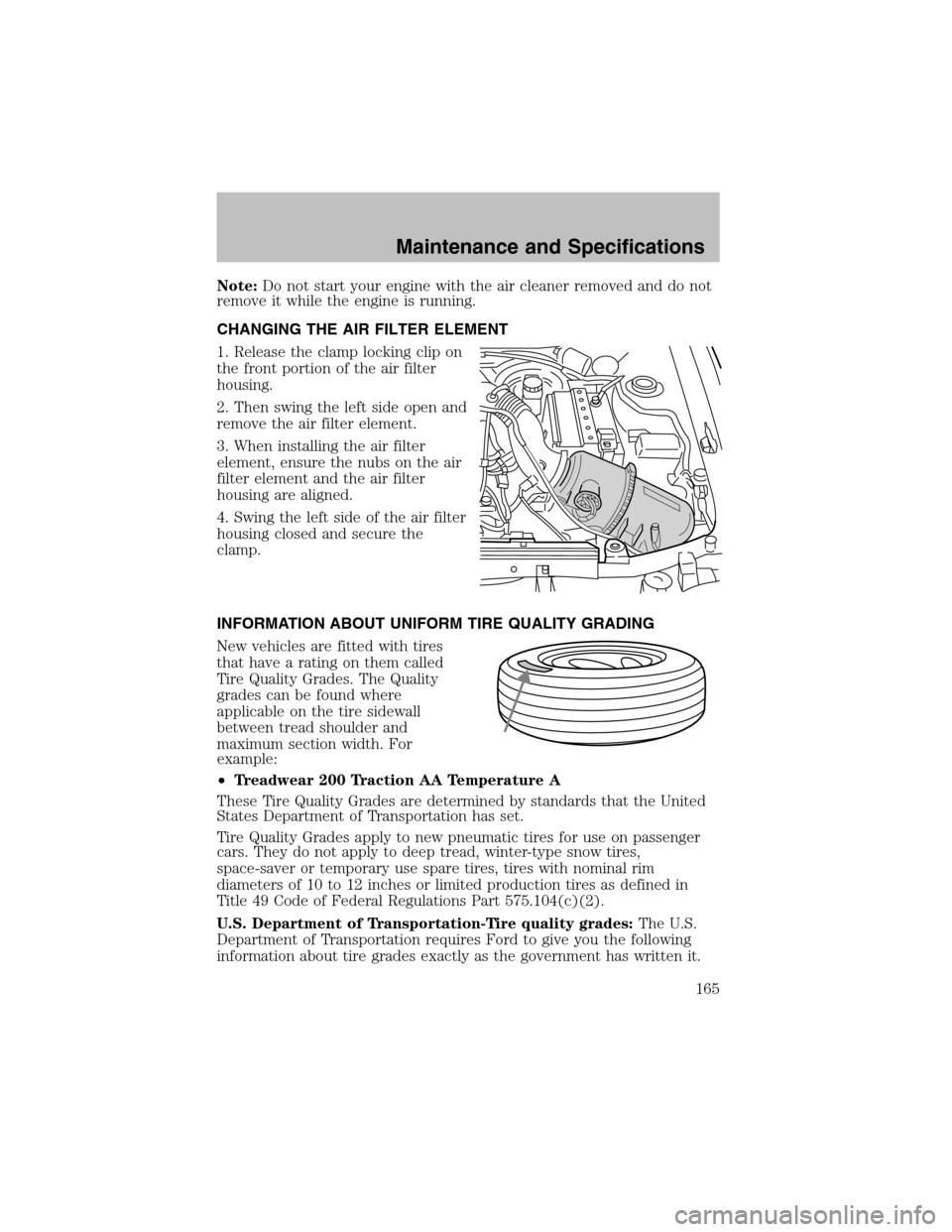
CHANGING THE AIR FILTER ELEMENT
1. Release the clamp locking clip on
the front portion of the air filter
housing.
2. Then swing the left side open and
remove the air filter element.
3. When installing the air filter
element, ensure the nubs on the air
filter element and the air filter
housing are aligned.
4. Swing the left side of the air filter
housing closed and secure the
clamp.
INFORMATION ABOUT UNIFORM TIRE QUALITY GRADING
New vehicles are fitted with tires
that have a rating on themcalled
Tire Quality Grades. The Quality
grades can be found where
applicable on the tire sidewall
between tread shoulder and
maximum section width. For
example:
•Treadwear 200 Traction AA Temperature A
These Tire Quality Grades are determined by standards that the United
States Department of Transportation has set.
Tire Quality Grades apply to new pneumatic tires for use on passenger
cars. They do not apply to deep tread, winter-type snow tires,
space-saver or temporary use spare tires, tires with nominal rim
diameters of 10 to 12 inches or limited production tires as defined in
Title 49 Code of Federal Regulations Part 575.104(c)(2).
U.S. Department of Transportation-Tire quality grades:The U.S.
Department of Transportation requires Ford to give you the following
information about tire grades exactly as the government has written it.
Maintenance and Specifications
165
Page 166 of 184
Treadwear
The treadwear grade is a comparative rating based on the wear rate of
the tire when tested under controlled conditions on a specified
government test course. For example, a tire graded 150 would wear one
and one-half (1 1/2) times as well on the government course as a tire
graded 100. The relative performance of tires depends upon the actual
conditions of their use, however, and may depart significantly from the
normdue to variations in driving habits, service practices, and
differences in road characteristics and climate.
Traction AA A B C
The traction grades, fromhighest to lowest are AA, A, B, and C. The
grades represent the tire’s ability to stop on wet pavement as measured
under controlled conditions on specified government test surfaces of
asphalt and concrete. A tire marked C may have poor traction
performance.
The traction grade assigned to this tire is based on
straight-ahead braking traction tests, and does not include
acceleration, cornering, hydroplaning or peak traction characteristics.
Temperature A B C
The temperature grades are A (the highest), B and C, representing the
tire’s resistance to the generation of heat and its ability to dissipate heat
when tested under controlled conditions on a specified indoor laboratory
test wheel. Sustained high temperature can cause the material of the tire
to degenerate and reduce tire life, and excessive temperature can lead to
sudden tire failure. The grade C corresponds to a level of performance
which all passenger car tires must meet under the Federal Motor Vehicle
Safety Standard No. 109. Grades B and A represent higher levels of
performance on the laboratory test wheel than the minimum required by
law.
The temperature grade for this tire is established for a tire that
is properly inflated and not overloaded. Excessive speed,
underinflation, or excessive loading, either separately or in
combination, can cause heat buildup and possible tire failure.
SERVICING YOUR TIRES
Checking the tire pressure
•Use an accurate tire pressure gauge.
Maintenance and Specifications
166
Page 167 of 184
•Check the tire pressure when tires are cold, after the vehicle has been
parked for at least one hour or has been driven less than 5 km(3
miles).
•Adjust tire pressure to recommended specifications found on the
Certification Label.
Improperly inflated tires can affect vehicle handling and can fail
suddenly, possibly resulting in loss of vehicle control, vehicle
rollover and/or personal injury.
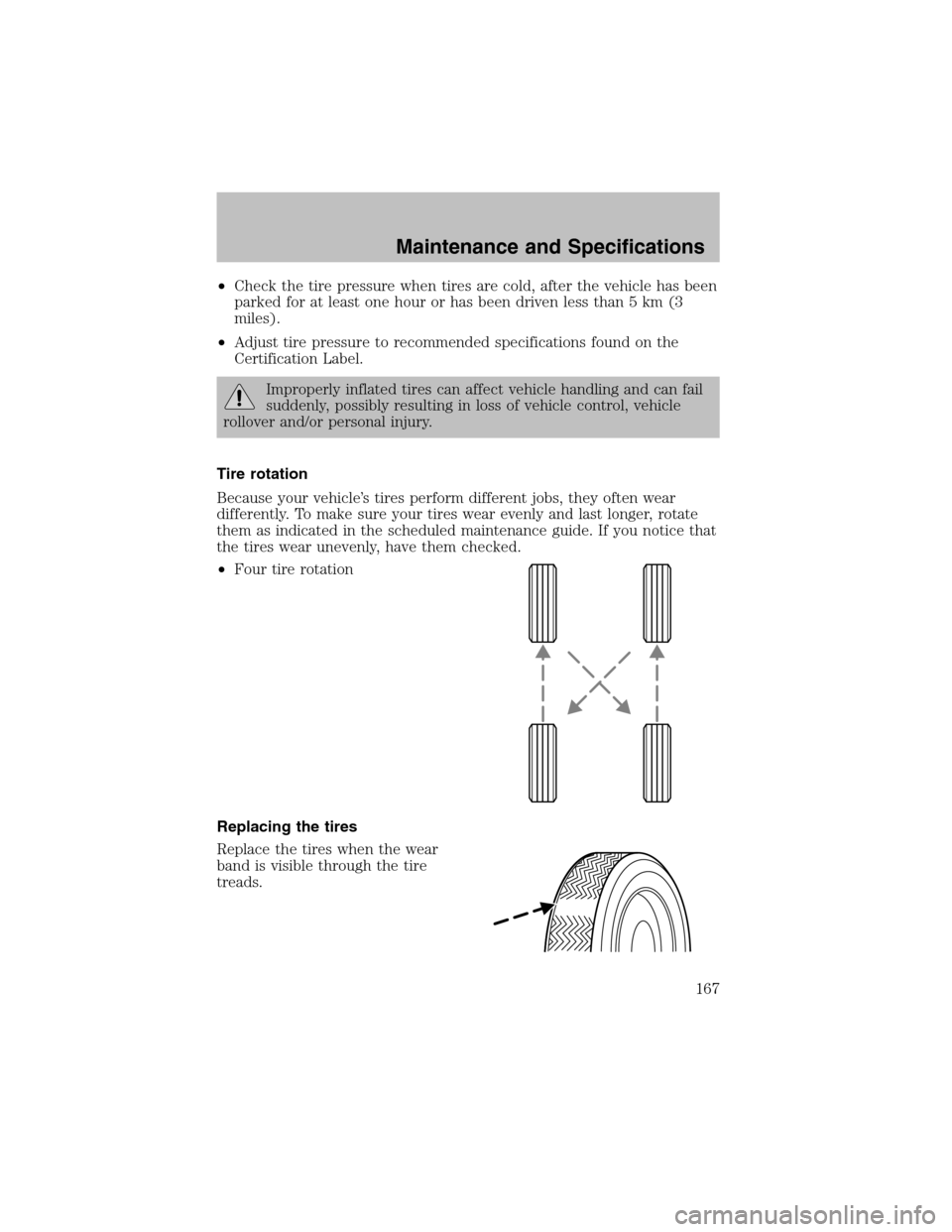
Tire rotation
Because your vehicle’s tires performdifferent jobs, they often wear
differently. To make sure your tires wear evenly and last longer, rotate
themas indicated in the scheduled maintenance guide. If you notice that
the tires wear unevenly, have themchecked.
•Four tire rotation
Replacing the tires
Replace the tires when the wear
band is visible through the tire
treads.
Maintenance and Specifications
167
Page 168 of 184
When replacing full size tires, never mix radial bias-belted, or
bias-type tires. Use only the tire sizes that are listed on the
Certification or Tire Label. Make sure that all tires are the same size,
speed rating, and load-carrying capacity. Use only the tire combinations
recommended on the label. If you do not follow these precautions,
your vehicle may not drive properly and safely.
Make sure that all replacement tires are of the same size, type,
load-carrying capacity and tread design (e.g., “All Terrain”,
“Touring”, etc.), as originally offered by Ford.
Failure to follow these precautions may adversely affect the
handling of the vehicle, and increase the risk of loss of vehicle
control, vehicle rollover and/or personal injury.
Tires that are larger or smaller than your vehicle’s original tires may also
affect the accuracy of your speedometer.
SNOW TIRES AND CHAINS
Snow tires must be the same size and grade as the tires you
currently have on your vehicle.
The tires on your vehicle have all weather treads to provide traction in
rain and snow. However, in some climates, you may need to use snow
tires and chains. If you need to use snow tires and chains, it is
recommended that steel wheels are used of the same size and
specifications as those originally installed.
Follow these guidelines when using snow tires and chains:
•Do not use tire chains on aluminum wheels. Chains may chip the
wheels.
•SAE Class S chains may be used on P185/65R14 tires.
•Do not use tire chains with 38 cm(15 inch) wheel/tire options. Using
chains on this size tire may cause damage to steering, suspension
and/or body components.
•Install chains securely, verifying that the chains do not touch any
wiring, brake lines or fuel lines.
•Drive cautiously. If you hear the chains rub or bang against your
vehicle, stop and re-tighten the chains. If this does not work, remove
the chains to prevent damage to your vehicle.
Maintenance and Specifications
168
Page 169 of 184
•If possible, avoid fully loading your vehicle.
•Remove the tire chains when they are no longer needed. Do not use
tire chains on dry roads.
•The suspension insulation and bumpers will help prevent vehicle
damage. Do not remove these components from your vehicle when
using snow tires and chains.
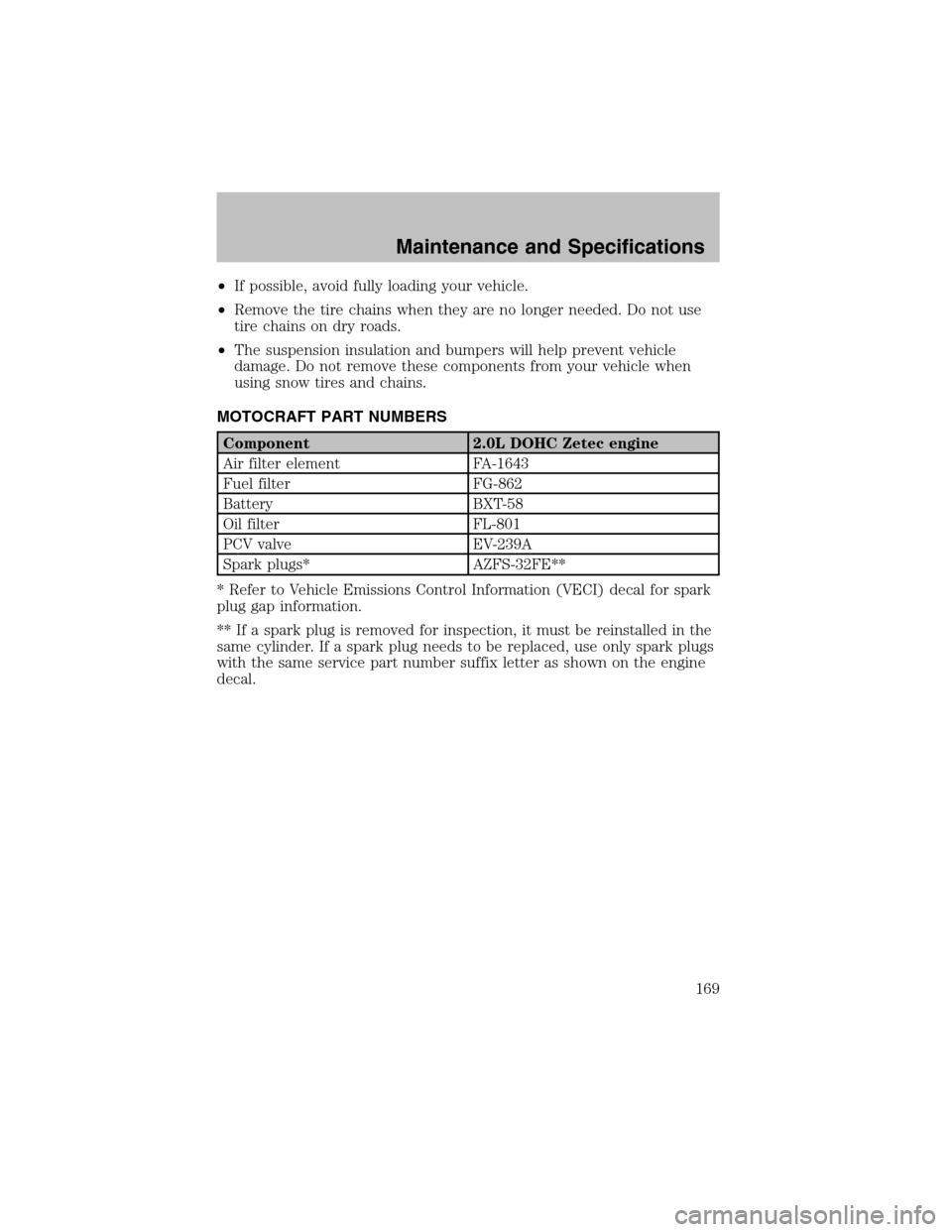
MOTOCRAFTPARTNUMBERS
Component 2.0L DOHC Zetecengine
Air filter element FA-1643
Fuel filter FG-862
Battery BXT-58
Oil filter FL-801
PCV valve EV-239A
Spark plugs* AZFS-32FE**
* Refer to Vehicle Emissions Control Information (VECI) decal for spark
plug gap information.
** If a spark plug is removed for inspection, it must be reinstalled in the
same cylinder. If a spark plug needs to be replaced, use only spark plugs
with the same service part number suffix letter as shown on the engine
decal.
Maintenance and Specifications
169
Page 170 of 184
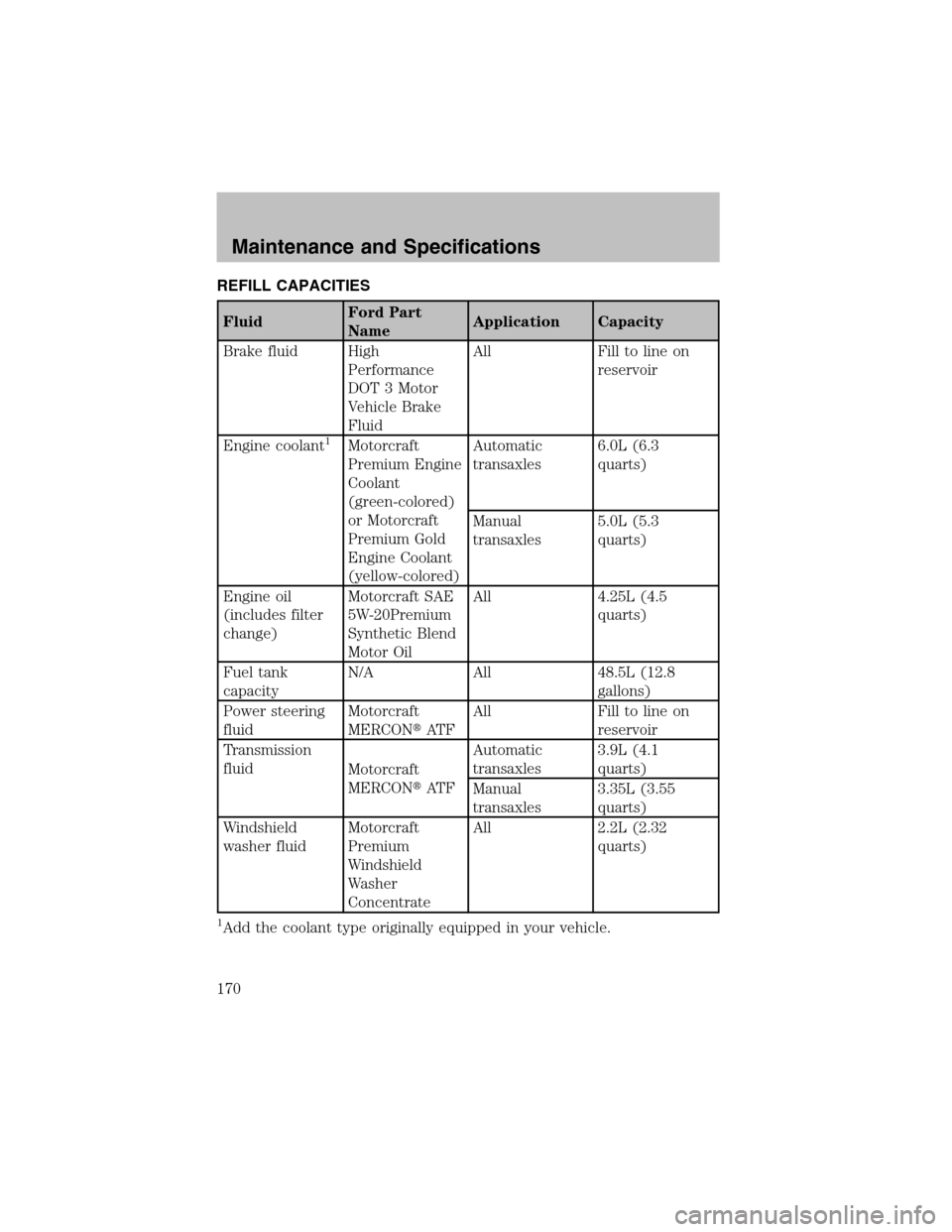
REFILL CAPACITIES
FluidFord Part
NameApplication Capacity
Brake fluid High
Performance
DOT 3 Motor
Vehicle Brake
FluidAll Fill to line on
reservoir
Engine coolant
1Motorcraft
Premium Engine
Coolant
(green-colored)
or Motorcraft
Premium Gold
Engine Coolant
(yellow-colored)Automatic
transaxles6.0L (6.3
quarts)
Manual
transaxles5.0L (5.3
quarts)
Engine oil
(includes filter
change)Motorcraft SAE
5W-20Premium
Synthetic Blend
Motor OilAll 4.25L (4.5
quarts)
Fuel tank
capacityN/A All 48.5L (12.8
gallons)
Power steering
fluidMotorcraft
MERCON�AT FAll Fill to line on
reservoir
Transmission
fluid
Motorcraft
MERCON�AT FAutomatic
transaxles3.9L (4.1
quarts)
Manual
transaxles3.35L (3.55
quarts)
Windshield
washer fluidMotorcraft
Premium
Windshield
Washer
ConcentrateAll 2.2L (2.32
quarts)
1Add the coolant type originally equipped in your vehicle.
Maintenance and Specifications
170
Page 171 of 184
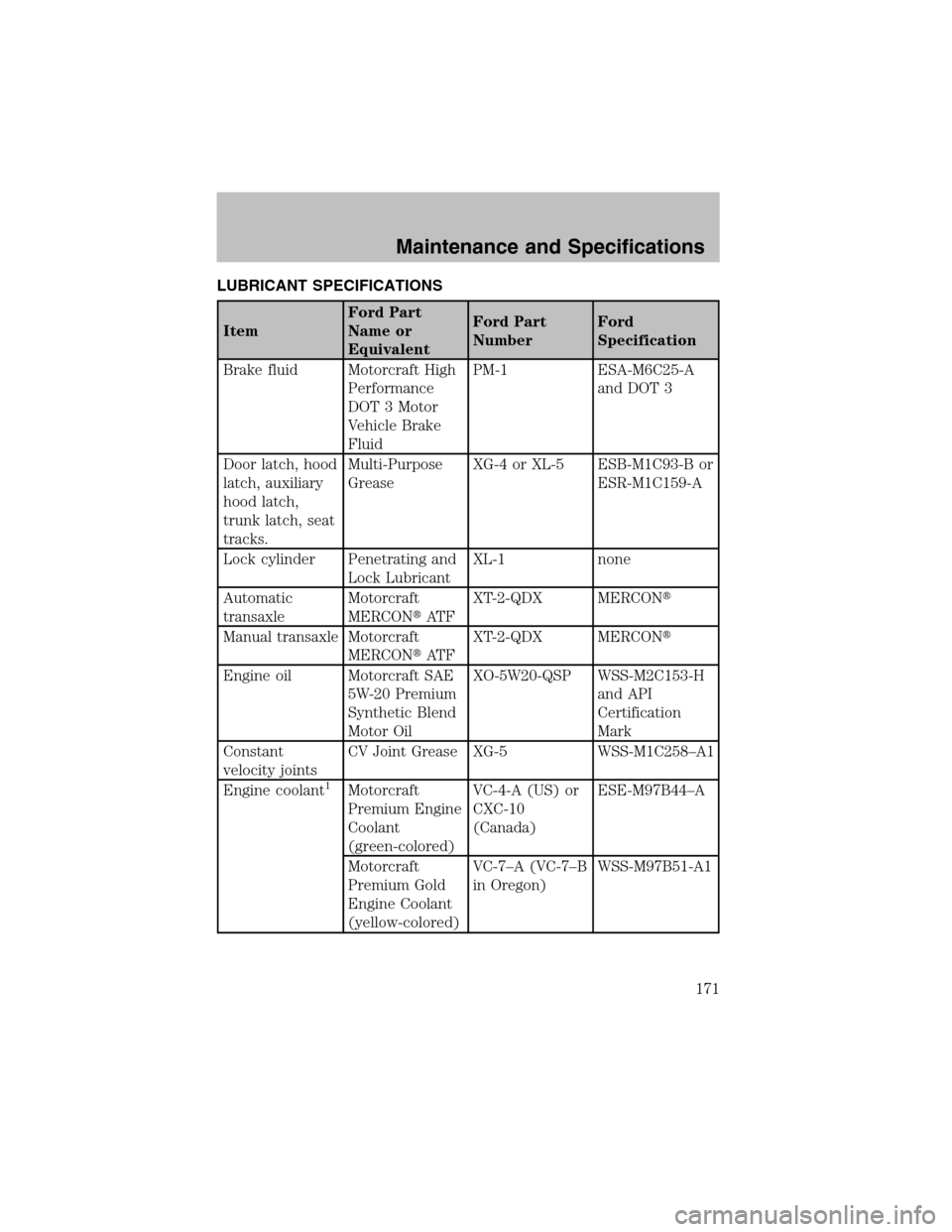
LUBRICANTSPECIFICATIONS
ItemFord Part
Name or
EquivalentFord Part
NumberFord
Specification
Brake fluid Motorcraft High
Performance
DOT 3 Motor
Vehicle Brake
FluidPM-1 ESA-M6C25-A
and DOT 3
Door latch, hood
latch, auxiliary
hood latch,
trunk latch, seat
tracks.Multi-Purpose
GreaseXG-4 or XL-5 ESB-M1C93-B or
ESR-M1C159-A
Lock cylinder Penetrating and
Lock LubricantXL-1 none
Automatic
transaxleMotorcraft
MERCON�AT FXT-2-QDX MERCON�
Manual transaxle Motorcraft
MERCON�AT FXT-2-QDX MERCON�
Engine oil Motorcraft SAE
5W-20 Premium
Synthetic Blend
Motor OilXO-5W20-QSP WSS-M2C153-H
and API
Certification
Mark
Constant
velocity jointsCV Joint Grease XG-5 WSS-M1C258–A1
Engine coolant
1Motorcraft
Premium Engine
Coolant
(green-colored)VC-4-A (US) or
CXC-10
(Canada)ESE-M97B44–A
Motorcraft
Premium Gold
Engine Coolant
(yellow-colored)VC-7–A (VC-7–B
in Oregon)WSS-M97B51-A1
Maintenance and Specifications
171
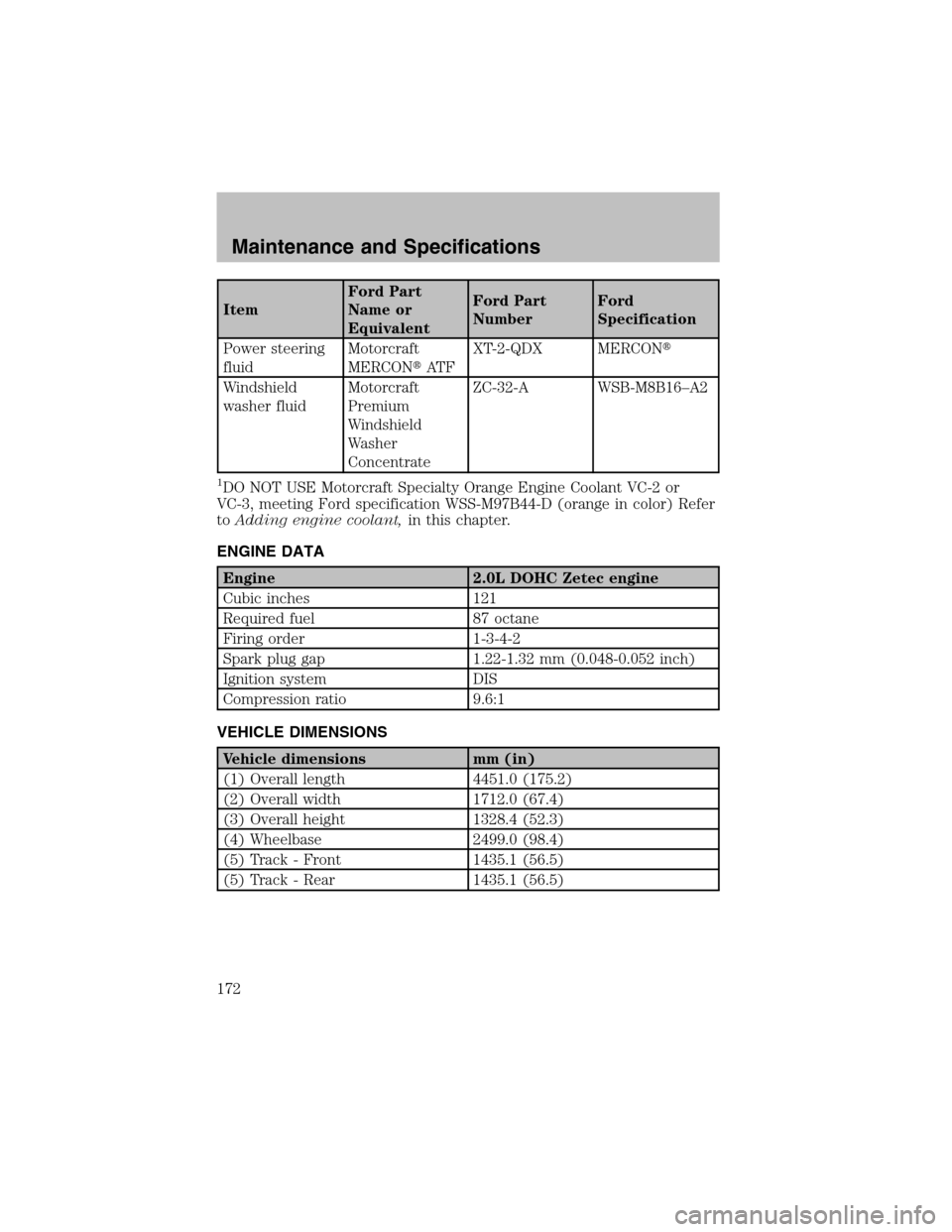
Page 172 of 184
ItemFord Part
Name or
EquivalentFord Part
NumberFord
Specification
Power steering
fluidMotorcraft
MERCON�AT FXT-2-QDX MERCON�
Windshield
washer fluidMotorcraft
Premium
Windshield
Washer
ConcentrateZC-32-A WSB-M8B16–A2
1DO NOT USE Motorcraft Specialty Orange Engine Coolant VC-2 or
VC-3, meeting Ford specification WSS-M97B44-D (orange in color) Refer
toAdding engine coolant,in this chapter.
ENGINE DATA
Engine 2.0L DOHC Zetecengine
Cubic inches 121
Required fuel 87 octane
Firing order 1-3-4-2
Spark plug gap 1.22-1.32 mm (0.048-0.052 inch)
Ignition systemDIS
Compression ratio 9.6:1
VEHICLE DIMENSIONS
Vehicle dimensions mm (in)
(1) Overall length 4451.0 (175.2)
(2) Overall width 1712.0 (67.4)
(3) Overall height 1328.4 (52.3)
(4) Wheelbase 2499.0 (98.4)
(5) Track - Front 1435.1 (56.5)
(5) Track - Rear 1435.1 (56.5)
Maintenance and Specifications
172