2003 FORD ESCORT parking brake
[x] Cancel search: parking brakePage 145 of 184
When lifting a plastic-cased battery, excessive pressure on the
end walls could cause acid to flow through the vent caps,
resulting in personal injury and/or damage to the vehicle or battery.
Lift the battery with a battery carrier or with your hands on opposite
corners.
Keep batteries out of reach of children. Batteries contain sulfuric
acid. Avoid contact with skin, eyes or clothing. Shield your eyes
when working near the battery to protect against possible splashing of
acid solution. In case of acid contact with skin or eyes, flush
immediately with water for a minimum of 15 minutes and get prompt
medical attention. If acid is swallowed, call a physician immediately.
Battery posts, terminals and related accessories contain lead and
lead compounds.Wash hands after handling.
Because your vehicle’s engine is electronically controlled by a computer,
some control conditions are maintained by power from the battery. When
the battery is disconnected or a new battery is installed, the engine must
relearn its idle and fuel trimstrategy for optimumdriveability and
performance. To begin this process:
1. With the vehicle at a complete stop, set the parking brake.
2. Put the gearshift in P (Park) (automatic transaxle) or the neutral
position (manual transaxle), turn off all accessories and start the engine.
3. Run the engine until it reaches normal operating temperature.
4. Allow the engine to idle for at least one minute.
5. Turn the A/C on and allow the engine to idle for at least one minute.
6. Drive the vehicle to complete the relearning process.
•The vehicle may need to be driven 16 km (10 miles) or more to
relearn the idle and fuel trimstrategy.
•If you do not allow the engine to relearn its idle trim, the idle
quality of your vehicle may be adversely affected until the idle
trim is eventually relearned.
When the battery is disconnected or a new battery installed, the
transmission must learn its adaptive strategy. As a result of this, the
transmission may shift firmly. This operation is considered normal and
will fully update transmission operation to its optimum shift feel.
Maintenance and Specifications
145
Page 162 of 184
weather or pulling a trailer, the vehicle should be turned off for
about 30 minutes to allow fluid to cool before checking.
1. Drive the vehicle 30 km (20 miles) or until it reaches normal operating
temperature.
2. Park the vehicle on a level surface and engage the parking brake.
3. With the parking brake engaged and your foot on the brake pedal,
start the engine and move the gearshift lever through all of the gear
ranges. Allow sufficient time for each gear to engage.
4. Latch the gearshift lever in P (Park) and leave the engine running.
5. Remove the dipstick, wiping it clean with a clean, dry lint free rag. If
necessary, refer toIdentifying components in the engine compartment
in this chapter for the location of the dipstick.
6. Install the dipstick making sure it is fully seated in the filler tube.
7. Remove the dipstick and inspect the fluid level. The fluid should be in
the designated areas for normal operating temperature.
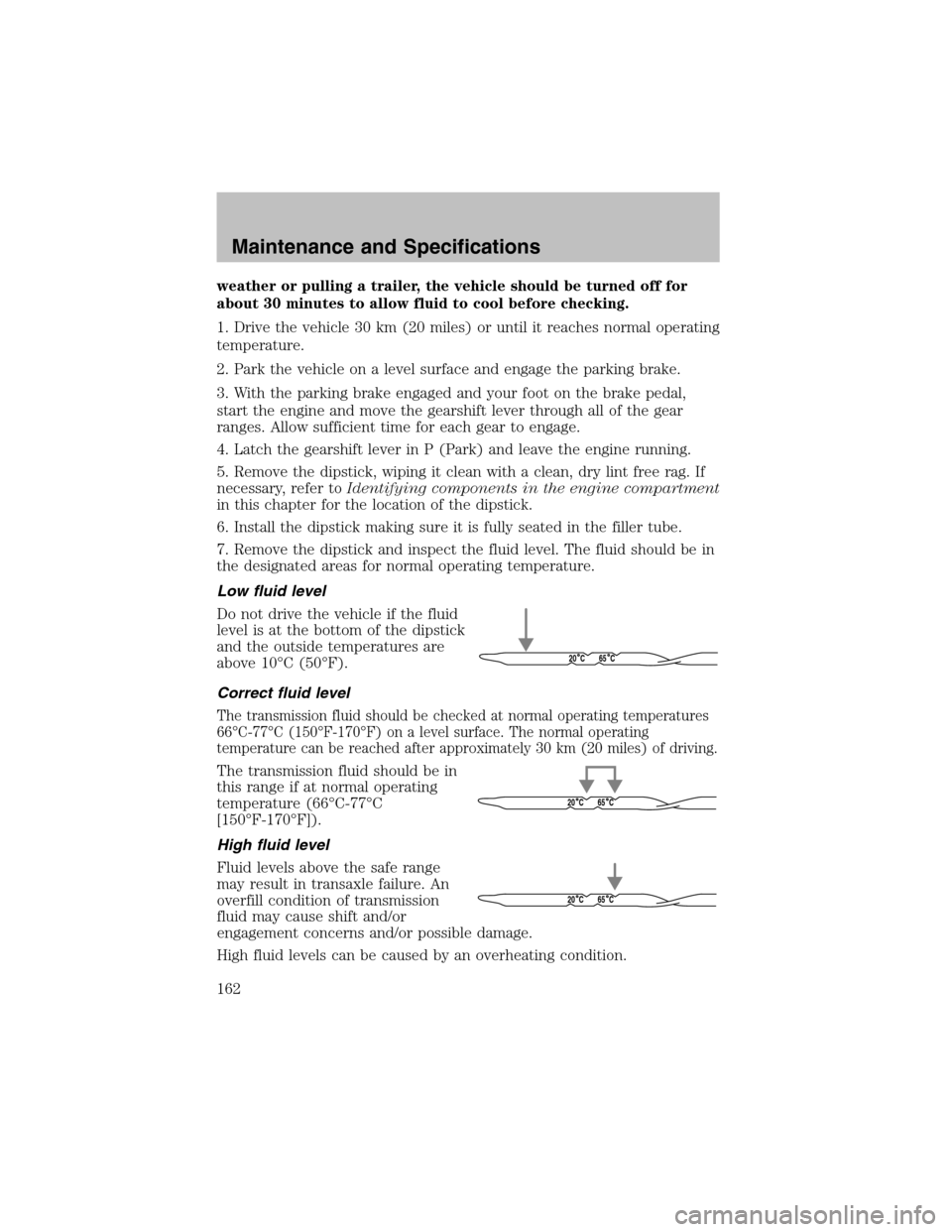
Low fluid level
Do not drive the vehicle if the fluid
level is at the bottomof the dipstick
and the outside temperatures are
above 10°C (50°F).
Correct fluid level
The transmission fluid should be checked at normal operating temperatures
66°C-77°C (150°F-170°F) on a level surface. The normal operating
temperature can be reached after approximately 30 km (20 miles) of driving.
The transmission fluid should be in
this range if at normal operating
temperature (66°C-77°C
[150°F-170°F]).
High fluid level
Fluid levels above the safe range
may result in transaxle failure. An
overfill condition of transmission
fluid may cause shift and/or
engagement concerns and/or possible damage.
High fluid levels can be caused by an overheating condition.
20 C65 C
20 C65 C
20 C65 C
Maintenance and Specifications
162
Page 179 of 184

A
ABS (see Brakes) .......................89
Air bag supplemental restraint
system..........................................69
and child safety seats ..............71
description ................................69
disposal ......................................73
driver air bag ............................71
indicator light ...........................73
operation ...................................71
passenger air bag .....................71
Air cleaner filter .......164–165, 169
Air conditioning
manual heating and air
conditioning system.................29
Antifreeze
(see Engine coolant) ................146
Anti-lock brake system
(see Brakes) ................................89
Anti-theft system........................56
arming the system ....................56
disarming a triggered system ..57
disarming an untriggered
system.......................................57
Audio system(see Radio) .........19
Automatic transaxle
driving with ...............................93
fluid, adding ............................161
fluid, checking ........................161
fluid, refill capacities ..............170
fluid, specification ..................172
Automatic transmission ..............91
Axle
lubricant specifications ..........171
B
Battery .......................................144acid, treating emergencies .....144
jumping a disabled battery ....114
maintenance-free ....................144
replacement, specifications ...169
servicing ..................................144
BeltMinder ...................................65
Brakes ....................................88–89
anti-lock .....................................89
anti-lock brake system(ABS)
warning light .............................90
fluid, checking and adding ....160
fluid, refill capacities ..............170
fluid, specifications .........171–172
lubricant specifications ..171–172
parking ......................................90
shift interlock ............................91
Bulbs ............................................37
C
Capacities for refilling fluids ....170
Cell phone use ............................49
Certification Label ....................174
Changing a tire .........................110
Child safety restraints ................74
child safety belts ......................74
Child safety seats ........................76
attaching with tether straps ....80
in front seat ..............................78
in rear seat ................................78
Cleaning your vehicle
engine compartment ..............131
instrument panel ....................133
interior .....................................133
plastic parts ............................132
washing ....................................130
waxing .....................................130
wheels ......................................131
wiper blades ............................132
Index
179
Page 182 of 184

cargo lamps ...............................34
fog lamps ...................................33
headlamps ...........................33, 38
headlamps, flash to pass ..........34
instrument panel, dimming .....34
interior lamps .....................37–38
replacing bulbs .............37, 40–42
Lane change indicator
(see Turn signal) ........................36
Lights, warning and indicator ....10
anti-lock brakes (ABS) ............90
Load limits ...................................99
GAWR ........................................99
GVWR ........................................99
trailer towing ............................99
Lubricant specifications ...171–172
M
Manual transaxle
fluid capacities ........................170
lubricant specifications ..........172
Manual transmission ...................97
reverse .......................................98
Mirrors
side view mirrors (power) .......45
Moon roof ....................................48
Motorcraft parts ................155, 169
O
Octane rating ............................154
Oil (see Engine oil) ..................141
P
Parking brake ..............................90
Parts (see Motorcraft parts) ....169Power distribution box
(see Fuses) ...............................108
Power door locks ........................51
Power steering ............................91
fluid, checking and adding ....160
fluid, refill capacity ................170
fluid, specifications .........171–172
Power Windows ...........................44
R
Radio ............................................19
Rear window defroster ...............32
Relays ................................105, 110
Remote entry system .................53
locking/unlocking doors ...........51
opening the trunk .....................54
Roadside assistance ..................103
S
Safety belts
(see Safety restraints) .........60–63
Safety defects, reporting ..........129
Safety restraints ....................60–63
belt minder ...............................65
cleaning the safety belts ..........68
extension assembly ..................64
for adults .............................61–63
for children .........................73–74
warning light and chime ..........64
Safety seats for children ............76
Seat belts (see Safety
restraints) ....................................60
Seats ............................................58
child safety seats ......................76
Servicing your vehicle ..............136
Index
182