2003 FORD ESCORT warning light
[x] Cancel search: warning lightPage 68 of 184
5. Buckle then unbuckle the safety belt three times, ending with the
safety belt unbuckled.
•After step 5 the safety belt warning light will be turned on for three
seconds.
6. Within seven seconds of the safety belt warning light turning off,
buckle then unbuckle the safety belt.
•This will disable BeltMinder if it is currently enabled, or enable
BeltMinder if it is currently disabled.
7. Confirmation of disabling BeltMinder is provided by the safety belt
warning light flashing four times per second for three seconds.
8. Confirmation of enabling BeltMinder is provided by:
•The safety belt warning light flashing four times per second for three
seconds.
•Followed by three seconds with the safety belt warning light off.
•Once again, the safety belt warning light will flash four times per
second for three seconds.
9. After receiving confirmation, the deactivation/activation procedure is
complete.
Safety belt maintenance
Inspect the safety belt systems periodically to make sure they work
properly and are not damaged. Inspect the safety belts to make sure
there are no nicks, tears or cuts. Replace if necessary. All safety belt
assemblies, including retractors, buckles, front seat belt buckle
assemblies, buckle support assemblies (slide bar-if equipped), shoulder
belt height adjusters (if equipped), shoulder belt guide on seatback (if
equipped), child safety seat LATCH and tether anchors, and attaching
hardware, should be inspected after a collision. Ford Motor Company
recommends that all safety belt assemblies used in vehicles involved in a
collision be replaced. However, if the collision was minor and a qualified
technician finds that the belts do not show damage and continue to
operate properly, they do not need to be replaced. Safety belt assemblies
not in use during a collision should also be inspected and replaced if
either damage or improper operation is noted.
Failure to inspect and if necessary replace the safety belt
assembly under the above conditions could result in severe
personal injuries in the event of a collision.
Refer toInteriorin theCleaningchapter.
Seating and Safety Restraints
68
Page 72 of 184
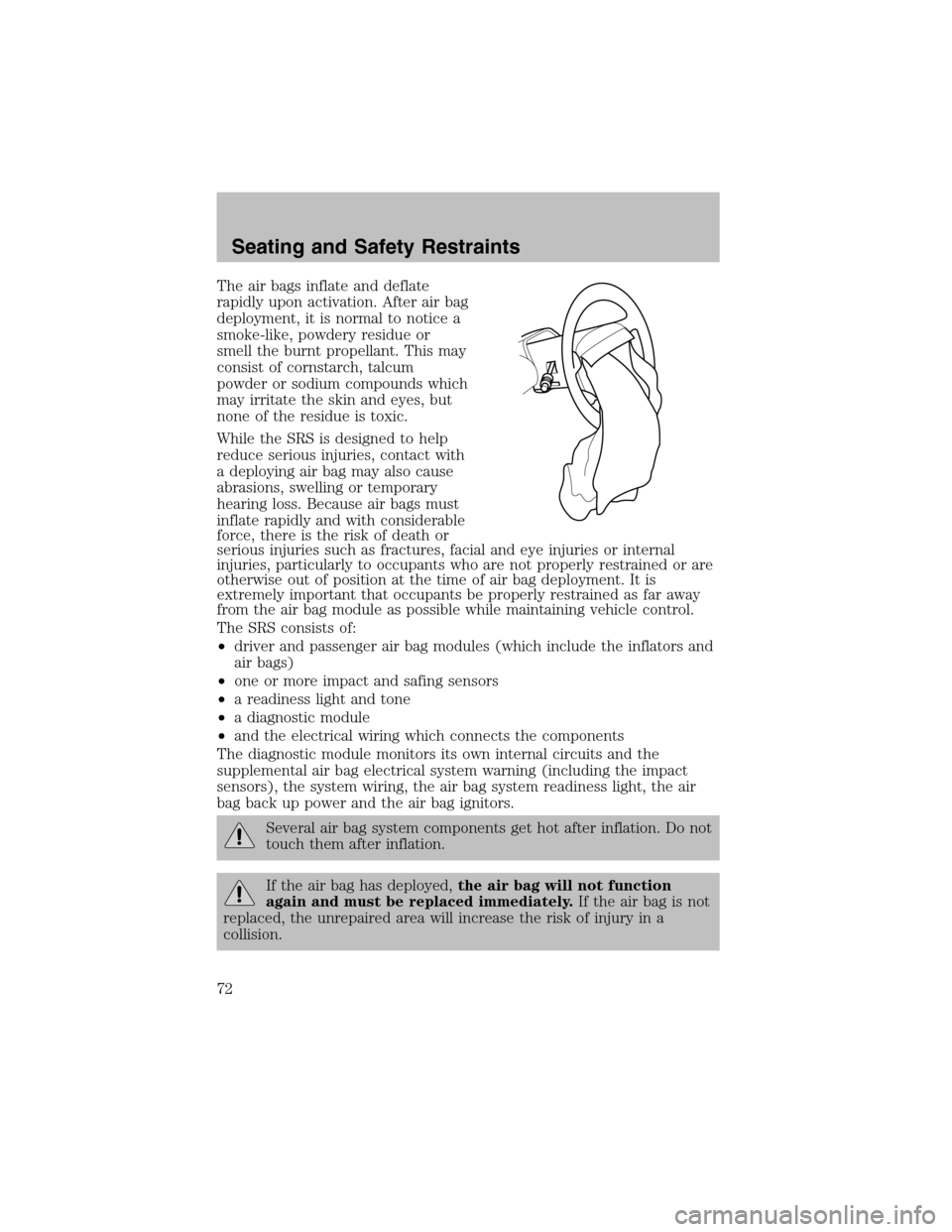
The air bags inflate and deflate
rapidly upon activation. After air bag
deployment, it is normal to notice a
smoke-like, powdery residue or
smell the burnt propellant. This may
consist of cornstarch, talcum
powder or sodiumcompounds which
may irritate the skin and eyes, but
none of the residue is toxic.
While the SRS is designed to help
reduce serious injuries, contact with
a deploying air bag may also cause
abrasions, swelling or temporary
hearing loss. Because air bags must
inflate rapidly and with considerable
force, there is the risk of death or
serious injuries such as fractures, facial and eye injuries or internal
injuries, particularly to occupants who are not properly restrained or are
otherwise out of position at the time of air bag deployment. It is
extremely important that occupants be properly restrained as far away
from the air bag module as possible while maintaining vehicle control.
The SRS consists of:
•driver and passenger air bag modules (which include the inflators and
air bags)
•one or more impact and safing sensors
•a readiness light and tone
•a diagnostic module
•and the electrical wiring which connects the components
The diagnostic module monitors its own internal circuits and the
supplemental air bag electrical system warning (including the impact
sensors), the systemwiring, the air bag systemreadiness light, the air
bag back up power and the air bag ignitors.
Several air bag systemcomponents get hot after inflation. Do not
touch themafter inflation.
If the air bag has deployed,the air bag will not function
again and must be replaced immediately.If the air bag is not
replaced, the unrepaired area will increase the risk of injury in a
collision.
Seating and Safety Restraints
72
Page 84 of 184
STARTING
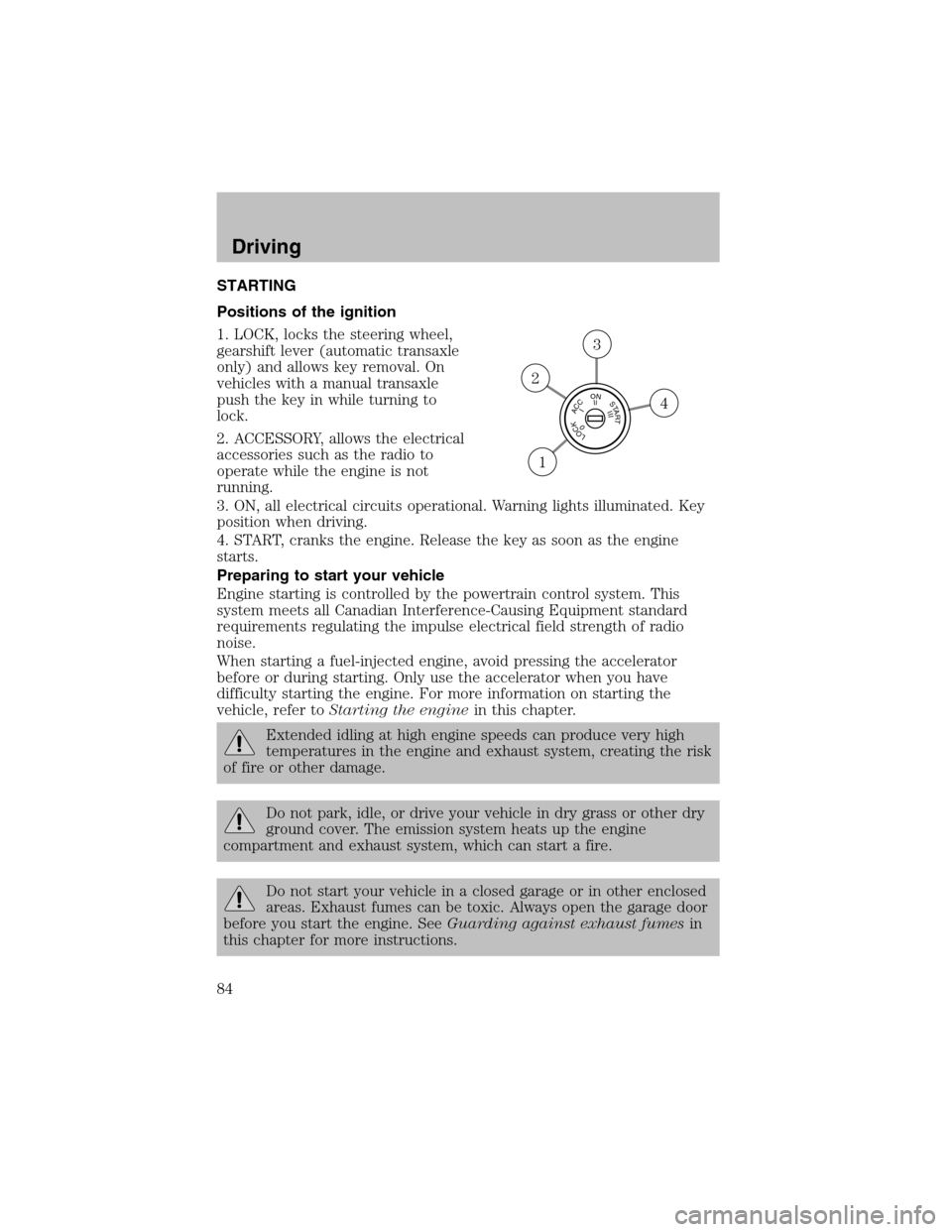
Positions of the ignition
1. LOCK, locks the steering wheel,
gearshift lever (automatic transaxle
only) and allows key removal. On
vehicles with a manual transaxle
push the key in while turning to
lock.
2. ACCESSORY, allows the electrical
accessories such as the radio to
operate while the engine is not
running.
3. ON, all electrical circuits operational. Warning lights illuminated. Key
position when driving.
4. START, cranks the engine. Release the key as soon as the engine
starts.
Preparing to start your vehicle
Engine starting is controlled by the powertrain control system. This
system meets all Canadian Interference-Causing Equipment standard
requirements regulating the impulse electrical field strength of radio
noise.
When starting a fuel-injected engine, avoid pressing the accelerator
before or during starting. Only use the accelerator when you have
difficulty starting the engine. For more information on starting the
vehicle, refer toStarting the enginein this chapter.
Extended idling at high engine speeds can produce very high
temperatures in the engine and exhaust system, creating the risk
of fire or other damage.
Do not park, idle, or drive your vehicle in dry grass or other dry
ground cover. The emission system heats up the engine
compartment and exhaust system, which can start a fire.
Do not start your vehicle in a closed garage or in other enclosed
areas. Exhaust fumes can be toxic. Always open the garage door
before you start the engine. SeeGuarding against exhaust fumesin
this chapter for more instructions.
LOCKACCONSTART0IIIIII4
3
2
1
Driving
84
Page 89 of 184
If you are driving down a long or steep hill, shift to a lower gear.
Do not apply your brakes continuously, as they may overheat
and become less effective.
Under normal operating conditions, brake dust may accumulate on the
wheels. Some brake dust is inevitable as brakes wear and does not
contribute to brake noise. The use of modern friction materials with
emphasis on improved performance and environmental considerations
can lead to more dust than in the past. Brake dust can be cleaned by
weekly washing with soapy water and a soft sponge. Heavier deposits can
be removed with Motorcraft Wheel and Tire Cleaner (ZC-37–A).
Anti-lock brake system (ABS) (if equipped)
On vehicles equipped with an anti-lock braking system(ABS), a noise
from the hydraulic pump motor and pulsation in the pedal may be
observed during ABS braking events. Pedal pulsation coupled with noise
while braking under panic conditions or on loose gravel, bumps, wet or
snowy roads is normal and indicates proper functioning of the vehicle’s
anti-lock brake system. The ABS performs a self-check after you start
the engine and begin to drive away. A brief mechanical noise may be
heard during this test. This is normal. If a malfunction is found, the ABS
warning light will come on. If the vehicle has continuous vibration or
shudder in the steering wheel while braking, the vehicle should be
inspected by a qualified service technician.
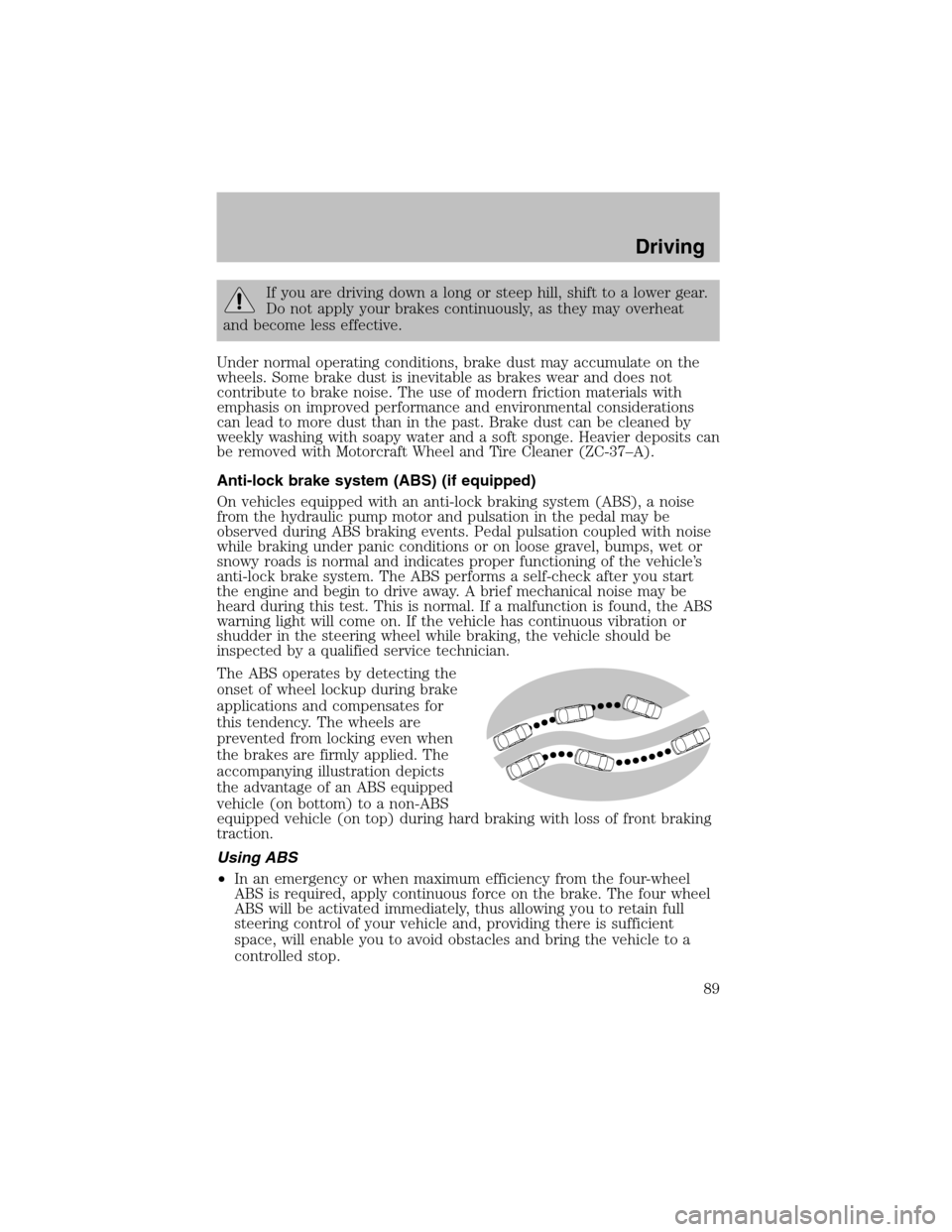
The ABS operates by detecting the
onset of wheel lockup during brake
applications and compensates for
this tendency. The wheels are
prevented fromlocking even when
the brakes are firmly applied. The
accompanying illustration depicts
the advantage of an ABS equipped
vehicle (on bottom) to a non-ABS
equipped vehicle (on top) during hard braking with loss of front braking
traction.
Using ABS
•In an emergency or when maximum efficiency from the four-wheel
ABS is required, apply continuous force on the brake. The four wheel
ABS will be activated immediately, thus allowing you to retain full
steering control of your vehicle and, providing there is sufficient
space, will enable you to avoid obstacles and bring the vehicle to a
controlled stop.
Driving
89
Page 90 of 184
•The anti-lock systemdoes not reduce stopping distance. Always leave
enough roombetween your vehicle and the vehicle in front of you to
stop.
•We recommend that you familiarize yourself with this braking
technique. However, avoid taking any unnecessary risks.
ABS warning lamp
ABS
TheABSwarning lamp in the instrument cluster momentarily illuminates
when the ignition is turned to the ON position. If the light does not
illuminate momentarily at start up, remains on or continues to flash, the
ABS needs to be serviced.
With the ABS light on, the anti-lock
brake systemis disabled and normal
braking is still effective unless the
brake warning light also remains
illuminated with parking brake
released. (If your brake warning lamp illuminates, have your vehicle
serviced immediately.)
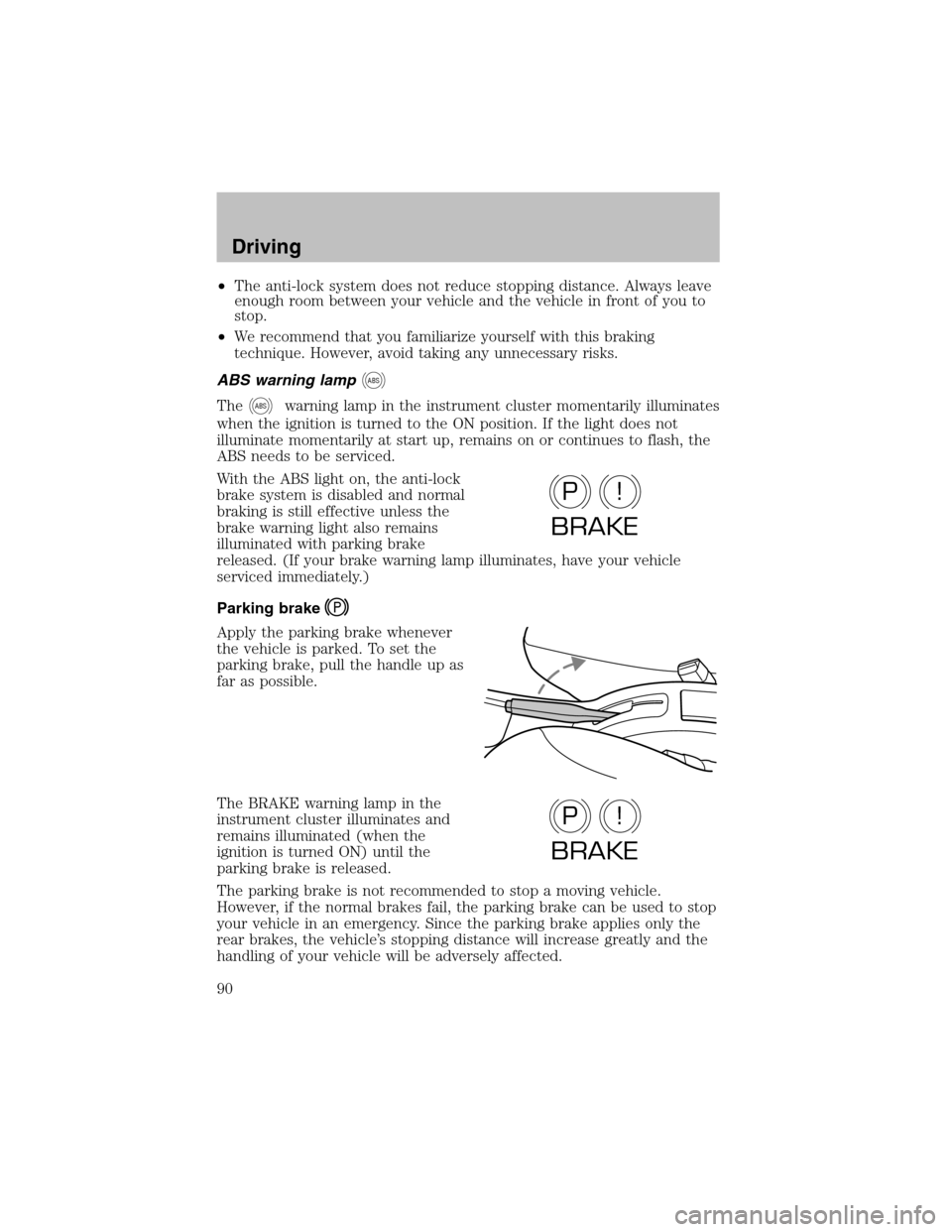
Parking brake
Apply the parking brake whenever
the vehicle is parked. To set the
parking brake, pull the handle up as
far as possible.
The BRAKE warning lamp in the
instrument cluster illuminates and
remains illuminated (when the
ignition is turned ON) until the
parking brake is released.
The parking brake is not recommended to stop a moving vehicle.
However, if the normal brakes fail, the parking brake can be used to stop
your vehicle in an emergency. Since the parking brake applies only the
rear brakes, the vehicle’s stopping distance will increase greatly and the
handling of your vehicle will be adversely affected.
P!
BRAKE
P!
BRAKE
Driving
90
Page 159 of 184
•Do not turn off the ignition while your vehicle is moving, especially at
high speeds.
•Have the items listed in your scheduled maintenance guide performed
according to the specified schedule.
The scheduled maintenance items listed in the scheduled maintenance
guide are essential to the life and performance of your vehicle and to its
emissions system.
If other than Ford, Motorcraft or Ford-authorized parts are used for
maintenance replacements or for service of components affecting
emission control, such non-Ford parts should be equivalent to genuine
Ford Motor Company parts in performance and durability.
Do not park, idle, or drive your vehicle in dry grass or other dry
ground cover. The emission system heats up the engine
compartment and exhaust system, which can start a fire.
Illumination of the “Service Engine Soon” light, charging system warning
light or the temperature warning light, fluid leaks, strange odors, smoke
or loss of engine power, could indicate that the emission control system
is not working properly.
Exhaust leaks may result in entry of harmful and potentially
lethal fumes into the passenger compartment.
Do not make any unauthorized changes to your vehicle or engine. By
law, vehicle owners and anyone who manufactures, repairs, services,
sells, leases, trades vehicles, or supervises a fleet of vehicles are not
permitted to intentionally remove an emission control device or prevent
it from working. Information about your vehicle’s emission system is on
the Vehicle Emission Control Information Decal located on or near the
engine. This decal identifies engine displacement and gives some tune up
specifications.
Please consult yourWarranty Guidefor complete emission warranty
information.
Readiness for Inspection/Maintenance (I/M) testing
In some localities, it may be a legal requirement to pass an I/M test of
the on-board diagnostics system. If your “Check Engine/Service Engine
Soon” light is on, refer to the description in theWarning lights and
chimessection of theInstrument clusterchapter. Your vehicle may not
pass the I/M test with the “Check Engine/Service Engine Soon” light on.
Maintenance and Specifications
159
Page 179 of 184

A
ABS (see Brakes) .......................89
Air bag supplemental restraint
system..........................................69
and child safety seats ..............71
description ................................69
disposal ......................................73
driver air bag ............................71
indicator light ...........................73
operation ...................................71
passenger air bag .....................71
Air cleaner filter .......164–165, 169
Air conditioning
manual heating and air
conditioning system.................29
Antifreeze
(see Engine coolant) ................146
Anti-lock brake system
(see Brakes) ................................89
Anti-theft system........................56
arming the system ....................56
disarming a triggered system ..57
disarming an untriggered
system.......................................57
Audio system(see Radio) .........19
Automatic transaxle
driving with ...............................93
fluid, adding ............................161
fluid, checking ........................161
fluid, refill capacities ..............170
fluid, specification ..................172
Automatic transmission ..............91
Axle
lubricant specifications ..........171
B
Battery .......................................144acid, treating emergencies .....144
jumping a disabled battery ....114
maintenance-free ....................144
replacement, specifications ...169
servicing ..................................144
BeltMinder ...................................65
Brakes ....................................88–89
anti-lock .....................................89
anti-lock brake system(ABS)
warning light .............................90
fluid, checking and adding ....160
fluid, refill capacities ..............170
fluid, specifications .........171–172
lubricant specifications ..171–172
parking ......................................90
shift interlock ............................91
Bulbs ............................................37
C
Capacities for refilling fluids ....170
Cell phone use ............................49
Certification Label ....................174
Changing a tire .........................110
Child safety restraints ................74
child safety belts ......................74
Child safety seats ........................76
attaching with tether straps ....80
in front seat ..............................78
in rear seat ................................78
Cleaning your vehicle
engine compartment ..............131
instrument panel ....................133
interior .....................................133
plastic parts ............................132
washing ....................................130
waxing .....................................130
wheels ......................................131
wiper blades ............................132
Index
179
Page 182 of 184

cargo lamps ...............................34
fog lamps ...................................33
headlamps ...........................33, 38
headlamps, flash to pass ..........34
instrument panel, dimming .....34
interior lamps .....................37–38
replacing bulbs .............37, 40–42
Lane change indicator
(see Turn signal) ........................36
Lights, warning and indicator ....10
anti-lock brakes (ABS) ............90
Load limits ...................................99
GAWR ........................................99
GVWR ........................................99
trailer towing ............................99
Lubricant specifications ...171–172
M
Manual transaxle
fluid capacities ........................170
lubricant specifications ..........172
Manual transmission ...................97
reverse .......................................98
Mirrors
side view mirrors (power) .......45
Moon roof ....................................48
Motorcraft parts ................155, 169
O
Octane rating ............................154
Oil (see Engine oil) ..................141
P
Parking brake ..............................90
Parts (see Motorcraft parts) ....169Power distribution box
(see Fuses) ...............................108
Power door locks ........................51
Power steering ............................91
fluid, checking and adding ....160
fluid, refill capacity ................170
fluid, specifications .........171–172
Power Windows ...........................44
R
Radio ............................................19
Rear window defroster ...............32
Relays ................................105, 110
Remote entry system .................53
locking/unlocking doors ...........51
opening the trunk .....................54
Roadside assistance ..................103
S
Safety belts
(see Safety restraints) .........60–63
Safety defects, reporting ..........129
Safety restraints ....................60–63
belt minder ...............................65
cleaning the safety belts ..........68
extension assembly ..................64
for adults .............................61–63
for children .........................73–74
warning light and chime ..........64
Safety seats for children ............76
Seat belts (see Safety
restraints) ....................................60
Seats ............................................58
child safety seats ......................76
Servicing your vehicle ..............136
Index
182