2003 FIAT PALIO brake light
[x] Cancel search: brake lightPage 22 of 156

21
IGNITION
SWITCH
The key can turn to 4 different po-
sitions
fig. 2:
–
STOP: engine switched off, ex-
tractable key, steering column lock.
Some electrical devices (e.g. door cen-
tralized lock etc.) remain operational.
–
MAR: ride position. All electrical
devices are operational.
–
AVV: engine starting.
–
PARK: engine switched-off, park-
ing lights switched on, extractable key,
steering column lock. To turn the key
in
PARK position, press the button
A.
In the event of a break-
in (e.g. attempted theft),
have the car checked at a
Fiat Dealership prior to driving
again.
fig. 1
P4E02062
KEYS
Two keys are provided with the car
& (
fig. 1) they are used for:
– the ignition;
– the front doors;
– the boot door.
Together with the keys, a self-stick
label is supplied. On this label is re-
ported the number to be quoted to
Fiat Dealershipwhen ordering du-
plicate keys.
fig. 2
P4E02017
When getting out of the
car, always remove the
key, to avoid someone ac-
cidentally activating the controls.
Remember to engage the hand
brake, ensuring complete lockup
of the car, engage gear and leave
the wheels steered. If the car is
parked on a very sloping road, we
recommend you lock the wheels
also with a wedge or a stone.
Never leave children alone in an
unattended car.
20-63 03/03/2003 06:02 PM Page 21
Page 36 of 156

35
WARNING
LIGHTS
The warning lights come on in the
following circumstances:
BATTERY NOT
CHARGING PROPER-
LY (red)
When there is
a fault in the current gen-
erating system.
Go to a
Fiat Dealershipand pre-
vent deploying the battery.
When the key is turned to
MAR the
light comes on but should go out the
moment the engine is started.
LOW ENGINE OIL
PRESSURE (red)
When
the engine oil pressure
drops under the normal
value.
When the key is turned to
MARthe
light comes on but should go out the
moment the engine is started.
A delay in the light going out is ac-
ceptable only when the engine is idling.
If the engine has been heavily taxed,
the light may flash when the engine re-
turns to idle. The light should howev-
er go out when you accelerate slight-
ly.
v
w
If the vwarning light
comes on while the car is
moving, stop the engine
immediately and contact a Fiat
Dealership.
INJECTION SYSTEM
FAILURE (red) (petrol
version)
When there is a
fault in the injection system.
When the ignition key is turned to
the
MAR position, the light comes on
but should go out after a few seconds.
The warning light will stay on or
come on when travelling to indicate
imperfect operation of the injection
system with possible loss of perfor-
mance, poor handling and higher con-
sumption.
g
In these conditions, you can contin-
ue driving but you should avoid de-
manding efforts from the engine or
high speeds. Contact a
Fiat Dealer-
ship
as soon as possible.
Using the car for long periods when
the warning light is on may cause dam-
age especially when the engine is run-
ning irregularly or misfiring. The car
should only be used for short periods
at low speeds.
Occasional and brief lighting of the
warning light is meaningless.
HANDBRAKE EN-
GAGED / LOW
BRAKE FLUID (red)
In
two cases:
1.When the handbrake is applied.
2. when the brake fluid level falls be-
low the minimum level.
x
20-63 03/03/2003 06:02 PM Page 35
Page 37 of 156

ABS (WHEEL AN-
TILOCKING SYS-
TEM) FAILURE (am-
ber)
When there is a fail-
ure in the ABS system.
In this case, the normal braking sys-
tem continues to work although with-
out the ABS assistance. Hence, have
the car seen to at a
Fiat Dealership
as soon as possible.
The warning light should come on
when the key is turned to
MARand
go out after approximately 2 seconds.
DIRECTION INDICA-
TORS (green) (flash-
ing)
When the direction
indicator control stalk is
operated (arrows).
PARKING LIGHTS
(green)
When the
side/tail lights are switched
on.
RE
3
MAIN BEAM HEAD-
LIGHTS (blue)
When main beam head-
lights are switched on
1
AIR BAG FAILURE
(red)
When there is an
airbag system failure.
If the xwarning light
comes on when travel-
ling, check whether the
handbrake is engaged. If the
warning light stays on and the
handbrake is not engaged, stop
immediately and contact a Fiat
Dealership.
>
Warning light >, with
the engine running, nor-
mally indicates a fault in
the ABS system only. In this case,
the braking system is still effi-
cient, though without the an-
tilocking device. You are advised
to go immediately to the nearest
Fiat Dealership, driving in a man-
ner to avoiding sharp braking and
get the system checked.
û
The warning light should
come on when the key is
turned to MAR and go
out after approximately 4 sec-
onds. If the warning light either
does not come on or comes on
when travelling, stop immedi-
ately and go to a Fiat Dealership.
The warning light should come on
when the key is turned to
MARand
go out after approximately 2 seconds.
36
INJECTION SYSTEM
FAILURE (red) (diesel
versions)
When there is a fault in the injection
system.
The warning light should come on
when the ignition key is turned to
MARand go out after a few seconds.
The warning light will stay on or
come on when travelling to indicate
imperfect operation of the injection
system with possible loss of perfor-
mance, poor handling and higher con-
sumption.
In these conditions, you can contin-
ue driving but you should avoid de-
manding efforts from the engine or
high speeds. Contact a
Fiat Dealer-
ship
as soon as possible.
Prolonged use of the car with warn-
ing light can cause damage to the en-
gine, specially in the event of misfir-
ing. The car can only be driven for a
short period of time at low ratios.
Occassional and brief lighting of the
warning light is meaningless.
20-63 03/03/2003 06:02 PM Page 36
Page 57 of 156
56
SLANT COMPENSATION
When the car is loaded, it slopes
backwards. This means that the head-
light beam rises. In this case, it is nec-
essary to return it to the correct po-
sition.
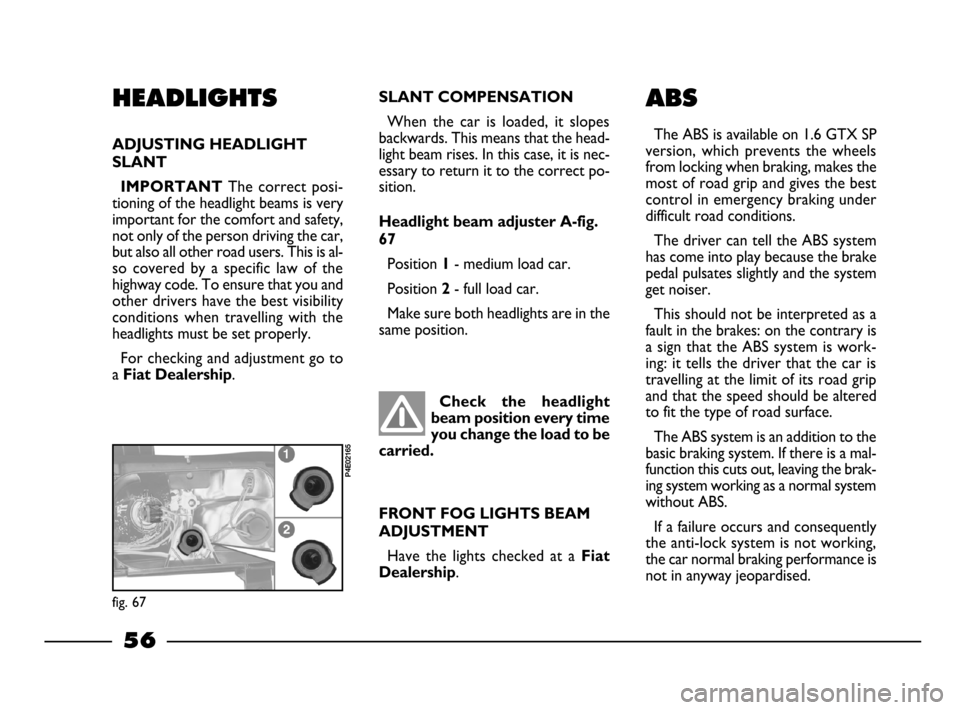
Headlight beam adjuster A-fig.
67
Position 1- medium load car.
Position
2- full load car.
Make sure both headlights are in the
same position.
Check the headlight
beam position every time
you change the load to be
carried.
FRONT FOG LIGHTS BEAM
ADJUSTMENT
Have the lights checked at a Fiat
Dealership
.
ABS
The ABS is available on 1.6 GTX SP
version, which prevents the wheels
from locking when braking, makes the
most of road grip and gives the best
control in emergency braking under
difficult road conditions.
The driver can tell the ABS system
has come into play because the brake
pedal pulsates slightly and the system
get noiser.
This should not be interpreted as a
fault in the brakes: on the contrary is
a sign that the ABS system is work-
ing: it tells the driver that the car is
travelling at the limit of its road grip
and that the speed should be altered
to fit the type of road surface.
The ABS system is an addition to the
basic braking system. If there is a mal-
function this cuts out, leaving the brak-
ing system working as a normal system
without ABS.
If a failure occurs and consequently
the anti-lock system is not working,
the car normal braking performance is
not in anyway jeopardised.
HEADLIGHTS
ADJUSTING HEADLIGHT
SLANT
IMPORTANT
The correct posi-
tioning of the headlight beams is very
important for the comfort and safety,
not only of the person driving the car,
but also all other road users. This is al-
so covered by a specific law of the
highway code. To ensure that you and
other drivers have the best visibility
conditions when travelling with the
headlights must be set properly.
For checking and adjustment go to
a
Fiat Dealership.
fig. 67
P4E02165
20-63 03/03/2003 06:03 PM Page 56
Page 58 of 156
57
If you have never driven a car with
ABS before, you should practice using
the system on slippery terrain, obvi-
ously with the necessary safety pre-
cautions and keeping to the Highway
code of the country you are in. It is al-
so a good idea to read the following
information carefully.
The advantage in using the ABS sys-
tem is that it continues to give you
maximum manoeuvrability even when
braking hard in conditions for poor
grip by preventing the wheels locking.
However, do not expect that with
ABS the braking distance will always
decrease: for example surfaces with
gravel or fresh snow on a slippery
road could infact increase the braking
distance.
To exploit the ABS system to the full
in the event of necessity, you should
take heed of the following advice:
If the brake fluid low
warning light x
comes on,
stop the car immediately
and contact the nearest Fiat Deal-
ership. Fluid leaks from the hy-
draulic system, in fact, can com-
promise the braking of both tradi-
tional systems and systems with
ABS.When the ABS is acti-
vated, you will feel the
brake pedal pulsating. Do
not remove your foot, but keep
it pressed. In doing so you will
stop in the shortest amount of
space possible under the current
road conditions.
If you follow these tips, you will be
able to brake better in any situation.
IMPORTANTCars fitted with ABS
are only to be fitted with wheel rims,
tyres and brake liners of the make and
model approved by the car manufac-
turer.
The ABS exploits the
tyre-road grip available to
the full, but it cannot im-
prove it; you should therefore
take every care when driving on
slippery surfaces, and not take
unnecessary risks. If the ABS sys-
tem cuts in it is a sign that the
grip between the tyre and the
road surface has reached the lim-
it: you must slow down to match
the speed to the road grip avail-
able
If there is a fault, the in-
strument panel warning
light
>will come on, at
this point, reduce speed and go to
a Fiat Dealership to have your car
checked and put it right imme-
diately.
Braking while cornering always re-
quires extreme care even when using
ABS.
The most important advice to follow
is this:
20-63 03/03/2003 06:03 PM Page 57
Page 66 of 156

65
The key switch is equipped with a
safety device which obliges, in the
event of engine starting malfunction to
return the key at
STOP prior to re-
peating the starting operation.
At the same time, when the engine is
running, the device prevents to shift
from
MAR postion to AVV position.
In the first operational seconds,
above all after a long inactivity peri-
od, you can hear a higher noise level
of the engine. Such phenomenon,
which does not compromise the func-
tionality and reliability, is typical of the
hydraulic tappets: the distribution sys-
tem, chosen for the engine of 100
16V
version of your Fiat Palio to contribute
to the maintenance intervention re-
duction.
STARTING THE ENGINE
IMPORTANT
Do not press the
accelerator until the engine has start-
ed.
1) Ensure that the handbrake is up.
2) Put the gear lever into neutral.
3)Press the clutch pedal right down.
4) Turn the ignition key to AVVand
release it as soon as the engine starts.If the engine does not start at the
first attempt, return the ignition key
to
STOP before trying to start the
engine again.
IMPORTANT Press the accelera-
tor slightly only if the outside temper-
ature is lower than –10°C and the en-
gine does not start at the first attempt.
IMPORTANTNever leave the ig-
nition key at
MARwhen the engine is
off.
Never touch the high
voltage wires (spark plug
wires) when the engine is
running.
It is dangerous to let the
engine run in a garage of
other closed area. The en-
gine consumes oxygen and gives
off carbon dioxide, carbon monox-
ide and other poisonous fumes.
STARTING THE
ENGINE
We recommend not to
push the engine to its lim-
its for the first period of
use (e.g. abrupt accelerations, ex-
cessively prolonged distances at
max revs, hard braking, etc.).
64-79 03/03/2003 06:45 PM Page 65
Page 68 of 156

67
With handbrake engaged and igni-
tion key at
MAR, the instrument pan-
el warning light
x
comes on.
To disengage the handbrake:
1)Slightly lift the handbrake and
press release button
A.
2)Keep the button pressed in and
lower the lever. Warning light
x
will
go out.
3)To prevent accidental movement
of the car, this procedure should be
carried out with the brake pedal
pressed down.
HANDBRAKE fig. 1
The handbrake lever is situated be-
tween the two front seats.
Pull the handbrake lever upwards un-
til the car cannot be moved. Four or
five clicks are generally enough when
the car is on level ground while nine
or ten may be required if the car is
on a steep slope or loaded.
IMPORTANTIf this is not the
case, take the car to a
Fiat Dealer-
ship
to have the handbrake adjusted.
Never leave unsuper-
vised children in the car.
Always remove the key
from the ignition switch and take
it with you when you get out of
the car.
fig. 1
P4E02046
PARKING
Stop the engine, engage the hand-
brake and engage first gear if the car
is faced uphill or reverse gear if it is
faced downhill in compliance with the
national Highway Code and leave the
wheels steered towards the road bor-
ders or the kerb. Block the wheels
with a wedge or a stone if the car is
parked on a steep slope.
Do not leave the ignition key at
MARbecause it drains the battery.
Always remove the key when you
leave the car.
64-79 03/03/2003 06:45 PM Page 67
Page 70 of 156

69
Water, ice or salt sprin-
kled on the road can de-
posit on the brake discs
and reduce efficiency of the first
braking.
Consider that fitting ex-
tra spoilers, alloy rims or
non standard wheel caps
can reduce ventilation of the
brakes and reduce their efficien-
cy under conditions of violent or
repeated braking or long down-
hill travel.
BEFORE GETTING BEHIND
THE WHEEL
– Make sure all lights including the
headlights are working properly.
– Adjust the position of the seats, the
steering wheel and the rearview mir-
rors properly for the best driving po-
sition.
– Carefully adjust the head restraints
so the back of the head and not the
nape of the neck is supported.
– Make sure that nothing (mats etc.)
gets in the way of the pedals when
they are pushed down.
– Do not drive using the clutch ped-
al as a foot rest. Such behaviour can
cause a premature wear of the clutch.
– Make sure that any child restraint
systems (child seats, carriers, etc.) are
properly fixed preferably on the back
seat. Follow the precautions listed in
the “Transporting children in safety”
paragraph in the “Getting to know the
car” chapter.
– Arrange the load in the boot in such
a way that it cannot be thrown for-
wards in the event of an accident.– Do not place clear objects or
sheets of paper on the dashboard that
reflect on the windscreen.
– Do not eat a heavy meal before
travelling. Light eating will help keep
your reflexes prompt. Above all, do
not have anything alcoholic to drink.
The use of some medicines can reduce
the driving capability: carefully read the
relevant use warnings.
Remember to periodically carry out
the checks specified in the “Repeated
checks before long trips” paragraph
given in this section.
64-79 03/03/2003 06:45 PM Page 69