2003 FIAT PALIO battery
[x] Cancel search: batteryPage 112 of 156

111
fig. 3 - 1.9 D versions
P4E02674
1.Engine oil- 2.Battery -3.Brake-
clutch fluid -
4.Windscreen/rear mir-
ror washer fluid -
5. Engine coolant -
6.Power steering fluid.
fig. 2 - Versions 1.6
P4E02276
1.Engine oil- 2.Battery -3.Brake-
clutch fluid -
4.Windscreen/rear mir-
ror washer fluid -
5. Engine coolant -
6.Power steering fluid
104-127 03/03/2003 06:53 PM Page 111
Page 118 of 156
117
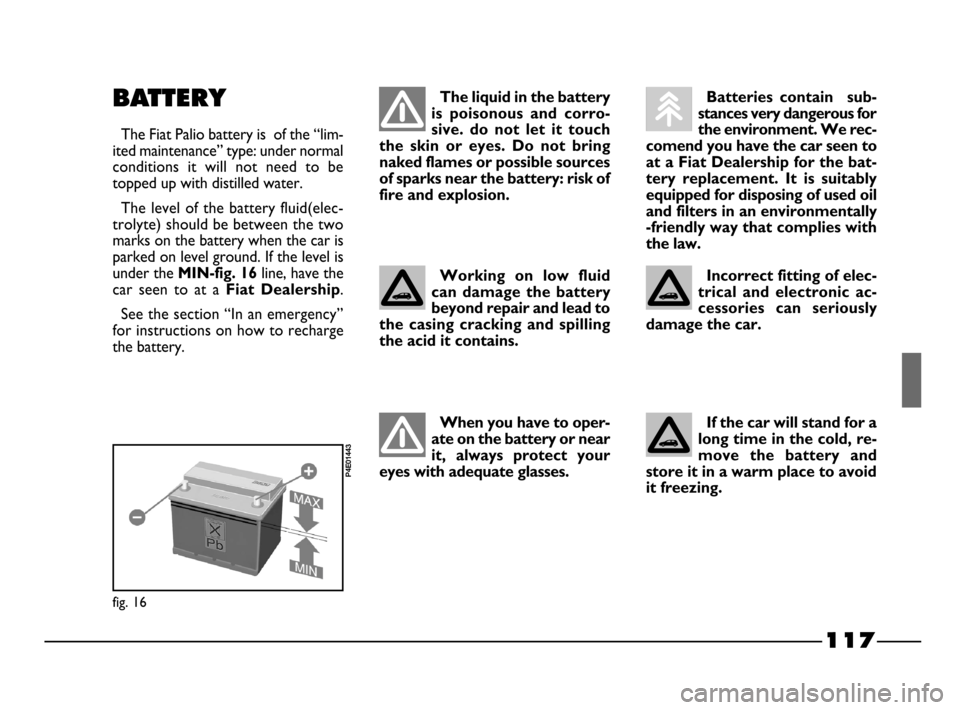
BATTERY
The Fiat Palio battery is of the “lim-
ited maintenance” type: under normal
conditions it will not need to be
topped up with distilled water.
The level of the battery fluid(elec-
trolyte) should be between the two
marks on the battery when the car is
parked on level ground. If the level is
under the
MIN-fig. 16 line, have the
car seen to at a
Fiat Dealership.
See the section “In an emergency”
for instructions on how to recharge
the battery.
The liquid in the battery
is poisonous and corro-
sive. do not let it touch
the skin or eyes. Do not bring
naked flames or possible sources
of sparks near the battery: risk of
fire and explosion.
Working on low fluid
can damage the battery
beyond repair and lead to
the casing cracking and spilling
the acid it contains.
When you have to oper-
ate on the battery or near
it, always protect your
eyes with adequate glasses.
fig. 16
P4E01443
Batteries contain sub-
stances very dangerous for
the environment. We rec-
comend you have the car seen to
at a Fiat Dealership for the bat-
tery replacement. It is suitably
equipped for disposing of used oil
and filters in an environmentally
-friendly way that complies with
the law.
Incorrect fitting of elec-
trical and electronic ac-
cessories can seriously
damage the car.
If the car will stand for a
long time in the cold, re-
move the battery and
store it in a warm place to avoid
it freezing.
104-127 03/03/2003 06:53 PM Page 117
Page 119 of 156

118
The total intake of these systems
(factory and after-market) must be less
than 0,6 mA x Ah (of the battery), as
shown in the following table:
Battery Maximum permissiblestand-by intake
50Ah 30 mA
Furthermore, remember that high in-
take electric devices (such as baby bot-
tle warmer, vacuum cleaners, cellular
phones, mini-fridges, etc.) powered
when the engine is off can deploy the
battery.
IMPORTANTIf you need to fit ad-
ditional systems in the car, remember
that improper wiring connections, in
particular if they affect safety devices,
are dangerous.
USEFUL ADVICE
FOR LENGTHENING
THE LIFE
OF YOUR BATTERY
When you park the car, ensure the
doors, boot and bonnet are closed
properly. The courtesy light must be
off.
Do not keep accessories (e.g. sound
system, hazard lights, etc.) switched on
for a long time when the engine is not
running.
IMPORTANTA battery which is
kept at a charge of less than 50% for
any length of time will be damaged by
sulphation leading to a reduction in
cranking power and a higher risk of
the battery electrolyte freezing (this
may even occur at - 10°C).
If the car is inactive for a long peri-
od of time, refer to “Long inactivity of
the car”, in the “Correct use of the
car” chapter.If you want to add electrical acces-
sories after buying the car which need
permanent electric supply(alarm,
free hand phone kit, radio navigator
with satellite antitheft system etc.) vis-
it a
Fiat Dealership. They can sug-
gest the most suitable accessories to
get and check whether the electric
system can support the required load
or whether a larger capacity battery
is required.
These devices will, in fact, run off the
battery even when the key is not in-
serted (car parked, engine stopped)
and can destroy the battery.
104-127 03/03/2003 06:53 PM Page 118
Page 120 of 156
Electrolyte
filling up
Insufficient
state of charge
Sufficient electrolyte lev-
el and state of chargeContact Fiat Dealership
Recharge (we suggest you
to contact
Fiat Dealership)
No action
119
If the indicator shows a light bright
coloration, or dark but without a
green central area, contact the
Fiat
Dealership
.
Checking the state of charge
Checking the state of charge of bat-
tery can be qualitatively carried out
through the optical indicator, with re-lation to coloration that the indicator
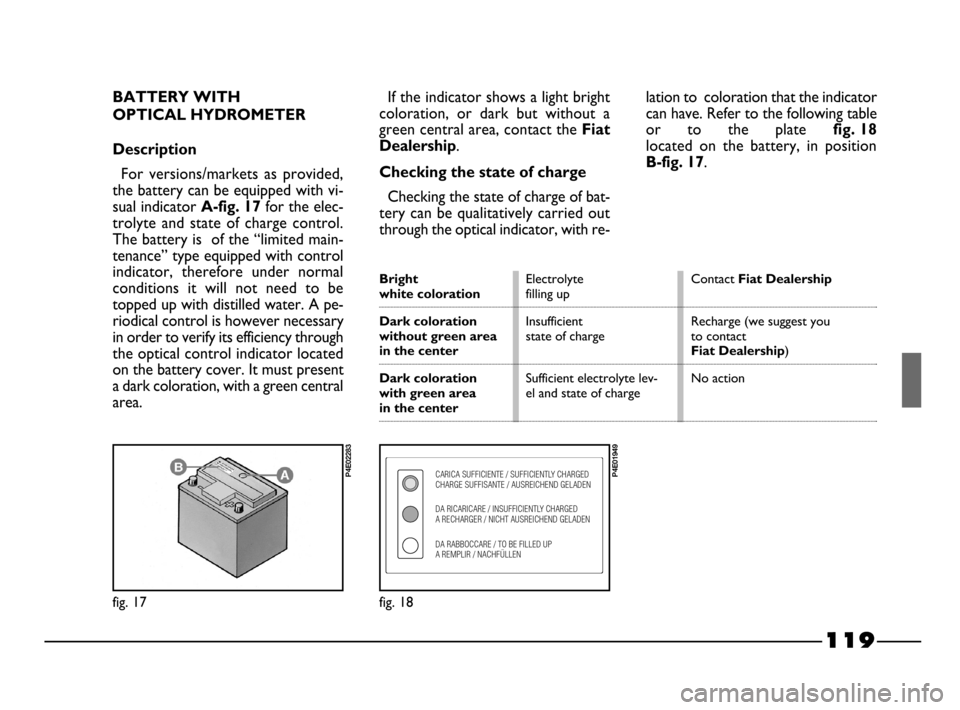
can have. Refer to the following table
or to the plate
fig. 18
located on the battery, in position
B-fig. 17.
fig. 18
P4E01949
BATTERY WITH
OPTICAL HYDROMETER
Description
For versions/markets as provided,
the battery can be equipped with vi-
sual indicator
A-fig. 17for the elec-
trolyte and state of charge control.
The battery is of the “limited main-
tenance” type equipped with control
indicator, therefore under normal
conditions it will not need to be
topped up with distilled water. A pe-
riodical control is however necessary
in order to verify its efficiency through
the optical control indicator located
on the battery cover. It must present
a dark coloration, with a green central
area.
Bright white coloration
Dark coloration
without green area
in the center
Dark coloration
with green area
in the center
fig. 17
P4E02283
104-127 03/03/2003 06:53 PM Page 119
Page 121 of 156

IMPORTANT If the sound system
or car alarm systems are not installed
correctly, they can interfere with the
working of the electronic control
units.
Modifications or repairs
to the electrical system
carried out incorrectly
and without bearing the features
of the system in mind can cause
malfunctions with the risk of fire.
120
ELECTRONIC
CONTROL UNITS
When the car is being used normal-
ly, special measures are not necessary.
The following instructions must be
followed very carefully however, if you
work on the electrical system or
where emergency starting is neces-
sary:
– Never disconnect the battery from
the electrical system while the engine
is running.
– Disconnect the battery from the
electrical system if you are recharg-
ing it. Modern battery chargers can
discharge voltage up to 20 V.
– Never perform emergency star-
tups with a battery charger. Always
use an auxiliary battery (see “Startup
with auxiliary battery” in “In an emer-
gency” chapter).– Be particularly careful when con-
necting the battery to the electrical
system. Make sure that the polarity is
correct and the connection is efficient.
After reconnecting the battery, the in-
jection/ignition control unit will need
to readapt its internal parameters.
Therefore, the car’s performance may
change slightly during the first few kilo-
meters.
– Do not connect or disconnect the
terminals of the electronic units while
the ignition key is at
MAR.
– Do not check polarity through
sparking.
– Disconnect the electronic units if
you are electrically welding the car
body. Remove the units if tempera-
tures exceed 80°C (special operations
on the bodywork etc.).
104-127 03/03/2003 06:53 PM Page 120
Page 138 of 156

Delivered power
1.20.8 kW
1.61.3 kW
1.9 D1.4 kW
137
ALTERNATOR
Rectifier bridge and built-in elec-
tronic voltage regulator. Battery be-
gins recharging as soon as the engine
starts.
STARTER MOTOR Modifications or repairs
to the electrical system
carried out incorrectly
and without bearing the features
of the system in mind can cause
malfunctions with the risk of fire.
ELECTRIC SYSTEM
Supply voltage: 12 Volt.
BATTERY
With negative earth.
Discharge capacity Discharge current 20 hour fast cold (–18°C)
1.250 Ah 250A
1.650 Ah 250A
1.9 D60 Ah 320A
Max supplied nominalcurrent
1.290A
1.690A
1.9 D90A
128-143 03/03/2003 07:39 PM Page 137
Page 145 of 156

Abord instrument ................... 33
ABS ................................................. 56
Accessories Purchased
Air cleaner (replacement) ....... 116
Air bag ........................................... 58
Air re-circulation.......................... 40
Air vents......................................... 38
Alternator (specifications) ........ 137
Ashtray ........................................... 47
Battery
- jump starting ......................... 81
- specifications........................... 137
- with optical hydrometer .... 119
- useful advices .......................... 118
- maintenance ............................ 118
- recharging ................................ 98
Bodywork
- bodywork type code ........... 130
- maintenance .......................... 125Boot
- extending ................................. 52
- tailgate opening/closing ........ 16-51
Brake lights
(bulb replacement) ................. 90
Brake-clutch fluid level ............... 115
Brakes
- service and emergency ....... 134
- fluid level ................................ 115
Bulb (replacement) ..................... 86
- bulb types ............................... 86
By the Owner ............................... 79Car dimensions ......................... 139
Car maintenance ......................... 104
Ceiling lights
- control ..................................... 46
- bulb replacement ................... 92
Centralized locking .................... 17-49
Chassis(marking) ......................... 129
Cheap running that respects
the environment ..................... 73
Checking the levels .................... 111
Children safety ............................ 18-49
Climate control system- climate ..................................... 39
- controls.................................... 14-39
- fast demisting ........................ 40
- maintenance .......................... 125
- air re-circulation .................... 40
- heating ...................................... 39
Climate/heating control
system ........................................ 37
Clutch ............................................. 133
Containing running costs and
pollution .................................... 75
Control switches ........................ 15-44
Correct use of your car ............ 64
Dashboard ................................ 9
Demisting ....................................... 40
- rear window .......................... 40
- windscreen and side
window ...................................... 40
Differential ..................................... 133
Digital clock ................................. 34
INDEX
144
144-152 03/03/2003 07:30 PM Page 144
Page 148 of 156

147
Spark plugs ................................... 121
Speedometer................................. 33
Starter (specifications) ............... 137
Starting the engine ...................... 65
- Jump starting ......................... 81
- bump starting ........................ 66-82
- ignition switch ....................... 21
- turning off the engine .......... 66
- starting procedure ................ 65
- engine warm up (just
started) ................................... 66
Steering column lock .................. 11-22
Steering column stalks ............... 13-41
Steering........................................... 135
Storing the car ............................. 78
Sun visors ...................................... 47
Suspensions .................................. 134
Symbols .......................................... 4
Technical specifications ........... 128
Third brake light ......................... 91Towing the car ........................... 101
Transmission ................................. 133
Transporting children in
safety .......................................... 29
Tubing ............................................ 123
Tyre pressure ......................... 121-143
Tyres
- specifications........................... 136
- Correct reading .................... 136
- maintenance .......................... 121
- inflation pressure ............ 121-143
- changing the wheel................ 82
Useful accessories ................... 79
Ventilation.................................. 40
Warning lights
- injection system failure ....... 35
- air bag failure ......................... 36- engaged handbrake .............. 35
- direction indicators ............. 36
- low brake-clutch fluid level 35
- low engine oil pressure........ 35
- low battery recharge ......... 35
- main beam headlights .......... 36
- Exterior lights ......................... 36
- unserviceable ABS ................. 36
Weights .......................................... 138
Wheel rims.................................... 136
- correct reading of the rim .. 136
Wheels
- wheel geometry ..................... 136
- specifications........................... 136
- maintenance .......................... 121
- replacement ........................... 82
Windows
- electric window winder .... 15-49
- manual window winder ...... 16-50
- cleaning operation ................. 126
Windscreen washer
- control .................................... 13-42
144-152 03/03/2003 07:30 PM Page 147