2003 FIAT PALIO fog light
[x] Cancel search: fog lightPage 16 of 156

15
COMMAND
SWITCHES
Switches fig. 17.
A - Rear windscreen heater switch.
B - Front fog light switch with LED.
C - A/C on/off switch.
ELECTRIC WIN-
DOW WINDER
FRONT ELECTRICAL WIN-
DOW WINDERS
Press the switch fig. 18 to lower
the window. Raise the switch to
wind up the window.
A- Switch for adjusting front left
window.
B - Switch for adjusting front right
window.
Each door handle has a switch on it
to raise/lower its window.
fig. 17
P4E02287
fig. 18
P4E02011
fig. 19
P4E02012
ELECTRIC REAR WINDOWS
fig. 19
A
- Switch on door handle.
B - Rear left-hand window switch.
C - Rear right-hand window switch.
D - Rear window enable switch.
1-19 03/03/2003 05:44 PM Page 15
Page 45 of 156

44
fig. 41
P4E02029
fig. 40
P4E02287
CONTROLS
fig. 40
The buttons located above the cen-
tral air vents.
The controls can only be operated
when the ignition key is at
MAR.
When a function is activated the LED
on the respective button will light up.
Press the button again to switch the
control off.
Heated rear window
Button A: to switch on /off the ther-
mal rear window.
Rear fog light
Button B: These lights can only be
switched on when the dipped beam
headlights or the front foglights are
switched on.
Fog lights
ButtonB: These lights can only be
switched on when the parking lights
are on.
Climate control system
Button C: to switch on/off the air
conditioner.
FUEL CUT-OFF SWITCH
fig. 41
This is a safety cut-off switch which
comes into operation in the case of an
accident to block the supply of fuel
thereby stopping the engine.
If, after an accident, you
can smell petrol or see
that the fuel feed system
is leaking, to avoid the risk of fire,
do not reset the switch.
If you cannot see any fuel leaks and
the car is in a fit state to continue its
20-63 03/03/2003 06:03 PM Page 44
Page 57 of 156
56
SLANT COMPENSATION
When the car is loaded, it slopes
backwards. This means that the head-
light beam rises. In this case, it is nec-
essary to return it to the correct po-
sition.
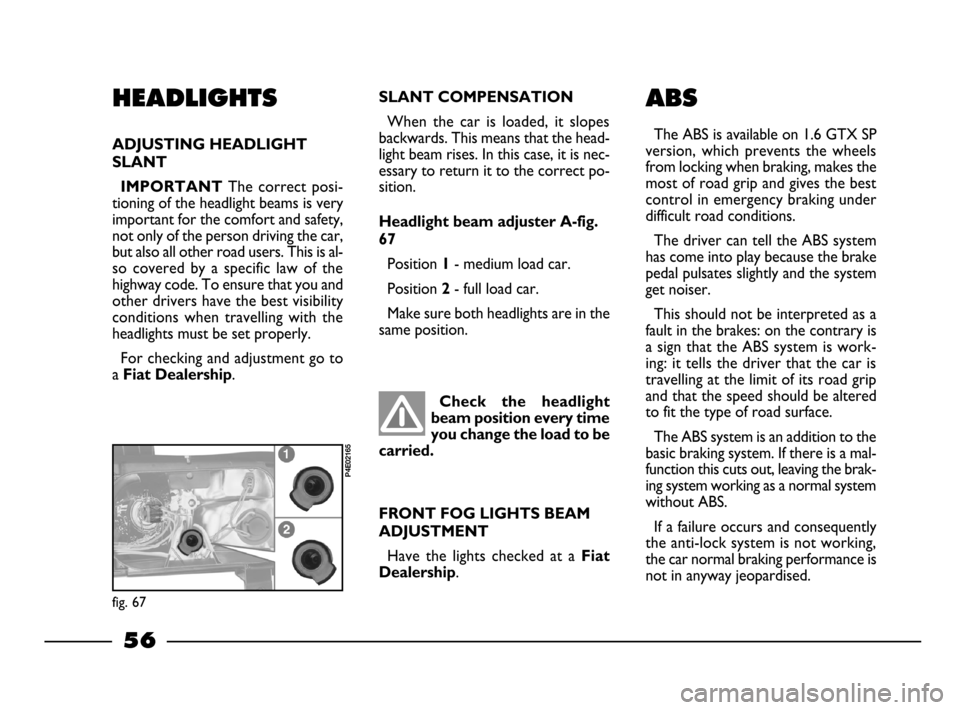
Headlight beam adjuster A-fig.
67
Position 1- medium load car.
Position
2- full load car.
Make sure both headlights are in the
same position.
Check the headlight
beam position every time
you change the load to be
carried.
FRONT FOG LIGHTS BEAM
ADJUSTMENT
Have the lights checked at a Fiat
Dealership
.
ABS
The ABS is available on 1.6 GTX SP
version, which prevents the wheels
from locking when braking, makes the
most of road grip and gives the best
control in emergency braking under
difficult road conditions.
The driver can tell the ABS system
has come into play because the brake
pedal pulsates slightly and the system
get noiser.
This should not be interpreted as a
fault in the brakes: on the contrary is
a sign that the ABS system is work-
ing: it tells the driver that the car is
travelling at the limit of its road grip
and that the speed should be altered
to fit the type of road surface.
The ABS system is an addition to the
basic braking system. If there is a mal-
function this cuts out, leaving the brak-
ing system working as a normal system
without ABS.
If a failure occurs and consequently
the anti-lock system is not working,
the car normal braking performance is
not in anyway jeopardised.
HEADLIGHTS
ADJUSTING HEADLIGHT
SLANT
IMPORTANT
The correct posi-
tioning of the headlight beams is very
important for the comfort and safety,
not only of the person driving the car,
but also all other road users. This is al-
so covered by a specific law of the
highway code. To ensure that you and
other drivers have the best visibility
conditions when travelling with the
headlights must be set properly.
For checking and adjustment go to
a
Fiat Dealership.
fig. 67
P4E02165
20-63 03/03/2003 06:03 PM Page 56
Page 72 of 156

71
DRIVING AT NIGHT
If you are driving at night these are
the main rules to follow:
– Drive carefully: it is harder to dri-
ve at night.
– Slow down especially if the road is
not lit.
– At the first signs of sleepiness, stop:
continuing would be a risk for yourself
and everybody else. Only start driving
again when you have had enough rest
– Keep a greater safety distance from
the cars in front of you than during
daylight hours: it is hard to judge how
fast other cars are going when all you
can see are their lights.
– Make sure the headlight beams are
properly positioned: if they are too
low, they reduce visibility and strain
your eyes. If they are too high they can
dazzle other drivers.
– Only use main beam headlights
when you are driving outside town
and make sure they do not annoy oth-
er drivers.– Dip your headlights as soon as you
see cars coming in the other direction
and pass them with the headlights
dipped.
– Keep all lights clean.
– Be careful of animals crossing the
road when driving in the country.
DRIVING IN THE RAIN
Rain and wet road surfaces spell dan-
ger.
All manoeuvres are more difficult on
a wet road because the grip of the
wheels on the tarmac is greatly re-
duced. This is why braking distances
are much longer and road-holding is
lower.
Here is some advice for driving in the
rain:
– Reduce speed and maintain a
greater safety distance from the cars
in front.
– If it is raining particularly heavily, vis-
ibility is also reduced. In these cases,
switch on the dipped headlights even if
it is still daylight so you can be seen
more easily. – Do not drive through puddles at
speed and hold on tightly to the wheel
if you do: a puddle taken at high speed
might cause you to lose control of the
car (“aquaplaning”).
– Move the ventilation controls to
the position for demisting the win-
dows (see chapter “Getting to know
your car”) to avoid visibility problems.
– Periodically check the condition of
the windscreen wiper blades.
DRIVING IN FOG
– If the fog is thick, do not start out
on a journey.
If driving in mist, blanket fog or when
there is the danger of fog patches:
– Keep your speed down.
– Turn on the dipped headlights and
front foglights, if fitted, even during the
day. Do not drive with your headlights
at main beam.
64-79 03/03/2003 06:45 PM Page 71
Page 73 of 156

72
– Remember that fog also means the
tarmac is wet and therefore manoeu-
vres of all kinds are more difficult and
stopping distances are longer.
– Keep a good distance from the ve-
hicle in front of you.
– As far as possible, avoid spurts of
speed or sudden deceleration.
– Do not overtake other vehicles if
you can help it.
– If you are forced to stop your car
(breakdown, limited visibility etc.) try
to stop off the road. Turn on the haz-
ard lights and, if possible, the dipped
beam headlights. Rhythmically sound
the horn if you realize another car is
coming.MOUNTAIN DRIVING
– When driving downhill, use the en-
gine braking by engaging a low gear, so
as not to overheat the brakes.
– Under no circumstances should
you drive downhill with the engine off
or with the car in neutral, let alone
with the ignition key out.
– Drive at a moderate speed without
cutting corners.
– Remember that overtaking while
going uphill is slower and therefore re-
quires more free road. If you are be-
ing overtaken while driving uphill,
make it easier for the other vehicle
to pass.
DRIVING ON SNOW AND
ICE
Here are some tips for driving in
these conditions:
– Before starting off make sure that
the windscreen wiper blades are not
frozen to the windscreen.
– Remove the snow from the climate
control system air vent. – Keep your speed down.
– Use chains if the roads are covered
in snow: see paragraph “Snow chains”
in this chapter.
– Do not stay parked on high snow
for too long with engine running: the
snow could divert the carbon oxide
of the exhaust gases in the passenger
compartment.
– Mainly use the braking effect of the
engine and under all circumstances
avoid braking sharply.
– When braking in a car not fitted
with ABS, reduce the possibility of the
wheels locking by varying the pressure
you exert on the brake pedal.
– Do not accelerate suddenly and
avoid swerving.
– In the winter, even apparently dry
roads may have icy patches. Be care-
ful therefore when driving over patch-
es that do not get much exposure to
sun or are lined with trees or rocks
where ice may have not have melted.
– Keep a good distance from the ve-
hicles in front.
64-79 03/03/2003 06:45 PM Page 72
Page 88 of 156

87
fig. 12
P4E01417
Bulbs Reference Type Powera fig. 12
Dipped beam
Main beam
Front parking/tail lights
Front direction indicators
Rear direction indicators
Front foglights
Rear parking/tail lights
Stop
Reversing light
Number plate light
Front ceiling lightE H7 55W
D H1 55W
A W5W 5W
B PY21W21W
B P21W21W
D H3 55W
B P21/5W21/5W
B P21/5W21/5W
B P21W21W
C W5W 5W
C C10W10W
80-103 03/03/2003 06:49 PM Page 87
Page 90 of 156

89
FRONT SIDE LIGHTS
To replace the 12V-5W bulb:
1)Release the spring A-fig . 16and
remove the plastic protective cover.
2)Remove the bulb holder C-fig.
16-17
, by turning it anticlockwise.
3) Remove the bulb by turning it an-
ticlockwise.
4) After having replaced the bulb, re-
fit the bulb holder and the protective
cover.
FRONT DIRECTION
INDICATORS
To replace the 12V-21W bulb:
1) Release the spring A-fig . 16and
remove the plastic protective cover.
2)Remove the bulb holder B-fig.
16-17
, by turning it anticlockwise.
3) Remove the bulb by turning it an-
ticlockwise.
4) After having replaced the bulb, re-
fit the bulb holder and the protective
cover.
FRONT FOGLIGHTS
To replace the halogen bulb (type
H3, 12V-55W).
1) Loosen the fog light fastening
screws
A-fig. 18to the front bumper.
fig. 16
P4E02182
fig. 17
P4E02183P4E02437
fig. 18
80-103 03/03/2003 06:49 PM Page 89
Page 91 of 156

90
FRONT FOGLIGHTS
To replace the halogen bulb (type
H3, 12V-55W).
1) Turn the wheels to the left to re-
place the right-hand light and vice-ver-
sa.
2) Loosen the screws A-fig. 19of
the cover on the wheelhouse and pull
the cover downwards.
3) Disconnect the connectorA-fig.
20
and turn the cover B anticlockwise.
4)release the clip C-fig. 20and re-
move the bulb holder.
5)Remove the bulb and replace it
with an other one of same type and
power
fig. 21.
6)Then insert the bulb holder in its
seat and fix it through clip
C-fig. 20.
7)Refit the cover Bby turning it
clockwise and connect the electrical
connector.
8)Refit the wheelhouse cover and
fix it by using screws
A-fig. 19.
REAR LIGHT CLUSTER
To replace a bulb:
1) From inside the boot, lift the
opening on the covering panel and un-
screw nut
A-fig. 23.
2) Remove the electrical connector
A-fig. 22.
3)
Remove the bulb group fig. 24.
4)Remove the bulbs by pushing
them lightly and turning them anti-
clockwise.
fig. 20
P4E02185
fig. 21
P4E02186
fig. 19
P4E02184
80-103 03/03/2003 06:49 PM Page 90