2003 DODGE RAM Heating
[x] Cancel search: HeatingPage 297 of 2895
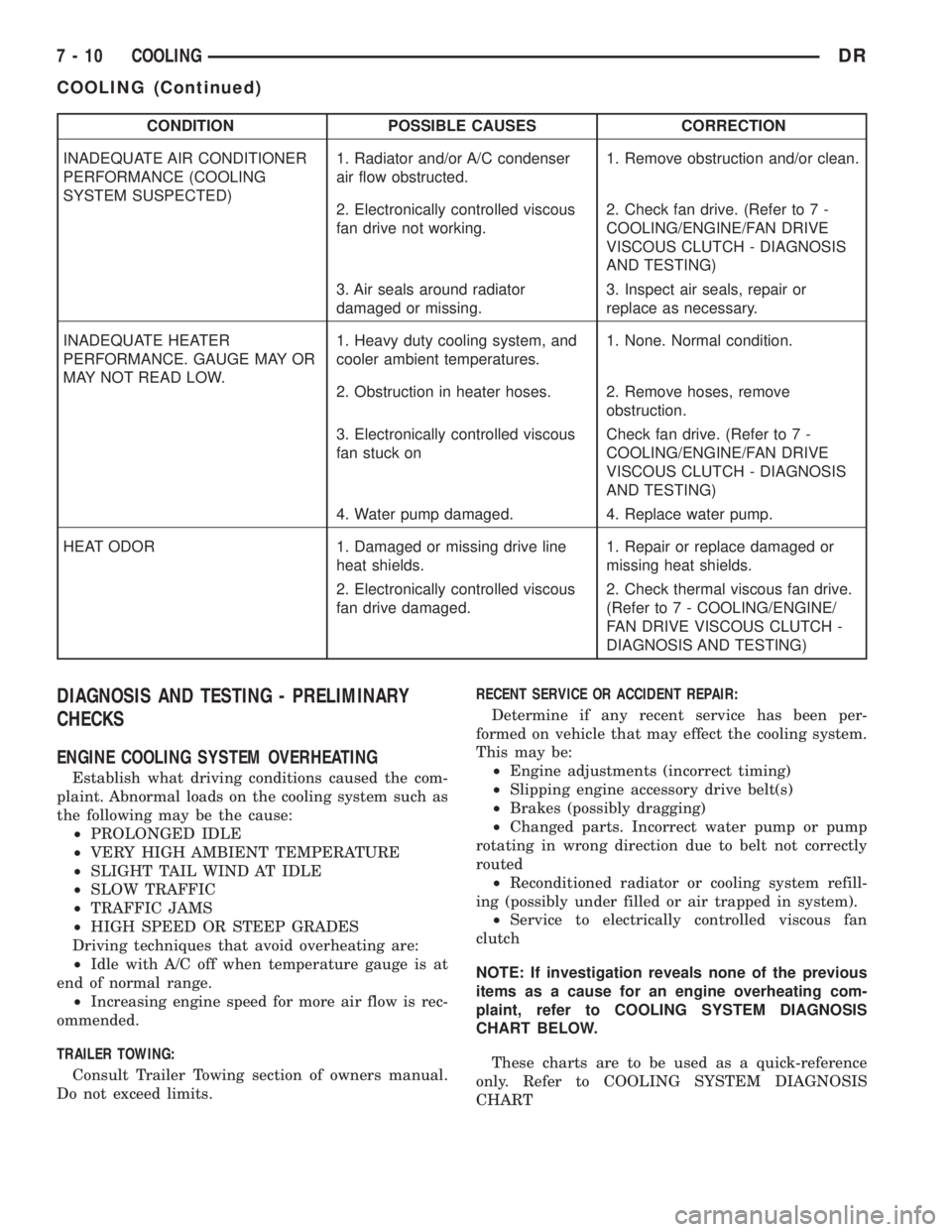
CONDITION POSSIBLE CAUSES CORRECTION
INADEQUATE AIR CONDITIONER
PERFORMANCE (COOLING
SYSTEM SUSPECTED)1. Radiator and/or A/C condenser
air flow obstructed.1. Remove obstruction and/or clean.
2. Electronically controlled viscous
fan drive not working.2. Check fan drive. (Refer to 7 -
COOLING/ENGINE/FAN DRIVE
VISCOUS CLUTCH - DIAGNOSIS
AND TESTING)
3. Air seals around radiator
damaged or missing.3. Inspect air seals, repair or
replace as necessary.
INADEQUATE HEATER
PERFORMANCE. GAUGE MAY OR
MAY NOT READ LOW.1. Heavy duty cooling system, and
cooler ambient temperatures.1. None. Normal condition.
2. Obstruction in heater hoses. 2. Remove hoses, remove
obstruction.
3. Electronically controlled viscous
fan stuck onCheck fan drive. (Refer to 7 -
COOLING/ENGINE/FAN DRIVE
VISCOUS CLUTCH - DIAGNOSIS
AND TESTING)
4. Water pump damaged. 4. Replace water pump.
HEAT ODOR 1. Damaged or missing drive line
heat shields.1. Repair or replace damaged or
missing heat shields.
2. Electronically controlled viscous
fan drive damaged.2. Check thermal viscous fan drive.
(Refer to 7 - COOLING/ENGINE/
FAN DRIVE VISCOUS CLUTCH -
DIAGNOSIS AND TESTING)
DIAGNOSIS AND TESTING - PRELIMINARY
CHECKS
ENGINE COOLING SYSTEM OVERHEATING
Establish what driving conditions caused the com-
plaint. Abnormal loads on the cooling system such as
the following may be the cause:
²PROLONGED IDLE
²VERY HIGH AMBIENT TEMPERATURE
²SLIGHT TAIL WIND AT IDLE
²SLOW TRAFFIC
²TRAFFIC JAMS
²HIGH SPEED OR STEEP GRADES
Driving techniques that avoid overheating are:
²Idle with A/C off when temperature gauge is at
end of normal range.
²Increasing engine speed for more air flow is rec-
ommended.
TRAILER TOWING:
Consult Trailer Towing section of owners manual.
Do not exceed limits.RECENT SERVICE OR ACCIDENT REPAIR:
Determine if any recent service has been per-
formed on vehicle that may effect the cooling system.
This may be:
²Engine adjustments (incorrect timing)
²Slipping engine accessory drive belt(s)
²Brakes (possibly dragging)
²Changed parts. Incorrect water pump or pump
rotating in wrong direction due to belt not correctly
routed
²Reconditioned radiator or cooling system refill-
ing (possibly under filled or air trapped in system).
²Service to electrically controlled viscous fan
clutch
NOTE: If investigation reveals none of the previous
items as a cause for an engine overheating com-
plaint, refer to COOLING SYSTEM DIAGNOSIS
CHART BELOW.
These charts are to be used as a quick-reference
only. Refer to COOLING SYSTEM DIAGNOSIS
CHART
7 - 10 COOLINGDR
COOLING (Continued)
Page 298 of 2895

COOLING SYSTEM DIAGNOSIS CHART
CONDITION POSSIBLE CAUSES CORRECTION
TEMPERATURE GAUGE
READS LOW1. Has a Diagnostic Trouble
Code (DTC) been set indicating
a stuck open thermostat?1. (Refer to 25 - EMISSIONS CONTROL -
DESCRIPTION) for On-Board Diagnostics
and DTC information. Replace thermostat
if necessary.
2. Is the temperature sending
unit connected?2. Check the temperature sensor
connector. (Refer to 8 - ELECTRICAL/
INSTRUMENT CLUSTER - SCHEMATIC -
ELECTRICAL) Repair connector if
necessary.
3. Is the temperature gauge
operating OK?3. Check gauge operation. (Refer to 8 -
ELECTRICAL/INSTRUMENT CLUSTER/
ENGINE TEMPERATURE GAUGE -
DESCRIPTION). Repair as necessary.
4. Coolant level low in cold
ambient temperatures
accompanied with poor heater
performance.4. Check coolant level in the coolant
reserve/overflow tank or degas bottle and
the radiator. Inspect system for leaks.
Repair leaks as necessary. Refer to the
Coolant section of the manual text for
WARNINGS and CAUTIONS associated
with removing the radiator cap.
5. Improper operation of internal
heater doors or heater controls.5. Inspect heater and repair as necessary.
(Refer to 24 - HEATING & AIR
CONDITIONING - DIAGNOSIS AND
TESTING) for procedures.
DRCOOLING 7 - 11
COOLING (Continued)
Page 299 of 2895

CONDITION POSSIBLE CAUSES CORRECTION
TEMPERATURE GAUGE
READS HIGH OR THE
COOLANT WARNING LAMP
ILLUMINATES. COOLANT MAY
OR MAY NOT BE LOST OR
LEAKING FROM THE COOLING
SYSTEM1. Trailer is being towed, a steep
hill is being climbed, vehicle is
operated in slow moving traffic,
or engine is being idled with
very high ambient (outside)
temperatures and the air
conditioning is on. Higher
altitudes could aggravate these
conditions.1. This may be a temporary condition and
repair is not necessary. Turn off the air
conditioning and attempt to drive the
vehicle without any of the previous
conditions. Observe the temperature
gauge. The gauge should return to the
normal range. If the gauge does not return
to the normal range, determine the cause
for overheating and repair. Refer to
Possible Causes (2-18).
2. Is the temperature gauge
reading correctly?2. Check gauge. (Refer to 8 -
ELECTRICAL/INSTRUMENT CLUSTER -
SCHEMATIC - ELECTRICAL). Repair as
necessary.
3. Is the temperature warning
illuminating unnecessarily?3. (Refer to 8 - ELECTRICAL/
INSTRUMENT CLUSTER - SCHEMATIC -
ELECTRICAL).
4. Coolant low in coolant
reserve/overflow tank and
radiator?4. Check for coolant leaks and repair as
necessary. (Refer to 7 - COOLING -
DIAGNOSIS AND TESTING).
5. Pressure cap not installed
tightly. If cap is loose, boiling
point of coolant will be lowered.
Also refer to the following Step
6.5. Tighten cap
6. Poor seals at the radiator
cap.6. (a) Check condition of cap and cap
seals. Refer to Radiator Cap. Replace cap
if necessary.
(b) Check condition of radiator filler neck.
If neck is bent or damaged, replace
radiator (5.9L) or degas bottle (3.7L, 4.7L).
7. Coolant level low in radiator
but not in coolant reserve/
overflow tank. This means the
radiator is not drawing coolant
from the coolant reserve/
overflow tank as the engine
cools (5.9L).7. (a) Check condition of radiator cap and
cap seals. Refer to Radiator Cap in this
Group. Replace cap if necessary.
(b) Check condition of radiator filler neck.
If neck is bent or damaged, replace
radiator.
(c) Check condition of the hose from the
radiator to the coolant tank. It should fit
tight at both ends without any kinks or
tears. Replace hose if necessary.
(d) Check coolant reserve/overflow tank
and tanks hoses for blockage. Repair as
necessary.
8. Incorrect coolant
concentration8. Check coolant. (Refer to LUBRICATION
& MAINTENANCE/FLUID TYPES -
DESCRIPTION).
9. Coolant not flowing through
system9. Check for coolant flow at radiator filler
neck with some coolant removed, engine
warm and thermostat open. Coolant
should be observed flowing through
radiator. If flow is not observed, determine
area of obstruction and repair as
necessary.
7 - 12 COOLINGDR
COOLING (Continued)
Page 300 of 2895

CONDITION POSSIBLE CAUSES CORRECTION
10. Radiator or A/C condenser
fins are dirty or clogged.10. Remove insects and debris. (Refer to
7 - COOLING - STANDARD
PROCEDURE).
11. Radiator core is corroded or
plugged.11. Have radiator re-cored or replaced.
12. Fuel or ignition system
problems.12. Refer to 14 - Fuel System or 8 -
Electrical for diagnosis and testing
procedures.
13. Dragging brakes. 13. Check and correct as necessary.
(Refer to 5 - BRAKES - DIAGNOSIS AND
TESTING) for correct procedures.
14. Bug screen or cardboard is
being , reducing airflow.14. Remove bug screen or cardboard.
15. Thermostat partially or
completely shut.15. Check thermostat operation and
replace as necessary. (Refer to 7 -
COOLING/ENGINE/ENGINE COOLANT
THERMOSTAT - REMOVAL) .
16. Viscous fan drive not
operating properly.16. Check fan drive operation and replace
as necessary. (Refer to 7 - COOLING/
ENGINE/FAN DRIVE VISCOUS CLUTCH
- REMOVAL).
17. Cylinder head gasket
leaking.17. Check for cylinder head gasket leaks.
(Refer to 7 - COOLING - DIAGNOSIS
AND TESTING).
18. Heater core leaking. 18. Check heater core for leaks. (Refer to
24 - HEATING & AIR CONDITIONING/
PLUMBING - DIAGNOSIS AND
TESTING). Repair as necessary.
DRCOOLING 7 - 13
COOLING (Continued)
Page 302 of 2895
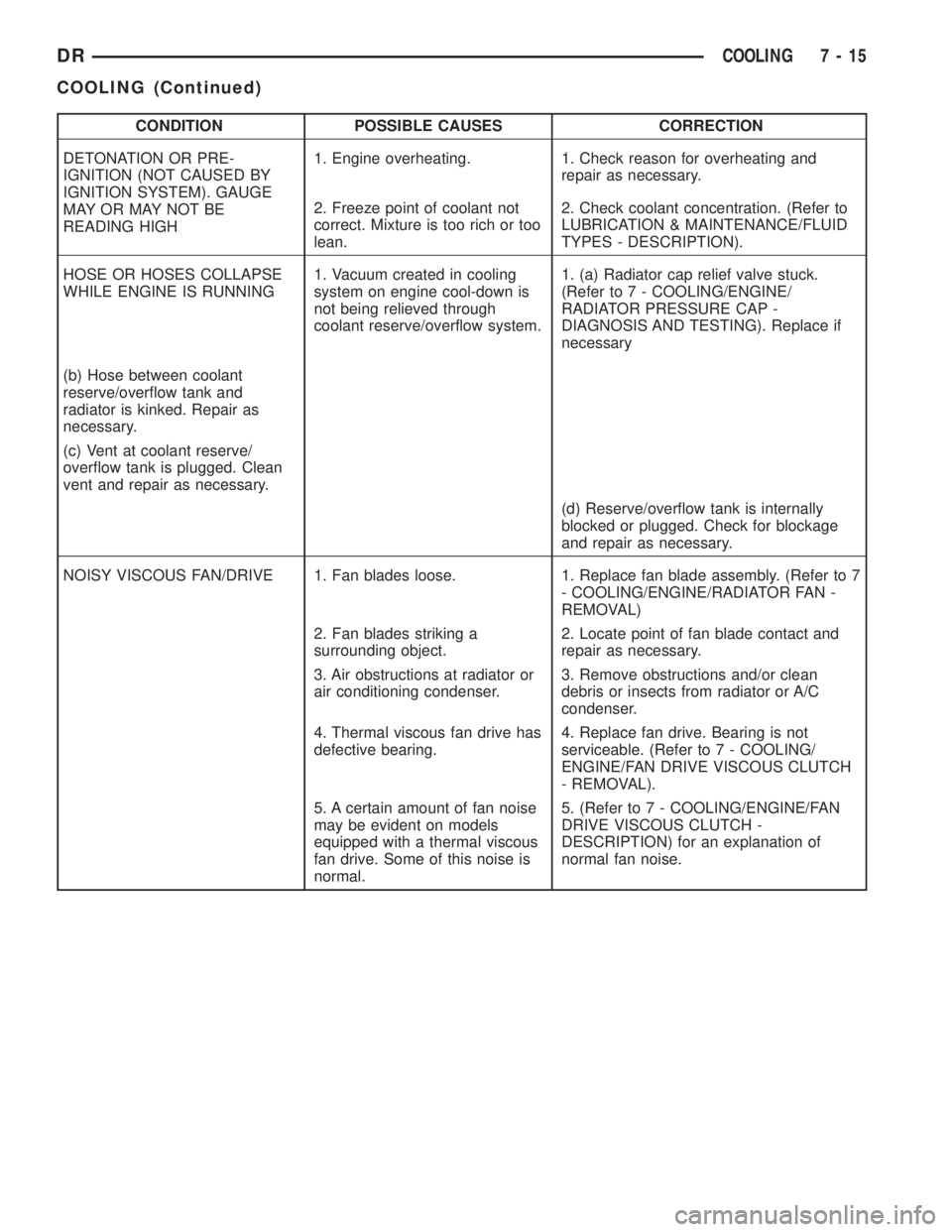
CONDITION POSSIBLE CAUSES CORRECTION
DETONATION OR PRE-
IGNITION (NOT CAUSED BY
IGNITION SYSTEM). GAUGE
MAY OR MAY NOT BE
READING HIGH1. Engine overheating. 1. Check reason for overheating and
repair as necessary.
2. Freeze point of coolant not
correct. Mixture is too rich or too
lean.2. Check coolant concentration. (Refer to
LUBRICATION & MAINTENANCE/FLUID
TYPES - DESCRIPTION).
HOSE OR HOSES COLLAPSE
WHILE ENGINE IS RUNNING1. Vacuum created in cooling
system on engine cool-down is
not being relieved through
coolant reserve/overflow system.1. (a) Radiator cap relief valve stuck.
(Refer to 7 - COOLING/ENGINE/
RADIATOR PRESSURE CAP -
DIAGNOSIS AND TESTING). Replace if
necessary
(b) Hose between coolant
reserve/overflow tank and
radiator is kinked. Repair as
necessary.
(c) Vent at coolant reserve/
overflow tank is plugged. Clean
vent and repair as necessary.
(d) Reserve/overflow tank is internally
blocked or plugged. Check for blockage
and repair as necessary.
NOISY VISCOUS FAN/DRIVE 1. Fan blades loose. 1. Replace fan blade assembly. (Refer to 7
- COOLING/ENGINE/RADIATOR FAN -
REMOVAL)
2. Fan blades striking a
surrounding object.2. Locate point of fan blade contact and
repair as necessary.
3. Air obstructions at radiator or
air conditioning condenser.3. Remove obstructions and/or clean
debris or insects from radiator or A/C
condenser.
4. Thermal viscous fan drive has
defective bearing.4. Replace fan drive. Bearing is not
serviceable. (Refer to 7 - COOLING/
ENGINE/FAN DRIVE VISCOUS CLUTCH
- REMOVAL).
5. A certain amount of fan noise
may be evident on models
equipped with a thermal viscous
fan drive. Some of this noise is
normal.5. (Refer to 7 - COOLING/ENGINE/FAN
DRIVE VISCOUS CLUTCH -
DESCRIPTION) for an explanation of
normal fan noise.
DRCOOLING 7 - 15
COOLING (Continued)
Page 303 of 2895
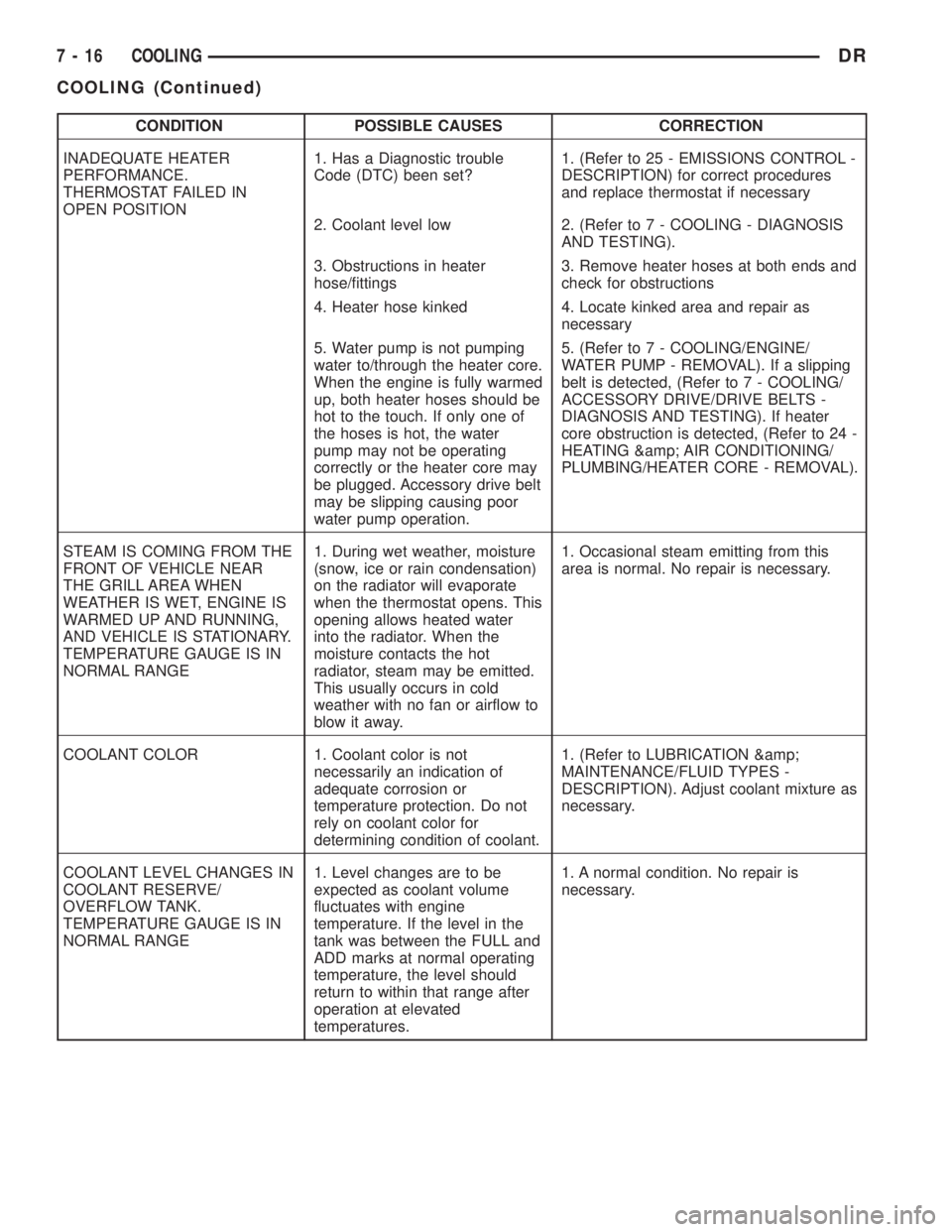
CONDITION POSSIBLE CAUSES CORRECTION
INADEQUATE HEATER
PERFORMANCE.
THERMOSTAT FAILED IN
OPEN POSITION1. Has a Diagnostic trouble
Code (DTC) been set?1. (Refer to 25 - EMISSIONS CONTROL -
DESCRIPTION) for correct procedures
and replace thermostat if necessary
2. Coolant level low 2. (Refer to 7 - COOLING - DIAGNOSIS
AND TESTING).
3. Obstructions in heater
hose/fittings3. Remove heater hoses at both ends and
check for obstructions
4. Heater hose kinked 4. Locate kinked area and repair as
necessary
5. Water pump is not pumping
water to/through the heater core.
When the engine is fully warmed
up, both heater hoses should be
hot to the touch. If only one of
the hoses is hot, the water
pump may not be operating
correctly or the heater core may
be plugged. Accessory drive belt
may be slipping causing poor
water pump operation.5. (Refer to 7 - COOLING/ENGINE/
WATER PUMP - REMOVAL). If a slipping
belt is detected, (Refer to 7 - COOLING/
ACCESSORY DRIVE/DRIVE BELTS -
DIAGNOSIS AND TESTING). If heater
core obstruction is detected, (Refer to 24 -
HEATING & AIR CONDITIONING/
PLUMBING/HEATER CORE - REMOVAL).
STEAM IS COMING FROM THE
FRONT OF VEHICLE NEAR
THE GRILL AREA WHEN
WEATHER IS WET, ENGINE IS
WARMED UP AND RUNNING,
AND VEHICLE IS STATIONARY.
TEMPERATURE GAUGE IS IN
NORMAL RANGE1. During wet weather, moisture
(snow, ice or rain condensation)
on the radiator will evaporate
when the thermostat opens. This
opening allows heated water
into the radiator. When the
moisture contacts the hot
radiator, steam may be emitted.
This usually occurs in cold
weather with no fan or airflow to
blow it away.1. Occasional steam emitting from this
area is normal. No repair is necessary.
COOLANT COLOR 1. Coolant color is not
necessarily an indication of
adequate corrosion or
temperature protection. Do not
rely on coolant color for
determining condition of coolant.1. (Refer to LUBRICATION &
MAINTENANCE/FLUID TYPES -
DESCRIPTION). Adjust coolant mixture as
necessary.
COOLANT LEVEL CHANGES IN
COOLANT RESERVE/
OVERFLOW TANK.
TEMPERATURE GAUGE IS IN
NORMAL RANGE1. Level changes are to be
expected as coolant volume
fluctuates with engine
temperature. If the level in the
tank was between the FULL and
ADD marks at normal operating
temperature, the level should
return to within that range after
operation at elevated
temperatures.1. A normal condition. No repair is
necessary.
7 - 16 COOLINGDR
COOLING (Continued)
Page 305 of 2895
CAUTION: Follow manufacturers instructions when
using these products.
STANDARD PROCEDUREÐDRAINING COOLING
SYSTEM 3.7L/4.7L/5.7L ENGINE
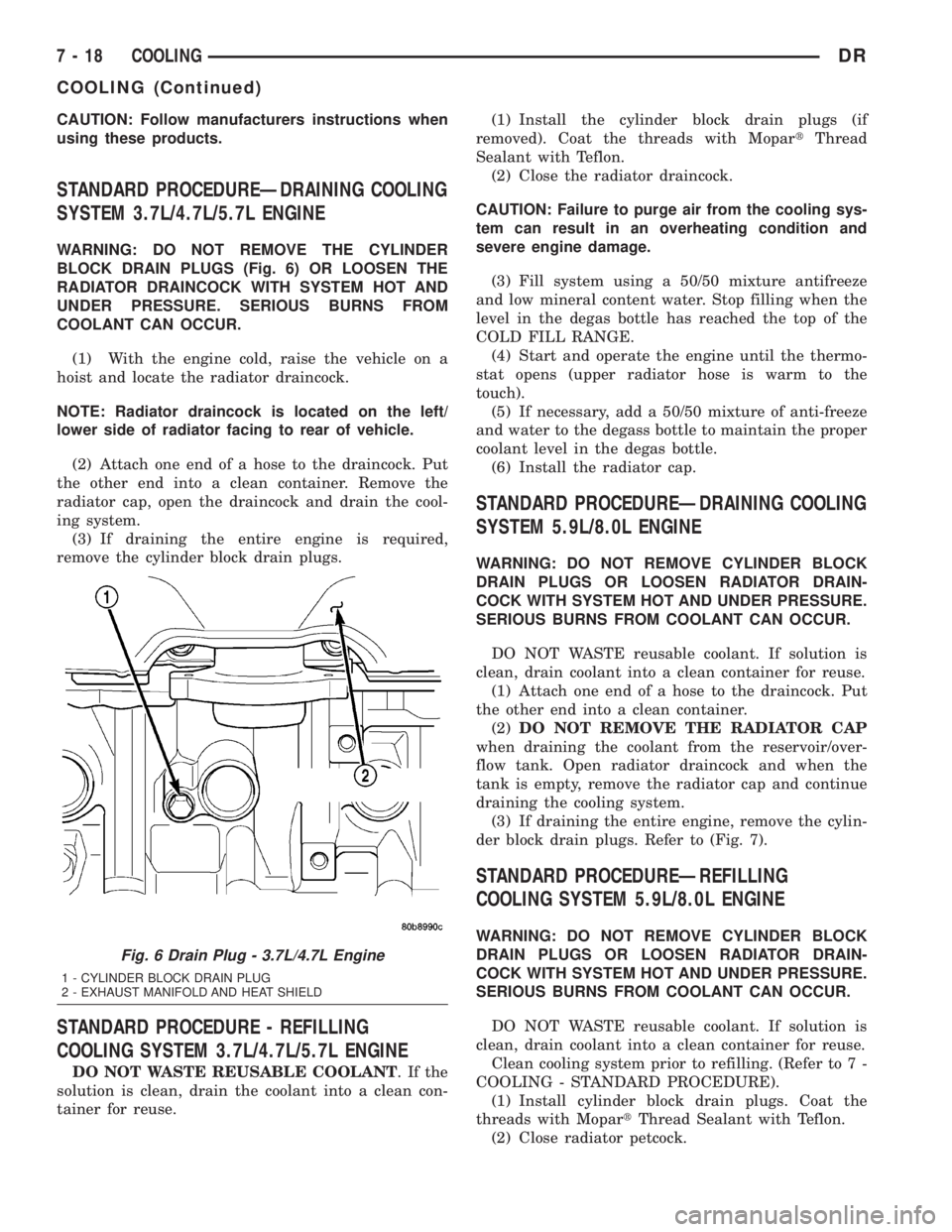
WARNING: DO NOT REMOVE THE CYLINDER
BLOCK DRAIN PLUGS (Fig. 6) OR LOOSEN THE
RADIATOR DRAINCOCK WITH SYSTEM HOT AND
UNDER PRESSURE. SERIOUS BURNS FROM
COOLANT CAN OCCUR.
(1) With the engine cold, raise the vehicle on a
hoist and locate the radiator draincock.
NOTE: Radiator draincock is located on the left/
lower side of radiator facing to rear of vehicle.
(2) Attach one end of a hose to the draincock. Put
the other end into a clean container. Remove the
radiator cap, open the draincock and drain the cool-
ing system.
(3) If draining the entire engine is required,
remove the cylinder block drain plugs.
STANDARD PROCEDURE - REFILLING
COOLING SYSTEM 3.7L/4.7L/5.7L ENGINE
DO NOT WASTE REUSABLE COOLANT.Ifthe
solution is clean, drain the coolant into a clean con-
tainer for reuse.(1) Install the cylinder block drain plugs (if
removed). Coat the threads with MopartThread
Sealant with Teflon.
(2) Close the radiator draincock.
CAUTION: Failure to purge air from the cooling sys-
tem can result in an overheating condition and
severe engine damage.
(3) Fill system using a 50/50 mixture antifreeze
and low mineral content water. Stop filling when the
level in the degas bottle has reached the top of the
COLD FILL RANGE.
(4) Start and operate the engine until the thermo-
stat opens (upper radiator hose is warm to the
touch).
(5) If necessary, add a 50/50 mixture of anti-freeze
and water to the degass bottle to maintain the proper
coolant level in the degas bottle.
(6) Install the radiator cap.
STANDARD PROCEDUREÐDRAINING COOLING
SYSTEM 5.9L/8.0L ENGINE
WARNING: DO NOT REMOVE CYLINDER BLOCK
DRAIN PLUGS OR LOOSEN RADIATOR DRAIN-
COCK WITH SYSTEM HOT AND UNDER PRESSURE.
SERIOUS BURNS FROM COOLANT CAN OCCUR.
DO NOT WASTE reusable coolant. If solution is
clean, drain coolant into a clean container for reuse.
(1) Attach one end of a hose to the draincock. Put
the other end into a clean container.
(2)DO NOT REMOVE THE RADIATOR CAP
when draining the coolant from the reservoir/over-
flow tank. Open radiator draincock and when the
tank is empty, remove the radiator cap and continue
draining the cooling system.
(3) If draining the entire engine, remove the cylin-
der block drain plugs. Refer to (Fig. 7).
STANDARD PROCEDUREÐREFILLING
COOLING SYSTEM 5.9L/8.0L ENGINE
WARNING: DO NOT REMOVE CYLINDER BLOCK
DRAIN PLUGS OR LOOSEN RADIATOR DRAIN-
COCK WITH SYSTEM HOT AND UNDER PRESSURE.
SERIOUS BURNS FROM COOLANT CAN OCCUR.
DO NOT WASTE reusable coolant. If solution is
clean, drain coolant into a clean container for reuse.
Clean cooling system prior to refilling. (Refer to 7 -
COOLING - STANDARD PROCEDURE).
(1) Install cylinder block drain plugs. Coat the
threads with MopartThread Sealant with Teflon.
(2) Close radiator petcock.
Fig. 6 Drain Plug - 3.7L/4.7L Engine
1 - CYLINDER BLOCK DRAIN PLUG
2 - EXHAUST MANIFOLD AND HEAT SHIELD
7 - 18 COOLINGDR
COOLING (Continued)
Page 309 of 2895

ACCESSORY DRIVE
TABLE OF CONTENTS
page page
BELT TENSIONERS - 3.7L / 4.7L
DESCRIPTION.........................22
OPERATION...........................22
REMOVAL.............................22
INSTALLATION.........................23
BELT TENSIONERS - 5.9L
DESCRIPTION.........................23
OPERATION...........................23
REMOVAL.............................23
INSTALLATION.........................24
BELT TENSIONERS - 5.9L DIESEL
DESCRIPTION.........................24
OPERATION...........................24
REMOVAL.............................25
INSTALLATION.........................25DRIVE BELTS - 3.7L / 4.7L
DIAGNOSIS AND TESTING - ACCESSORY
DRIVE BELT.........................25
REMOVAL.............................27
INSTALLATION.........................27
DRIVE BELTS - 5.9L
DIAGNOSIS AND TESTING - ACCESSORY
DRIVE BELT.........................28
REMOVAL.............................30
INSTALLATION.........................31
DRIVE BELTS - 5.9L DIESEL
DIAGNOSIS AND TESTINGÐACCESSORY
DRIVE BELT.........................31
REMOVAL.............................34
INSTALLATION.........................34
BELT TENSIONERS - 3.7L /
4.7L
DESCRIPTION
Correct drive belt tension is required to ensure
optimum performance of the belt driven engine acces-
sories. If specified tension is not maintained, belt
slippage may cause; engine overheating, lack of
power steering assist, loss of air conditioning capac-
ity, reduced generator output rate, and greatly
reduced belt life.
It is not necessary to adjust belt tension on the
3.7L or 4.7L engine. These engines are equipped with
an automatic belt tensioner (Fig. 1). The tensioner
maintains correct belt tension at all times. Due to
use of this belt tensioner, do not attempt to use a belt
tension gauge on 3.7L or 4.7L engines.
OPERATION
The automatic belt tensioner maintains belt ten-
sion by using internal spring pressure, a pivoting
arm and pulley to press against the drive belt.
REMOVAL
On 3.7L and 4.7L engines, the tensioner is
equipped with an indexing tang on back of ten-
sioner and an indexing stop on tensioner hous-
ing. If a new belt is being installed, tang must
be within approximately 24 mm (.94 inches) ofindexing stop. Belt is considered new if it has
been used 15 minutes or less.
If the above specification cannot be met, check for:
²The wrong belt being installed (incorrect length/
width)
²Worn bearings on an engine accessory (A/C com-
pressor, power steering pump, water pump, idler pul-
ley or generator)
²A pulley on an engine accessory being loose
²Misalignment of an engine accessory
²Belt incorrectly routed.
Fig. 1 AUTOMATIC BELT TENSIONER
1 - AUTOMATIC TENSIONER ASSEMBLY
7 - 22 ACCESSORY DRIVEDR