2003 CHEVROLET VENTURE height
[x] Cancel search: heightPage 44 of 486
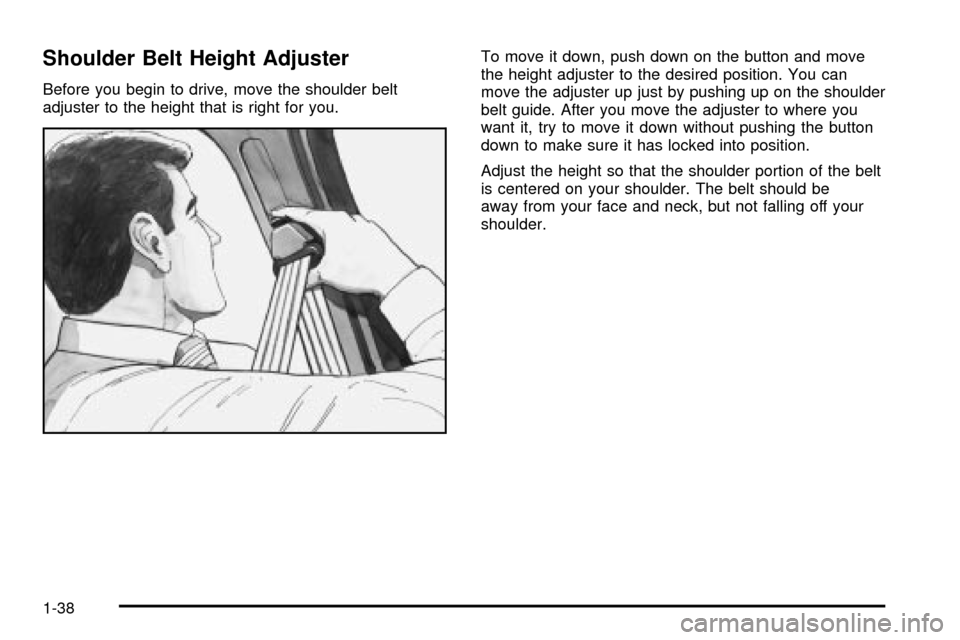
Shoulder Belt Height Adjuster
Before you begin to drive, move the shoulder belt
adjuster to the height that is right for you.To move it down, push down on the button and move
the height adjuster to the desired position. You can
move the adjuster up just by pushing up on the shoulder
belt guide. After you move the adjuster to where you
want it, try to move it down without pushing the button
down to make sure it has locked into position.
Adjust the height so that the shoulder portion of the belt
is centered on your shoulder. The belt should be
away from your face and neck, but not falling off your
shoulder.
1-38
Page 66 of 486
Q:What are the different types of add-on child
restraints?
A:Add-on child restraints, which are purchased by
the vehicle's owner, are available in four basic
types. Selection of a particular restraint should take
into consideration not only the child's weight,
height and age but also whether or not the restraint
will be compatible with the motor vehicle in
which it will be used.
For most basic types of child restraints, there are
many different models available. When purchasing a
child restraint, be sure it is designed to be used
in a motor vehicle. If it is, the restraint will have a
label saying that it meets federal motor vehicle
safety standards.
The restraint manufacturer's instructions that come
with the restraint state the weight and height
limitations for a particular child restraint. In addition,
there are many kinds of restraints available for
children with special needs.
{CAUTION:
Newborn infants need complete support,
including support for the head and neck. This
is necessary because a newborn infant's neck
is weak and its head weighs so much
compared with the rest of its body. In a crash,
an infant in a rear-facing seat settles into the
restraint, so the crash forces can be
distributed across the strongest part of an
infant's body, the back and shoulders. Infants
always should be secured in appropriate infant
restraints.
1-60
Page 89 of 486
If your vehicle has this option in a bucket seat, each
bucket seat that has the built-in child restraint ®ts in only
one location in your vehicle. To ®nd out where a
bucket seat that has a built-in child restraint must be
located in your vehicle see
Rear Seat Operation
on page 1-7. If your vehicle has this option in a 60/40
bench seat, this bench seat will only ®t in the second
row of your vehicle. In both types of seats, the built-in
child restraint works the same way.
This child restraint system conforms to all applicable
Federal Motor Vehicle Safety Standards.
Each child restraint is designed for use only by children
who weigh between 22 and 40 pounds (10 and 18 kg)
and whose height is between 33.5 and 40 inches
(850 and 1 016 mm) and who are capable of sitting
upright alone.
The child should also be at least one year old. It is
important to use a rear-facing infant restraint until the
child is about a year old. A rear-facing restraint gives the
infant's head, neck and body the support they would
need in a crash. See
Older Children on page 1-55orInfants and Young Children on page 1-58.
Q:What if the top of my child's shoulders is above
the shoulder belt slots for the ®ve-point child
restraint harness system?
A:A child whose shoulders are above the shoulder
belt slots for the ®ve point child restraint harness
system shouldn't use this child restraint. Instead,
the child should sit on the vehicle's regular
seat cushion and use the vehicle's adult
safety belts.
{CAUTION:
BEFORE YOU USE THIS CHILD RESTRAINT,
BE SURE THE TOP OF THE CHILD'S
SHOULDERS IS BELOW THE SLOTS THAT
THE HARNESS GOES THROUGH. A CHILD
WHOSE SHOULDERS ARE ABOVE THOSE
SLOTS COULD BE INJURED DURING A
SUDDEN STOP OR CRASH. IF THE TOP OF
THE CHILD'S SHOULDERS IS ABOVE THE
SLOTS, DON'T USE THIS CHILD RESTRAINT
WHILE THE VEHICLE IS IN MOTION.
1-83
Page 373 of 486

Brake Pedal Travel
See your dealer if the brake pedal does not return to
normal height, or if there is a rapid increase in
pedal travel. This could be a sign of brake trouble.
Brake Adjustment
Every time you apply the brakes, with or without the
vehicle moving, your brakes adjust for wear.
Replacing Brake System Parts
The braking system on a vehicle is complex. Its many
parts have to be of top quality and work well together if
the vehicle is to have really good braking. Your
vehicle was designed and tested with top-quality GM
brake parts. When you replace parts of your braking
system Ð for example, when your brake linings
wear down and you need new ones put in Ð be sure
you get new approved GM replacement parts. If you do
not, your brakes may no longer work properly. For
example, if someone puts in brake linings that are wrong
for your vehicle, the balance between your front and
rear brakes can change Ð for the worse. The braking
performance you have come to expect can change
in many other ways if someone puts in the wrong
replacement brake parts.
Battery
Your new vehicle comes with a maintenance free
ACDelcožbattery. When it is time for a new battery, get
one that has the replacement number shown on the
original battery's label. We recommend an ACDelco
ž
battery. SeeEngine Compartment Overview on
page 5-12for battery location.
Warning:Battery posts, terminals and related
accessories contain lead and lead compounds,
chemicals known to the State of California to cause
cancer and reproductive harm. Wash hands after
handling.
5-43
Page 397 of 486
{CAUTION:
Using the wrong replacement wheels, wheel
bolts or wheel nuts on your vehicle can be
dangerous. It could affect the braking and
handling of your vehicle, make your tires lose
air and make you lose control. You could have
a collision in which you or others could be
injured. Always use the correct wheel, wheel
bolts and wheel nuts for replacement.
Notice:The wrong wheel can also cause problems
with bearing life, brake cooling, speedometer or
odometer calibration, headlamp aim, bumper height,
vehicle ground clearance and tire or tire chain
clearance to the body and chassis.
See
Changing a Flat Tire on page 5-71for more
information.
Used Replacement Wheels
{CAUTION:
Putting a used wheel on your vehicle is
dangerous. You can't know how it's been used
or how far it's been driven. It could fail
suddenly and cause a crash. If you have to
replace a wheel, use a new GM original
equipment wheel.
Tire Chains
Notice:Use tire chains only where legal and only
when you must. Use only SAE Class ªSº type chains
that are the proper size for your tires. Install them
on the front tires and tighten them as tightly as
possible with the ends securely fastened. Drive
slowly and follow the chain manufacturer's
instructions. If you can hear the chains contacting
your vehicle, stop and retighten them. If the contact
continues, slow down until it stops. Driving too
fast or spinning the wheels with chains on will
damage your vehicle.
5-67
Page 428 of 486
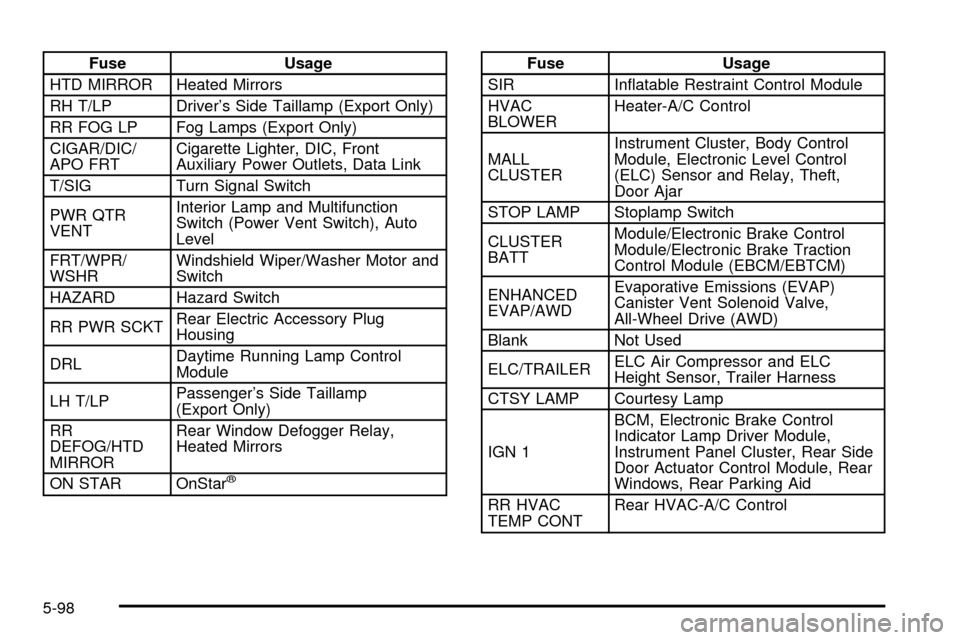
Fuse Usage
HTD MIRROR Heated Mirrors
RH T/LP Driver's Side Taillamp (Export Only)
RR FOG LP Fog Lamps (Export Only)
CIGAR/DIC/
APO FRTCigarette Lighter, DIC, Front
Auxiliary Power Outlets, Data Link
T/SIG Turn Signal Switch
PWR QTR
VENTInterior Lamp and Multifunction
Switch (Power Vent Switch), Auto
Level
FRT/WPR/
WSHRWindshield Wiper/Washer Motor and
Switch
HAZARD Hazard Switch
RR PWR SCKTRear Electric Accessory Plug
Housing
DRLDaytime Running Lamp Control
Module
LH T/LPPassenger's Side Taillamp
(Export Only)
RR
DEFOG/HTD
MIRRORRear Window Defogger Relay,
Heated Mirrors
ON STAR OnStar
ž
Fuse Usage
SIR In¯atable Restraint Control Module
HVAC
BLOWERHeater-A/C Control
MALL
CLUSTERInstrument Cluster, Body Control
Module, Electronic Level Control
(ELC) Sensor and Relay, Theft,
Door Ajar
STOP LAMP Stoplamp Switch
CLUSTER
BATTModule/Electronic Brake Control
Module/Electronic Brake Traction
Control Module (EBCM/EBTCM)
ENHANCED
EVAP/AWDEvaporative Emissions (EVAP)
Canister Vent Solenoid Valve,
All-Wheel Drive (AWD)
Blank Not Used
ELC/TRAILERELC Air Compressor and ELC
Height Sensor, Trailer Harness
CTSY LAMP Courtesy Lamp
IGN 1BCM, Electronic Brake Control
Indicator Lamp Driver Module,
Instrument Panel Cluster, Rear Side
Door Actuator Control Module, Rear
Windows, Rear Parking Aid
RR HVAC
TEMP CONTRear HVAC-A/C Control
5-98
Page 483 of 486

Service (cont.)
Doing Your Own Work................................... 5-3
Engine Soon Light.......................................3-45
Publications Ordering Information...................7-10
Traction System Warning Message.................3-50
Setting Preset PTYs........................................3-86
Setting Preset Stations............3-63, 3-66, 3-73, 3-83
Setting the Temperature...........................3-30, 3-32
Setting the Time.............................................3-61
Radios with Radio Data Systems (RDS).........3-61
Radios without Radio Data Systems (RDS).....3-61
Setting the Tone
(Bass/Treble)......................3-63, 3-66, 3-74, 3-83
Sheet Metal Damage.......................................5-93
Shifting Into Park (P).......................................2-39
Shifting Out of Park (P)...................................2-41
Shoulder Belt Height Adjuster...........................1-38
Side Window Latches......................................2-25
Skidding........................................................4-14
Sliding Door Delayed Locking...........................2-13
Sliding Door Lock...........................................2-14
Sliding Door, Power........................................2-17
Sliding Door Security Lock...............................2-15
Sliding Doors, Dual.........................................2-13
Some Other Rainy Weather Tips.......................4-19
Spare Tire Check............................................6-11
Special Fabric Cleaning Problems.....................5-88
Speci®cations, Capacities...............................5-103
Speedometer..................................................3-38Split Bench Seats............................................. 1-8
Starter Switch Check.......................................6-12
Starting Your Engine.......................................2-32
Steering in Emergencies..................................4-11
Steering, Suspension and Front Drive Axle
Boot and Seal Inspection..............................6-15
Steering Tips..................................................4-10
Steering........................................................4-10
Stereo RCA Jacks..........................................3-94
Storage Areas................................................2-51
Compact Overhead Console..........................2-52
Convenience Center.....................................2-58
Convenience Net.........................................2-57
Cupholder(s)...............................................2-51
Front Seat Storage Net................................2-54
Glove Box..................................................2-51
Luggage Carrier..........................................2-55
Overhead Console.......................................2-52
Rear Storage Area.......................................2-57
Storing a Flat or Spare Tire and Tools...............5-82
Storing the Built-In Child Restraint.....................1-91
Storing the Spare Tire and Tools.......................5-83
Stowable Seat................................................1-26
Stuck in Sand, Mud, Ice or Snow......................4-30
Sun Visors.....................................................2-26
Switchbanks, Instrument Panel..........................3-21
Switchbanks...................................................3-20
Overhead Console.......................................3-21
15