2003 CHEVROLET VENTURE mirror
[x] Cancel search: mirrorPage 307 of 486
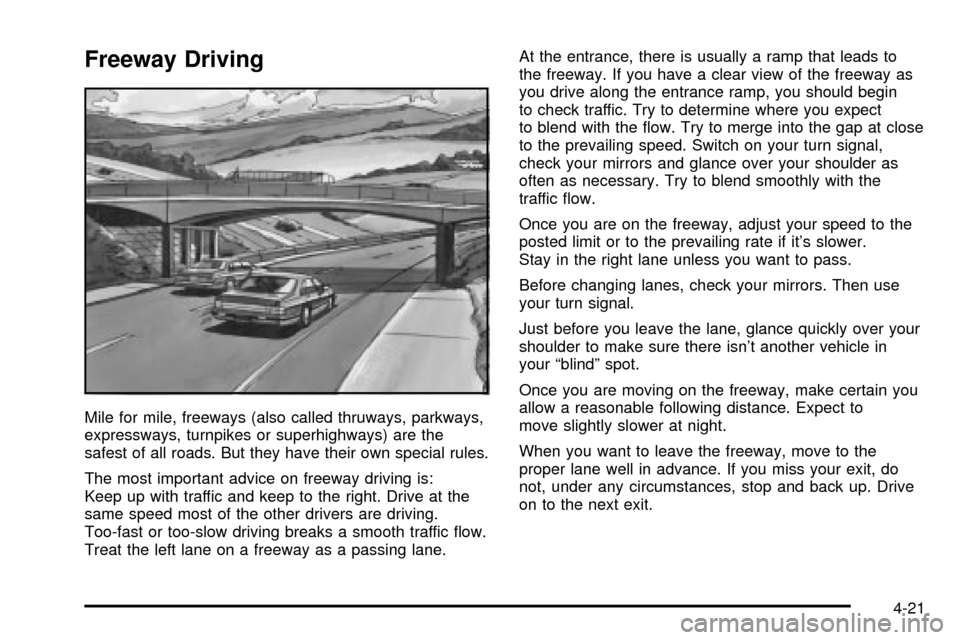
Freeway Driving
Mile for mile, freeways (also called thruways, parkways,
expressways, turnpikes or superhighways) are the
safest of all roads. But they have their own special rules.
The most important advice on freeway driving is:
Keep up with traffic and keep to the right. Drive at the
same speed most of the other drivers are driving.
Too-fast or too-slow driving breaks a smooth traffic ¯ow.
Treat the left lane on a freeway as a passing lane.At the entrance, there is usually a ramp that leads to
the freeway. If you have a clear view of the freeway as
you drive along the entrance ramp, you should begin
to check traffic. Try to determine where you expect
to blend with the ¯ow. Try to merge into the gap at close
to the prevailing speed. Switch on your turn signal,
check your mirrors and glance over your shoulder as
often as necessary. Try to blend smoothly with the
traffic ¯ow.
Once you are on the freeway, adjust your speed to the
posted limit or to the prevailing rate if it's slower.
Stay in the right lane unless you want to pass.
Before changing lanes, check your mirrors. Then use
your turn signal.
Just before you leave the lane, glance quickly over your
shoulder to make sure there isn't another vehicle in
your ªblindº spot.
Once you are moving on the freeway, make certain you
allow a reasonable following distance. Expect to
move slightly slower at night.
When you want to leave the freeway, move to the
proper lane well in advance. If you miss your exit, do
not, under any circumstances, stop and back up. Drive
on to the next exit.
4-21
Page 309 of 486

Highway Hypnosis
Is there actually such a condition as ªhighway
hypnosisº? Or is it just plain falling asleep at the wheel?
Call it highway hypnosis, lack of awareness, or
whatever.
There is something about an easy stretch of road with
the same scenery, along with the hum of the tires on the
road, the drone of the engine, and the rush of the
wind against the vehicle that can make you sleepy. Don't
let it happen to you! If it does, your vehicle can leave
the road in
less than a second,and you could crash and
be injured.What can you do about highway hypnosis? First, be
aware that it can happen.
Then here are some tips:
·Make sure your vehicle is well ventilated, with a
comfortably cool interior.
·Keep your eyes moving. Scan the road ahead and
to the sides. Check your mirrors and your
instruments frequently.
·If you get sleepy, pull off the road into a rest,
service or parking area and take a nap, get some
exercise, or both. For safety, treat drowsiness
on the highway as an emergency.
4-23
Page 326 of 486
Driving with a Trailer
{CAUTION:
If you have a rear-most window open and you
pull a trailer with your vehicle, carbon
monoxide (CO) could come into your vehicle.
You can't see or smell CO. It can cause
unconsciousness or death. See ªEngine
Exhaustº in the Index. To maximize your safety
when towing a trailer:
·Have your exhaust system inspected for
leaks, and make necessary repairs before
starting on your trip.
·Keep the rear-most windows closed.
·If exhaust does come into your vehicle
through a window in the rear or another
opening, drive with your front, main
heating or cooling system on and with the
fan on any speed. This will bring fresh,
outside air into your vehicle. Do not use
the climate control setting for maximum air
because it only recirculates the air inside
your vehicle. See ªClimate Controlsº in
the Index.Towing a trailer requires a certain amount of experience.
Before setting out for the open road, you'll want to get
to know your rig. Acquaint yourself with the feel of
handling and braking with the added weight of the trailer.
And always keep in mind that the vehicle you are
driving is now a good deal longer and not nearly as
responsive as your vehicle is by itself.
Before you start, check the trailer hitch and platform
(and attachments), safety chains, electrical connector,
lamps, tires and mirror adjustment. If the trailer has
electric brakes, start your vehicle and trailer moving and
then apply the trailer brake controller by hand to be
sure the brakes are working. This lets you check your
electrical connection at the same time.
During your trip, check occasionally to be sure that the
load is secure, and that the lamps and any trailer
brakes are still working.
4-40
Page 427 of 486
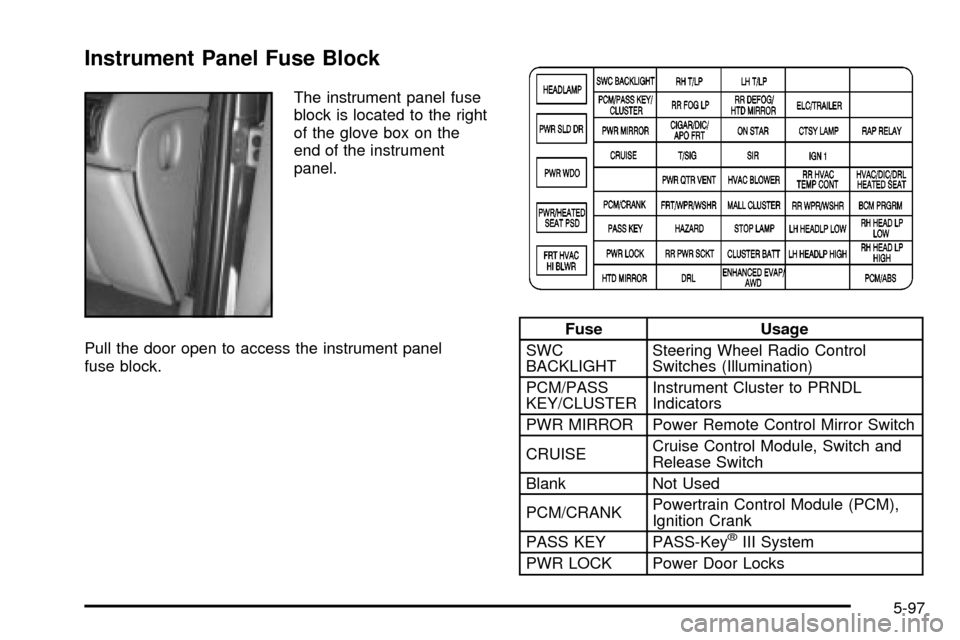
Instrument Panel Fuse Block
The instrument panel fuse
block is located to the right
of the glove box on the
end of the instrument
panel.
Pull the door open to access the instrument panel
fuse block.
Fuse Usage
SWC
BACKLIGHTSteering Wheel Radio Control
Switches (Illumination)
PCM/PASS
KEY/CLUSTERInstrument Cluster to PRNDL
Indicators
PWR MIRROR Power Remote Control Mirror Switch
CRUISECruise Control Module, Switch and
Release Switch
Blank Not Used
PCM/CRANKPowertrain Control Module (PCM),
Ignition Crank
PASS KEY PASS-Key
žIII System
PWR LOCK Power Door Locks
5-97
Page 428 of 486
Fuse Usage
HTD MIRROR Heated Mirrors
RH T/LP Driver's Side Taillamp (Export Only)
RR FOG LP Fog Lamps (Export Only)
CIGAR/DIC/
APO FRTCigarette Lighter, DIC, Front
Auxiliary Power Outlets, Data Link
T/SIG Turn Signal Switch
PWR QTR
VENTInterior Lamp and Multifunction
Switch (Power Vent Switch), Auto
Level
FRT/WPR/
WSHRWindshield Wiper/Washer Motor and
Switch
HAZARD Hazard Switch
RR PWR SCKTRear Electric Accessory Plug
Housing
DRLDaytime Running Lamp Control
Module
LH T/LPPassenger's Side Taillamp
(Export Only)
RR
DEFOG/HTD
MIRRORRear Window Defogger Relay,
Heated Mirrors
ON STAR OnStar
ž
Fuse Usage
SIR In¯atable Restraint Control Module
HVAC
BLOWERHeater-A/C Control
MALL
CLUSTERInstrument Cluster, Body Control
Module, Electronic Level Control
(ELC) Sensor and Relay, Theft,
Door Ajar
STOP LAMP Stoplamp Switch
CLUSTER
BATTModule/Electronic Brake Control
Module/Electronic Brake Traction
Control Module (EBCM/EBTCM)
ENHANCED
EVAP/AWDEvaporative Emissions (EVAP)
Canister Vent Solenoid Valve,
All-Wheel Drive (AWD)
Blank Not Used
ELC/TRAILERELC Air Compressor and ELC
Height Sensor, Trailer Harness
CTSY LAMP Courtesy Lamp
IGN 1BCM, Electronic Brake Control
Indicator Lamp Driver Module,
Instrument Panel Cluster, Rear Side
Door Actuator Control Module, Rear
Windows, Rear Parking Aid
RR HVAC
TEMP CONTRear HVAC-A/C Control
5-98
Page 431 of 486
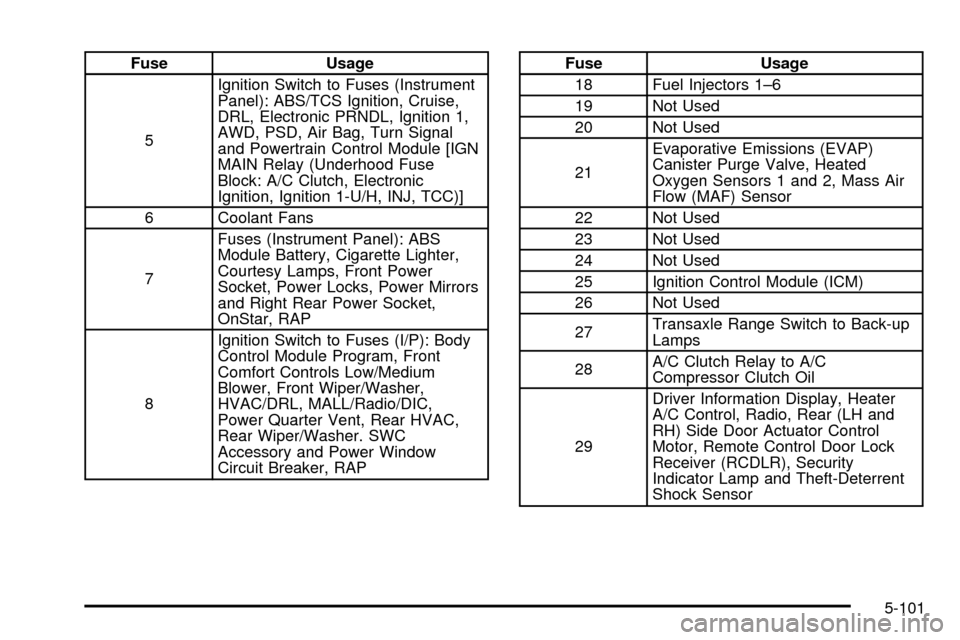
Fuse Usage
5Ignition Switch to Fuses (Instrument
Panel): ABS/TCS Ignition, Cruise,
DRL, Electronic PRNDL, Ignition 1,
AWD, PSD, Air Bag, Turn Signal
and Powertrain Control Module [IGN
MAIN Relay (Underhood Fuse
Block: A/C Clutch, Electronic
Ignition, Ignition 1-U/H, INJ, TCC)]
6 Coolant Fans
7Fuses (Instrument Panel): ABS
Module Battery, Cigarette Lighter,
Courtesy Lamps, Front Power
Socket, Power Locks, Power Mirrors
and Right Rear Power Socket,
OnStar, RAP
8Ignition Switch to Fuses (I/P): Body
Control Module Program, Front
Comfort Controls Low/Medium
Blower, Front Wiper/Washer,
HVAC/DRL, MALL/Radio/DIC,
Power Quarter Vent, Rear HVAC,
Rear Wiper/Washer. SWC
Accessory and Power Window
Circuit Breaker, RAPFuse Usage
18 Fuel Injectors 1±6
19 Not Used
20 Not Used
21Evaporative Emissions (EVAP)
Canister Purge Valve, Heated
Oxygen Sensors 1 and 2, Mass Air
Flow (MAF) Sensor
22 Not Used
23 Not Used
24 Not Used
25 Ignition Control Module (ICM)
26 Not Used
27Transaxle Range Switch to Back-up
Lamps
28A/C Clutch Relay to A/C
Compressor Clutch Oil
29Driver Information Display, Heater
A/C Control, Radio, Rear (LH and
RH) Side Door Actuator Control
Motor, Remote Control Door Lock
Receiver (RCDLR), Security
Indicator Lamp and Theft-Deterrent
Shock Sensor
5-101
Page 477 of 486

J
Jump Starting.................................................5-44
K
Key Lock Cylinders Service..............................6-12
Keyless Entry System....................................... 2-5
Keys............................................................... 2-3
L
Lamps on Reminder........................................3-15
Lamps...........................................................3-15
Exterior......................................................3-15
Interior.......................................................3-17
Lap Belt................................................1-46, 1-47
Lap-Shoulder Belt...................................1-36, 1-49
Last Door Closed Locking................................2-12
Last Door Locking...........................................2-64
LATCH System...............................................1-69
Child Restraints...........................................1-69
Securing a Child Restraint Designed for the
LATCH System........................................1-71
Latches, Side Window.....................................2-25
Leaving Your Vehicle With the
Engine Running..........................................2-40Leaving Your Vehicle.......................................2-13
Liftgate..........................................................2-22
Lighted Vanity Mirror.......................................2-26
Light.............................................................3-40
Air Bag Readiness.......................................3-40
Anti-Lock Brake System Warning...................3-42
Brake System Warning.................................3-41
Malfunction Indicator....................................3-45
Safety Belt Reminder...................................3-40
TCS Warning Light......................................3-43
Traction Control System (TCS) Warning..........3-43
Loading Your Vehicle.......................................4-34
Lockout Deterrent...........................................2-64
Lockout Protection..........................................2-13
Locks............................................................2-63
Automatic Door...........................................2-63
Door........................................................... 2-9
Last Door Closed Locking.............................2-12
Leaving Your Vehicle....................................2-13
Lockout Protection.......................................2-13
Power Door................................................2-11
Programmable Automatic Door Locks.............2-12
Loss of Control...............................................4-14
Low Engine Oil Level Message.........................3-53
Low Fuel Warning Message.............................3-57
Low Oil Pressure Message...............................3-52
Luggage Carrier..............................................2-55
9
Page 479 of 486

Mirrors..........................................................2-44
Manual Rearview Mirror................................2-44
Outside Convex Mirror.................................2-45
Outside Heated Mirrors................................2-45
Outside Power Mirrors..................................2-44
MyGMLink.com................................................ 7-3
N
New Vehicle Break-In......................................2-31
Normal Maintenance Replacement Parts...........5-104
O
Odometer......................................................3-38
Off-Road Recovery..........................................4-12
Oil ................................................................5-13
Engine.......................................................5-13
Pressure Message.......................................3-52
Older Children, Restraints................................1-55
Online Owner Center........................................ 7-3
OnStar
žPersonal Calling.................................2-46
OnStaržServices............................................2-46
OnStaržSystem.............................................2-45
OnStaržVirtual Advisor....................................2-46
Operation Tips................................................3-28
Operation......................................................3-25
Other Warning Devices...................................... 3-6
Outlet Adjustment............................................3-28Outside.........................................................2-45
Convex Mirror.............................................2-45
Heated Mirrors............................................2-45
Power Mirrors.............................................2-44
Overhead Console Switchbank..........................3-21
Overhead Console..........................................2-52
Overheated Engine Protection Operating Mode . . . 5-26
Overseas ± Customer Assistance........................ 7-5
Owners, Canadian............................................... ii
Owner's Information........................................7-11
P
Park Aid........................................................3-22
Park (P)........................................................2-39
Shifting Into................................................2-39
Shifting Out of............................................2-41
Parking Brake and Automatic Transaxle Park (P)
Mechanism Check.......................................6-14
Parking on Hills..............................................4-42
Parking.........................................................3-22
Assist........................................................3-22
Brake........................................................2-38
Over Things That Burn.................................2-42
Part A - Scheduled Maintenance Services............ 6-4
Part B - Owner Checks and Services................6-10
Part C - Periodic MaintenanceInspections..........6-15
Part D - Recommended Fluids and Lubricants....6-17
Part E - Maintenance Record...........................6-19
11