Page 36 of 374
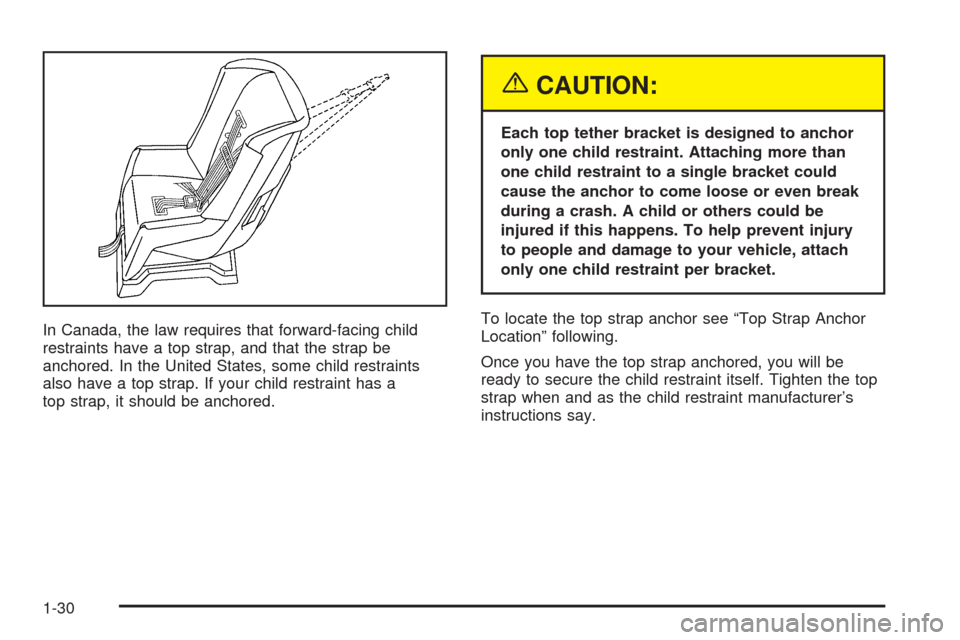
In Canada, the law requires that forward-facing child
restraints have a top strap, and that the strap be
anchored. In the United States, some child restraints
also have a top strap. If your child restraint has a
top strap, it should be anchored.
{CAUTION:
Each top tether bracket is designed to anchor
only one child restraint. Attaching more than
one child restraint to a single bracket could
cause the anchor to come loose or even break
during a crash. A child or others could be
injured if this happens. To help prevent injury
to people and damage to your vehicle, attach
only one child restraint per bracket.
To locate the top strap anchor see “Top Strap Anchor
Location” following.
Once you have the top strap anchored, you will be
ready to secure the child restraint itself. Tighten the top
strap when and as the child restraint manufacturer’s
instructions say.
1-30
Page 37 of 374
Top Strap Anchor Location
Your vehicle has a top
strap anchor for the
passenger’s seating
position. The anchor is
located on the back
of the seat.
Lower Anchorages and Top Tethers
for Children (LATCH System)
Your vehicle is equipped with the LATCH system.
There are anchors for the passenger seat.
This system, designed to make installation of child
restraints easier, does not use the vehicle’s safety belts.
Instead, it uses vehicle anchors and child restraint
attachments to secure the restraints. Some restraints
also use another vehicle anchor to secure a top
tether strap.A. Lower Anchorage
B. Lower Anchorage
C. Top Tether
1-31
Page 38 of 374
A. Lower Anchorage
B. Lower Anchorage
In order to use the LATCH system in your vehicle, you
need a child restraint designed for that system.To assist you in locating the anchors for this child
restraint system, the passenger seat has visible metal
anchors in the seat, where the seatback meets the
seat cushion.
{CAUTION:
If a LATCH-type child restraint is not attached
to its anchorage points, the restraint will not
be able to protect the child correctly. In a
crash, the child could be seriously injured or
killed. Make sure that a LATCH-type child
restraint is properly installed using the
anchorage points, or use the vehicle’s safety
belts to secure the restraint, following the
instructions that came with that restraint, and
also the instructions in this manual.
1-32
Page 39 of 374

Securing a Child Restraint Designed
for the LATCH System
Your vehicle has a passenger airbag. There is an airbag
off switch in the glove box you can use to turn off the
passenger’s airbag. SeeAirbag Off Switch on page 1-48
for more on this, including important safety information.
Unless the passenger’s airbag has been turned off,
neverput a rear-facing child restraint in this vehicle.Here is why:{CAUTION:
A child in a rear-facing child restraint can be
seriously injured or killed if the passenger’s
airbag inates. This is because the back of the
rear-facing child restraint would be very close
to the inating airbag. Do not use a rear-facing
child restraint in this vehicle unless the
passenger’s airbag has been turned off.
Even though the airbag off switch is designed
to turn off the passenger’s frontal airbag, no
system is fail-safe, and no one can guarantee
that an airbag will not deploy under some
unusual circumstance, even though it is turned
off. We recommend that rear-facing child
restraints be transported in vehicles with a
rear seat that will accommodate a rear-facing
child restraint, whenever possible.
If you need to secure a forward-facing child
restraint in the passenger seat, always move
the passenger seat as far back as it will go.
1-33
Page 40 of 374

{CAUTION:
If the airbag readiness light ever comes on
when you have turned off the passenger’s
frontal airbag, it means that something may be
wrong with the airbag system. The passenger’s
frontal airbag could inate even though the
switch is off. If this ever happens, do not let
anyone whom the national government has
identied as a member of a passenger airbag
risk group sit in the passenger’s position
(for example, do not secure a rear-facing child
restraint in your vehicle) until you have your
vehicle serviced. SeeAirbag Off Switch on
page 1-48.1. Your vehicle has a passenger’s airbag. See
Airbag Off Switch on page 1-48. If your child
restraint is forward-facing, always move the seat
as far back as it will go before securing it in
this seat. SeePower Seats on page 1-2. Never
use a rear-facing child restraint in this seat unless
the airbag is off.
2. Find the LATCH anchorages in the passenger
seat. SeeLower Anchorages and Top Tethers
for Children (LATCH System) on page 1-31.
3. Put the child restraint on the seat.
4. Attach and tighten the LATCH attachments on
the child restraint to the LATCH anchorages in
the vehicle. The child restraint instructions will
show you how.
5. If the child restraint is forward-facing, attach and
tighten the top tether to the top tether anchorage.
The child restraint instructions will show you
how. Also seeTop Strap on page 1-29.
6. Push and pull the child restraint in different
directions to be sure it is secure.
1-34
Page 42 of 374
Securing a Child Restraint in the
Passenger Seat Position
Your vehicle has a passenger air bag. There is an air
bag off switch in the glove box you can use to turn
off the passenger’s air bag. SeeAirbag Off Switch
on page 1-48for more on this, including important
safety information.
Unless the passenger’s air bag has been turned off,
neverput a rear-facing child restraint in this vehicle.
1-36
Page 43 of 374

Here is why:
{CAUTION:
A child in a rear-facing child restraint can be
seriously injured or killed if the passenger’s
airbag inates. This is because the back of the
rear-facing child restraint would be very close
to the inating airbag. Do not use a rear-facing
child restraint in this vehicle unless the
passenger’s airbag has been turned off.
Even though the airbag off switch is designed
to turn off the passenger’s frontal airbag, no
system is fail-safe, and no one can guarantee
that an airbag will not deploy under some
unusual circumstance, even though it is turned
off. We recommend that rear-facing child
restraints be transported in vehicles with a
rear seat that will accommodate a rear-facing
child restraint, whenever possible.
If you need to secure a forward-facing child
restraint in the passenger seat, always move
the passenger seat as far back as it will go.
{CAUTION:
If the airbag readiness light ever comes on
when you have turned off the passenger’s
frontal airbag, it means that something may be
wrong with the airbag system. The passenger’s
frontal airbag could inate even though the
switch is off. If this ever happens, do not let
anyone whom the national government has
identied as a member of a passenger airbag
risk group sit in the passenger’s position
(for example, do not secure a rear-facing child
restraint in your vehicle) until you have your
vehicle serviced. SeeAirbag Off Switch on
page 1-48.
If your child restraint is equipped with the LATCH
system, seeLower Anchorages and Top Tethers for
Children (LATCH System) on page 1-31. SeeTop Strap
on page 1-29if the child restraint has one.
1-37
Page 44 of 374
If your child restraint does not have the LATCH system,
you will be using the lap-shoulder belt. Be sure to
follow the instructions that came with the child restraint.
Secure the child in the child restraint when and as
the instructions say.
1. Your vehicle has a passenger’s air bag. If you are
using a rear-facing child restraint in this seat, make
sure the air bag is turned off. SeeAirbag Off
Switch on page 1-48. If your child restraint is
forward-facing, always move the seat as far back
as it will go before securing it in this seat. See
Power Seats on page 1-2.
2. Put the child restraint on the seat.
3. Pick up the latch plate, and run the lap and shoulder
portions of the vehicle’s safety belt through or
around the restraint. The child restraint instructions
will show you how.
4. Buckle the belt. Make sure the release button is
positioned so you would be able to unbuckle the
safety belt quickly if you ever had to.
1-38