Page 391 of 556
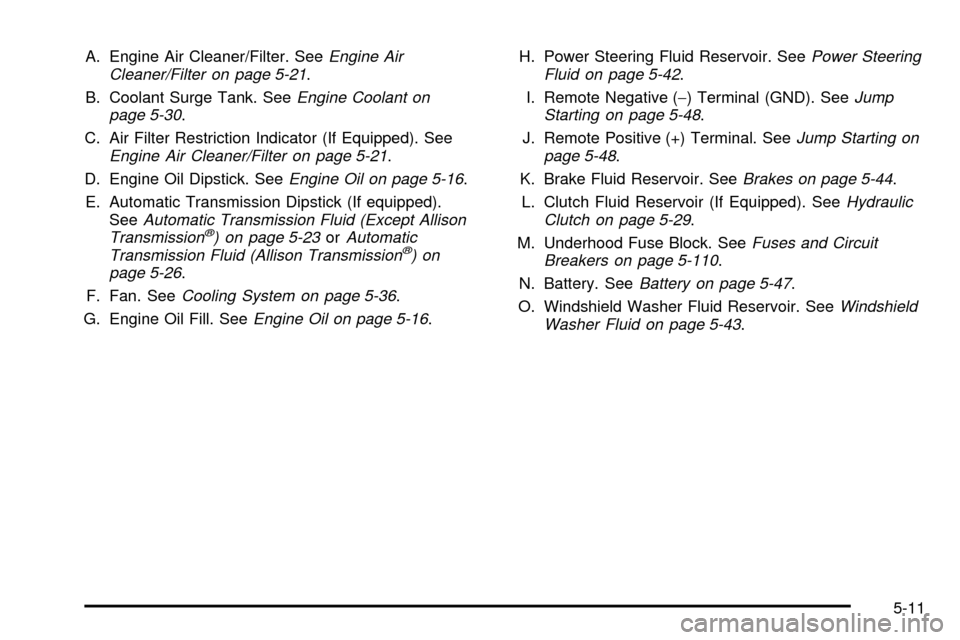
A. Engine Air Cleaner/Filter. SeeEngine Air
Cleaner/Filter on page 5-21.
B. Coolant Surge Tank. See
Engine Coolant on
page 5-30.
C. Air Filter Restriction Indicator (If Equipped). See
Engine Air Cleaner/Filter on page 5-21.
D. Engine Oil Dipstick. See
Engine Oil on page 5-16.
E. Automatic Transmission Dipstick (If equipped).
See
Automatic Transmission Fluid (Except Allison
Transmissionž) on page 5-23orAutomatic
Transmission Fluid (Allison Transmissionž)on
page 5-26.
F. Fan. See
Cooling System on page 5-36.
G. Engine Oil Fill. See
Engine Oil on page 5-16.H. Power Steering Fluid Reservoir. See
Power Steering
Fluid on page 5-42.
I. Remote Negative (-) Terminal (GND). See
Jump
Starting on page 5-48.
J. Remote Positive (+) Terminal. See
Jump Starting on
page 5-48.
K. Brake Fluid Reservoir. See
Brakes on page 5-44.
L. Clutch Fluid Reservoir (If Equipped). See
Hydraulic
Clutch on page 5-29.
M. Underhood Fuse Block. See
Fuses and Circuit
Breakers on page 5-110.
N. Battery. See
Battery on page 5-47.
O. Windshield Washer Fluid Reservoir. See
Windshield
Washer Fluid on page 5-43.
5-11
Page 393 of 556
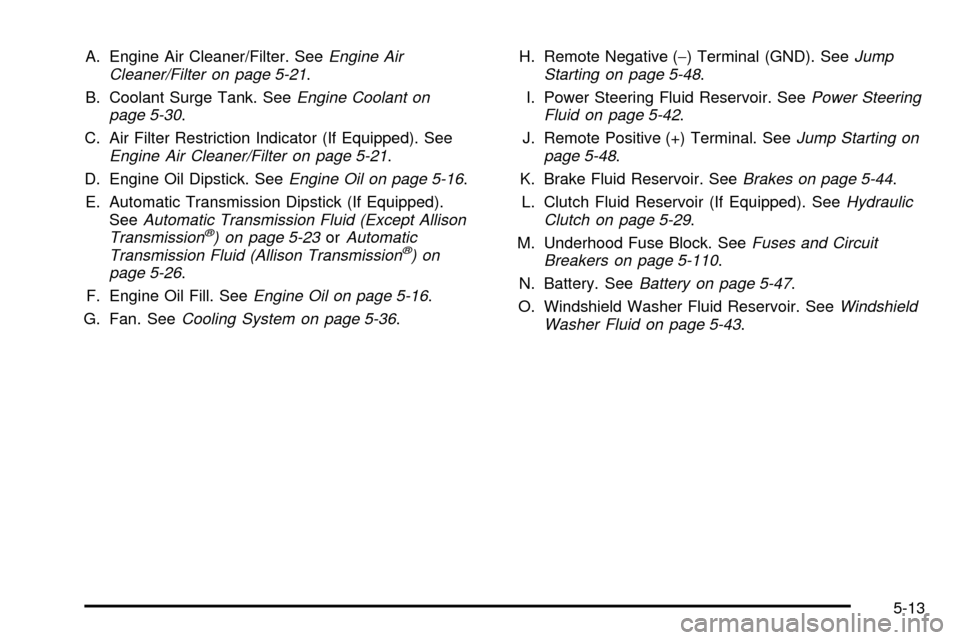
A. Engine Air Cleaner/Filter. SeeEngine Air
Cleaner/Filter on page 5-21.
B. Coolant Surge Tank. See
Engine Coolant on
page 5-30.
C. Air Filter Restriction Indicator (If Equipped). See
Engine Air Cleaner/Filter on page 5-21.
D. Engine Oil Dipstick. See
Engine Oil on page 5-16.
E. Automatic Transmission Dipstick (If Equipped).
See
Automatic Transmission Fluid (Except Allison
Transmissionž) on page 5-23orAutomatic
Transmission Fluid (Allison Transmissionž)on
page 5-26.
F. Engine Oil Fill. See
Engine Oil on page 5-16.
G. Fan. See
Cooling System on page 5-36.H. Remote Negative (-) Terminal (GND). See
Jump
Starting on page 5-48.
I. Power Steering Fluid Reservoir. See
Power Steering
Fluid on page 5-42.
J. Remote Positive (+) Terminal. See
Jump Starting on
page 5-48.
K. Brake Fluid Reservoir. See
Brakes on page 5-44.
L. Clutch Fluid Reservoir (If Equipped). See
Hydraulic
Clutch on page 5-29.
M. Underhood Fuse Block. See
Fuses and Circuit
Breakers on page 5-110.
N. Battery. See
Battery on page 5-47.
O. Windshield Washer Fluid Reservoir. See
Windshield
Washer Fluid on page 5-43.
5-13
Page 395 of 556
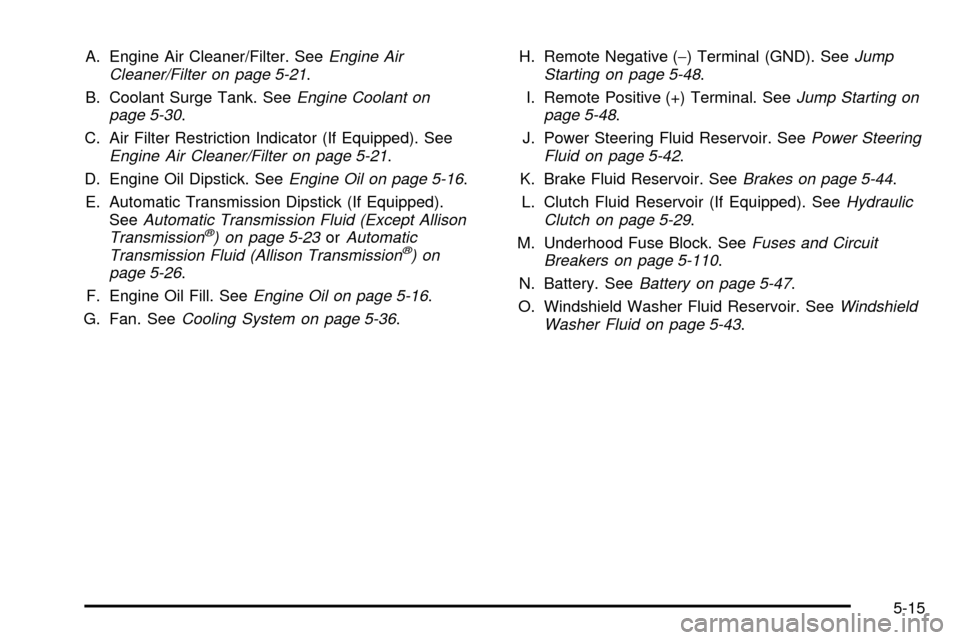
A. Engine Air Cleaner/Filter. SeeEngine Air
Cleaner/Filter on page 5-21.
B. Coolant Surge Tank. See
Engine Coolant on
page 5-30.
C. Air Filter Restriction Indicator (If Equipped). See
Engine Air Cleaner/Filter on page 5-21.
D. Engine Oil Dipstick. See
Engine Oil on page 5-16.
E. Automatic Transmission Dipstick (If Equipped).
See
Automatic Transmission Fluid (Except Allison
Transmissionž) on page 5-23orAutomatic
Transmission Fluid (Allison Transmissionž)on
page 5-26.
F. Engine Oil Fill. See
Engine Oil on page 5-16.
G. Fan. See
Cooling System on page 5-36.H. Remote Negative (-) Terminal (GND). See
Jump
Starting on page 5-48.
I. Remote Positive (+) Terminal. See
Jump Starting on
page 5-48.
J. Power Steering Fluid Reservoir. See
Power Steering
Fluid on page 5-42.
K. Brake Fluid Reservoir. See
Brakes on page 5-44.
L. Clutch Fluid Reservoir (If Equipped). See
Hydraulic
Clutch on page 5-29.
M. Underhood Fuse Block. See
Fuses and Circuit
Breakers on page 5-110.
N. Battery. See
Battery on page 5-47.
O. Windshield Washer Fluid Reservoir. See
Windshield
Washer Fluid on page 5-43.
5-15
Page 422 of 556
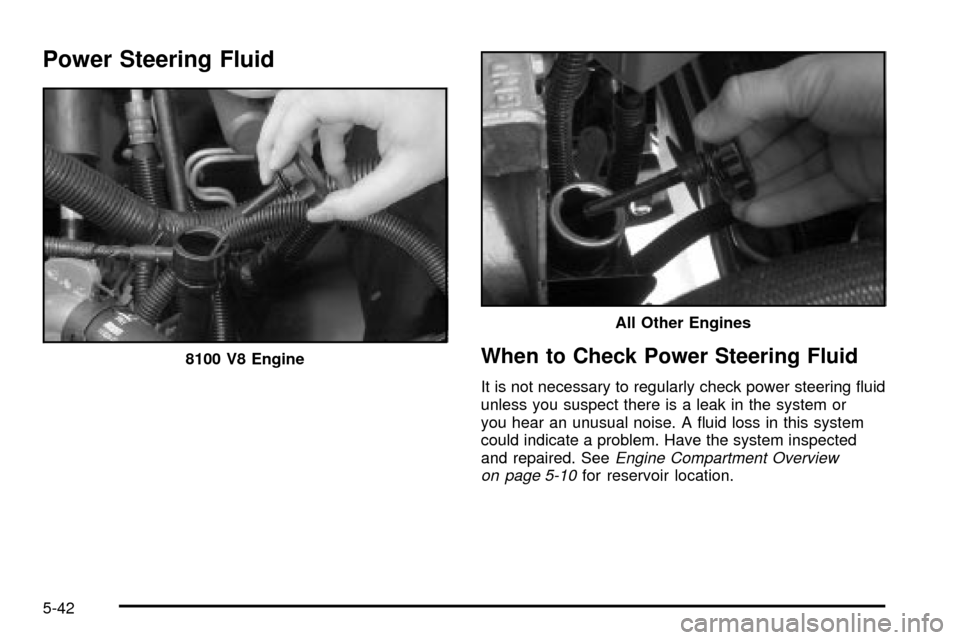
Power Steering Fluid
When to Check Power Steering Fluid
It is not necessary to regularly check power steering ¯uid
unless you suspect there is a leak in the system or
you hear an unusual noise. A ¯uid loss in this system
could indicate a problem. Have the system inspected
and repaired. See
Engine Compartment Overview
on page 5-10for reservoir location. 8100 V8 Engine
All Other Engines
5-42
Page 423 of 556
How to Check Power Steering Fluid
Turn the key off, let the engine compartment cool down,
wipe the cap and the top of the reservoir clean, then
unscrew the cap and wipe the dipstick with a clean rag.
Replace the cap and completely tighten it. Then
remove the cap again and look at the ¯uid level on the
dipstick.
The level should be at the FULL COLD mark. If
necessary, add only enough ¯uid to bring the level up to
the mark.
What to Use
To determine what kind of ¯uid to use, seePart D:
Recommended Fluids and Lubricants on page 6-19.
Always use the proper ¯uid. Failure to use the proper
¯uid can cause leaks and damage hoses and seals.
Windshield Washer Fluid
What to Use
When you need windshield washer ¯uid, be sure to read
the manufacturer's instructions before use. If you will
be operating your vehicle in an area where the
temperature may fall below freezing, use a ¯uid that has
sufficient protection against freezing. See
Engine
Compartment Overview on page 5-10for reservoir
location.
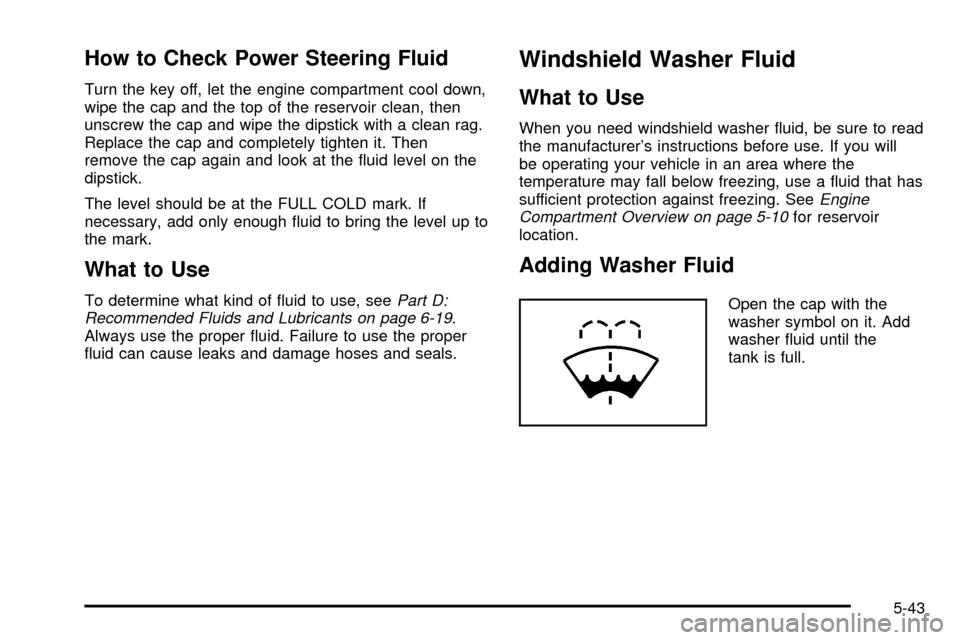
Adding Washer Fluid
Open the cap with the
washer symbol on it. Add
washer ¯uid until the
tank is full.
5-43
Page 459 of 556
If a Tire Goes Flat
It's unusual for a tire to ªblowoutº while you're driving,
especially if you maintain your tires properly. If air goes
out of a tire, it's much more likely to leak out slowly.
But if you should ever have a ªblowout,º here are a few
tips about what to expect and what to do:
If a front tire fails, the ¯at tire will create a drag that
pulls the vehicle toward that side. Take your foot off the
accelerator pedal and grip the steering wheel ®rmly.
Steer to maintain lane position, and then gently brake to
a stop well out of the traffic lane.
A rear blowout, particularly on a curve, acts much like a
skid and may require the same correction you'd use
in a skid. In any rear blowout, remove your foot from the
accelerator pedal. Get the vehicle under control by
steering the way you want the vehicle to go. It may be
very bumpy and noisy, but you can still steer. Gently
brake to a stop, well off the road if possible.{CAUTION:
Lifting a vehicle and getting under it to do
maintenance or repairs is dangerous without
the appropriate safety equipment and training.
The jack provided with your vehicle is
designed only for changing a ¯at tire. If it is
used for anything else, you or others could be
badly injured or killed if the vehicle slips off
the jack. Use the jack provided with your
vehicle only for changing a ¯at tire.
If a tire goes ¯at, the next part shows how to use your
jacking equipment to change a ¯at tire safely.
5-79
Page 492 of 556
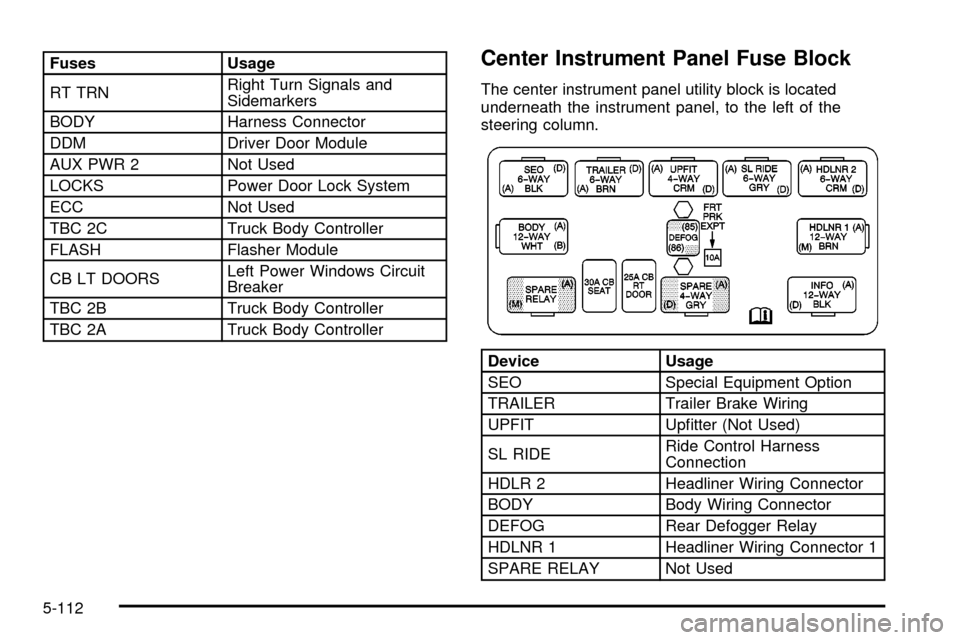
Fuses Usage
RT TRNRight Turn Signals and
Sidemarkers
BODY Harness Connector
DDM Driver Door Module
AUX PWR 2 Not Used
LOCKS Power Door Lock System
ECC Not Used
TBC 2C Truck Body Controller
FLASH Flasher Module
CB LT DOORSLeft Power Windows Circuit
Breaker
TBC 2B Truck Body Controller
TBC 2A Truck Body ControllerCenter Instrument Panel Fuse Block
The center instrument panel utility block is located
underneath the instrument panel, to the left of the
steering column.
Device Usage
SEO Special Equipment Option
TRAILER Trailer Brake Wiring
UPFIT Up®tter (Not Used)
SL RIDERide Control Harness
Connection
HDLR 2 Headliner Wiring Connector
BODY Body Wiring Connector
DEFOG Rear Defogger Relay
HDLNR 1 Headliner Wiring Connector 1
SPARE RELAY Not Used
5-112
Page 503 of 556
Maintenance Schedule......................................6-2
Introduction...................................................6-2
Your Vehicle and the Environment....................6-2
Maintenance Requirements..............................6-2
How This Section is Organized.........................6-3
Part A: Scheduled Maintenance Services...........6-4
Using Your Maintenance Schedule....................6-4
Scheduled Maintenance...................................6-5
Part B: Owner Checks and Services................6-12
At the First 100, 1,000 and 6,000 Miles
(160, 1 600 and 10 000km)........................6-12
At Each Fuel Fill..........................................6-12
At Least Once a Month.................................6-12
At Least Twice a Year...................................6-13
At Least Once a Year...................................6-14Part C: Periodic MaintenanceInspections.........6-17
Steering and Suspension Inspection................6-17
Exhaust System Inspection............................6-17
Fuel System Inspection..................................6-17
Engine Cooling System Inspection...................6-17
Throttle System Inspection
(V6 Only).................................................6-18
Transfer Case and Front Axle (All-Wheel
Drive) Inspection.......................................6-18
Transfer Case and Front Axle (Four-Wheel
Drive) Inspection.......................................6-18
Brake System Inspection................................6-18
Part D: Recommended Fluids and Lubricants. . . .6-19
Part E: Maintenance Record...........................6-22
Section 6 Maintenance Schedule
6-1