2003 CHEVROLET SILVERADO change wheel
[x] Cancel search: change wheelPage 453 of 556
{CAUTION:
Rust or dirt on a wheel, or on the parts to
which it is fastened, can make wheel nuts
become loose after a time. The wheel could
come off and cause an accident. When you
change a wheel, remove any rust or dirt from
places where the wheel attaches to the vehicle.
In an emergency, you can use a cloth or a
paper towel to do this; but be sure to use a
scraper or wire brush later, if you need to, to
get all the rust or dirt off. See ªChanging a Flat
Tireº in the Index.
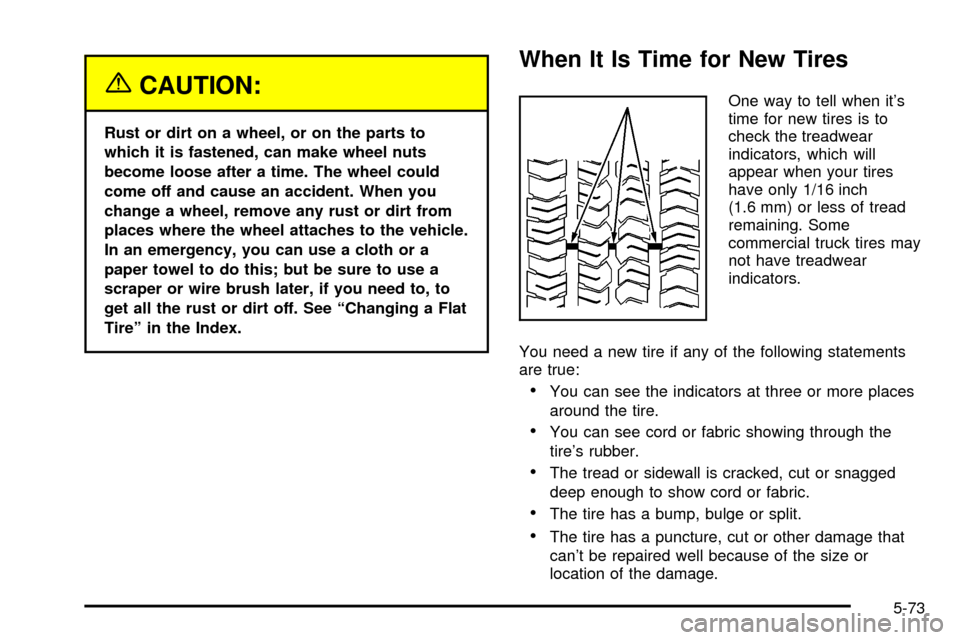
When It Is Time for New Tires
One way to tell when it's
time for new tires is to
check the treadwear
indicators, which will
appear when your tires
have only 1/16 inch
(1.6 mm) or less of tread
remaining. Some
commercial truck tires may
not have treadwear
indicators.
You need a new tire if any of the following statements
are true:
·You can see the indicators at three or more places
around the tire.
·You can see cord or fabric showing through the
tire's rubber.
·The tread or sidewall is cracked, cut or snagged
deep enough to show cord or fabric.
·The tire has a bump, bulge or split.
·The tire has a puncture, cut or other damage that
can't be repaired well because of the size or
location of the damage.
5-73
Page 459 of 556
If a Tire Goes Flat
It's unusual for a tire to ªblowoutº while you're driving,
especially if you maintain your tires properly. If air goes
out of a tire, it's much more likely to leak out slowly.
But if you should ever have a ªblowout,º here are a few
tips about what to expect and what to do:
If a front tire fails, the ¯at tire will create a drag that
pulls the vehicle toward that side. Take your foot off the
accelerator pedal and grip the steering wheel ®rmly.
Steer to maintain lane position, and then gently brake to
a stop well out of the traffic lane.
A rear blowout, particularly on a curve, acts much like a
skid and may require the same correction you'd use
in a skid. In any rear blowout, remove your foot from the
accelerator pedal. Get the vehicle under control by
steering the way you want the vehicle to go. It may be
very bumpy and noisy, but you can still steer. Gently
brake to a stop, well off the road if possible.{CAUTION:
Lifting a vehicle and getting under it to do
maintenance or repairs is dangerous without
the appropriate safety equipment and training.
The jack provided with your vehicle is
designed only for changing a ¯at tire. If it is
used for anything else, you or others could be
badly injured or killed if the vehicle slips off
the jack. Use the jack provided with your
vehicle only for changing a ¯at tire.
If a tire goes ¯at, the next part shows how to use your
jacking equipment to change a ¯at tire safely.
5-79
Page 460 of 556

Changing a Flat Tire
If a tire goes ¯at, avoid further tire and wheel damage
by driving slowly to a level place. Turn on your
hazard warning ¯ashers.
{CAUTION:
Changing a tire can cause an injury. The
vehicle can slip off the jack and roll over you
or other people. You and they could be badly
injured. Find a level place to change your tire.
To help prevent the vehicle from moving:
1. Set the parking brake ®rmly.
2. Put the shift lever in PARK (P).
3. Turn off the engine.
4. Put the wheel blocks at the front and rear
of the tire farthest away from the one
being changed. That would be the tire on
the other side of the vehicle, at the
opposite end.The following steps will tell you how to use the jack and
change a tire.
5-80
Page 469 of 556
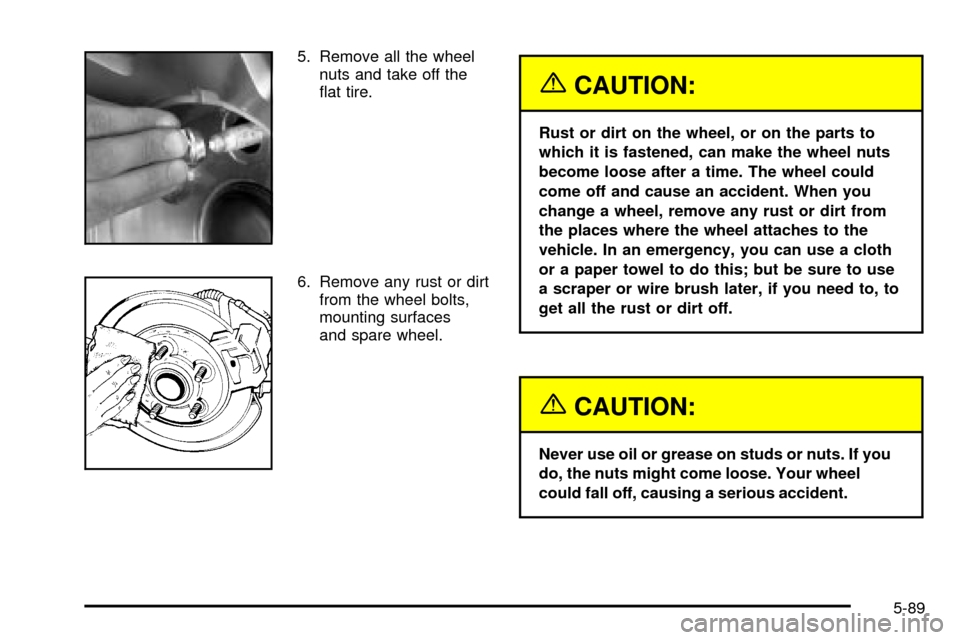
5. Remove all the wheel
nuts and take off the
¯at tire.
6. Remove any rust or dirt
from the wheel bolts,
mounting surfaces
and spare wheel.
{CAUTION:
Rust or dirt on the wheel, or on the parts to
which it is fastened, can make the wheel nuts
become loose after a time. The wheel could
come off and cause an accident. When you
change a wheel, remove any rust or dirt from
the places where the wheel attaches to the
vehicle. In an emergency, you can use a cloth
or a paper towel to do this; but be sure to use
a scraper or wire brush later, if you need to, to
get all the rust or dirt off.
{CAUTION:
Never use oil or grease on studs or nuts. If you
do, the nuts might come loose. Your wheel
could fall off, causing a serious accident.
5-89
Page 506 of 556

Part A: Scheduled Maintenance
Services
This part contains engine oil and chassis lubrication
scheduled maintenance which explains the engine oil life
system and how it indicates when to change the
engine oil and ®lter. Lubricate chassis components with
each oil change. Also, listed are scheduled maintenance
services which are to be performed at the mileage
intervals speci®ed.
Using Your Maintenance Schedule
We at General Motors want to help you keep your
vehicle in good working condition. But we don't know
exactly how you'll drive it. You may drive very short
distances only a few times a week. Or you may drive
long distances all the time in very hot, dusty weather.
You may use your vehicle in making deliveries. Or
you may drive it to work, to do errands or in many other
ways.
Because of all the different ways people use their
vehicles, maintenance needs vary. You may need more
frequent checks and replacements. So please read
the following and note how you drive. If you have any
questions on how to keep your vehicle in good condition,
see your dealer.This part tells you the maintenance services you should
have done and when to schedule them.
When you go to your dealer for your service needs,
you'll know that GM-trained and supported service
people will perform the work using genuine GM parts.
The proper ¯uids and lubricants to use are listed in Part
D. Make sure whoever services your vehicle uses
these. All parts should be replaced and all necessary
repairs done before you or anyone else drives the
vehicle.
This schedule is for vehicles that:
·carry passengers and cargo within recommended
limits. You will ®nd these limits on your vehicle's
Certi®cation/Tire label. See
Loading Your Vehicle on
page 4-58.
·are driven on reasonable road surfaces within legal
driving limits.
·are driven off-road in the recommended manner.
See
Off-Road Driving with Your Four-Wheel-Drive
Vehicle on page 4-22.
·use the recommended fuel. SeeGasoline Octane
on page 5-4
.
6-4
Page 520 of 556

Throttle System Inspection
(V6 Only)
Inspect the throttle system for interference or binding,
and for damaged or missing parts. Replace parts
as needed. Replace any components that have high
effort or excessive wear. Do not lubricate accelerator
and cruise control cables.
Transfer Case and Front Axle
(All-Wheel Drive) Inspection
Every 12 months, or at engine oil change intervals,
check front axle and transfer case and add lubricant
when necessary. A ¯uid loss could indicate a problem.
Check and have it repaired, if needed. Check vent
hose at transfer case for kinks and proper installation.
Transfer Case and Front Axle
(Four-Wheel Drive) Inspection
Every 12 months or at engine oil change intervals,
check front axle and transfer case and add lubricant
when necessary. A ¯uid loss could indicate a problem;
check and have it repaired, if needed. On manual
shift transfer case, oil the control lever pivot point. Check
vent hose at transfer case for kinks and proper
installation. More frequent lubrication may be required
on off-road use.
Brake System Inspection
Inspect the complete system. Inspect brake lines and
hoses for proper hook-up, binding, leaks, cracks,
cha®ng, etc. Inspect disc brake pads for wear and rotors
for surface condition. Inspect other brake parts,
including calipers, parking brake, etc. You may need to
have your brakes inspected more often if your driving
habits or conditions result in frequent braking.
6-18
Page 553 of 556

Tires (cont.)
Changing a Flat Tire....................................5-80
Dual Tire Operation.....................................5-70
If a Tire Goes Flat.......................................5-79
In¯ation -- Tire Pressure...............................5-69
Inspection and Rotation................................5-71
Uniform Tire Quality Grading.........................5-75
Wheel Alignment and Tire Balance.................5-76
Wheel Replacement.....................................5-76
When It Is Time for New Tires......................5-73
To Use the Engine Coolant Heater....................2-24
Top Strap Anchor Location...............................1-44
Top Strap......................................................1-42
Torque Lock (Automatic Transmission)...............2-48
Total Weight on Your Vehicle's Tires..................4-84
Tow/Haul Mode Light.......................................3-53
Tow/Haul Mode, Overdrive Disable....................3-53
Tow/Haul Mode
(Automatic Transmission)..............................2-28
Towing..........................................................4-95
Power Take-Off (PTO)..................................4-95
Recreational Vehicle.....................................4-55
Towing a Trailer..........................................4-68
Your Vehicle...............................................4-55
TRACTION ACTIVE........................................3-70
Traction.........................................................4-10
Assist System (TAS)....................................4-10
Manual Selectable Ride................................4-12
Off Light.....................................................3-46Traction (cont.)
Trailer Brakes.................................................4-85
Trailer Wiring Harness.....................................4-89
Trailer...........................................................4-67
Recommendations.......................................4-67
TRANS HOT IDLE ENGINE (Allison
Transmission
žOnly).....................................3-71
Transfer Case and Front Axle (Four-Wheel Drive)
Inspection...................................................6-18
Transfer Case........................................5-54, 5-56
TRANSMISSION HOT.....................................3-70
Transmission Operation, Automatic....................2-25
Transmission Operation, Manual........................2-29
Transmission, Transaxle, Transfer Case Unit
Repair Manual............................................7-10
Transmission..................................................5-23
Fluid, Automatic..................................5-23, 5-26
Fluid, Manual..............................................5-28
Temperature Gage.......................................3-47
Up-Shift Light..............................................3-43
Transportation Options...................................... 7-7
Traveling to Remote Areas...............................4-26
Trip Information Button....................................3-55
Trip Odometer................................................3-35
Truck-Camper Loading Information....................4-65
Turn and Lane Change Signals.......................... 3-8
TURN SIGNAL ON.........................................3-71
Turn Signal/Multifunction Lever........................... 3-7
Turn Signals When Towing a Trailer..................4-87
17
Page 554 of 556

U
Underbody Flushing Service.............................6-16
Underhood Fuse Block...................................5-113
Understanding Radio Reception.......................3-123
Uniform Tire Quality Grading............................5-75
United States ± Customer Assistance.................. 7-4
Up-Shift Light.................................................3-43
Using Cleaner on Fabric................................5-101
Using Song List Mode...................................3-109
Using the Recovery Hooks...............................4-53
V
Vehicle Identi®cation......................................5-108
Number (VIN)............................................5-108
Service Parts Identi®cation Label..................5-109
Vehicle Personalization....................................2-66
Memory Seat..............................................2-66
Vehicle Storage..............................................5-48
Vehicle............................................................ 4-5
Control........................................................ 4-5
Damage Warnings........................................... iv
Loading......................................................4-58
Parking Your...............................................2-49
Symbols......................................................... iv
Video Screen................................................3-113
Visors...........................................................2-17
Voltmeter Gage..............................................3-42
W
Warning Lights, Gages and Indicators................3-33
Warnings.......................................................3-65
DIC Warnings and Messages........................3-65
Hazard Warning Flashers............................... 3-6
Other Warning Devices.................................. 3-6
Safety and Symbols......................................... iii
Vehicle Damage.............................................. iv
Washing Your Vehicle....................................5-103
Weatherstrip Lubrication...................................6-13
Weight of the Trailer Tongue.............................4-84
Weight of the Trailer........................................4-70
What Kind of Engine Oil to Use........................5-18
What to Add..................................................5-46
What to Do with Used Oil................................5-20
What to Use..................................5-31, 5-43, 5-55
Wheels..........................................................5-76
Alignment and Tire Balance..........................5-76
Replacement...............................................5-76
When to Add Engine Oil..................................5-17
When to Change Engine Oil
(GM Oil Life System)...................................5-19
When to Check and Change....................5-23, 5-26
When to Check and What to Use.....................5-30
When to Check Lubricant.................................5-55
When to Check Power Steering Fluid................5-42
When to Check......................................5-28, 5-70
When to Inspect.............................................5-21
18