Page 393 of 556

A. Engine Air Cleaner/Filter. SeeEngine Air
Cleaner/Filter on page 5-21.
B. Coolant Surge Tank. See
Engine Coolant on
page 5-30.
C. Air Filter Restriction Indicator (If Equipped). See
Engine Air Cleaner/Filter on page 5-21.
D. Engine Oil Dipstick. See
Engine Oil on page 5-16.
E. Automatic Transmission Dipstick (If Equipped).
See
Automatic Transmission Fluid (Except Allison
Transmissionž) on page 5-23orAutomatic
Transmission Fluid (Allison Transmissionž)on
page 5-26.
F. Engine Oil Fill. See
Engine Oil on page 5-16.
G. Fan. See
Cooling System on page 5-36.H. Remote Negative (-) Terminal (GND). See
Jump
Starting on page 5-48.
I. Power Steering Fluid Reservoir. See
Power Steering
Fluid on page 5-42.
J. Remote Positive (+) Terminal. See
Jump Starting on
page 5-48.
K. Brake Fluid Reservoir. See
Brakes on page 5-44.
L. Clutch Fluid Reservoir (If Equipped). See
Hydraulic
Clutch on page 5-29.
M. Underhood Fuse Block. See
Fuses and Circuit
Breakers on page 5-110.
N. Battery. See
Battery on page 5-47.
O. Windshield Washer Fluid Reservoir. See
Windshield
Washer Fluid on page 5-43.
5-13
Page 395 of 556

A. Engine Air Cleaner/Filter. SeeEngine Air
Cleaner/Filter on page 5-21.
B. Coolant Surge Tank. See
Engine Coolant on
page 5-30.
C. Air Filter Restriction Indicator (If Equipped). See
Engine Air Cleaner/Filter on page 5-21.
D. Engine Oil Dipstick. See
Engine Oil on page 5-16.
E. Automatic Transmission Dipstick (If Equipped).
See
Automatic Transmission Fluid (Except Allison
Transmissionž) on page 5-23orAutomatic
Transmission Fluid (Allison Transmissionž)on
page 5-26.
F. Engine Oil Fill. See
Engine Oil on page 5-16.
G. Fan. See
Cooling System on page 5-36.H. Remote Negative (-) Terminal (GND). See
Jump
Starting on page 5-48.
I. Remote Positive (+) Terminal. See
Jump Starting on
page 5-48.
J. Power Steering Fluid Reservoir. See
Power Steering
Fluid on page 5-42.
K. Brake Fluid Reservoir. See
Brakes on page 5-44.
L. Clutch Fluid Reservoir (If Equipped). See
Hydraulic
Clutch on page 5-29.
M. Underhood Fuse Block. See
Fuses and Circuit
Breakers on page 5-110.
N. Battery. See
Battery on page 5-47.
O. Windshield Washer Fluid Reservoir. See
Windshield
Washer Fluid on page 5-43.
5-15
Page 422 of 556
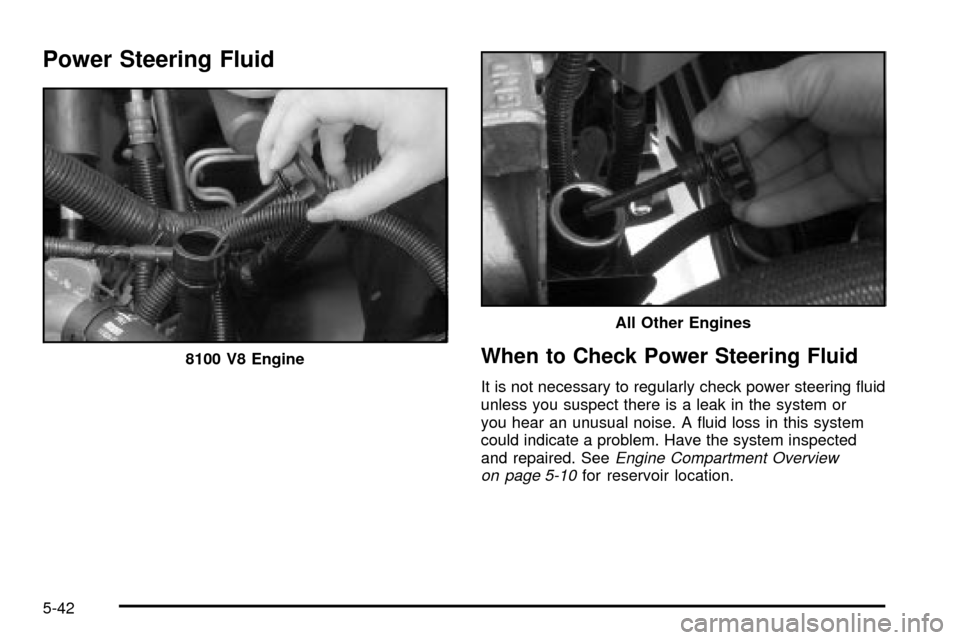
Power Steering Fluid
When to Check Power Steering Fluid
It is not necessary to regularly check power steering ¯uid
unless you suspect there is a leak in the system or
you hear an unusual noise. A ¯uid loss in this system
could indicate a problem. Have the system inspected
and repaired. See
Engine Compartment Overview
on page 5-10for reservoir location. 8100 V8 Engine
All Other Engines
5-42
Page 423 of 556

How to Check Power Steering Fluid
Turn the key off, let the engine compartment cool down,
wipe the cap and the top of the reservoir clean, then
unscrew the cap and wipe the dipstick with a clean rag.
Replace the cap and completely tighten it. Then
remove the cap again and look at the ¯uid level on the
dipstick.
The level should be at the FULL COLD mark. If
necessary, add only enough ¯uid to bring the level up to
the mark.
What to Use
To determine what kind of ¯uid to use, seePart D:
Recommended Fluids and Lubricants on page 6-19.
Always use the proper ¯uid. Failure to use the proper
¯uid can cause leaks and damage hoses and seals.
Windshield Washer Fluid
What to Use
When you need windshield washer ¯uid, be sure to read
the manufacturer's instructions before use. If you will
be operating your vehicle in an area where the
temperature may fall below freezing, use a ¯uid that has
sufficient protection against freezing. See
Engine
Compartment Overview on page 5-10for reservoir
location.
Adding Washer Fluid
Open the cap with the
washer symbol on it. Add
washer ¯uid until the
tank is full.
5-43
Page 492 of 556
Fuses Usage
RT TRNRight Turn Signals and
Sidemarkers
BODY Harness Connector
DDM Driver Door Module
AUX PWR 2 Not Used
LOCKS Power Door Lock System
ECC Not Used
TBC 2C Truck Body Controller
FLASH Flasher Module
CB LT DOORSLeft Power Windows Circuit
Breaker
TBC 2B Truck Body Controller
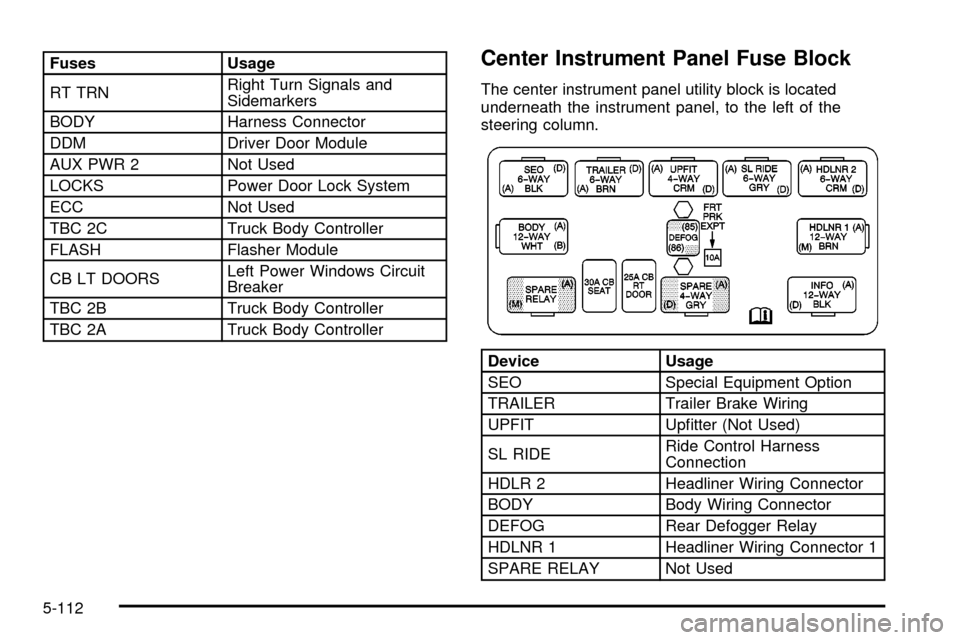
TBC 2A Truck Body ControllerCenter Instrument Panel Fuse Block
The center instrument panel utility block is located
underneath the instrument panel, to the left of the
steering column.
Device Usage
SEO Special Equipment Option
TRAILER Trailer Brake Wiring
UPFIT Up®tter (Not Used)
SL RIDERide Control Harness
Connection
HDLR 2 Headliner Wiring Connector
BODY Body Wiring Connector
DEFOG Rear Defogger Relay
HDLNR 1 Headliner Wiring Connector 1
SPARE RELAY Not Used
5-112
Page 519 of 556

Part C: Periodic
MaintenanceInspections
Listed in this part are inspections and services which
should be performed at least twice a year (for instance,
each spring and fall).
You should let your dealer's
service department do these jobs. Make sure any
necessary repairs are completed at once.
Proper procedures to perform these services may be
found in a service manual. SeeService Publications
Ordering Information on page 7-9.
Steering and Suspension Inspection
Inspect the front and rear suspension and steering
system for damaged, loose or missing parts, signs of
wear or lack of lubrication. Inspect the power steering
lines and hoses for proper hook-up, binding, leaks,
cracks, cha®ng, etc.
Exhaust System Inspection
Inspect the complete exhaust system. Inspect the body
near the exhaust system. Look for broken, damaged,
missing or out-of-position parts as well as open seams,
holes, loose connections or other conditions which
could cause a heat build-up in the ¯oor pan or could let
exhaust fumes into the vehicle. See
Engine Exhaust
on page 2-51.
Fuel System Inspection
Inspect the complete fuel system for damage or leaks.
Engine Cooling System Inspection
Inspect the hoses and have them replaced if they
are cracked, swollen or deteriorated. Inspect all pipes,
®ttings and clamps; replace as needed. Clean the
outside of the radiator and air conditioning condenser.
To help ensure proper operation, a pressure test of
the cooling system and pressure cap is recommended
at least once a year.
6-17
Page 521 of 556
Part D: Recommended Fluids and
Lubricants
Fluids and lubricants identi®ed below by name, part
number or speci®cation may be obtained from your
dealer.
Usage Fluid/Lubricant
Engine OilEngine oil with the American
Petroleum Institute Certi®ed for
Gasoline Engines starburst symbol
of the proper viscosity. To determine
the preferred viscosity for your
vehicle's engine, see
Engine Oil on
page 5-16.
Engine Coolant50/50 mixture of clean, drinkable
water and use only
DEX-COOL
žCoolant. SeeEngine
Coolant on page 5-30.
Hydraulic Brake
SystemDelco Supreme 11 Brake Fluid or
equivalent DOT-3 brake ¯uid.
Windshield
Washer SolventGM Optikleen
žWasher Solvent or
equivalent.
Usage Fluid/Lubricant
Hydraulic
Clutch System
(5±Speed
Trans.)Hydraulic Clutch Fluid (GM Part No.
U.S. 12345347, in Canada
10953517, or equivalent DOT-3
brake ¯uid).
Hydraulic
Clutch System
(6±Speed
Trans.)Hydraulic Clutch Fluid. Use only GM
Part No. U.S. 88958860, in Canada
88901244.
Power Steering
SystemGM Power Steering Fluid (GM Part
No. U.S. 1052884, in Canada
993294, or equivalent).
Manual
Transmission
(5±Speed with
Low Gear,
RPO MW3)GM Goodwrench Synthetic Manual
Transmission Fluid (GM Part No.
U.S. 12346190, in Canada
10953477) or equivalent SAE
75W-85 GL-4 gear oil.
Manual
Transmission
(5±Speed
without Low
Gear, RPO
MG5)Synchromesh Transmission Fluid
(GM Part No. U.S. 12345349, in
Canada 10953465, or equivalent).
6-19
Page 537 of 556

A
Accessory Power Outlets.................................3-19
Adding a Snow Plow or Similar Equipment.........4-61
Adding Washer Fluid.......................................5-43
Additional Program Information........................... 7-8
Additives, Fuel................................................. 5-5
Add-On Electrical Equipment...........................5-109
Add-On Equipment..........................................4-60
Adjusting the Speakers
(Balance/Fade)..................3-74, 3-78, 3-88, 3-101
After Off-Road Driving.....................................4-37
Air Bag Systems.............................................1-64
Adding Equipment to Your Air Bag-Equipped
Vehicle...................................................1-80
Air Bag Off Switch.......................................1-71
How Does an Air Bag Restrain?....................1-69
Passenger Sensing System...........................1-76
Servicing Your Air Bag-Equipped Vehicle.........1-80
What Makes an Air Bag In¯ate?....................1-69
What Will You See After an Air Bag In¯ates?......1-70
When Should an Air Bag In¯ate?...................1-68
Where Are the Air Bags?..............................1-66
Air Bag .........................................................3-37
Off Light.....................................................3-37
Passenger Status Indicator...........................3-40
Readiness Light..........................................3-36
Air Cleaner/Filter, Engine.................................5-21
Air Conditioning..............................................3-30
All-Wheel Drive (AWD) System.........................2-44All-Wheel Drive...............................................5-54
AM-FM Radio.................................................3-72
AM .............................................................3-123
Antenna, Fixed Mast......................................3-125
Antenna, XMŸ Satellite Radio Antenna
System.....................................................3-125
Anti-Lock Brake, System Warning Light..............3-45
Anti-lock Brake System..................................... 4-6
Appearance Care..........................................5-100
Care of Safety Belts...................................5-103
Chemical Paint Spotting..............................5-106
Cleaning the Inside of Your Vehicle..............5-100
Cleaning the Outside of Your Vehicle............5-103
Finish Damage..........................................5-106
Sheet Metal Damage..................................5-105
Underbody Maintenance.............................5-106
Vehicle Care/Appearance Materials...............5-107
Weatherstrips............................................5-103
Approaching a Hill..........................................4-28
Ashtrays........................................................3-20
Audio Output................................................3-117
Audio System(s).............................................3-71
AM-FM Radio.............................................3-72
Audio Steering Wheel Controls....................3-122
Care of Your Cassette Tape Player...............3-123
Care of Your CD and DVD Player................3-124
Care of Your CDs and DVDs.......................3-124
Chime Level Adjustment.............................3-125
Fixed Mast Antenna...................................3-125
Radio with Cassette and CD.........................3-85
1