2003 CHEVROLET S10 oil level
[x] Cancel search: oil levelPage 298 of 432
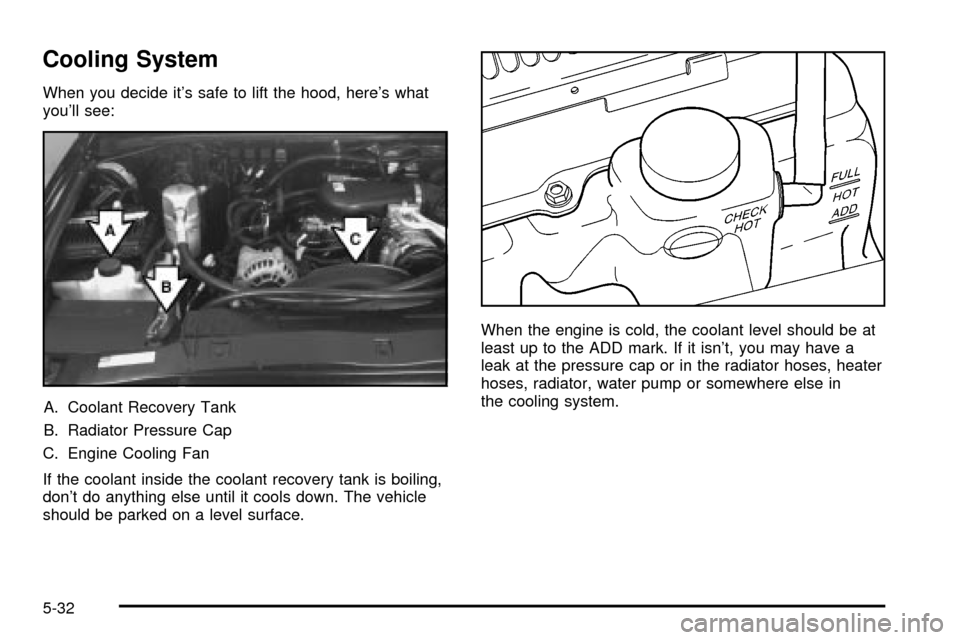
Cooling System
When you decide it's safe to lift the hood, here's what
you'll see:
A. Coolant Recovery Tank
B. Radiator Pressure Cap
C. Engine Cooling Fan
If the coolant inside the coolant recovery tank is boiling,
don't do anything else until it cools down. The vehicle
should be parked on a level surface.When the engine is cold, the coolant level should be at
least up to the ADD mark. If it isn't, you may have a
leak at the pressure cap or in the radiator hoses, heater
hoses, radiator, water pump or somewhere else in
the cooling system.
5-32
Page 300 of 432

How to Add Coolant to the Coolant
Recovery Tank
If you haven't found a problem yet, but the coolant level
isn't at the ADD mark, add a 50/50 mixture ofclean,
drinkable waterand DEX-COOLžengine coolant at the
coolant recovery tank. SeeEngine Coolant on
page 5-27for more information.
{CAUTION:
Adding only plain water to your cooling system
can be dangerous. Plain water, or some other
liquid such as alcohol, can boil before the
proper coolant mixture will. Your vehicle's
coolant warning system is set for the proper
coolant mixture. With plain water or the wrong
mixture, your engine could get too hot but you
would not get the overheat warning. Your
engine could catch ®re and you or others could
be burned. Use a 50/50 mixture of clean,
drinkable water and DEX-COOL
žcoolant.
Notice:In cold weather, water can freeze and crack
the engine, radiator, heater core and other parts.
Use the recommended coolant and the proper
coolant mixture.
{CAUTION:
You can be burned if you spill coolant on hot
engine parts. Coolant contains ethylene glycol
and it will burn if the engine parts are hot
enough. Do not spill coolant on a hot engine.
5-34
Page 309 of 432

Checking Brake Fluid
You can check the brake ¯uid without taking off the cap.
Just look at the brake ¯uid
reservoir. The ¯uid level
should be above MIN. If it
isn't have your brake
system checked to see if
there is a leak.
After work is done on the brake hydraulic system,
make sure the level is above the MIN but not over the
MAX mark.
What to Add
When you do need brake ¯uid, use only DOT-3 brake
¯uid. Use new brake ¯uid from a sealed container
only. See
Part D: Recommended Fluids and Lubricants
on page 6-33.Always clean the brake ¯uid reservoir cap and the area
around the cap before removing it. This will help
keep dirt from entering the reservoir.
{CAUTION:
With the wrong kind of ¯uid in your brake
system, your brakes may not work well, or they
may not even work at all. This could cause a
crash. Always use the proper brake ¯uid.
Notice:
·Using the wrong ¯uid can badly damage brake
system parts. For example, just a few drops of
mineral-based oil, such as engine oil, in your
brake system can damage brake system
parts so badly that they'll have to be replaced.
Don't let someone put in the wrong kind of ¯uid.
·If you spill brake ¯uid on your vehicle's painted
surfaces, the paint ®nish can be damaged. Be
careful not to spill brake ¯uid on your vehicle. If
you do, wash it off immediately. See
ªAppearance Careº in the Index.
5-43
Page 370 of 432

Maintenance Schedule
Introduction
Important: Keep engine oil at the proper level and
change as recommended.
Have you purchased the GM Protection Plan? The Plan
supplements your new vehicle warranties. See your
Warranty and Owner Assistance booklet or your dealer
for details.
Your Vehicle and the Environment
Proper vehicle maintenance not only helps to keep your
vehicle in good working condition, but also helps the
environment. Improper vehicle maintenance can
even affect the quality of the air we breathe. Improper
¯uid levels or the wrong tire in¯ation can increase
the level of emissions from your vehicle. To help protect
our environment, and to keep your vehicle in good
condition, be sure to maintain your vehicle properly.
Maintenance Requirements
Maintenance intervals, checks, inspections and
recommended ¯uids and lubricants as prescribed in this
manual are necessary to keep your vehicle in good
working condition. Any damage caused by failure to
follow scheduled maintenance may not be covered by
warranty.
6-2
Page 375 of 432

Every 100,000 Miles (166 000 km):Spark Plug Wire
Inspection. Spark Plug Replacement. 4.3L V6 Engine
Only: Positive Crankcase Ventilation (PCV) Valve
Inspection.
Every 150,000 Miles (240 000 km):Cooling System
Service (or every 60 months, whichever occurs
®rst). Engine Accessory Drive Belt Inspection.
These intervals only summarize maintenance services.
Be sure to follow the complete scheduled maintenance
on the following pages.
Short Trip/City Scheduled
Maintenance
The services shown in this schedule up to 100,000 miles
(166 000 km) should be repeated after 100,000 miles
(166 000 km) at the same intervals for the life of
this vehicle. The services shown at 150,000 miles
(240 000 km) should be repeated at the same interval
after 150,000 miles (240 000 km) for the life of this
vehicle.
See
Part B: Owner Checks and Services on page 6-26andPart C: Periodic MaintenanceInspections on
page 6-31.
Footnotes
²The U.S. Environmental Protection Agency or the
California Air Resources Board has determined that the
failure to perform this maintenance item will not nullify
the emission warranty or limit recall liability prior to
the completion of the vehicle's useful life. We, however,
urge that all recommended maintenance services be
performed at the indicated intervals and the
maintenance be recorded.
#Lubricate the front suspension, ball joints, steering
linkage, parking brake cable guides, propshaft splines,
universal joints, constant velocity joint and brake
pedal springs.
+A good time to check your brakes is during tire
rotation. See Brake System Inspection on page 6-32.
**
Drive axle service. See Part D: Recommended Fluids
and Lubricants on page 6-33for proper lubricant to use:
·Check ¯uid level and add ¯uid as needed. If driving in
dusty areas or when towing a trailer, drain ¯uid and
re®ll every 15,000 miles (25 000 km).
·If your vehicle has a locking differential, drain ¯uid
and re®ll at ®rst engine oil change.
·More frequent lubrication may be required for
heavy-duty or off-road use.
6-7
Page 376 of 432

3,000 Miles (5 000 km)
qChange engine oil and ®lter (or every 3 months,
whichever occurs ®rst).An Emission Control Service.
qLubricate chassis components (or every 3 months,
whichever occurs ®rst).(See footnote #.)
qCheck rear/front axle ¯uid level and add ¯uid as
needed. Check constant velocity joints and axle seals
for leaking.
(See footnote **.)
6,000 Miles (10 000 km)
qChange engine oil and ®lter (or every 3 months,
whichever occurs ®rst).An Emission Control Service.
qLubricate chassis components (or every 3 months,
whichever occurs ®rst).(See footnote #.)
qCheck rear/front axle ¯uid level and add ¯uid as
needed. Check constant velocity joints and axle seals
for leaking.
(See Footnote **.)
qRotate tires. SeeTire Inspection and Rotation on
page 5-64for proper rotation pattern and additional
information.(See footnote +.)
9,000 Miles (15 000 km)
qChange engine oil and ®lter (or every 3 months,
whichever occurs ®rst).An Emission Control Service.
qLubricate chassis components (or every 3 months,
whichever occurs ®rst).(See footnote #.)
qCheck rear/front axle ¯uid level and add ¯uid as
needed. Check constant velocity joints and axle seals
for leaking.
(See footnote **.)
12,000 Miles (20 000 km)
qChange engine oil and ®lter (or every 3 months,
whichever occurs ®rst).An Emission Control Service.
qLubricate chassis components (or every 3 months,
whichever occurs ®rst).(See footnote #.)
qCheck rear/front axle ¯uid level and add ¯uid as
needed. Check constant velocity joints and axle seals
for leaking.
(See footnote **.)
qRotate tires. SeeTire Inspection and Rotation on
page 5-64for proper rotation pattern and additional
information.(See footnote +.)
15,000 Miles (25 000 km)
qChange engine oil and ®lter (or every 3 months,
whichever occurs ®rst).An Emission Control Service.
qLubricate chassis components (or every 3 months,
whichever occurs ®rst).(See footnote #.)
qInspect engine air cleaner ®lter. If necessary, replace
the ®lter. If vehicle is driven in dusty/dirty conditions,
inspect ®lter at every engine oil change. See
Engine Air Cleaner/Filter on page 5-19for more
information.An Emission Control Service. (See
footnote ².)
qCheck rear/front axle ¯uid level and add ¯uid as
needed. Check constant velocity joints and axle seals
for leaking.
(See footnote **.)
6-8
Page 377 of 432

qFor Two-Wheel-Drive vehicles only: Clean and
repack the front wheel bearings (or at each
brake relining, whichever occurs ®rst).
qChange automatic transmission ¯uid and ®lter if the
vehicle is mainly driven under one or more of these
conditions:
þ In heavy city traffic where the outside
temperature regularly reaches 90ÉF (32ÉC) or
higher.
þ In hilly or mountainous terrain.
þ When doing frequent trailer towing.
þ Uses such as found in taxi, police or delivery
service.
If you do not use your vehicle under any of these
conditions, change the ¯uid and ®lter every 50,000 miles
(83 000 km).
18,000 Miles (30 000 km)
qChange engine oil and ®lter (or every 3 months,
whichever occurs ®rst).An Emission Control Service.
qLubricate chassis components (or every 3 months,
whichever occurs ®rst).(See footnote #.)
qCheck rear/front axle ¯uid level and add ¯uid as
needed. Check constant velocity joints and axle seals
for leaking.
(See footnote **.)
qRotate tires. SeeTire Inspection and Rotation on
page 5-64for proper rotation pattern and additional
information.(See footnote +.)
21,000 Miles (35 000 km)
qChange engine oil and ®lter (or every 3 months,
whichever occurs ®rst).An Emission Control Service.
qLubricate chassis components (or every 3 months,
whichever occurs ®rst).(See footnote #.)
qCheck rear/front axle ¯uid level and add ¯uid as
needed. Check constant velocity joints and axle seals
for leaking.
(See footnote **.)
24,000 Miles (40 000 km)
qChange engine oil and ®lter (or every 3 months,
whichever occurs ®rst).An Emission Control Service.
qLubricate chassis components (or every 3 months,
whichever occurs ®rst).(See footnote #.)
qCheck rear/front axle ¯uid level and add ¯uid as
needed. Check constant velocity joints and axle seals
for leaking.
(See footnote **.)
qRotate tires. SeeTire Inspection and Rotation on
page 5-64for proper rotation pattern and additional
information.(See footnote +.)
6-9
Page 378 of 432

27,000 Miles (45 000 km)
qChange engine oil and ®lter (or every 3 months,
whichever occurs ®rst).An Emission Control Service.
qLubricate chassis components (or every 3 months,
whichever occurs ®rst).(See footnote #.)
qCheck rear/front axle ¯uid level and add ¯uid as
needed. Check constant velocity joints and axle seals
for leaking.
(See footnote **.)
30,000 Miles (50 000 km)
qChange engine oil and ®lter (or every 3 months,
whichever occurs ®rst).An Emission Control Service.
qLubricate chassis components (or every 3 months,
whichever occurs ®rst).(See footnote #.)
qCheck rear/front axle ¯uid level and add ¯uid as
needed. Check constant velocity joints and axle seals
for leaking.
(See footnote **.)
qFor Two-Wheel-Drive vehicles only: Clean and
repack the front wheel bearings (or at each
brake relining, whichever occurs ®rst).
q4.3L V6 Engine Only: Replace fuel ®lter.
An Emission
Control Service. (See footnote ².)
qReplace engine air cleaner ®lter. SeeEngine Air
Cleaner/Filter on page 5-19for more information.An Emission Control Service.
qChange automatic transmission ¯uid and ®lter if the
vehicle is mainly driven under one or more of these
conditions:
þ In heavy city traffic where the outside
temperature regularly reaches 90ÉF (32ÉC) or
higher.
þ In hilly or mountainous terrain.
þ When doing frequent trailer towing.
þ Uses such as found in taxi, police or delivery
service.
If you do not use your vehicle under any of these
conditions, change the ¯uid and ®lter every 50,000 miles
(83 000 km).
qRotate tires. SeeTire Inspection and Rotation on
page 5-64for proper rotation pattern and additional
information.(See footnote +.)
33,000 Miles (55 000 km)
qChange engine oil and ®lter (or every 3 months,
whichever occurs ®rst).An Emission Control Service.
qLubricate chassis components (or every 3 months,
whichever occurs ®rst).(See footnote #.)
qCheck rear/front axle ¯uid level and add ¯uid as
needed. Check constant velocity joints and axle seals
for leaking.
(See footnote **.)
6-10