2003 CHEVROLET IMPALA engine overheat
[x] Cancel search: engine overheatPage 287 of 408
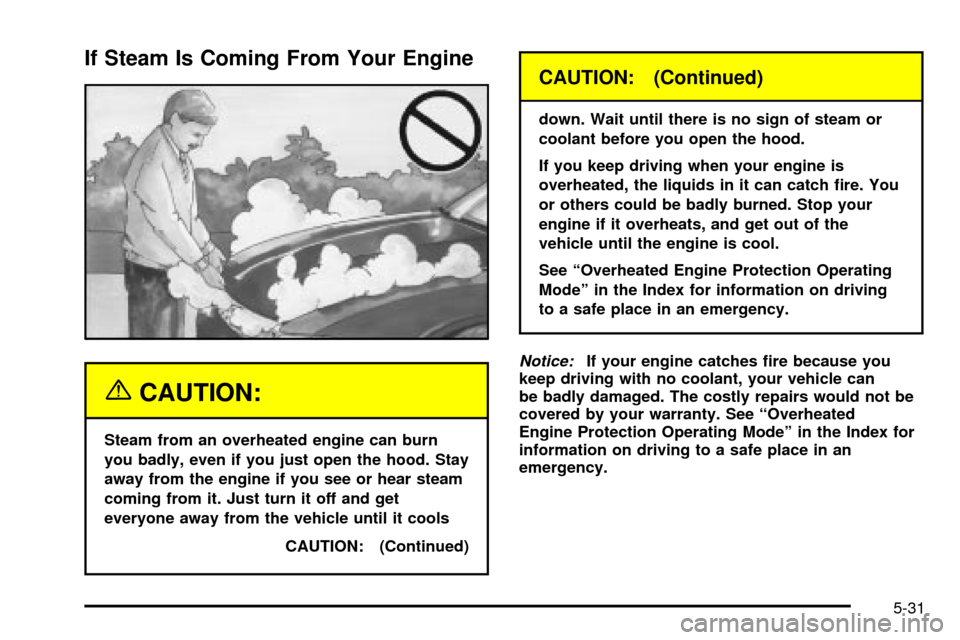
If Steam Is Coming From Your Engine
{CAUTION:
Steam from an overheated engine can burn
you badly, even if you just open the hood. Stay
away from the engine if you see or hear steam
coming from it. Just turn it off and get
everyone away from the vehicle until it cools
CAUTION: (Continued)
CAUTION: (Continued)
down. Wait until there is no sign of steam or
coolant before you open the hood.
If you keep driving when your engine is
overheated, the liquids in it can catch ®re. You
or others could be badly burned. Stop your
engine if it overheats, and get out of the
vehicle until the engine is cool.
See ªOverheated Engine Protection Operating
Modeº in the Index for information on driving
to a safe place in an emergency.
Notice:If your engine catches ®re because you
keep driving with no coolant, your vehicle can
be badly damaged. The costly repairs would not be
covered by your warranty. See ªOverheated
Engine Protection Operating Modeº in the Index for
information on driving to a safe place in an
emergency.
5-31
Page 288 of 408

If No Steam Is Coming From Your
Engine
An overheat warning along with a low coolant message
can indicate a serious problem.
If you get an engine overheat warning, but see or hear
no steam, the problem may not be too serious.
Sometimes the engine can get a little too hot when you:
·Climb a long hill on a hot day.
·Stop after high-speed driving.
·Idle for long periods in traffic.
·Tow a trailer.
If you get the overheat warning with no sign of steam,
try this for a minute or so:
1. In heavy traffic, let the engine idle in NEUTRAL (N)
while stopped. If it is safe to do so, pull off the road,
shift to PARK (P) or NEUTRAL (N)l and let the
engine idle.2. Turn on your heater to full hot at the highest fan
speed and open the window as necessary.
If you no longer have the overheat warning, you can
drive. Just to be safe, drive slower for about 10 minutes.
If the warning doesn't come back on, you can
drive normally.
If the warning continues, pull over, stop, and park your
vehicle right away.
If there's still no sign of steam, you can idle the engine
for three minutes while you're parked. If you still
have the warning,
turn off the engine and get everyone
out of the vehicleuntil it cools down. Also, see
ªOverheated Engine Protection Operating Modeº listed
previously in this section.
You may decide not to lift the hood but to get service
help right away.
5-32
Page 290 of 408
{CAUTION:
An electric engine cooling fan under the hood
can start up even when the engine is not
running and can injure you. Keep hands,
clothing and tools away from any underhood
electric fan.
If the coolant inside the coolant recovery tank is boiling,
don't do anything else until it cools down. The vehicle
should be parked on a level surface.
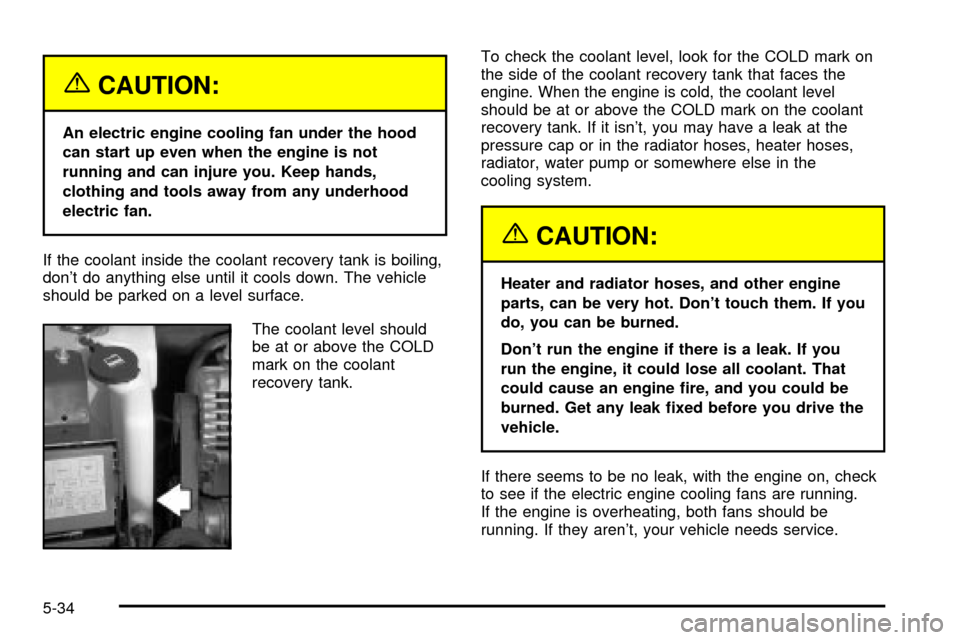
The coolant level should
be at or above the COLD
mark on the coolant
recovery tank.To check the coolant level, look for the COLD mark on
the side of the coolant recovery tank that faces the
engine. When the engine is cold, the coolant level
should be at or above the COLD mark on the coolant
recovery tank. If it isn't, you may have a leak at the
pressure cap or in the radiator hoses, heater hoses,
radiator, water pump or somewhere else in the
cooling system.
{CAUTION:
Heater and radiator hoses, and other engine
parts, can be very hot. Don't touch them. If you
do, you can be burned.
Don't run the engine if there is a leak. If you
run the engine, it could lose all coolant. That
could cause an engine ®re, and you could be
burned. Get any leak ®xed before you drive the
vehicle.
If there seems to be no leak, with the engine on, check
to see if the electric engine cooling fans are running.
If the engine is overheating, both fans should be
running. If they aren't, your vehicle needs service.
5-34
Page 291 of 408
Notice:Engine damage from running your engine
without coolant isn't covered by your warranty.
See ªOverheated Engine Protection Operating
Modeº in the Index for information on driving to a
safe place in an emergency.
Notice:When adding coolant, it is important that
you use only DEX-COOLž(silicate-free) coolant.
If coolant other than DEX-COOLžis added to
the system, premature engine, heater core or
radiator corrosion may result. In addition, the engine
coolant will require change sooner Ð at 30,000 miles
(50 000 km) or 24 months, whichever occurs ®rst.
Damage caused by the use of coolant other
than DEX-COOL
žis not covered by your new
vehicle warranty.
How to Add Coolant to the Coolant
Recovery Tank
If you haven't found a problem yet, but the coolant level
isn't at the COLD mark, add a 50/50 mixture ofclean,
drinkable waterand DEX-COOLžengine coolant at
the coolant recovery tank. SeeEngine Coolant on
page 5-27
{CAUTION:
Adding only plain water to your cooling
system can be dangerous. Plain water, or
some other liquid such as alcohol, can boil
before the proper coolant mixture will. Your
vehicle's coolant warning system is set for the
proper coolant mixture. With plain water or the
wrong mixture, your engine could get too hot
but you wouldn't get the overheat warning.
Your engine could catch ®re and you or others
could be burned. Use a 50/50 mixture of clean,
drinkable water and DEX-COOL
žcoolant.
5-35
Page 292 of 408
Notice:In cold weather, water can freeze and crack
the engine, radiator, heater core and other parts.
Use the recommended coolant and the proper
coolant mixture.
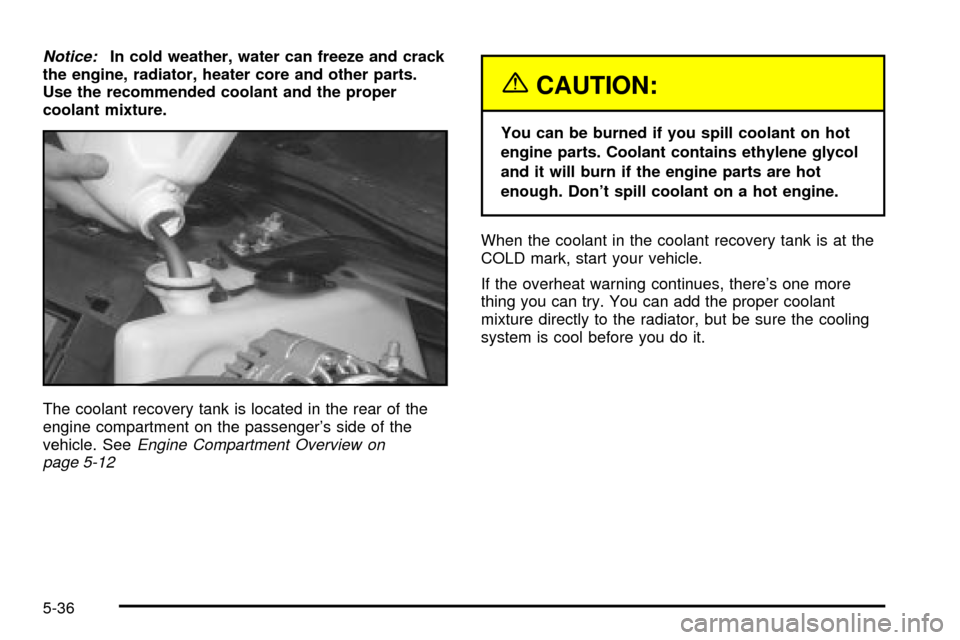
The coolant recovery tank is located in the rear of the
engine compartment on the passenger's side of the
vehicle. See
Engine Compartment Overview on
page 5-12
{CAUTION:
You can be burned if you spill coolant on hot
engine parts. Coolant contains ethylene glycol
and it will burn if the engine parts are hot
enough. Don't spill coolant on a hot engine.
When the coolant in the coolant recovery tank is at the
COLD mark, start your vehicle.
If the overheat warning continues, there's one more
thing you can try. You can add the proper coolant
mixture directly to the radiator, but be sure the cooling
system is cool before you do it.
5-36
Page 294 of 408
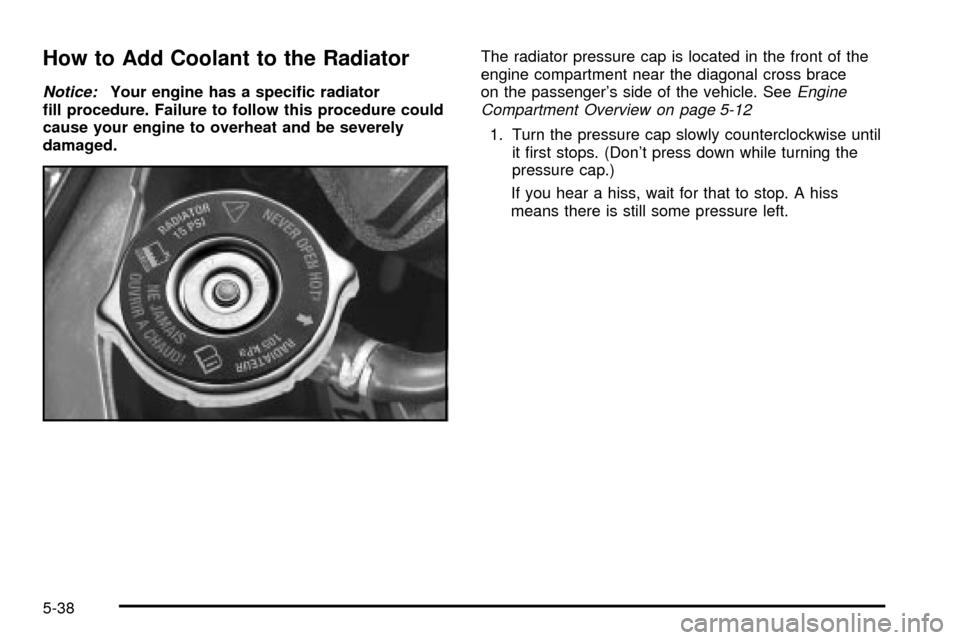
How to Add Coolant to the Radiator
Notice:Your engine has a speci®c radiator
®ll procedure. Failure to follow this procedure could
cause your engine to overheat and be severely
damaged.The radiator pressure cap is located in the front of the
engine compartment near the diagonal cross brace
on the passenger's side of the vehicle. SeeEngine
Compartment Overview on page 5-12
1. Turn the pressure cap slowly counterclockwise until
it ®rst stops. (Don't press down while turning the
pressure cap.)
If you hear a hiss, wait for that to stop. A hiss
means there is still some pressure left.
5-38
Page 397 of 408

Door (cont.)
Driver Information Center (DIC).........................3-49
Driver............................................................1-15
Position, Safety Belt.....................................1-15
Driver's Side Instrument Panel Fuse Block.........5-96
Driving On Grades..........................................4-39
Driving on Snow or Ice....................................4-26
Driving Through Deep Standing Water...............4-19
Driving Through Flowing Water.........................4-19
Driving with a Trailer.......................................4-38
Driving..........................................................4-16
At Night.....................................................4-16
City...........................................................4-20
Defensive..................................................... 4-2
Drunken....................................................... 4-2
Freeway.....................................................4-21
Hill and Mountain Roads..............................4-23
In Rain and on Wet Roads...........................4-17
Winter........................................................4-25
Dual Climate Control System............................3-22
E
Electrical System............................................5-94
Add-On Equipment......................................5-94
Fuses and Circuit Breakers...........................5-95
Headlamp Wiring.........................................5-94
Power Windows and Other Power Options......5-95
Windshield Wiper Fuses...............................5-94Electrical System (cont.)
Emergency Trunk Release Handle.....................2-12
Emissions Inspection and
Maintenance Programs.................................3-39
Engine Coolant Level Check.............................6-10
Engine Cooling When Trailer Towing..................4-40
Engine Oil Additives........................................5-20
Engine Oil Level Check...................................6-10
Engine..........................................................5-22
Air Cleaner/Filter.........................................5-22
Battery.......................................................5-48
Change Oil Message...................................3-44
Check and Service Engine Soon Light............3-37
Compartment Overview................................5-12
Coolant Heater............................................2-22
Coolant Temperature Gage...........................3-36
Coolant......................................................5-27
Cooling System Inspection............................6-15
Exhaust.....................................................2-31
Low Oil Level Message................................3-43
Oil .............................................................5-16
Overheating................................................5-30
Starting......................................................2-19
Entry Lighting.................................................3-17
Erasing HomeLinkžButtons..............................2-42
EXIT (Exit Feature Customization Mode)............2-53
Express-Down Window....................................2-14
Extender, Safety Belt.......................................1-30
Exterior Lamps...............................................3-14
5
Page 402 of 408

Mirrors..........................................................2-35
Automatic Dimming Rearview with OnStarž.....2-35
Automatic Dimming Rearview........................2-34
Manual Rearview Mirror with OnStar
ž.............2-33
Manual Rearview Mirror................................2-33
Outside Convex Mirror.................................2-36
Outside Power Mirrors..................................2-36
MyGMLink.com................................................ 7-3
N
New Vehicle Break-In......................................2-18
Normal Maintenance Replacement Parts...........5-105
O
Odometer......................................................3-31
Off-Road Recovery..........................................4-12
OIL LIFE (GM Oil Life System Reset)................2-46
Oil ................................................................5-16
Engine.......................................................5-16
Pressure Message.......................................3-43
Older Children, Restraints................................1-31
Online Owner Center........................................ 7-3
OnStar
žPersonal Calling.................................2-38
OnStaržServices............................................2-37
OnStaržSystem.............................................2-37
OnStaržVirtual Advisor....................................2-38
Operation Tips................................................3-26ORIG. SET (Return to the Original Settings).......2-52
Other Warning Devices...................................... 3-6
Outlet Adjustment............................................3-25
Outside.........................................................2-36
Convex Mirror.............................................2-36
Power Mirrors.............................................2-36
Overheated Engine Protection Operating Mode . . . 5-30
Overseas ± Customer Assistance........................ 7-4
Owners, Canadian............................................... ii
Owner's Information........................................7-11
P
Parade Dimming.............................................3-18
Park (P)........................................................2-30
Shifting Out of............................................2-30
Parking Brake and Automatic Transaxle
Park (P) Mechanism Check...........................6-13
Parking on Hills..............................................4-39
Parking.........................................................2-27
Brake........................................................2-27
Over Things That Burn.................................2-31
Park(P).........................................................2-27
Shifting Into................................................2-27
Part A - Scheduled Maintenance Services............ 6-4
Part B - Owner Checks and Services................6-10
Part C - Periodic MaintenanceInspections..........6-14
Part D - Recommended Fluids and Lubricants....6-16
Part E - Maintenance Record...........................6-17
10