Page 294 of 408
How to Add Coolant to the Radiator
Notice:Your engine has a speci®c radiator
®ll procedure. Failure to follow this procedure could
cause your engine to overheat and be severely
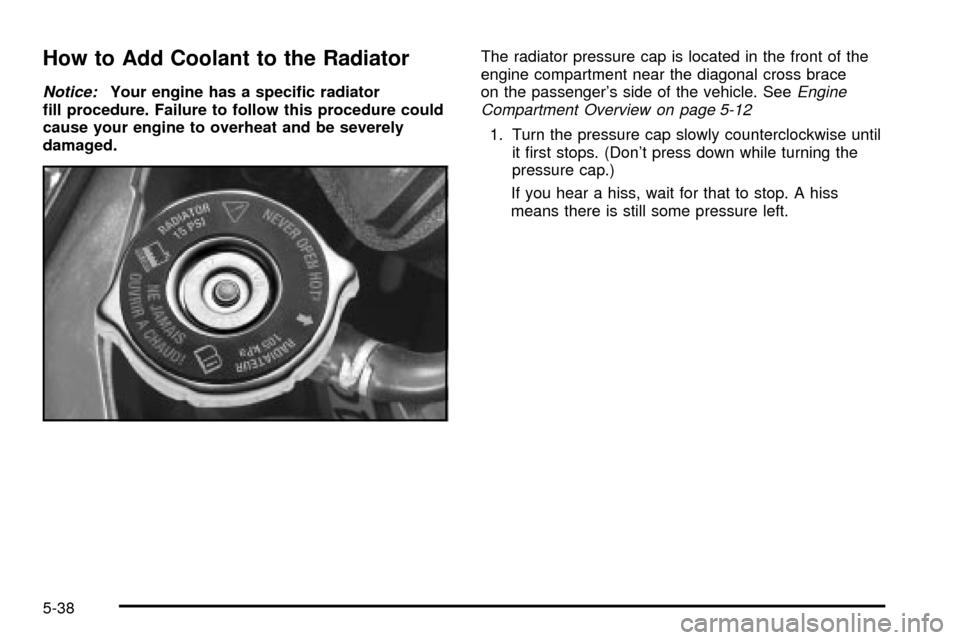
damaged.The radiator pressure cap is located in the front of the
engine compartment near the diagonal cross brace
on the passenger's side of the vehicle. SeeEngine
Compartment Overview on page 5-12
1. Turn the pressure cap slowly counterclockwise until
it ®rst stops. (Don't press down while turning the
pressure cap.)
If you hear a hiss, wait for that to stop. A hiss
means there is still some pressure left.
5-38
Page 297 of 408
5. Fill the radiator with the proper DEX-COOLž
coolant mixture, up to the base of the ®ller
neck. SeeEngine Coolant on page 5-27
If you see a stream of coolant coming from an air
bleed valve, close the valve. Otherwise, close
the valves after the radiator is ®lled.
6. Rinse or wipe any spilled coolant from the engine
and the compartment.
7. If you have the 3800 V6 engine, replace the 3800
Series II V6 engine cover shield.7.1. Remove the oil ®ll tube, with cap attached,
from the valve cover.
7.2. Insert the catch tab on the cover shield
under the bracket on the engine.
7.3. Place the hole in the cover shield over the
hole in the valve cover. Install oil ®ll tube and
cap by twisting clockwise.
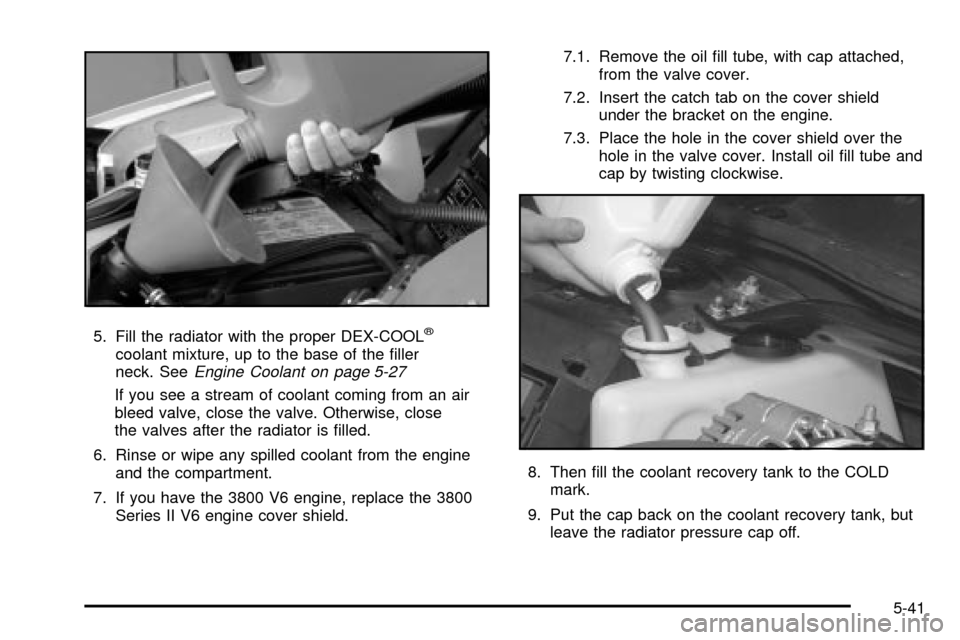
8. Then ®ll the coolant recovery tank to the COLD
mark.
9. Put the cap back on the coolant recovery tank, but
leave the radiator pressure cap off.
5-41
Page 298 of 408
10. Start the engine and let it run until you can feel the
upper radiator hose getting hot. Watch out for the
engine cooling fans.
11. By this time, the coolant level inside the radiator
®ller neck may be lower. If the level is lower, add
more of the proper DEX-COOL
žcoolant mixture
through the ®ller neck until the level reaches
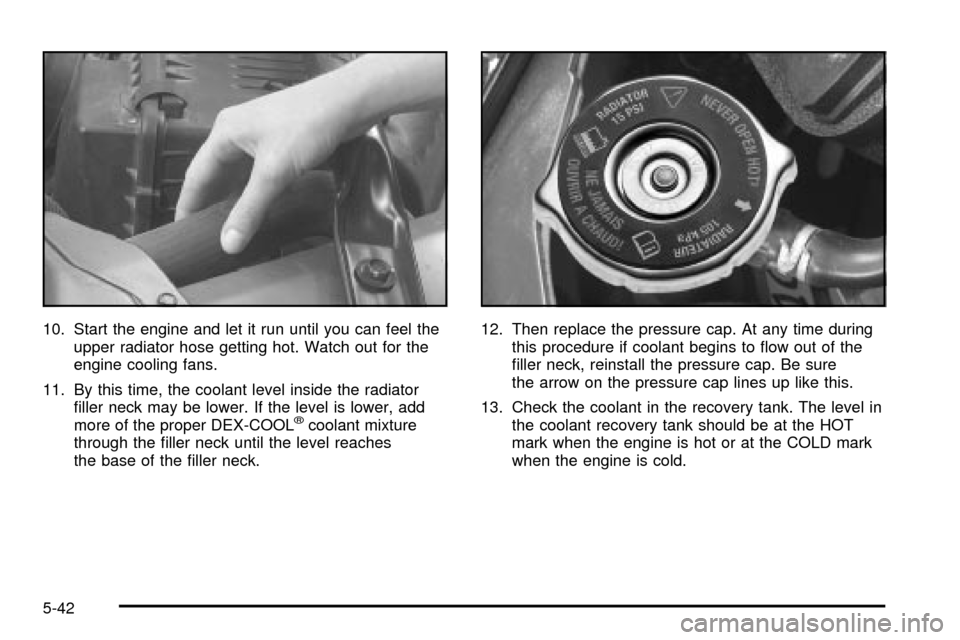
the base of the ®ller neck.12. Then replace the pressure cap. At any time during
this procedure if coolant begins to ¯ow out of the
®ller neck, reinstall the pressure cap. Be sure
the arrow on the pressure cap lines up like this.
13. Check the coolant in the recovery tank. The level in
the coolant recovery tank should be at the HOT
mark when the engine is hot or at the COLD mark
when the engine is cold.
5-42
Page 371 of 408

90,000 Miles (150 000 km)
qIf Equipped: Replace passenger compartment air
®lter. If you drive regularly under dusty conditions,
the ®lter may require replacement more often.
qReplace engine air cleaner ®lter. See
Engine Air
Cleaner/Filter on page 5-22for more information.An Emission Control Service.
qRotate tires. SeeTire Inspection and Rotation on
page 5-65for proper rotation pattern and additional
information.(See footnote .) (See footnote +.)
97,500 Miles (162 500 km)
qRotate tires. SeeTire Inspection and Rotation on
page 5-65for proper rotation pattern and additional
information.(See footnote .) (See footnote +.)
100,000 Miles (166 000 km)
qInspect spark plug wires.An Emission Control
Service.
qReplace spark plugs.An Emission Control Service.
qChange automatic transaxle ¯uid and ®lter if the
vehicle is mainly driven under one or more of
these conditions:
þ In heavy city traffic where the outside
temperature regularly reaches 90ÉF (32ÉC) or
higher.
þ In hilly or mountainous terrain.
þ When doing frequent trailer towing.
þ Uses such as found in taxi, police or delivery
service.
qIf you haven't used your vehicle under severe
conditions listed previously and, therefore, haven't
changed your automatic transaxle ¯uid, change both
the ¯uid and ®lter.
150,000 Miles (240 000 km)
qDrain, ¯ush and re®ll cooling system (or every
60 months since last service, whichever occurs ®rst).
See
Engine Coolant on page 5-27for what to use.
Inspect hoses. Clean radiator, condenser, pressure
cap and neck. Pressure test the cooling system
and pressure cap.
An Emission Control Service.
qInspect engine accessory drive belt.An Emission
Control Service.
6-9
Page 377 of 408

Fuel System Inspection
Inspect the complete fuel system for damage or leaks.
Engine Cooling System Inspection
Inspect the hoses and have them replaced if they
are cracked, swollen or deteriorated. Inspect all pipes,
®ttings and clamps; replace as needed. Clean the
outside of the radiator and air conditioning condenser.
To help ensure proper operation, a pressure test of
the cooling system and pressure cap is recommended
at least once a year.
Throttle System Inspection
Inspect the throttle system for interference or binding,
and for damaged or missing parts. Replace parts
as needed. Replace any components that have high
effort or excessive wear. Do not lubricate accelerator
and cruise control cables.
Brake System Inspection
Inspect the complete system. Inspect brake lines and
hoses for proper hook-up, binding, leaks, cracks,
cha®ng, etc. Inspect disc brake pads for wear and rotors
for surface condition. Inspect other brake parts,
including calipers, parking brake, etc. You may need to
have your brakes inspected more often if your driving
habits or conditions result in frequent braking.
6-15
Page 403 of 408

Passenger Compartment Air Filter.....................3-26
Passenger's Side Instrument Panel Fuse Block . . . 5-98
Passing.................................................4-13, 4-38
Passlock
ž......................................................2-17 .
ii
Plan Ahead When Possible................................ 7-8
Playing a Cassette Tape..........................3-62, 3-85
Playing a Compact Disc..........................3-73, 3-87
Playing the Radio...........................3-55, 3-65, 3-77
Power Steering...............................................4-10
Power...........................................................3-19
Accessory Outlets........................................3-19
Auxiliary Connection.....................................3-20
Door Locks.................................................. 2-9
Drop..........................................................3-20
Electrical System.........................................5-95
Six-Way Seats.............................................. 1-3
Steering Fluid.............................................5-43
Windows....................................................2-14
Programmable Automatic Door Locks.................. 2-9
Programmable Modes...............................2-9, 2-45
Programming the HomeLink Transmitter.............2-39
Q
Questions and Answers About Safety Belts.........1-13
R
Radiator Pressure Cap....................................5-30
Radio Data System (RDS)...............3-54, 3-64, 3-75
Radio Messages.............................3-59, 3-70, 3-82
Radios..........................................................3-53
Care of Your Cassette Tape Player................3-91
Care of Your CD Player...............................3-92
Care of Your CDs........................................3-92
Radio with Cassette and CD.........................3-75
Radio with Cassette.....................................3-54
Radio with CD............................................3-64
Setting the Time..........................................3-53
Theft-Deterrent............................................3-89
Understanding Reception..............................3-91
RDS Messages..............................3-58, 3-69, 3-81
Reading Lamps..............................................3-18
Rear Safety Belt Comfort Guides......................1-28
Rear Seat Passenger Positions.........................1-25
Rear Seat Passengers, Safety Belts..................1-25
Rear Storage Area..........................................2-43
Rear Window Defogger....................................3-25
Rearview Mirror, Automatic Dimming with
OnStar
ž.....................................................2-35
Rearview Mirror, Automatic Dimming..................2-34
Rearview Mirror with OnStar
ž...........................2-33
Rearview Mirrors.............................................2-33
11