Page 269 of 408

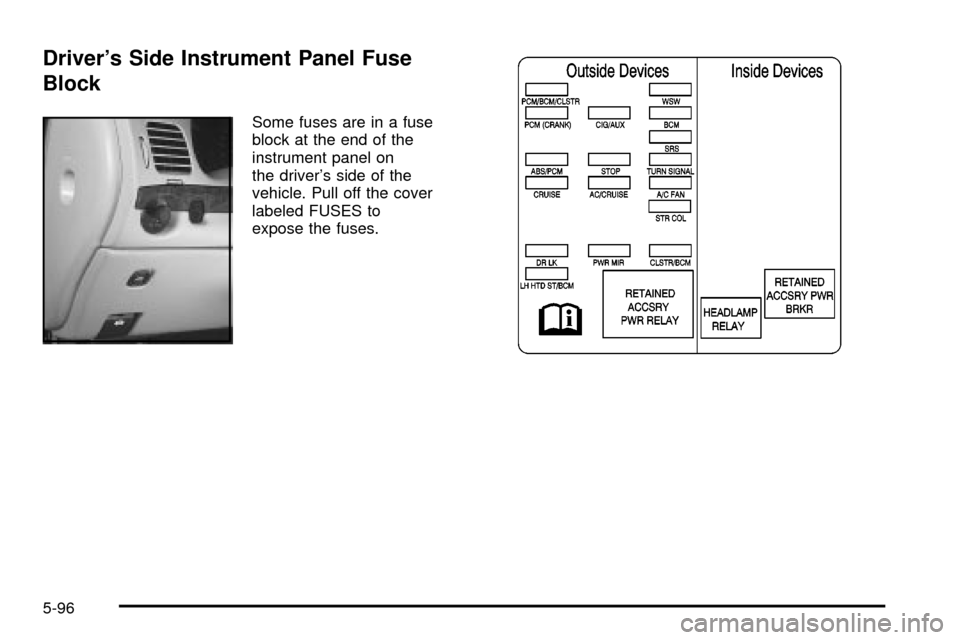
A. Windshield Washer Fluid Reservoir. SeeWindshield
Washer Fluid on page 5-44.
B. Battery. See
Battery on page 5-48.
C. Remote Positive (+) Terminal. See
Jump Starting on
page 5-49.
D. Upper Underhood Fuse Block. See ªUpperhood
Fuse Block (Upper)º under
Fuses and Circuit
Breakers on page 5-95.
E. Lower Underhood Fuse Block. See ªUnderhood
Fuse Block (Lower)º under
Fuses and Circuit
Breakers on page 5-95.
F. Radiator Pressure Cap. See
Radiator Pressure Cap
on page 5-30.
G. Engine Coolant Recovery Tank. See
Cooling System
on page 5-33.
H. Power Steering Fluid Reservoir. See
Power Steering
Fluid on page 5-43.I. Electric Cooling Fan. See
Cooling System on
page 5-33.
J. Engine Oil Fill Cap. See ªChecking Engine Oilº
under
Engine Oil on page 5-16.
K. Engine Oil Dipstick. See ªChecking Engine Oilº
under
Engine Oil on page 5-16.
L. Bleed Valves (underneath engine shield). See ªHow
to Add Coolant to the Radiatorº under
Cooling
System on page 5-33.
M. Transaxle Fluid Dipstick. See
Automatic Transaxle
Fluid on page 5-24.
N. Brake Master Cylinder Reservoir. See
Brakes on
page 5-45.
O. Engine Air Cleaner/Filter. See
Engine Air
Cleaner/Filter on page 5-22.
5-13
Page 271 of 408

A. Windshield Washer Fluid Reservoir. SeeWindshield
Washer Fluid on page 5-44.
B. Battery. See
Battery on page 5-48.
C. Remote Positive (+) Terminal. See
Jump Starting on
page 5-49.
D. Upper Underhood Fuse Block. See ªUpperhood
Fuse Block (Upper)º under
Fuses and Circuit
Breakers on page 5-95.
E. Lower Underhood Fuse Block. See ªUnderhood
Fuse Block (Lower)º under
Fuses and Circuit
Breakers on page 5-95.
F. Radiator Pressure Cap. See
Radiator Pressure Cap
on page 5-30.
G. Engine Coolant Recovery Tank. See
Cooling System
on page 5-33
H. Power Steering Fluid Reservoir (low in engine
compartment). SeePower Steering Fluid on
page 5-43.I. Electric Cooling Fan. See
Cooling System on
page 5-33.
J. Engine Oil Dipstick. See ªChecking Engine Oilº
under
Engine Oil on page 5-16.
K. Engine Oil Fill Cap. See ªChecking Engine Oilº
under
Engine Oil on page 5-16.
L. Bleed Valves (underneath engine shield). See ªHow
to Add Coolant to the Radiatorº under
Cooling
System on page 5-33.
M. Transaxle Fluid Dipstick. See
Automatic Transaxle
Fluid on page 5-24.
N. Brake Master Cylinder Reservoir. See
Brakes on
page 5-45.
O. Engine Air Cleaner/Filter. See
Engine Air
Cleaner/Filter on page 5-22.
5-15
Page 284 of 408
What to Use
Use a mixture of one-halfclean, drinkable waterand
one-half DEX-COOLžcoolant which won't damage
aluminum parts. If you use this coolant mixture,
you don't need to add anything else.
{CAUTION:
Adding only plain water to your cooling
system can be dangerous. Plain water, or
some other liquid such as alcohol, can boil
before the proper coolant mixture will. Your
vehicle's coolant warning system is set for the
proper coolant mixture. With plain water or the
wrong mixture, your engine could get too hot
but you wouldn't get the overheat warning.
Your engine could catch ®re and you or others
could be burned. Use a 50/50 mixture of clean,
drinkable water and DEX-COOL
žcoolant.
Notice:If you use an improper coolant mixture,
your engine could overheat and be badly damaged.
The repair cost wouldn't be covered by your
warranty. Too much water in the mixture can freeze
and crack the engine, radiator, heater core and
other parts.If you have to add coolant more than four times a year,
have your dealer check your cooling system.
Notice:If you use the proper coolant, you don't
have to add extra inhibitors or additives which claim
to improve the system. These can be harmful.
Checking Coolant
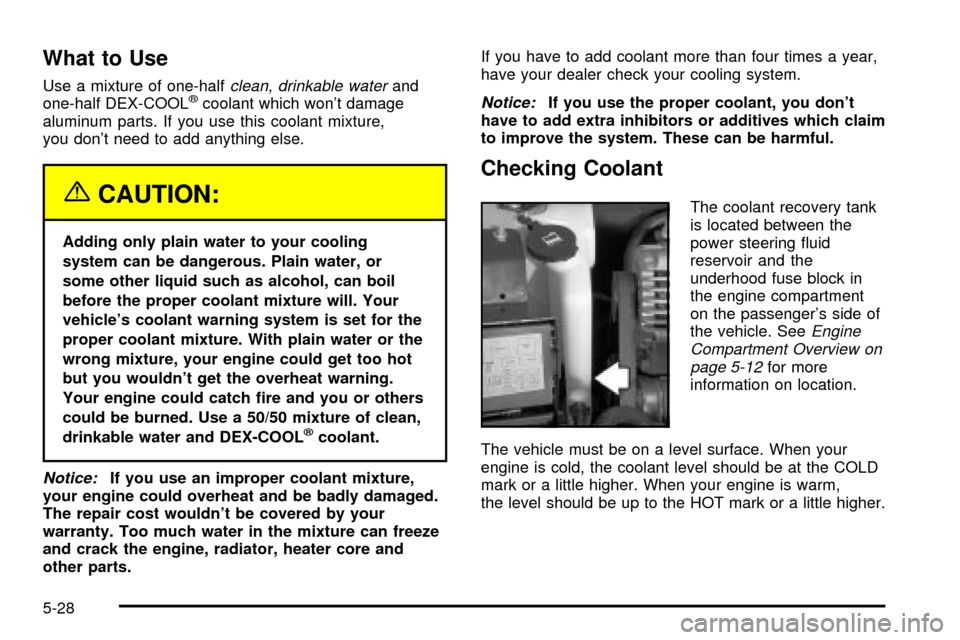
The coolant recovery tank
is located between the
power steering ¯uid
reservoir and the
underhood fuse block in
the engine compartment
on the passenger's side of
the vehicle. See
Engine
Compartment Overview on
page 5-12
for more
information on location.
The vehicle must be on a level surface. When your
engine is cold, the coolant level should be at the COLD
mark or a little higher. When your engine is warm,
the level should be up to the HOT mark or a little higher.
5-28
Page 306 of 408

Notice:Ignoring these steps could result in costly
damage to your vehicle that wouldn't be covered
by your warranty.
Trying to start your vehicle by pushing or pulling it
won't work, and it could damage your vehicle.
Notice:If the other system isn't a 12-volt system
with a negative ground, both vehicles can be
damaged.
1. Check the other vehicle. It must have a 12±volt
battery with a negative ground system.
2. Get the vehicles close enough so the jumper cables
can reach, but be sure the vehicles aren't touching
each other. If they are, it could cause a ground
connection you don't want. You wouldn't be able to
start your vehicle, and the bad grounding could
damage the electrical systems.
To avoid the possibility of the vehicles rolling, set
the parking brake ®rmly on both vehicles involved in
the jump start procedure. Put an automatic
transaxle in PARK (P) or a manual transaxle in
NEUTRAL before setting the parking brake.
Notice:If you leave your radio on, it could be badly
damaged. The repairs wouldn't be covered by
your warranty.
3. Turn off the ignition on both vehicles. Unplug
unnecessary accessories plugged into the cigarette
lighter or in the accessory power outlets. Turn off
the radio and all lamps that aren't needed. This will
avoid sparks and help save both batteries. And it
could save your radio!
4. Open the hoods and locate the batteries. Find the
positive (+) and negative (-) terminal locations on
each vehicle.
You will not need to access your battery for jump
starting. Your vehicle has a remote positive (+) jump
starting terminal for that purpose. The remote
positive (+) terminal is located in the engine
compartment on the passenger's side of the vehicle,
next to the upper underhood fuse block. See
Engine Compartment Overview on page 5-12for
more information on location.
5-50
Page 350 of 408
Electrical System
Add-On Electrical Equipment
Notice:Don't add anything electrical to your
vehicle unless you check with your dealer ®rst.
Some electrical equipment can damage your vehicle
and the damage wouldn't be covered by your
warranty. Some add-on electrical equipment can
keep other components from working as they
should.
Your vehicle has an air bag system. Before attempting
to add anything electrical to your vehicle, see
Servicing Your Air Bag-Equipped Vehicle on page 1-60.
Headlamp Wiring
The headlamp circuit is protected by individual fuses in
the underhood fuse block. An electrical overload will
cause the fuse to blow. If this happens, have your
headlamp system checked right away.
Windshield Wiper Fuses
The windshield wiper motor is protected by a circuit
breaker and a fuse. If the motor overheats due to heavy
snow, etc., the wiper will stop until the motor cools. If
the overload is caused by some electrical problem, have
it ®xed.
5-94
Page 351 of 408
Power Windows and Other Power
Options
A circuit breaker in the driver's side instrument panel
fuse block protects the power windows and other power
accessories. When the current load is too heavy, the
circuit breaker opens and closes, protecting the
circuit until the problem is ®xed.
Fuses and Circuit Breakers
The wiring circuits in your vehicle are protected from
short circuits by a combination of fuses. This greatly
reduces the chance of ®res caused by electrical
problems.
Look at the silver-colored band inside the fuse. If the
band is broken or melted, replace the fuse. Be sure you
replace a bad fuse with a new one of the identical
size and rating.
5-95
Page 352 of 408
Driver's Side Instrument Panel Fuse
Block
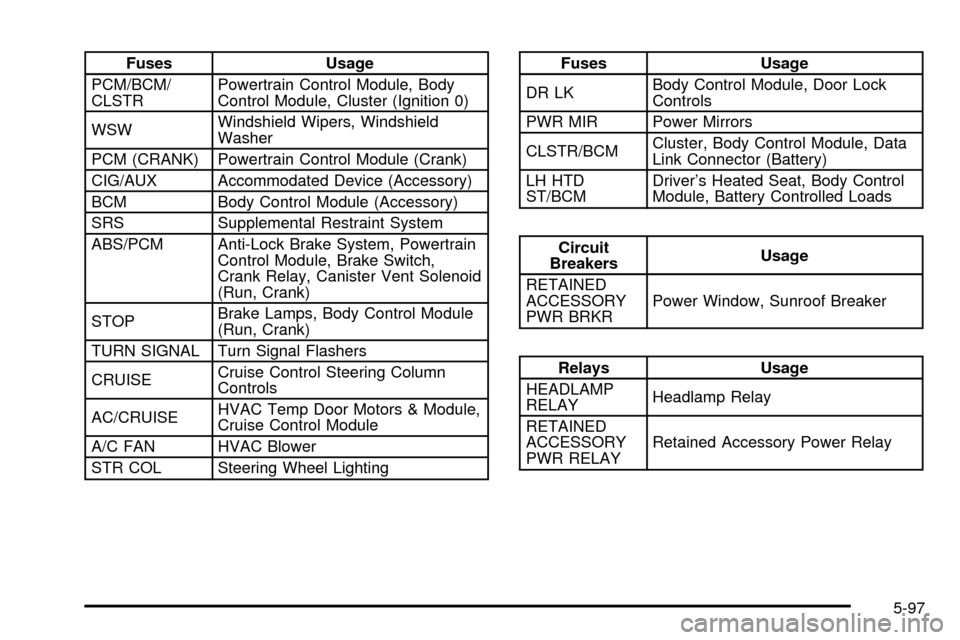
Some fuses are in a fuse
block at the end of the
instrument panel on
the driver's side of the
vehicle. Pull off the cover
labeled FUSES to
expose the fuses.
5-96
Page 353 of 408
Fuses Usage
PCM/BCM/
CLSTRPowertrain Control Module, Body
Control Module, Cluster (Ignition 0)
WSWWindshield Wipers, Windshield
Washer
PCM (CRANK) Powertrain Control Module (Crank)
CIG/AUX Accommodated Device (Accessory)
BCM Body Control Module (Accessory)
SRS Supplemental Restraint System
ABS/PCM Anti-Lock Brake System, Powertrain
Control Module, Brake Switch,
Crank Relay, Canister Vent Solenoid
(Run, Crank)
STOPBrake Lamps, Body Control Module
(Run, Crank)
TURN SIGNAL Turn Signal Flashers
CRUISECruise Control Steering Column
Controls
AC/CRUISEHVAC Temp Door Motors & Module,
Cruise Control Module
A/C FAN HVAC Blower
STR COL Steering Wheel LightingFuses Usage
DR LKBody Control Module, Door Lock
Controls
PWR MIR Power Mirrors
CLSTR/BCMCluster, Body Control Module, Data
Link Connector (Battery)
LH HTD
ST/BCMDriver's Heated Seat, Body Control
Module, Battery Controlled Loads
Circuit
BreakersUsage
RETAINED
ACCESSORY
PWR BRKRPower Window, Sunroof Breaker
Relays Usage
HEADLAMP
RELAYHeadlamp Relay
RETAINED
ACCESSORY
PWR RELAYRetained Accessory Power Relay
5-97