Page 249 of 386

Part B: Owner Checks and Services
Listed in this part are owner checks and services
which should be performed at the intervals speci®ed to
help ensure the safety, dependability and emission
control performance of your vehicle.
Be sure any necessary repairs are completed at once.
Whenever any ¯uids or lubricants are added to your
vehicle, make sure they are the proper ones, as shown
in Part D.
At the First 100, 1,000 and 6,000
Miles (160, 1 600 and 10 000km)
For vehicles with dual wheels, check dual wheel nut
torque. For proper torque, seeCapacities and
Speci®cations on page 5-97.
At Each Fuel Fill
It is important for you or a service station attendant to
perform these underhood checks at each fuel ®ll.
Engine Oil Level Check
Check the engine oil level and add the proper oil if
necessary. SeeEngine Oil on page 5-13for further
details.
Engine Coolant Level Check
Check the engine coolant level and add DEX-COOLž
coolant mixture if necessary. SeeEngine Coolant
on page 5-21for further details.
Windshield Washer Fluid Level Check
Check the windshield washer ¯uid level in the windshield
washer tank and add the proper ¯uid if necessary.
See
Windshield Washer Fluid on page 5-35for further
details.
At Least Once a Month
Tire In¯ation Check
Visually inspect your tires and make sure tires are
in¯ated to the correct pressures. Don't forget to check
your spare tire. See
Tires on page 5-56for further
details.
6-11
Page 250 of 386

Cassette Tape Player Service
Clean cassette tape player. Cleaning should be done
every 50 hours of tape play. SeeAudio System(s)
on page 3-40for further details.
At Least Twice a Year
Restraint System Check
Make sure the safety belt reminder light and all your
belts, buckles, latch plates, retractors and anchorages
are working properly. Look for any other loose or
damaged safety belt system parts. If you see anything
that might keep a safety belt system from doing its
job, have it repaired. Have any torn or frayed safety belts
replaced.
Also look for any opened or broken air bag coverings,
and have them repaired or replaced. (The air bag
system does not need regular maintenance.)
Wiper Blade Check
Inspect wiper blades for wear or cracking. Replace
blade inserts that appear worn or damaged or that
streak or miss areas of the windshield. Also see
Cleaning the Outside of Your Vehicle on page 5-84.
Spare Tire Check
At least twice a year, after the monthly in¯ation check of
the spare tire determines that the spare is in¯ated to
the correct tire in¯ation pressure, make sure that
the spare tire is stored securely. Push, pull, and then try
to rotate or turn the tire. If it moves, use the
ratchet/wheel wrench to tighten the cable. See
Changing
a Flat Tire on page 5-65.
Weatherstrip Lubrication
Silicone grease on weatherstrips will make them last
longer, seal better, and not stick or squeak. Apply
silicone grease with a clean cloth. During very cold,
damp weather more frequent application may be
required. See
Part D: Recommended Fluids and
Lubricants on page 6-18.
Automatic Transmission Check
Check the transmission ¯uid level; add if needed. SeeAutomatic Transmission Fluid on page 5-19. A ¯uid loss
may indicate a problem. Check the system and repair
if needed.
6-12
Page 327 of 386
·Bad wear
·Bad handling
·Bad fuel economy
If your tires have too much air (overin¯ation), you
can get the following:
·Unusual wear
·Bad handling
·Rough ride
·Needless damage from road hazards
When to Check
Check your tires once a month or more.
Also, check the tire pressure of the spare tire.
How to Check
Use a good quality pocket-type gage to check tire
pressure. You can't tell if your tires are properly in¯ated
simply by looking at them. Radial tires may look
properly in¯ated even when they're underin¯ated.
Be sure to put the valve caps back on the valve stems.
They help prevent leaks by keeping out dirt and
moisture.
Dual Tire Operation
When the vehicle is new, or whenever a wheel, wheel
bolt or wheel nut is replaced, check the wheel nut torque
after 100, 1,000 and 6,000 miles (160, 1 600 and
10 000 km) of driving. For proper torque and wheel nut
tightening information, see ªTightening the Wheel
Nutsº later in this section.
The outer tire on a dual wheel setup generally wears
faster than the inner tire. Your tires will wear more
evenly and last longer if you rotate the tires periodically.
See ªTire Inspection and Rotationº earlier in this
section. Also see ªScheduled Maintenance Servicesº in
the Index for scheduled rotation intervals
{CAUTION:
If you operate your vehicle with a tire that is
badly underin¯ated, the tire can overheat. An
overheated tire can lose air suddenly or catch
®re. You or others could be injured. Be sure all
tires (including the spare) are properly in¯ated.
See ªTiresº and ªIn¯ation ± Tire Pressureº in the Index
for more information on proper tire in¯ation.
5-57
Page 328 of 386

Tire Inspection and Rotation
Tires should be rotated every 6,000 to 8,000 miles
(10 000 to 13 000 km).
Any time you notice unusual wear, rotate your tires as
soon as possible and check wheel alignment. Also
check for damaged tires or wheels. See
When It Is Time
for New Tires on page 5-59andWheel Replacement
on page 5-62for more information.
Make sure the spare tire is stored securely. Push, pull,
and then try to rotate or turn the tire. If it moves,
use the ratchet/wheel wrench to tighten the cable. See
Changing a Flat Tire on page 5-65.
If your vehicle has dual rear wheels, also see
Dual Tire
Operation on page 5-57.
The purpose of regular rotation is to achieve more
uniform wear for all tires on the vehicle. The ®rst rotation
is the most important. See ªPart A: Scheduled
Maintenance Services,º in Section 6, for scheduled
rotation intervals.If your vehicle has single rear wheels, always use one
of the correct rotation patterns shown here when rotating
your tires.
If your vehicle has dual rear wheels, always use one of
the correct rotation patterns shown here when rotating
your tires.
5-58
Page 337 of 386
The tools you'll be using include the jack (A), jack
handle extension (B), jack handle (C), wheel wrench (D)
and the ratchet (E).
Your spare tire is stored underneath the rear of your
vehicle. You will use the wheel wrench (D) and the
ratchet (E) to lower the spare tire.
The ratchet has a DOWN side and an UP side.Attach the wheel wrench
and ratchet, with the
DOWN side facing you.
The wheel wrench
has a socket end and a
¯at chisel end.
Put the ¯at chisel end of the wheel wrench on an angle
through the hole between the body and the bumper.
Be sure the ¯at end connects into the hoist shaft.
5-67
Page 338 of 386
Turn the ratchet counterclockwise to lower the spare tire
to the ground. If the spare tire does not lower to the
ground, the secondary latch is engaged causing the tire
not to lower. See ªSecondary Latch Systemº later in
this section.When the tire has been lowered, pull the tire toward you
so you can reach the tire retainer and pull it up
through the wheel opening.
If you have a vehicle which was completed from a cab
and chassis, refer to the information from the body
supplier/installer.
The spare tire is a full-size tire, like the other tires on
your vehicle.
Notice:To help avoid vehicle damage, do not drive
the vehicle before the cable is restored.
5-68
Page 341 of 386
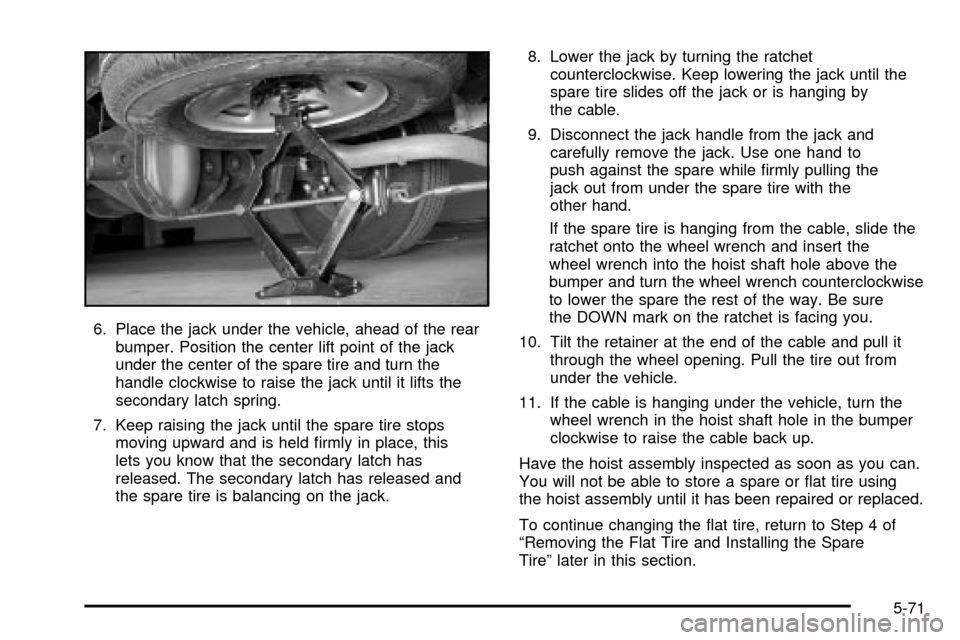
6. Place the jack under the vehicle, ahead of the rear
bumper. Position the center lift point of the jack
under the center of the spare tire and turn the
handle clockwise to raise the jack until it lifts the
secondary latch spring.
7. Keep raising the jack until the spare tire stops
moving upward and is held ®rmly in place, this
lets you know that the secondary latch has
released. The secondary latch has released and
the spare tire is balancing on the jack.8. Lower the jack by turning the ratchet
counterclockwise. Keep lowering the jack until the
spare tire slides off the jack or is hanging by
the cable.
9. Disconnect the jack handle from the jack and
carefully remove the jack. Use one hand to
push against the spare while ®rmly pulling the
jack out from under the spare tire with the
other hand.
If the spare tire is hanging from the cable, slide the
ratchet onto the wheel wrench and insert the
wheel wrench into the hoist shaft hole above the
bumper and turn the wheel wrench counterclockwise
to lower the spare the rest of the way. Be sure
the DOWN mark on the ratchet is facing you.
10. Tilt the retainer at the end of the cable and pull it
through the wheel opening. Pull the tire out from
under the vehicle.
11. If the cable is hanging under the vehicle, turn the
wheel wrench in the hoist shaft hole in the bumper
clockwise to raise the cable back up.
Have the hoist assembly inspected as soon as you can.
You will not be able to store a spare or ¯at tire using
the hoist assembly until it has been repaired or replaced.
To continue changing the ¯at tire, return to Step 4 of
ªRemoving the Flat Tire and Installing the Spare
Tireº later in this section.
5-71
Page 342 of 386
Removing the Wheel Covers
If your vehicle has plastic wheel nut caps, loosen them
by turning the wheel wrench counterclockwise. The
wheel nut caps are designed to remain with the center
cap. Remove the center cap.
If the wheel has a smooth center piece, place the chisel
end of the wheel wrench in the slot on the wheel and
gently pry it out.
Removing the Flat Tire and Installing
the Spare Tire
1. With the DOWN side facing you, use the ratchet
and wheel wrench to loosen all the wheel nuts.
Don't remove them yet.
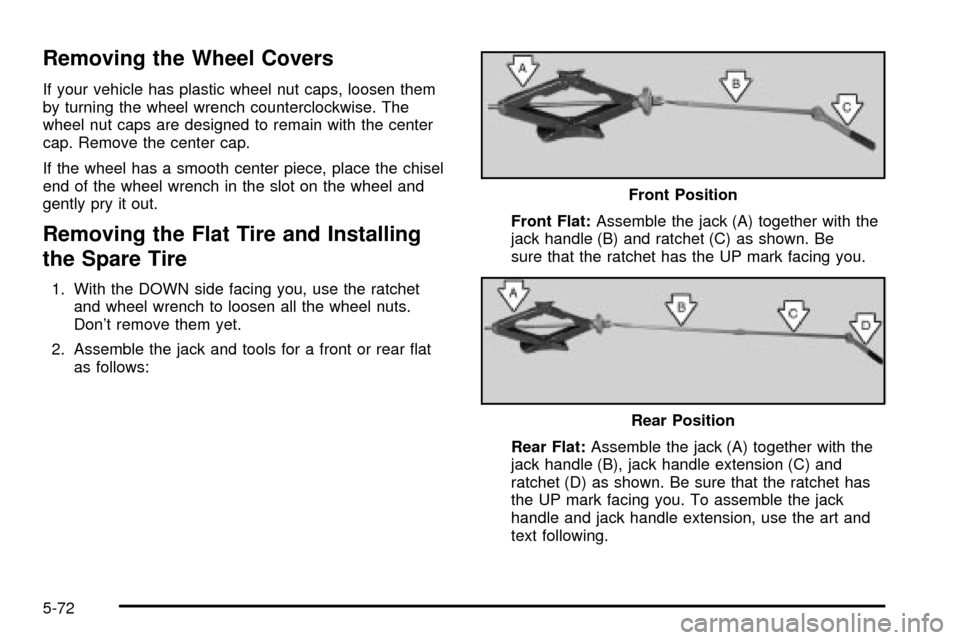
2. Assemble the jack and tools for a front or rear ¯at
as follows:Front Flat:Assemble the jack (A) together with the
jack handle (B) and ratchet (C) as shown. Be
sure that the ratchet has the UP mark facing you.
Rear Flat:Assemble the jack (A) together with the
jack handle (B), jack handle extension (C) and
ratchet (D) as shown. Be sure that the ratchet has
the UP mark facing you. To assemble the jack
handle and jack handle extension, use the art and
text following.Front Position
Rear Position
5-72