2003 CHEVROLET EXPRESS CARGO VAN wheel
[x] Cancel search: wheelPage 239 of 386
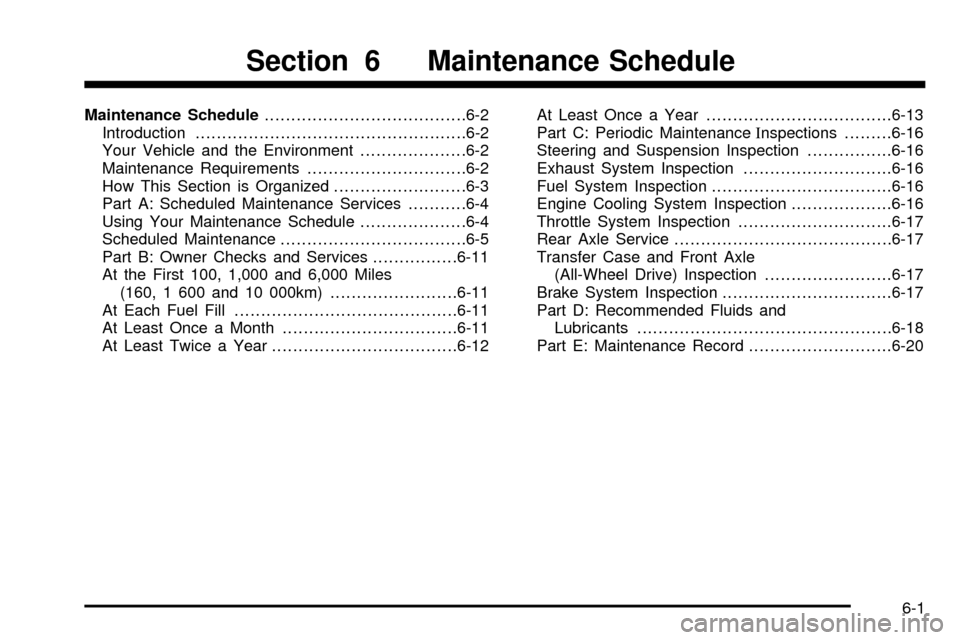
Maintenance Schedule......................................6-2
Introduction...................................................6-2
Your Vehicle and the Environment....................6-2
Maintenance Requirements..............................6-2
How This Section is Organized.........................6-3
Part A: Scheduled Maintenance Services...........6-4
Using Your Maintenance Schedule....................6-4
Scheduled Maintenance...................................6-5
Part B: Owner Checks and Services................6-11
At the First 100, 1,000 and 6,000 Miles
(160, 1 600 and 10 000km)........................6-11
At Each Fuel Fill..........................................6-11
At Least Once a Month.................................6-11
At Least Twice a Year...................................6-12At Least Once a Year...................................6-13
Part C: Periodic MaintenanceInspections.........6-16
Steering and Suspension Inspection................6-16
Exhaust System Inspection............................6-16
Fuel System Inspection..................................6-16
Engine Cooling System Inspection...................6-16
Throttle System Inspection.............................6-17
Rear Axle Service.........................................6-17
Transfer Case and Front Axle
(All-Wheel Drive) Inspection........................6-17
Brake System Inspection................................6-17
Part D: Recommended Fluids and
Lubricants................................................6-18
Part E: Maintenance Record...........................6-20
Section 6 Maintenance Schedule
6-1
Page 245 of 386

30,000 Miles (50 000 km)
qInspect engine air cleaner ®lter change indicator. If
necessary, replace the ®lter. If vehicle is driven in
dusty/dirty conditions, inspect ®lter change indicator
at every engine oil change. See
Engine Air
Cleaner/Filter on page 5-17for more information.An Emission Control Service. (See footnote ².)
qCheck rear/front axle ¯uid level and add ¯uid as
needed. Check constant velocity joints and axle
seals for leaking.
qClean and repack the front wheel bearings
(or at each brake relining, whichever occurs ®rst).
qRotate tires. See
Tire Inspection and Rotation on
page 5-58for proper rotation pattern and additional
information.(See footnote +.)
qReplace fuel ®lter.An Emission Control Service.
(See footnote ².)
qVehicles With GVWR Above 10,000 lbs. Only:
Inspect shields for damage or looseness. Adjust or
replace as required.
This is a Noise Emission Control
Service. Applicable only to vehicles sold in the
United States.
37,500 Miles (62 500 km)
qCheck rear/front axle ¯uid level and add ¯uid as
needed. Check constant velocity joints and axle
seals for leaking.
qRotate tires. See
Tire Inspection and Rotation on
page 5-58for proper rotation pattern and additional
information.(See footnote +.)
45,000 Miles (75 000 km)
qInspect engine air cleaner ®lter change indicator. If
necessary, replace the ®lter. If vehicle is driven in
dusty/dirty conditions, inspect ®lter change indicator
at every engine oil change. See
Engine Air
Cleaner/Filter on page 5-17for more information.An Emission Control Service. (See footnote ².)
qCheck rear/front axle ¯uid level and add ¯uid as
needed. Check constant velocity joints and axle
seals for leaking.
qVehicles With GVWR Above 10,000 lbs. Only:
Inspect shields for damage or looseness. Adjust or
replace as required.
This is a Noise Emission Control
Service. Applicable only to vehicles sold in the
United States.
qRotate tires. SeeTire Inspection and Rotation on
page 5-58for proper rotation pattern and additional
information.(See footnote +.)
6-7
Page 246 of 386

50,000 Miles (83 000 km)
qChange automatic transmission ¯uid and ®lter if the
vehicle's GVWR is over 8,600 lbs or if the vehicle is
mainly driven under one or more of these conditions:
þ In heavy city traffic where the outside
temperature regularly reaches 90ÉF (32ÉC) or
higher.
þ In hilly or mountainous terrain.
þ When doing frequent trailer towing.
þ Uses such as found in taxi, police or delivery
service.
If you do not use your vehicle under any of these
conditions, change the ¯uid and ®lter at 100,000 miles
(166 000 km).
52,500 Miles (87 500 km)
qCheck rear/front axle ¯uid level and add ¯uid as
needed. Check constant velocity joints and axle
seals for leaking.
qRotate tires. See
Tire Inspection and Rotation on
page 5-58for proper rotation pattern and additional
information.(See footnote +.)
60,000 Miles (100 000 km)
qInspect engine air cleaner ®lter change indicator. If
necessary, replace the ®lter. If vehicle is driven in
dusty/dirty conditions, inspect ®lter change indicator
at every engine oil change. See
Engine Air
Cleaner/Filter on page 5-17for more information.An Emission Control Service. (See footnote ².)
qCheck rear/front axle ¯uid level and add ¯uid as
needed. Check constant velocity joints and axle
seals for leaking.
qClean and repack the front wheel bearings
(or at each brake relining, whichever occurs ®rst).
qRotate tires. See
Tire Inspection and Rotation on
page 5-58for proper rotation pattern and additional
information.(See footnote +.)
qReplace fuel ®lter.An Emission Control Service.
(See footnote ².)
qVehicles With GVWR Above 10,000 lbs. Only:
Inspect shields for damage or looseness. Adjust or
replace as required.
This is a Noise Emission Control
Service. Applicable only to vehicles sold in the
United States.
qInspect Evaporative Control System. Check all fuel
and vapor lines and hoses for proper hook-up,
routing and condition. Check that the purge valve
works properly, if equipped. Replace as needed.
An Emission Control Service. (See footnote ².)
6-8
Page 247 of 386

67,500 Miles (112 500 km)
qCheck rear/front axle ¯uid level and add ¯uid as
needed. Check constant velocity joints and axle
seals for leaking.
qRotate tires. See
Tire Inspection and Rotation on
page 5-58for proper rotation pattern and additional
information.(See footnote +.)
75,000 Miles (125 000 km)
qInspect engine air cleaner ®lter change indicator. If
necessary, replace the ®lter. If vehicle is driven in
dusty/dirty conditions, inspect ®lter change indicator
at every engine oil change. See
Engine Air
Cleaner/Filter on page 5-17for more information.An Emission Control Service. (See footnote ².)
qCheck rear/front axle ¯uid level and add ¯uid as
needed. Check constant velocity joints and axle
seals for leaking.
qVehicles With GVWR Above 10,000 lbs. Only:
Inspect shields for damage or looseness. Adjust or
replace as required.
This is a Noise Emission Control
Service. Applicable only to vehicles sold in the
United States.
qRotate tires. SeeTire Inspection and Rotation on
page 5-58for proper rotation pattern and additional
information.(See footnote +.)
82,500 Miles (137 500 km)
qCheck rear/front axle ¯uid level and add ¯uid as
needed. Check constant velocity joints and axle
seals for leaking.
qRotate tires. See
Tire Inspection and Rotation on
page 5-58for proper rotation pattern and additional
information.(See footnote +.)
90,000 Miles (150 000 km)
qInspect engine air cleaner ®lter change indicator. If
necessary, replace the ®lter. If vehicle is driven in
dusty/dirty conditions, inspect ®lter change indicator
at every engine oil change. See
Engine Air
Cleaner/Filter on page 5-17for more information.An Emission Control Service. (See footnote ².)
qCheck rear/front axle ¯uid level and add ¯uid as
needed. Check constant velocity joints and axle
seals for leaking.
qClean and repack the front wheel bearings
(or at each brake relining, whichever occurs ®rst.)
qReplace fuel ®lter.
An Emission Control Service.
(See footnote ².)
qVehicles With GVWR Above 10,000 lbs. Only:
Inspect shields for damage or looseness. Adjust or
replace as required.
This is a Noise Emission Control
Service. Applicable only to vehicles sold in the
United States.
6-9
Page 249 of 386

Part B: Owner Checks and Services
Listed in this part are owner checks and services
which should be performed at the intervals speci®ed to
help ensure the safety, dependability and emission
control performance of your vehicle.
Be sure any necessary repairs are completed at once.
Whenever any ¯uids or lubricants are added to your
vehicle, make sure they are the proper ones, as shown
in Part D.
At the First 100, 1,000 and 6,000
Miles (160, 1 600 and 10 000km)
For vehicles with dual wheels, check dual wheel nut
torque. For proper torque, seeCapacities and
Speci®cations on page 5-97.
At Each Fuel Fill
It is important for you or a service station attendant to
perform these underhood checks at each fuel ®ll.
Engine Oil Level Check
Check the engine oil level and add the proper oil if
necessary. SeeEngine Oil on page 5-13for further
details.
Engine Coolant Level Check
Check the engine coolant level and add DEX-COOLž
coolant mixture if necessary. SeeEngine Coolant
on page 5-21for further details.
Windshield Washer Fluid Level Check
Check the windshield washer ¯uid level in the windshield
washer tank and add the proper ¯uid if necessary.
See
Windshield Washer Fluid on page 5-35for further
details.
At Least Once a Month
Tire In¯ation Check
Visually inspect your tires and make sure tires are
in¯ated to the correct pressures. Don't forget to check
your spare tire. See
Tires on page 5-56for further
details.
6-11
Page 250 of 386

Cassette Tape Player Service
Clean cassette tape player. Cleaning should be done
every 50 hours of tape play. SeeAudio System(s)
on page 3-40for further details.
At Least Twice a Year
Restraint System Check
Make sure the safety belt reminder light and all your
belts, buckles, latch plates, retractors and anchorages
are working properly. Look for any other loose or
damaged safety belt system parts. If you see anything
that might keep a safety belt system from doing its
job, have it repaired. Have any torn or frayed safety belts
replaced.
Also look for any opened or broken air bag coverings,
and have them repaired or replaced. (The air bag
system does not need regular maintenance.)
Wiper Blade Check
Inspect wiper blades for wear or cracking. Replace
blade inserts that appear worn or damaged or that
streak or miss areas of the windshield. Also see
Cleaning the Outside of Your Vehicle on page 5-84.
Spare Tire Check
At least twice a year, after the monthly in¯ation check of
the spare tire determines that the spare is in¯ated to
the correct tire in¯ation pressure, make sure that
the spare tire is stored securely. Push, pull, and then try
to rotate or turn the tire. If it moves, use the
ratchet/wheel wrench to tighten the cable. See
Changing
a Flat Tire on page 5-65.
Weatherstrip Lubrication
Silicone grease on weatherstrips will make them last
longer, seal better, and not stick or squeak. Apply
silicone grease with a clean cloth. During very cold,
damp weather more frequent application may be
required. See
Part D: Recommended Fluids and
Lubricants on page 6-18.
Automatic Transmission Check
Check the transmission ¯uid level; add if needed. SeeAutomatic Transmission Fluid on page 5-19. A ¯uid loss
may indicate a problem. Check the system and repair
if needed.
6-12
Page 255 of 386

Throttle System Inspection
Inspect the throttle system for interference or binding,
and for damaged or missing parts. Replace parts
as needed. Replace any components that have high
effort or excessive wear. Do not lubricate accelerator
and cruise control cables.
Rear Axle Service
Check the gear lubricant level in the rear axle and add if
needed. SeeRear Axle on page 5-47. A ¯uid loss
may indicate a problem. Check the axle and repair it if
needed.
Transfer Case and Front Axle
(All-Wheel Drive) Inspection
Every 12 months, or at engine oil change intervals,
check front axle and transfer case and add lubricant
when necessary. A ¯uid loss could indicate a problem.
Check and have it repaired, if needed. Check vent
hose at transfer case for kinks and proper installation.
Brake System Inspection
Inspect the complete system. Inspect brake lines and
hoses for proper hook-up, binding, leaks, cracks,
cha®ng, etc. Inspect disc brake pads for wear and rotors
for surface condition. Inspect other brake parts,
including calipers, parking brake, etc. Check parking
brake adjustment. You may need to have your brakes
inspected more often if your driving habits or
conditions result in frequent braking.
6-17
Page 256 of 386
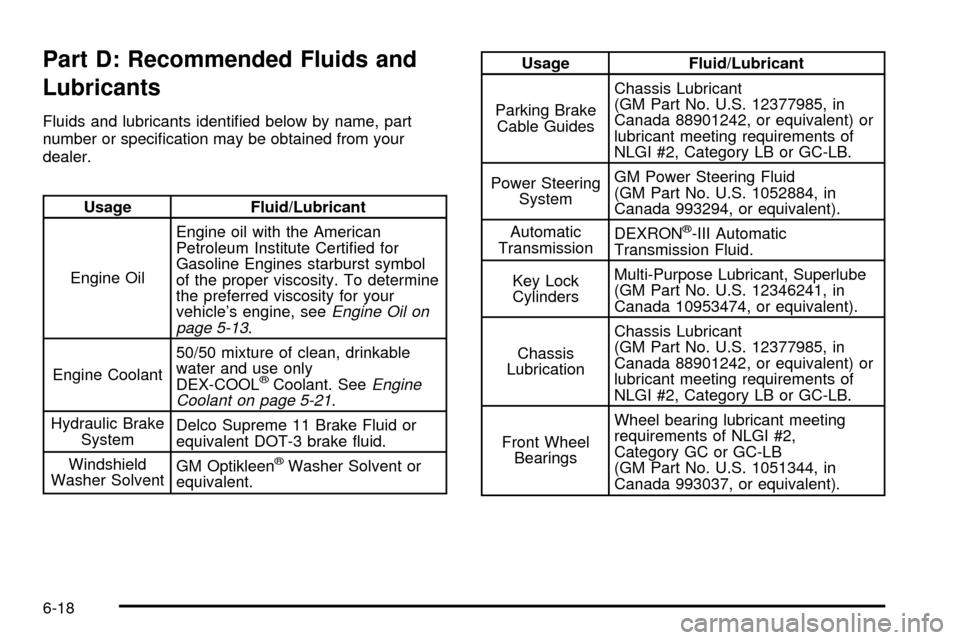
Part D: Recommended Fluids and
Lubricants
Fluids and lubricants identi®ed below by name, part
number or speci®cation may be obtained from your
dealer.
Usage Fluid/Lubricant
Engine OilEngine oil with the American
Petroleum Institute Certi®ed for
Gasoline Engines starburst symbol
of the proper viscosity. To determine
the preferred viscosity for your
vehicle's engine, see
Engine Oil on
page 5-13.
Engine Coolant50/50 mixture of clean, drinkable
water and use only
DEX-COOL
žCoolant. SeeEngine
Coolant on page 5-21.
Hydraulic Brake
SystemDelco Supreme 11 Brake Fluid or
equivalent DOT-3 brake ¯uid.
Windshield
Washer SolventGM Optikleen
žWasher Solvent or
equivalent.
Usage Fluid/Lubricant
Parking Brake
Cable GuidesChassis Lubricant
(GM Part No. U.S. 12377985, in
Canada 88901242, or equivalent) or
lubricant meeting requirements of
NLGI #2, Category LB or GC-LB.
Power Steering
SystemGM Power Steering Fluid
(GM Part No. U.S. 1052884, in
Canada 993294, or equivalent).
Automatic
TransmissionDEXRON
ž-III Automatic
Transmission Fluid.
Key Lock
CylindersMulti-Purpose Lubricant, Superlube
(GM Part No. U.S. 12346241, in
Canada 10953474, or equivalent).
Chassis
LubricationChassis Lubricant
(GM Part No. U.S. 12377985, in
Canada 88901242, or equivalent) or
lubricant meeting requirements of
NLGI #2, Category LB or GC-LB.
Front Wheel
BearingsWheel bearing lubricant meeting
requirements of NLGI #2,
Category GC or GC-LB
(GM Part No. U.S. 1051344, in
Canada 993037, or equivalent).
6-18