2003 CHEVROLET EXPRESS CARGO VAN battery
[x] Cancel search: batteryPage 312 of 386
4. Open the hoods and locate the positive (+) and
negative (-) terminal locations of the other vehicle.
Your vehicle has a remote positive (+) jump
starting terminal and a remote negative (-) jump
starting terminal. You should always use these
remote terminals instead of the terminals on the
battery.
The remote positive (+) terminal is located behind a
red plastic cover near the engine accessory drive
bracket on the driver's side below the alternator. To
uncover the remote positive (+) terminal, open
the red plastic cover.
The remote negative (-) terminal is located on the
engine drive bracket on all V8 engines and it is
marked ªGND.º
On V6 engines the remote negative (-) terminal is
located on a tab attached to the engine accessory
drive bracket where it is marked ªGND.º
{CAUTION:
Using a match near a battery can cause battery
gas to explode. People have been hurt doing
this, and some have been blinded. Use a
¯ashlight if you need more light.
Be sure the battery has enough water. You
don't need to add water to the ACDelco
ž
battery installed in your new vehicle. But if a
battery has ®ller caps, be sure the right
amount of ¯uid is there. If it is low, add water
to take care of that ®rst. If you don't, explosive
gas could be present.
Battery ¯uid contains acid that can burn you.
Don't get it on you. If you accidentally get it in
your eyes or on your skin, ¯ush the place with
water and get medical help immediately.
5-42
Page 313 of 386
{CAUTION:
Fans or other moving engine parts can injure
you badly. Keep your hands away from moving
parts once the engine is running.
5. Check that the jumper cables don't have loose or
missing insulation. If they do, you could get a
shock. The vehicles could be damaged, too.
Before you connect the cables, here are some
basic things you should know. Positive (+) will go to
positive (+) or to a remote positive (+) terminal if
the vehicle has one. Negative (-) will go to a heavy,
unpainted metal engine part or to a remote
negative (-) terminal if the vehicle has one.
Don't connect positive (+) to negative (-) or you will
get a short that would damage the battery and
maybe other parts, too. And don't connect
the negative (-) cable to the negative (-) terminal
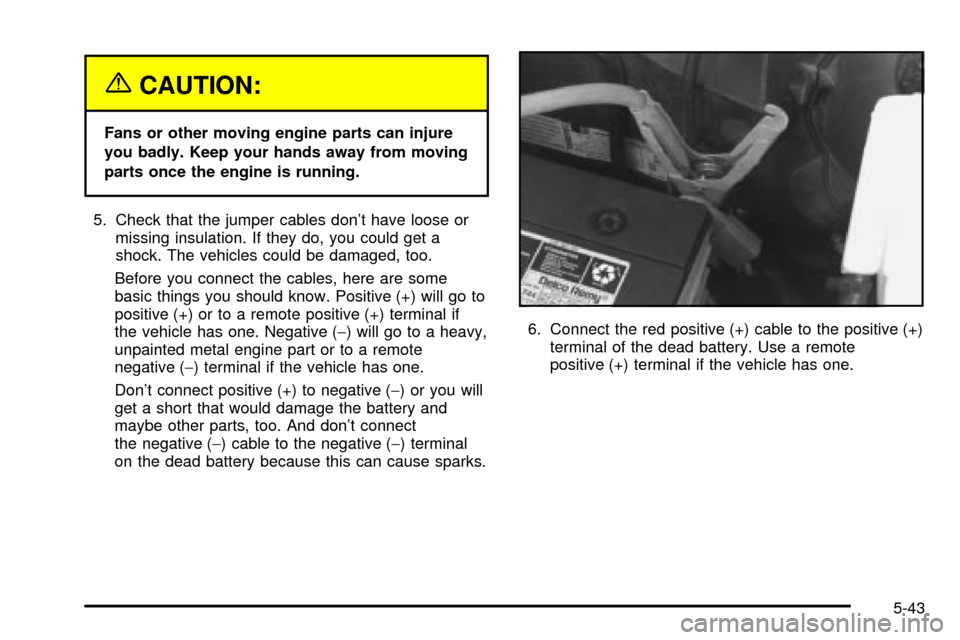
on the dead battery because this can cause sparks.6. Connect the red positive (+) cable to the positive (+)
terminal of the dead battery. Use a remote
positive (+) terminal if the vehicle has one.
5-43
Page 314 of 386
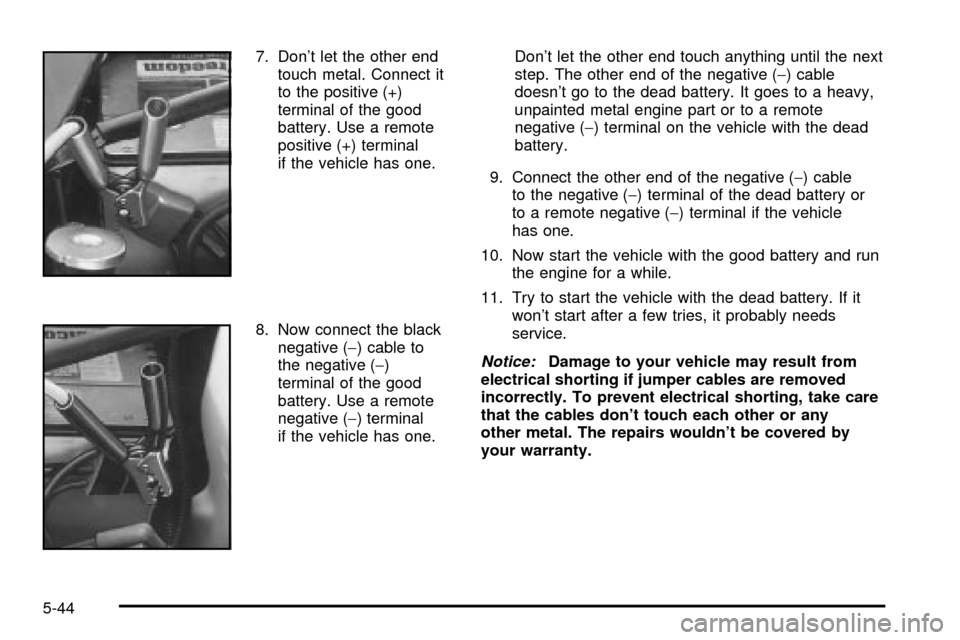
7. Don't let the other end
touch metal. Connect it
to the positive (+)
terminal of the good
battery. Use a remote
positive (+) terminal
if the vehicle has one.
8. Now connect the black
negative (-) cable to
the negative (-)
terminal of the good
battery. Use a remote
negative (-) terminal
if the vehicle has one.Don't let the other end touch anything until the next
step. The other end of the negative (-) cable
doesn't go to the dead battery. It goes to a heavy,
unpainted metal engine part or to a remote
negative (-) terminal on the vehicle with the dead
battery.
9. Connect the other end of the negative (-) cable
to the negative (-) terminal of the dead battery or
to a remote negative (-) terminal if the vehicle
has one.
10. Now start the vehicle with the good battery and run
the engine for a while.
11. Try to start the vehicle with the dead battery. If it
won't start after a few tries, it probably needs
service.
Notice:Damage to your vehicle may result from
electrical shorting if jumper cables are removed
incorrectly. To prevent electrical shorting, take care
that the cables don't touch each other or any
other metal. The repairs wouldn't be covered by
your warranty.
5-44
Page 315 of 386
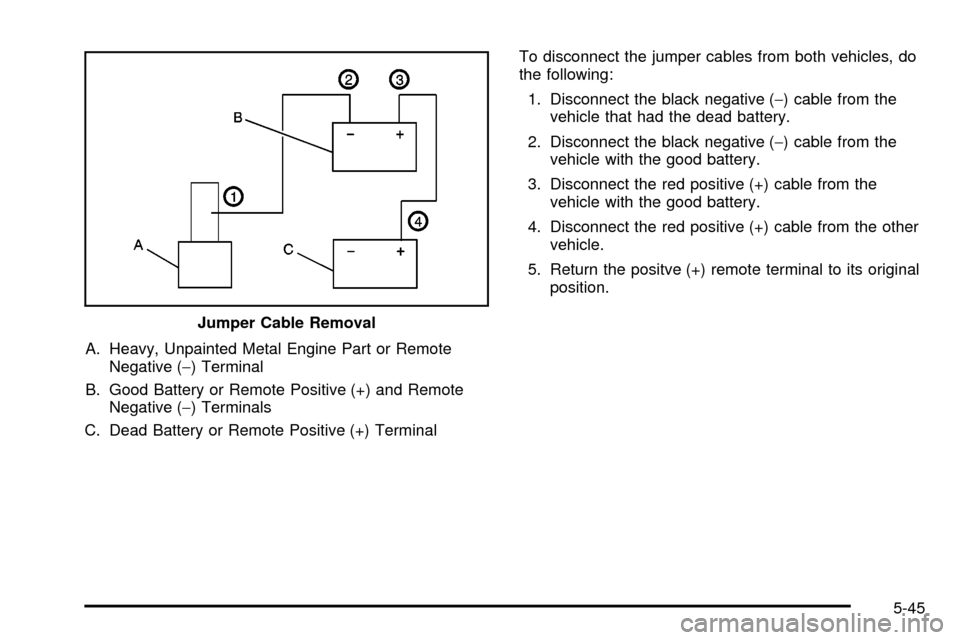
A. Heavy, Unpainted Metal Engine Part or Remote
Negative (-) Terminal
B. Good Battery or Remote Positive (+) and Remote
Negative (-) Terminals
C. Dead Battery or Remote Positive (+) TerminalTo disconnect the jumper cables from both vehicles, do
the following:
1. Disconnect the black negative (-) cable from the
vehicle that had the dead battery.
2. Disconnect the black negative (-) cable from the
vehicle with the good battery.
3. Disconnect the red positive (+) cable from the
vehicle with the good battery.
4. Disconnect the red positive (+) cable from the other
vehicle.
5. Return the positve (+) remote terminal to its original
position.
Jumper Cable Removal
5-45
Page 365 of 386
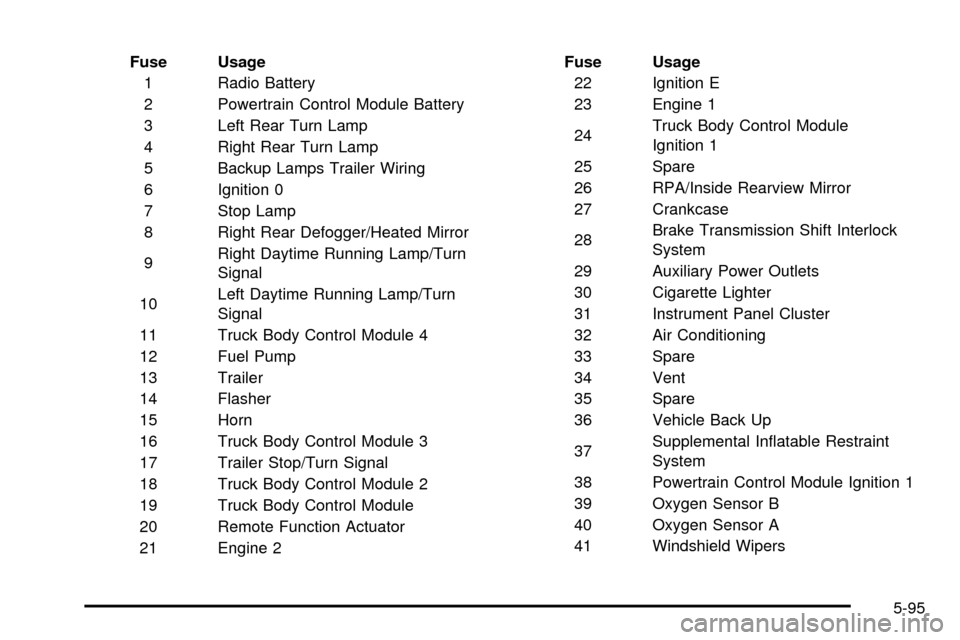
Fuse Usage
1 Radio Battery
2 Powertrain Control Module Battery
3 Left Rear Turn Lamp
4 Right Rear Turn Lamp
5 Backup Lamps Trailer Wiring
6 Ignition 0
7 Stop Lamp
8 Right Rear Defogger/Heated Mirror
9Right Daytime Running Lamp/Turn
Signal
10Left Daytime Running Lamp/Turn
Signal
11 Truck Body Control Module 4
12 Fuel Pump
13 Trailer
14 Flasher
15 Horn
16 Truck Body Control Module 3
17 Trailer Stop/Turn Signal
18 Truck Body Control Module 2
19 Truck Body Control Module
20 Remote Function Actuator
21 Engine 2Fuse Usage
22 Ignition E
23 Engine 1
24Truck Body Control Module
Ignition 1
25 Spare
26 RPA/Inside Rearview Mirror
27 Crankcase
28Brake Transmission Shift Interlock
System
29 Auxiliary Power Outlets
30 Cigarette Lighter
31 Instrument Panel Cluster
32 Air Conditioning
33 Spare
34 Vent
35 Spare
36 Vehicle Back Up
37Supplemental In¯atable Restraint
System
38 Powertrain Control Module Ignition 1
39 Oxygen Sensor B
40 Oxygen Sensor A
41 Windshield Wipers
5-95
Page 372 of 386
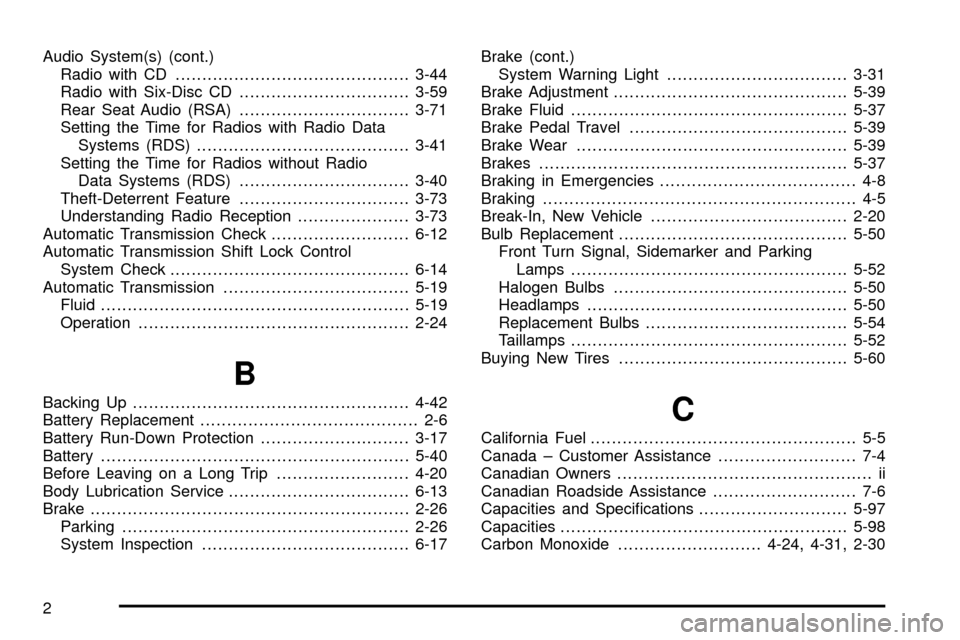
Audio System(s) (cont.)
Radio with CD............................................3-44
Radio with Six-Disc CD................................3-59
Rear Seat Audio (RSA)................................3-71
Setting the Time for Radios with Radio Data
Systems (RDS)........................................3-41
Setting the Time for Radios without Radio
Data Systems (RDS)................................3-40
Theft-Deterrent Feature................................3-73
Understanding Radio Reception.....................3-73
Automatic Transmission Check..........................6-12
Automatic Transmission Shift Lock Control
System Check.............................................6-14
Automatic Transmission...................................5-19
Fluid..........................................................5-19
Operation...................................................2-24
B
Backing Up....................................................4-42
Battery Replacement......................................... 2-6
Battery Run-Down Protection............................3-17
Battery..........................................................5-40
Before Leaving on a Long Trip.........................4-20
Body Lubrication Service..................................6-13
Brake............................................................2-26
Parking......................................................2-26
System Inspection.......................................6-17Brake (cont.)
System Warning Light..................................3-31
Brake Adjustment............................................5-39
Brake Fluid....................................................5-37
Brake Pedal Travel.........................................5-39
Brake Wear...................................................5-39
Brakes..........................................................5-37
Braking in Emergencies..................................... 4-8
Braking........................................................... 4-5
Break-In, New Vehicle.....................................2-20
Bulb Replacement...........................................5-50
Front Turn Signal, Sidemarker and Parking
Lamps....................................................5-52
Halogen Bulbs............................................5-50
Headlamps.................................................5-50
Replacement Bulbs......................................5-54
Taillamps....................................................5-52
Buying New Tires...........................................5-60C
California Fuel.................................................. 5-5
Canada ± Customer Assistance.......................... 7-4
Canadian Owners................................................ ii
Canadian Roadside Assistance........................... 7-6
Capacities and Speci®cations............................5-97
Capacities......................................................5-98
Carbon Monoxide...........................4-24, 4-31, 2-30
2
Page 375 of 386
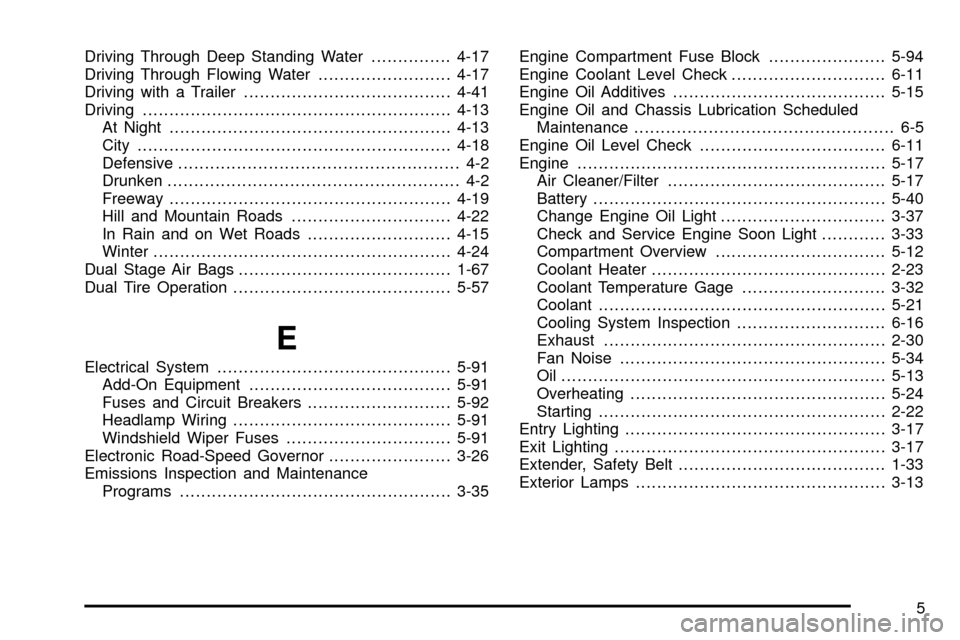
Driving Through Deep Standing Water...............4-17
Driving Through Flowing Water.........................4-17
Driving with a Trailer.......................................4-41
Driving..........................................................4-13
At Night.....................................................4-13
City...........................................................4-18
Defensive..................................................... 4-2
Drunken....................................................... 4-2
Freeway.....................................................4-19
Hill and Mountain Roads..............................4-22
In Rain and on Wet Roads...........................4-15
Winter........................................................4-24
Dual Stage Air Bags........................................1-67
Dual Tire Operation.........................................5-57
E
Electrical System............................................5-91
Add-On Equipment......................................5-91
Fuses and Circuit Breakers...........................5-92
Headlamp Wiring.........................................5-91
Windshield Wiper Fuses...............................5-91
Electronic Road-Speed Governor.......................3-26
Emissions Inspection and Maintenance
Programs...................................................3-35Engine Compartment Fuse Block......................5-94
Engine Coolant Level Check.............................6-11
Engine Oil Additives........................................5-15
Engine Oil and Chassis Lubrication Scheduled
Maintenance................................................. 6-5
Engine Oil Level Check...................................6-11
Engine..........................................................5-17
Air Cleaner/Filter.........................................5-17
Battery.......................................................5-40
Change Engine Oil Light...............................3-37
Check and Service Engine Soon Light............3-33
Compartment Overview................................5-12
Coolant Heater............................................2-23
Coolant Temperature Gage...........................3-32
Coolant......................................................5-21
Cooling System Inspection............................6-16
Exhaust.....................................................2-30
Fan Noise..................................................5-34
Oil .............................................................5-13
Overheating................................................5-24
Starting......................................................2-22
Entry Lighting.................................................3-17
Exit Lighting...................................................3-17
Extender, Safety Belt.......................................1-33
Exterior Lamps...............................................3-13
5