Page 290 of 368

If you need to replace any of your wheels, wheel bolts
or wheel nuts, replace them only with new GM
original equipment parts. This way, you will be sure to
have the right wheel, wheel bolts and wheel nuts
for your vehicle.
{CAUTION:
Using the wrong replacement wheels, wheel
bolts or wheel nuts on your vehicle can be
dangerous. It could affect the braking and
handling of your vehicle, make your tires lose
air and make you lose control. You could have
a collision in which you or others could be
injured. Always use the correct wheel, wheel
bolts and wheel nuts for replacement.
Notice:The wrong wheel can also cause problems
with bearing life, brake cooling, speedometer or
odometer calibration, headlamp aim, bumper height,
vehicle ground clearance and tire clearance to the
body and chassis.
{CAUTION:
Rust or dirt on a wheel, or on the parts to
which it is fastened, can make wheel nuts
become loose after a time. The wheel could
come off and cause a crash. When you change
a wheel, remove any rust or dirt from places
where the wheel attaches to the vehicle. In an
emergency, you can use a cloth or a paper
towel to do this; but be sure to use a scraper
or wire brush later, if you need to, to get all the
rust or dirt off.
{CAUTION:
Never use oil or grease on studs or the
threads of the wheel nuts. If you do, the wheel
nuts might come loose and the wheel could
fall off, causing a crash.
5-62
Page 292 of 368
Tire Chains
{CAUTION:
Don't use tire chains. There's not enough
clearance. Tire chains used on a vehicle
without the proper amount of clearance can
cause damage to the brakes, suspension or
other vehicle parts. The area damaged by the
tire chains could cause you to lose control of
your vehicle and you or others may be injured
in a crash. Use another type of traction device
only if its manufacturer recommends it for use
on your vehicle and tire size combination and
road conditions. Follow that manufacturer's
instructions. To help avoid damage to your
vehicle, drive slowly, readjust or remove the
device if it's contacting your vehicle, and don't
spin your wheels. If you do ®nd traction
devices that will ®t, install them on the
rear tires.
Lifting Your Vehicle
{CAUTION:
Lifting a vehicle can cause an injury. The
vehicle can slip off the jack and roll over you
or other people. You and they could be badly
injured. Find a level place to lift your vehicle.
To help prevent the vehicle from moving:
1. Set the parking brake ®rmly.
2. Put an automatic transmission shift lever
in PARK (P), or shift a manual
transmission to FIRST (1) or
REVERSE (R).
3. Turn off the engine.
To be even more certain the vehicle won't
move, you can put blocks in front of and
behind the wheels.
5-64
Page 294 of 368
Lifting From the Front
The front lifting point can be accessed for either the
driver's or passenger's side of the vehicle, behind the
front tires.
1. Locate the lifting point (B) on either side of your
vehicle to jack the vehicle according to the
illustration shown.
2. Be sure to place a block or pad between the jack
and the vehicle.
3. Lift the vehicle with the jack, making sure the jack
spans at least two of the crossmember ribs (A).
5-66
Page 296 of 368

If a Tire Goes Flat
Your Corvette has no spare tire, no tire changing
equipment and no place to store a tire.
It's unusual for a tire to ªblow outº while you're driving,
especially if you maintain your tires properly. See
Tires on page 5-54. If air goes out of a tire, it's much
more likely to leak out slowly.
If your vehicle has Extended Mobility Tires (EMT), you
won't need to stop on the side of the road to change
a ¯at tire. EMT tires can operate effectively with no air
pressure. If you drive on a de¯ated EMT for 50 miles
(80 km) or less and at speeds of 55 mph (90 km/h) or
less, there is a good chance that the tire can be
repaired. Contact the nearest authorized Chevrolet or
Goodyear EMT servicing facility, as soon as possible, to
have the ¯at tire inspected and repaired or replaced.
For more information, see
Extended Mobility Tires
(Except Z06) on page 5-54.
{CAUTION:
Special tools and procedures are required to
service an Extended Mobility Tire (EMT). If
these special tools and procedures aren't used
you or others could be injured and your
vehicle could be damaged. Always be sure the
proper tools and procedures, as described in
the service manual, are used.
To order a service manual, see
Service Publications
Ordering Information on page 7-10.
5-68
Page 297 of 368

Z06 models do not have Extended Mobility Tires. If a
Z06 model tire goes ¯at, avoid further tire and wheel
damage by driving slowly to a level place and stopping.
Then do this:
1. Turn on the hazard warning ¯ashers.
2. Set the parking brake ®rmly.
3. Put the shift lever (manual transmission) in
REVERSE (R).
4. Turn off the engine.
5. Inspect the ¯at tire.
If the tire has been separated from the wheel or has
damaged sidewalls or large tears that allow rapid
air loss, call a tire repair facility. See
Roadside
Assistance Program on page 7-6.If the ¯at tire is due to a slow leak caused by a nail or
other similar road hazard, the tire in¯ator kit may
be used to repair the damaged tire temporarily. The kit
uses a liquid tire sealant to seal small punctures in
the tread area of the tire. The ¯at tire is then in¯ated to
at least 26 psi (179 kPa) and driven to evenly distribute
the tire sealant. The tire pressure is checked after
driving for a maximum of 10 minutes to see if the slow
leak has been stopped. If the tire pressure is 19 psi
(131 kPa) or more, in¯ate the tire up to the standard
operating pressure as shown on the Tire Pressure Label
found on the rear edge of the driver's door. See
In¯ation -- Tire Pressure on page 5-56.
You should have the damaged tire repaired as soon as
possible. The tire sealant is a temporary repair only.
For more information regarding the tire in¯ator kit
see ªTire In¯ator Kit (Z06 Only)º following this section.
Notice:If the tire pressure has dropped below
19 psi (131 kPa), the vehicle should not be driven
further. Damage to the tire may be severe and
the sealant will not be effective. Contact Roadside
Assistance. See ªRoadside Assistanceº in the Index.
5-69
Page 298 of 368
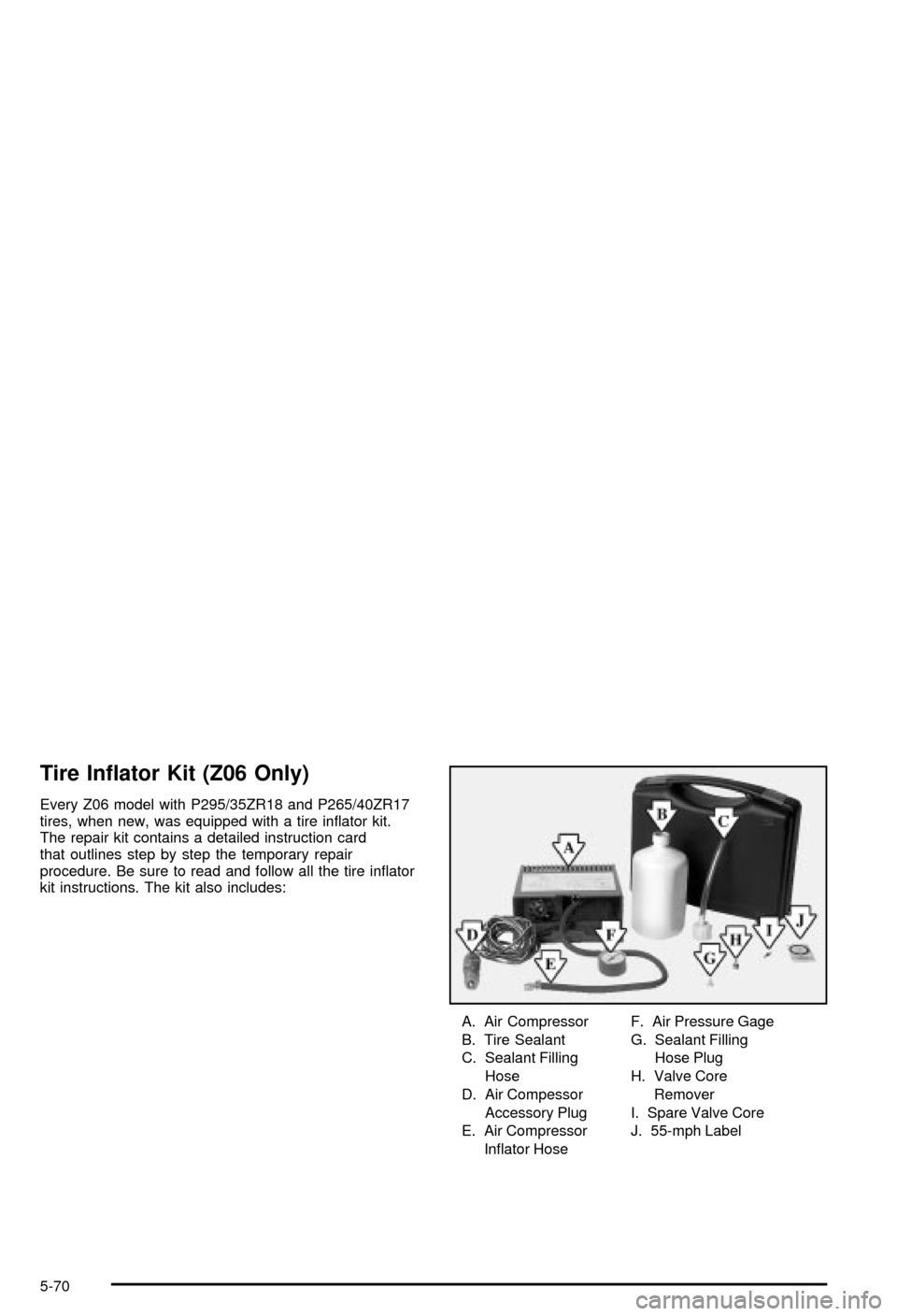
Tire In¯ator Kit (Z06 Only)
Every Z06 model with P295/35ZR18 and P265/40ZR17
tires, when new, was equipped with a tire in¯ator kit.
The repair kit contains a detailed instruction card
that outlines step by step the temporary repair
procedure. Be sure to read and follow all the tire in¯ator
kit instructions. The kit also includes:
A. Air Compressor
B. Tire Sealant
C. Sealant Filling
Hose
D. Air Compessor
Accessory Plug
E. Air Compressor
In¯ator HoseF. Air Pressure Gage
G. Sealant Filling
Hose Plug
H. Valve Core
Remover
I. Spare Valve Core
J. 55-mph Label
5-70
Page 299 of 368

Tire Sealant
The kit contains a liquid sealant that when injected into
a ¯at tire, may temporarily repair nail holes or cuts
in the tread area of the tire. The tire sealant cannot
repair tire damage caused while driving on a ¯at tire or
a tire that has had a ªblow outº or a tire that has
punctures in the sidewall areas. The tire sealant solution
is a one-time use application for one tire only. Check
the tire sealant expiration date; the sealant may not be
as effective beyond the expiration date. The tire
sealant can be peeled off easily after drying.
Notice:Do not use a tire sealant if your vehicle is
equipped with Extended Mobility Tires or tire
pressure monitors. The tire sealant can damage tire
pressure monitor sensors. See ªExtended Mobility
Tiresº in the Index.
Air Compressor
The air compressor included in the tire in¯ator kit, was
designed exclusively for the Z06 Model equipped
with P295/35ZR18 and P265/40ZR17 tires. After the
sealant has been injected into the ¯at tire, use the
air compressor to in¯ate the tire to at least 26 psi
(179 kPa). Instructions for connecting and using the air
compressor are located on the air compressor.A. In¯ating Hose
B. Air Pressure GageC. ON/OFF Switch
D. Air Compressor
Plug
Notice:The car engine must be running to avoid
draining the battery while running the air
compressor.
Follow the proper steps to be sure your vehicle won't
move. See
Parking Your Vehicle (Manual Transmission)
on page 2-34.
5-71
Page 306 of 368

Cleaning the Outside of Your
Vehicle
The paint ®nish on your vehicle provides beauty, depth
of color, gloss retention and durability.
Washing Your Vehicle
The best way to preserve your vehicle's ®nish is to keep
it clean by washing it often with lukewarm or cold water.
Don't wash your vehicle in the direct rays of the sun.
Use a car washing soap. Don't use strong soaps
or chemical detergents. Be sure to rinse the vehicle
well, removing all soap residue completely. You can get
GM-approved cleaning products from your dealer.
See
Vehicle Care/Appearance Materials on page 5-82.
Don't use cleaning agents that are petroleum based,
or that contain acid or abrasives. All cleaning agents
should be ¯ushed promptly and not allowed to dry on the
surface, or they could stain. Dry the ®nish with a soft,
clean chamois or an all-cotton towel to avoid surface
scratches and water spotting.
High pressure car washes may cause water to enter
your vehicle.
Notice:Conveyor systems on some automatic car
washes may damage your vehicle. They may not
have enough clearance for the undercarriage or for
the wide rear tires.
Check with the manager before using a car wash.
Cleaning Exterior Lamps/Lenses
Use only lukewarm or cold water, a soft cloth and a car
washing soap to clean exterior lamps and lenses.
Follow instructions under ªWashing Your Vehicle.º
Finish Care
Occasional waxing or mild polishing of your vehicle by
hand may be necessary to remove residue from the
paint ®nish. You can get GM-approved cleaning products
from your dealer. See
Vehicle Care/Appearance
Materials on page 5-82.
If your vehicle has a ªbasecoat/clearcoatº paint ®nish.
The clearcoat gives more depth and gloss to the colored
basecoat. Always use waxes and polishes that are
non-abrasive and made for a basecoat/clearcoat
paint ®nish.
Notice:Machine compounding or aggressive
polishing on a basecoat/clearcoat paint ®nish may
dull the ®nish or leave swirl marks.
Foreign materials such as calcium chloride and other
salts, ice melting agents, road oil and tar, tree sap, bird
droppings, chemicals from industrial chimneys, etc.,
can damage your vehicle's ®nish if they remain
on painted surfaces. Wash the vehicle as soon as
possible. If necessary, use non-abrasive cleaners that
are marked safe for painted surfaces to remove
foreign matter.
5-78