Page 258 of 368
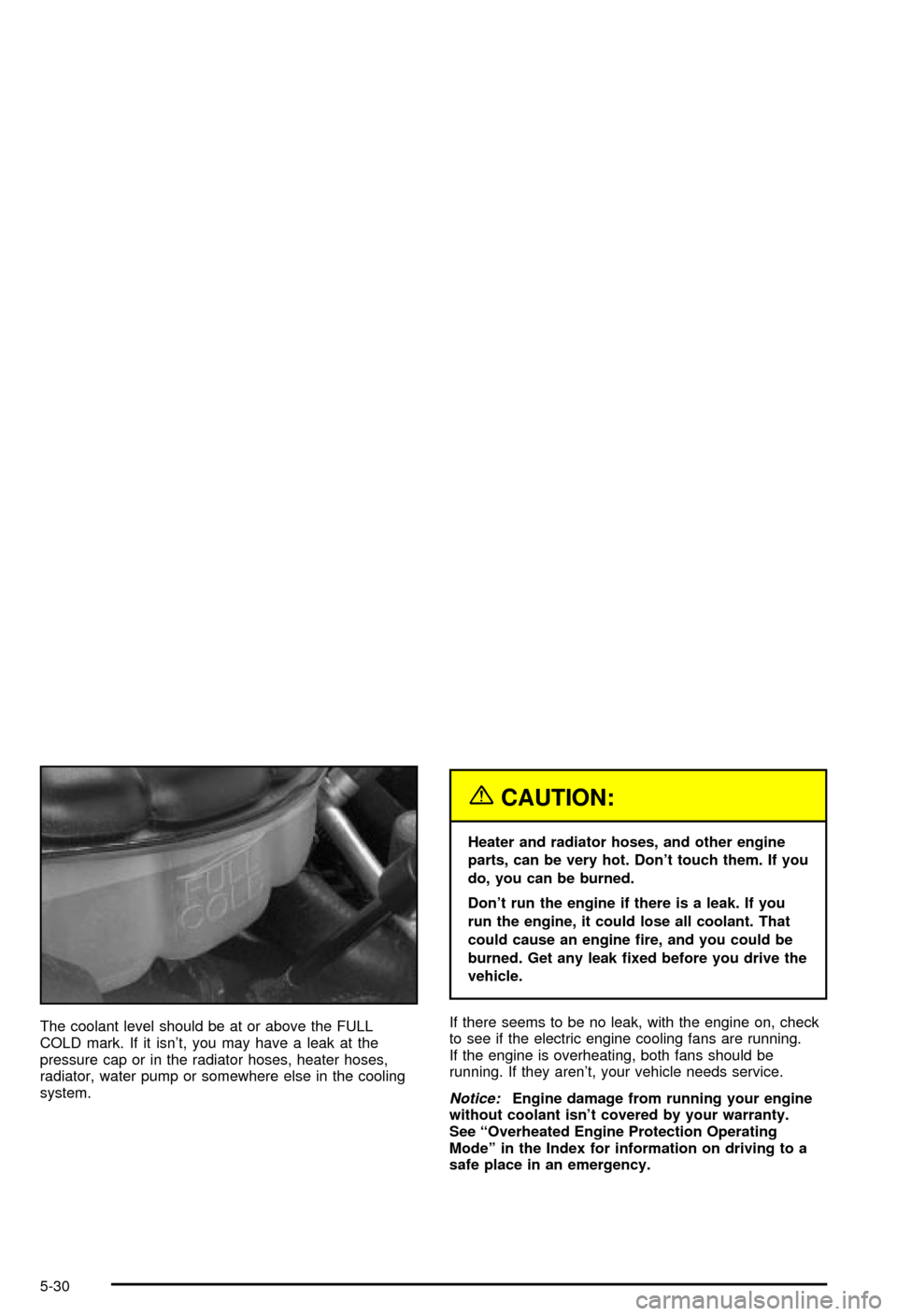
The coolant level should be at or above the FULL
COLD mark. If it isn't, you may have a leak at the
pressure cap or in the radiator hoses, heater hoses,
radiator, water pump or somewhere else in the cooling
system.
{CAUTION:
Heater and radiator hoses, and other engine
parts, can be very hot. Don't touch them. If you
do, you can be burned.
Don't run the engine if there is a leak. If you
run the engine, it could lose all coolant. That
could cause an engine ®re, and you could be
burned. Get any leak ®xed before you drive the
vehicle.
If there seems to be no leak, with the engine on, check
to see if the electric engine cooling fans are running.
If the engine is overheating, both fans should be
running. If they aren't, your vehicle needs service.
Notice:Engine damage from running your engine
without coolant isn't covered by your warranty.
See ªOverheated Engine Protection Operating
Modeº in the Index for information on driving to a
safe place in an emergency.
5-30
Page 259 of 368
Notice:When adding coolant, it is important that
you use only DEX-COOLž(silicate-free) coolant.
If coolant other than DEX-COOLžis added to
the system, premature engine, heater core or
radiator corrosion may result. In addition, the engine
coolant will require change sooner Ð at 30,000 miles
(50 000 km) or 24 months, whichever occurs ®rst.
Damage caused by the use of coolant other
than DEX-COOL
žis not covered by your new vehicle
warranty.
How to Add Coolant to the Coolant
Surge Tank
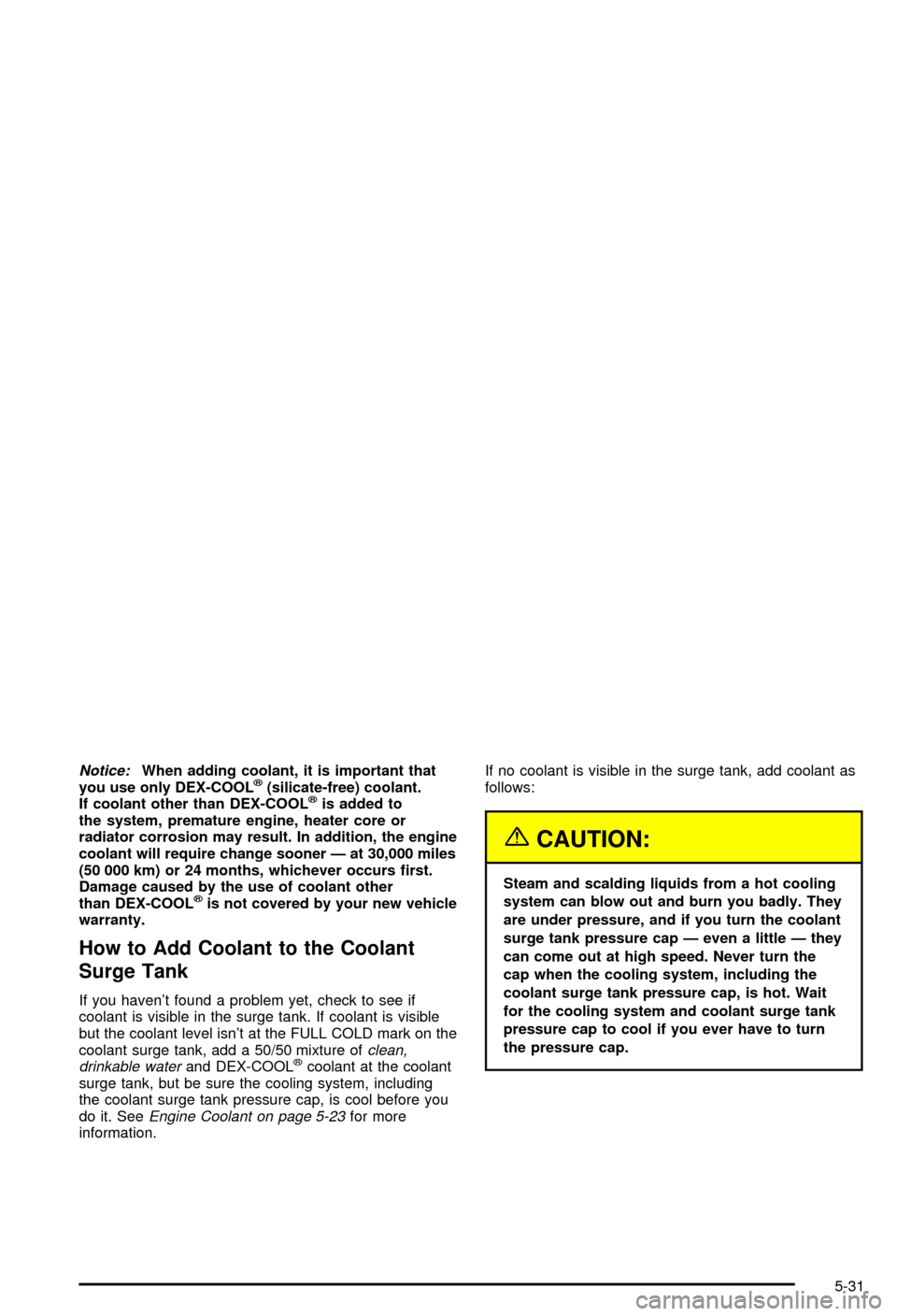
If you haven't found a problem yet, check to see if
coolant is visible in the surge tank. If coolant is visible
but the coolant level isn't at the FULL COLD mark on the
coolant surge tank, add a 50/50 mixture of
clean,
drinkable waterand DEX-COOLžcoolant at the coolant
surge tank, but be sure the cooling system, including
the coolant surge tank pressure cap, is cool before you
do it. See
Engine Coolant on page 5-23for more
information.If no coolant is visible in the surge tank, add coolant as
follows:
{CAUTION:
Steam and scalding liquids from a hot cooling
system can blow out and burn you badly. They
are under pressure, and if you turn the coolant
surge tank pressure cap Ð even a little Ð they
can come out at high speed. Never turn the
cap when the cooling system, including the
coolant surge tank pressure cap, is hot. Wait
for the cooling system and coolant surge tank
pressure cap to cool if you ever have to turn
the pressure cap.
5-31
Page 261 of 368
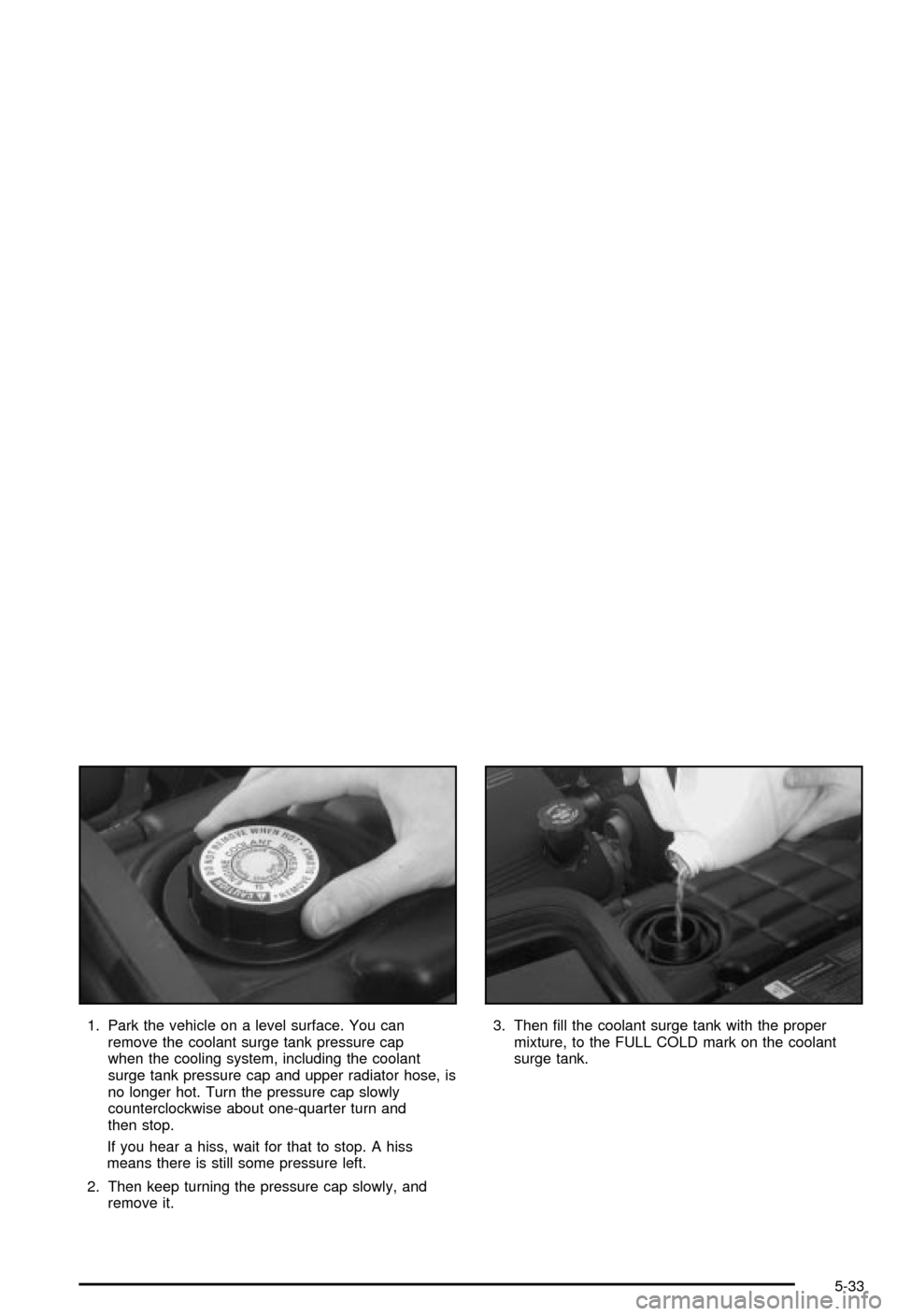
1. Park the vehicle on a level surface. You can
remove the coolant surge tank pressure cap
when the cooling system, including the coolant
surge tank pressure cap and upper radiator hose, is
no longer hot. Turn the pressure cap slowly
counterclockwise about one-quarter turn and
then stop.
If you hear a hiss, wait for that to stop. A hiss
means there is still some pressure left.
2. Then keep turning the pressure cap slowly, and
remove it.3. Then ®ll the coolant surge tank with the proper
mixture, to the FULL COLD mark on the coolant
surge tank.
5-33
Page 262 of 368
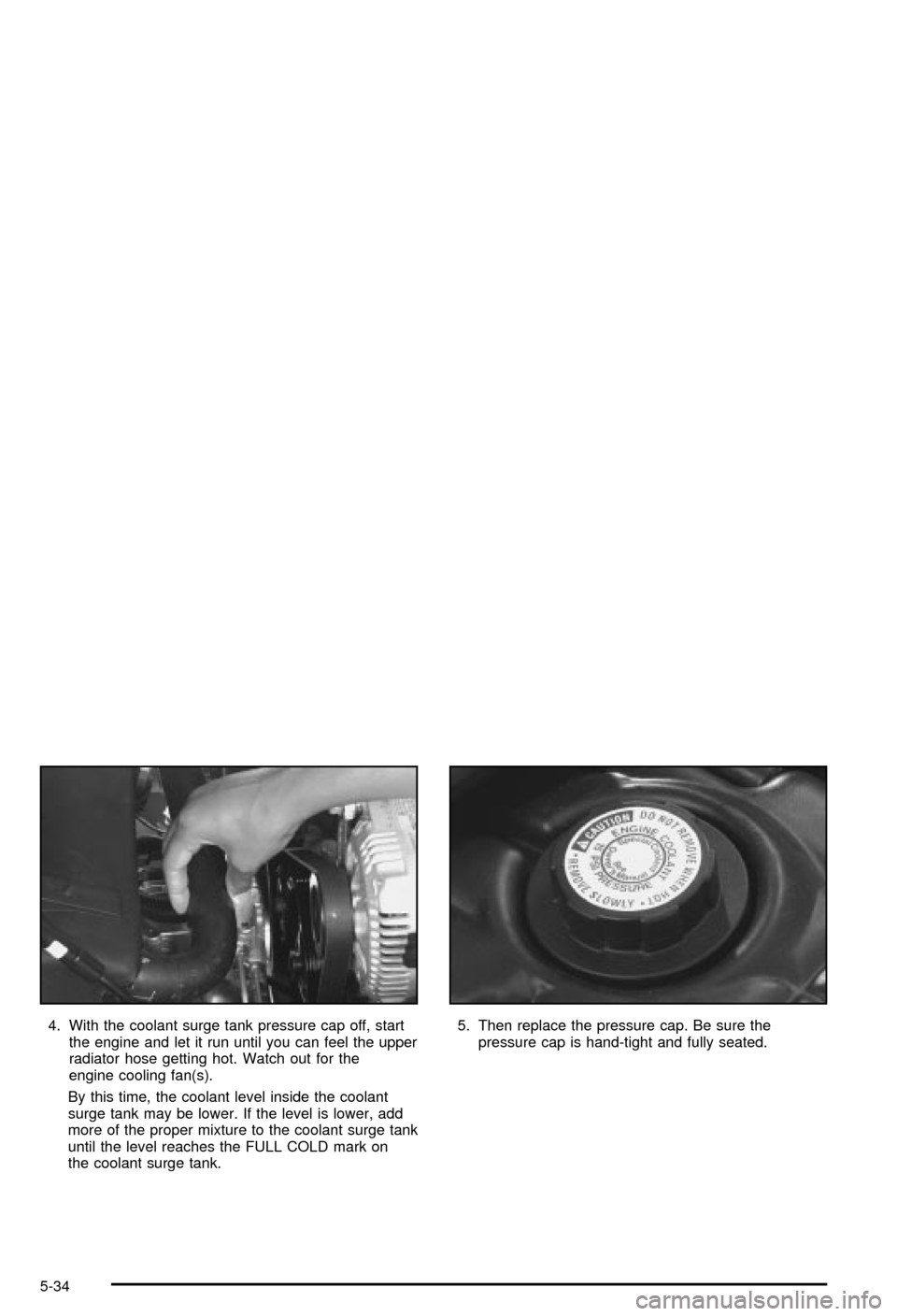
4. With the coolant surge tank pressure cap off, start
the engine and let it run until you can feel the upper
radiator hose getting hot. Watch out for the
engine cooling fan(s).
By this time, the coolant level inside the coolant
surge tank may be lower. If the level is lower, add
more of the proper mixture to the coolant surge tank
until the level reaches the FULL COLD mark on
the coolant surge tank.5. Then replace the pressure cap. Be sure the
pressure cap is hand-tight and fully seated.
5-34
Page 332 of 368

Part B: Owner Checks and Services
Listed in this part are owner checks and services
which should be performed at the intervals speci®ed to
help ensure the safety, dependability and emission
control performance of your vehicle.
Be sure any necessary repairs are completed at once.
Whenever any ¯uids or lubricants are added to your
vehicle, make sure they are the proper ones, as shown
in Part D.
At Each Fuel Fill
It is important for you or a service station attendant to
perform these underhood checks at each fuel ®ll.
Engine Oil Level Check
Check the engine oil level and add the proper oil if
necessary. SeeEngine Oil on page 5-13for further
details.
Engine Coolant Level Check
Check the engine coolant level and add DEX-COOLž
coolant mixture if necessary. SeeEngine Coolant
on page 5-23for further details.
Windshield Washer Fluid Level Check
Check the windshield washer ¯uid level in the windshield
washer tank and add the proper ¯uid if necessary.
See
Windshield Washer Fluid on page 5-36for further
details.
At Least Once a Month
Tire In¯ation Check
Make sure tires are in¯ated to the correct pressures.
SeeTires on page 5-54for further details.
Cassette Tape Player Service
Clean cassette tape player. Cleaning should be done
every 50 hours of tape play. SeeAudio System(s)
on page 3-62for further details.
Power Antenna Service
Clean power antenna mast. SeeAudio System(s) on
page 3-62for further details.
6-8
Page 359 of 368

Electrical System (cont.)
Power Windows and Other Power Options......5-85
Windshield Wiper Fuses...............................5-85
Emergency Trunk Release Handle
(Convertible Only)........................................2-13
Emissions Inspection and Maintenance
Programs...................................................3-40
Engine Accessory Drive Belt Routing.................5-95
Engine Compartment Fuse Block......................5-89
Engine Coolant Level Check.............................. 6-8
Engine Oil Additives........................................5-16
Engine Oil Level Check..................................... 6-8
Engine Oil Scheduled Maintenance..................... 6-5
Engine..........................................................5-18
Air Cleaner/Filter.........................................5-18
Battery.......................................................5-40
Check and Service Engine Soon Light............3-38
Compartment Overview................................5-12
Coolant Heater............................................2-23
Coolant Temperature Gage...........................3-38
Coolant......................................................5-23
Cooling System Inspection............................6-13
Exhaust.....................................................2-35
Oil Pressure Gage.......................................3-41
Oil .............................................................5-13
Overheating................................................5-26
Starting......................................................2-21
Exit/Entry Lighting...........................................3-16
Express-Down Window....................................2-15Extended Mobility Tires....................................5-54
Extender, Safety Belt.......................................1-20
Exterior Lamps...............................................3-12
F
Filter.............................................................5-18
Engine Air Cleaner......................................5-18
Finding a Station....................................3-63, 3-67
Finish Care....................................................5-78
Finish Damage...............................................5-81
Fixed Mast Antenna........................................3-79
Flash-to-Pass................................................... 3-7
Flat Tire........................................................5-68
Floor Mats.....................................................2-40
Fluid.............................................................5-20
Automatic Transmission................................5-20
Manual Transmission....................................5-20
Power Steering...........................................5-35
Windshield Washer......................................5-36
FM ...............................................................3-77
Fog Lamps....................................................3-14
Footnotes........................................................ 6-5
Front Air Dam................................................2-19
Fuel............................................................... 5-4
Additives...................................................... 5-6
California Fuel.............................................. 5-5
Filling a Portable Fuel Container..................... 5-9
Filling Your Tank........................................... 5-7
5