2003 CHEVROLET CORVETTE clutch
[x] Cancel search: clutchPage 170 of 368

COOLANT OVER TEMP:You will hear four chimes
and the CHECK GAGES telltale will come on when this
message is displayed. To acknowledge the warning,
press the RESET button. After you press the RESET
button, a message will be displayed and you will hear a
chime every minute until this condition changes. If
you do not press RESET, the message will remain on
the digital display until the condition changes.
If the engine coolant exceeds 255ÉF (124ÉC), this
message is displayed. If you have been operating your
vehicle under normal driving conditions, you should
pull off the road, stop your vehicle and turn off the
engine as soon as possible. You can monitor the coolant
temperature with the GAGES button on the DIC or
the engine coolant gage on the instrument panel cluster.
See
Engine Overheating on page 5-26.
REDUCE ENGINE RPM:You will hear four chimes
when this message is displayed. To acknowledge
the warning, press the RESET button. After you press
the RESET button, a message will be displayed and you
will hear a chime every minute until this condition
changes. If you do not press RESET, the message will
remain on the digital display until the condition
changes.
If the engine oil temperature exceeds 320ÉF (160ÉC),
this message is displayed. You should check the engine
coolant temperature and engine oil level. If your
engine is too hot, see
Engine Overheating on page 5-26.Your vehicle may need service, so see your dealer. You
can monitor the oil temperature with the GAGES
button on the DIC.
HIGH TRANS TEMP (Automatic Transmission
Only):You will hear four chimes when this message is
displayed. To acknowledge this warning, press the
RESET button. After you press the RESET button, the
message will be displayed every 10 minutes until
the condition changes. If you do not press RESET, the
message remains on the display until the condition
changes.
If the transmission ¯uid temperature rises above 270ÉF
(132ÉC) or rises rapidly, this message is displayed.
The transmission may shift gears or apply the torque
converter clutch to reduce the ¯uid temperature. Driving
aggressively or driving on long hills can cause the
transmission ¯uid temperature to be higher than normal.
If this message appears, you may continue to drive at
a slower speed. You should also monitor the
transmission ¯uid temperature and allow it to cool to at
least 230ÉF (110ÉC). The transmission ¯uid temperature
can be monitored with the GAGES button on the
DIC. See
Automatic Transmission Fluid on page 5-20.
You should also check the engine coolant temperature.
If it is also hot, see
Engine Overheating on page 5-26.
If the HIGH TRANS TEMP message is displayed during
normal vehicle operation on ¯at roads, your vehicle
may need service. See your dealer for an inspection.
3-58
Page 229 of 368

Service............................................................5-3
Doing Your Own Service Work.........................5-3
Adding Equipment to the Outside of Your
Vehicle......................................................5-4
Fuel................................................................5-4
Gasoline Octane............................................5-4
Gasoline Speci®cations....................................5-5
California Fuel...............................................5-5
Additives.......................................................5-6
Fuels in Foreign Countries...............................5-6
Filling Your Tank............................................5-7
Filling a Portable Fuel Container.......................5-9
Checking Things Under
the Hood....................................................5-10
Hood Release..............................................5-11
Engine Compartment Overview.......................5-12
Engine Oil...................................................5-13
Engine Air Cleaner/Filter................................5-18
Automatic Transmission Fluid.........................5-20
Manual Transmission Fluid.............................5-20
Hydraulic Clutch...........................................5-22
Engine Coolant.............................................5-23
Coolant Surge Tank Pressure Cap..................5-26
Engine Overheating.......................................5-26
Cooling System............................................5-29
Power Steering Fluid.....................................5-35Windshield Washer Fluid................................5-36
Brakes........................................................5-37
Battery........................................................5-40
Jump Starting...............................................5-41
Rear Axle.......................................................5-46
Bulb Replacement..........................................5-47
Halogen Bulbs..............................................5-47
Headlamps..................................................5-47
Taillamps and Turn Signal Lamps...................5-49
Back-Up Lamps............................................5-51
Replacement Bulbs.......................................5-51
Windshield Wiper Blade Replacement..............5-51
Tires..............................................................5-54
Extended Mobility Tires (Except Z06)...............5-54
In¯ation -- Tire Pressure................................5-56
Tire Pressure Monitor System (Except Z06)......5-57
Tire Rotation................................................5-58
Buying New Tires.........................................5-59
Uniform Tire Quality Grading..........................5-60
Wheel Alignment and Tire Balance..................5-61
Wheel Replacement......................................5-61
Tire Chains..................................................5-64
Lifting Your Vehicle.......................................5-64
If a Tire Goes Flat........................................5-68
Tire In¯ator Kit (Z06 Only).............................5-70
Section 5 Service and Appearance Care
5-1
Page 241 of 368

A. Coolant Surge Tank and Pressure Cap
B. Battery
C. Engine Oil Dipstick
D. Engine Oil Fill Cap
E. Engine Air Cleaner/Filter
F. Power Steering Fluid Reservoir
G. Brake Fluid Reservoir
H. Clutch Master Cylinder Reservoir
I. Windshield Washer Fluid Reservoir
Engine Oil
If the LOW OIL LEVEL message on the Driver
Information Center comes on, it means you need to
check your engine oil level right away. For more
information, see
Driver Information Center (DIC) on
page 3-44.
You should check your engine oil level regularly; this is
an added reminder.
Checking Engine Oil
It's a good idea to check your engine oil level every
time you get fuel. In order to get an accurate reading,
the oil must be warm and the vehicle must be on
level ground.
The engine oil dipstick
handle is a yellow ring
located near the coolant
surge tank. See
Engine
Compartment Overview on
page 5-12
for more
information on location.
Turn off the engine and give the oil a few minutes to
drain back into the oil pan. If you don't, the oil dipstick
might not show the actual level.
Pull out the dipstick and clean it with a paper towel or a
cloth, then push it back in all the way. Remove it
again, keeping the tip down.
5-13
Page 250 of 368
How to Add Fluid
Here's how to add ¯uid. Refer to the Maintenance
Schedule to determine what kind of ¯uid to use. See
Part D: Recommended Fluids and Lubricants on
page 6-14.
1. Remove the ®ller plug.
2. Add ¯uid at the ®ller plug hole. Add only enough
¯uid to bring the ¯uid level up to the bottom of the
®ller plug hole.
3. Install the ®ller plug. Be sure the plug is fully
seated.
4. Tighten the plug to 20 lb ft (27Y).
Hydraulic Clutch
The hydraulic clutch linkage in your vehicle is
self-adjusting. The master cylinder reservoir is ®lled with
hydraulic ¯uid.
It is not necessary to regularly check the ¯uid unless
you suspect there is a leak in the system. Adding ¯uid
won't correct a leak.
A ¯uid loss in this system could indicate a problem.
Have the system inspected and repaired.
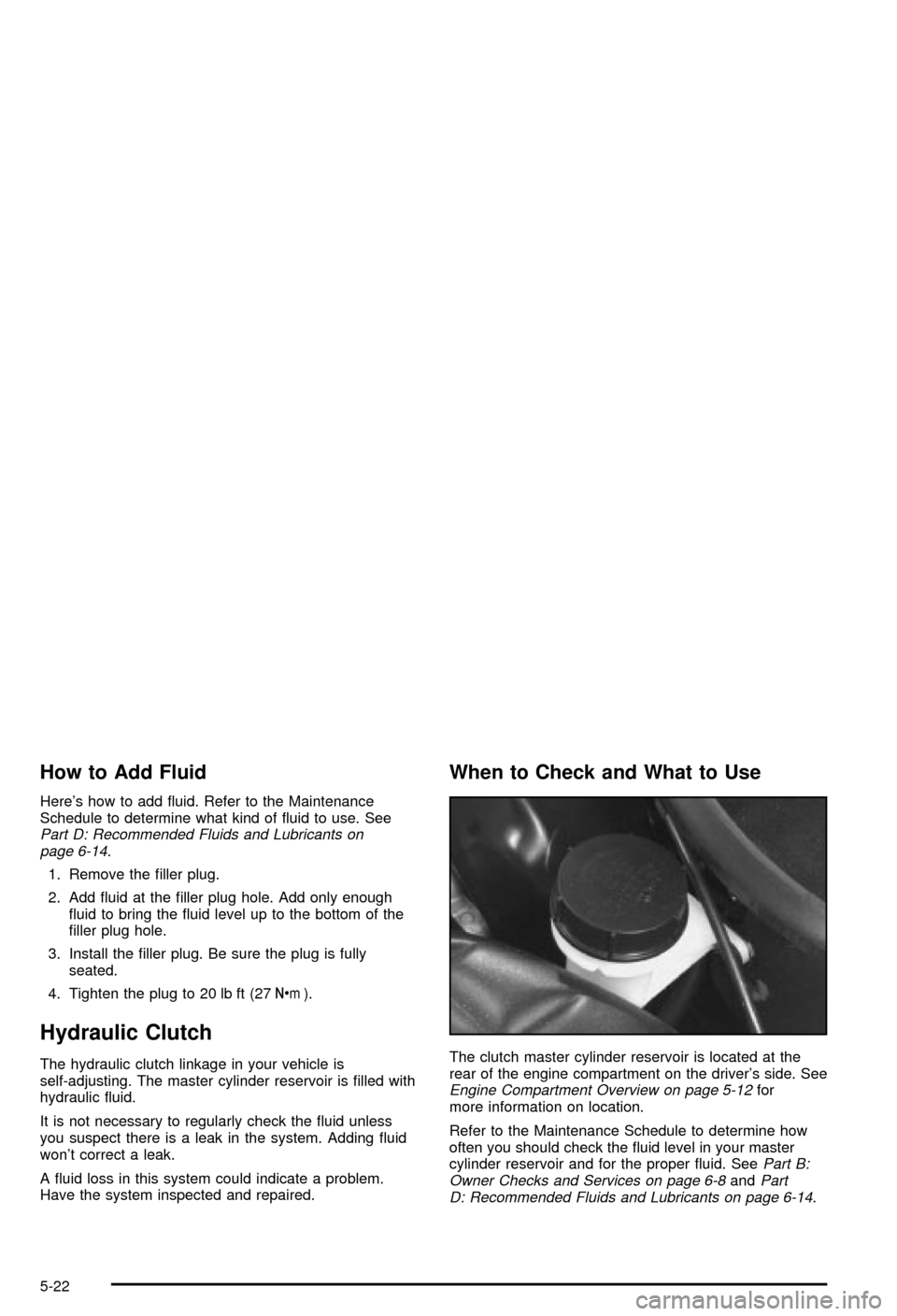
When to Check and What to Use
The clutch master cylinder reservoir is located at the
rear of the engine compartment on the driver's side. See
Engine Compartment Overview on page 5-12for
more information on location.
Refer to the Maintenance Schedule to determine how
often you should check the ¯uid level in your master
cylinder reservoir and for the proper ¯uid. See
Part B:
Owner Checks and Services on page 6-8andPart
D: Recommended Fluids and Lubricants on page 6-14.
5-22
Page 319 of 368
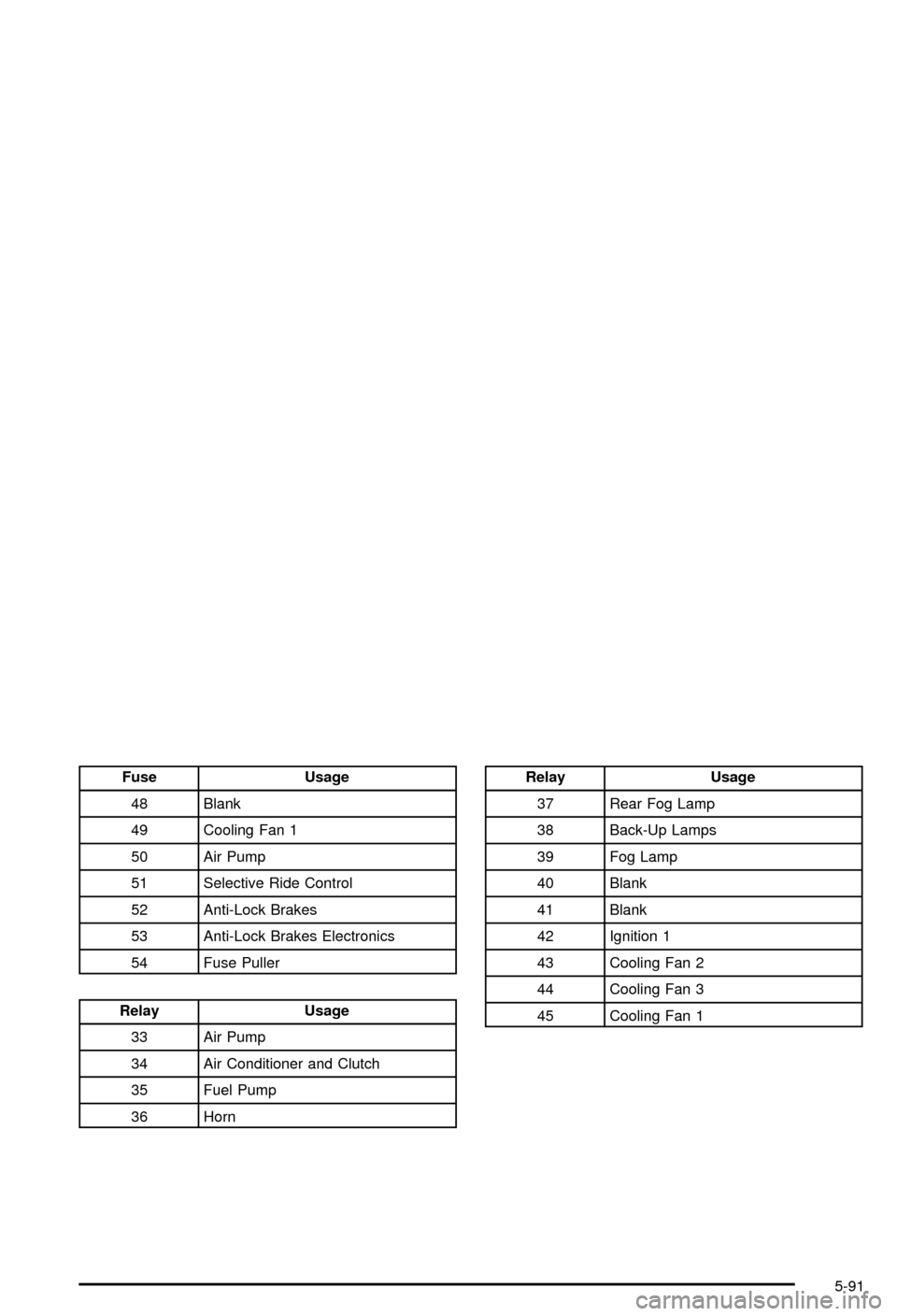
Fuse Usage
48 Blank
49 Cooling Fan 1
50 Air Pump
51 Selective Ride Control
52 Anti-Lock Brakes
53 Anti-Lock Brakes Electronics
54 Fuse Puller
Relay Usage
33 Air Pump
34 Air Conditioner and Clutch
35 Fuel Pump
36 Horn
Relay Usage
37 Rear Fog Lamp
38 Back-Up Lamps
39 Fog Lamp
40 Blank
41 Blank
42 Ignition 1
43 Cooling Fan 2
44 Cooling Fan 3
45 Cooling Fan 1
5-91
Page 334 of 368
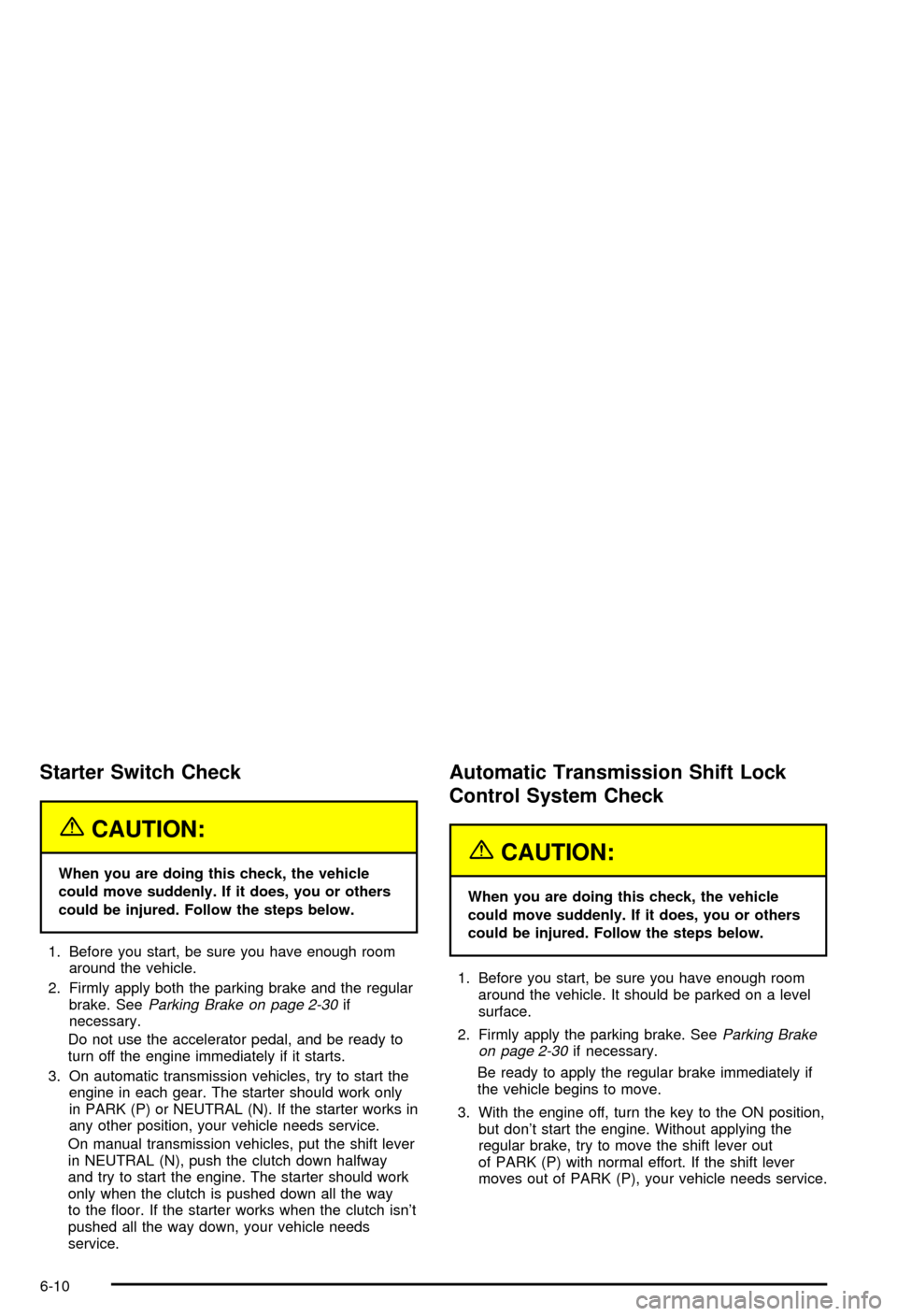
Starter Switch Check
{CAUTION:
When you are doing this check, the vehicle
could move suddenly. If it does, you or others
could be injured. Follow the steps below.
1. Before you start, be sure you have enough room
around the vehicle.
2. Firmly apply both the parking brake and the regular
brake. See
Parking Brake on page 2-30if
necessary.
Do not use the accelerator pedal, and be ready to
turn off the engine immediately if it starts.
3. On automatic transmission vehicles, try to start the
engine in each gear. The starter should work only
in PARK (P) or NEUTRAL (N). If the starter works in
any other position, your vehicle needs service.
On manual transmission vehicles, put the shift lever
in NEUTRAL (N), push the clutch down halfway
and try to start the engine. The starter should work
only when the clutch is pushed down all the way
to the ¯oor. If the starter works when the clutch isn't
pushed all the way down, your vehicle needs
service.
Automatic Transmission Shift Lock
Control System Check
{CAUTION:
When you are doing this check, the vehicle
could move suddenly. If it does, you or others
could be injured. Follow the steps below.
1. Before you start, be sure you have enough room
around the vehicle. It should be parked on a level
surface.
2. Firmly apply the parking brake. See
Parking Brake
on page 2-30if necessary.
Be ready to apply the regular brake immediately if
the vehicle begins to move.
3. With the engine off, turn the key to the ON position,
but don't start the engine. Without applying the
regular brake, try to move the shift lever out
of PARK (P) with normal effort. If the shift lever
moves out of PARK (P), your vehicle needs service.
6-10
Page 338 of 368
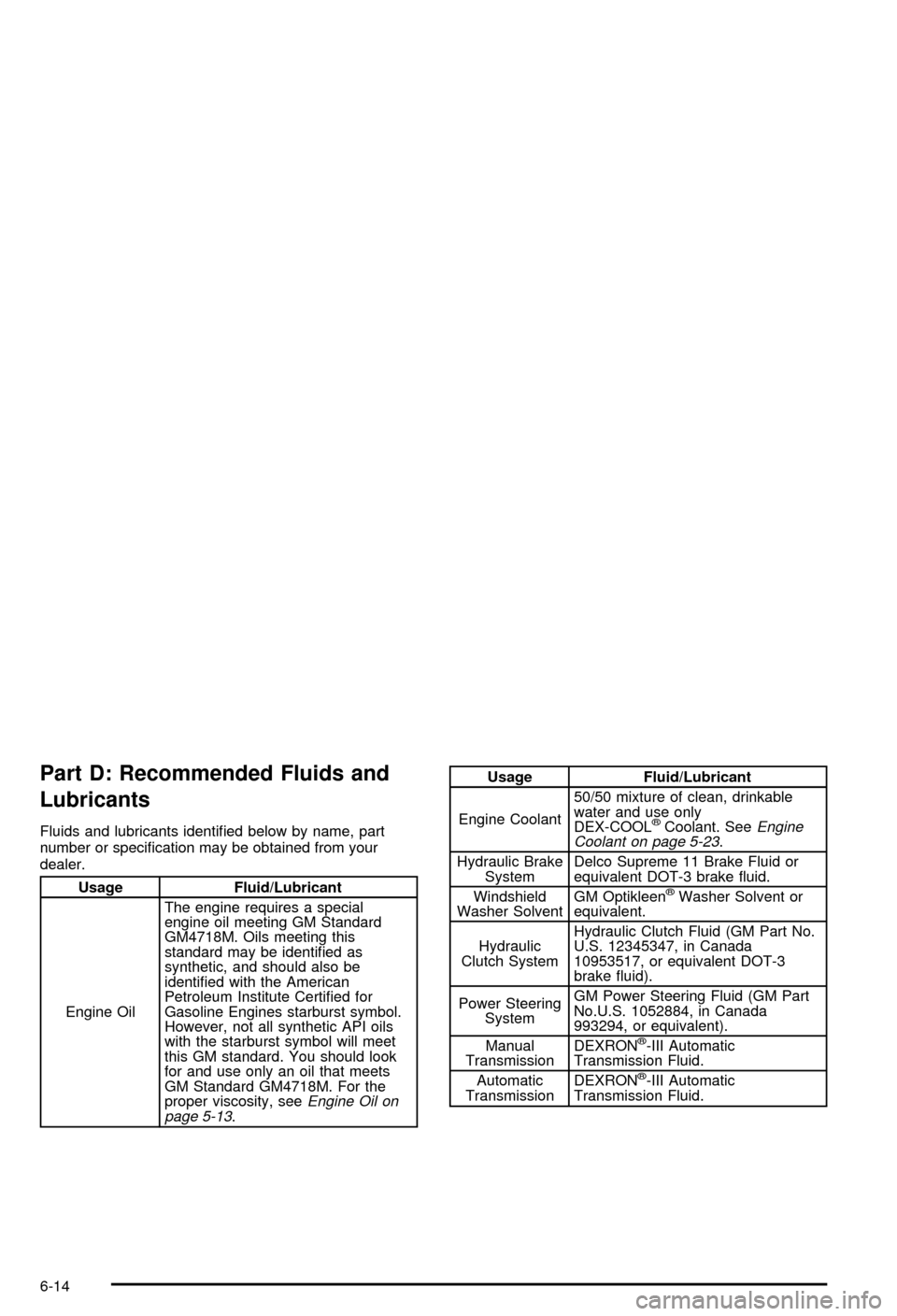
Part D: Recommended Fluids and
Lubricants
Fluids and lubricants identi®ed below by name, part
number or speci®cation may be obtained from your
dealer.
Usage Fluid/Lubricant
Engine OilThe engine requires a special
engine oil meeting GM Standard
GM4718M. Oils meeting this
standard may be identi®ed as
synthetic, and should also be
identi®ed with the American
Petroleum Institute Certi®ed for
Gasoline Engines starburst symbol.
However, not all synthetic API oils
with the starburst symbol will meet
this GM standard. You should look
for and use only an oil that meets
GM Standard GM4718M. For the
proper viscosity, see
Engine Oil on
page 5-13.
Usage Fluid/Lubricant
Engine Coolant50/50 mixture of clean, drinkable
water and use only
DEX-COOL
žCoolant. SeeEngine
Coolant on page 5-23.
Hydraulic Brake
SystemDelco Supreme 11 Brake Fluid or
equivalent DOT-3 brake ¯uid.
Windshield
Washer SolventGM Optikleen
žWasher Solvent or
equivalent.
Hydraulic
Clutch SystemHydraulic Clutch Fluid (GM Part No.
U.S. 12345347, in Canada
10953517, or equivalent DOT-3
brake ¯uid).
Power Steering
SystemGM Power Steering Fluid (GM Part
No.U.S. 1052884, in Canada
993294, or equivalent).
Manual
TransmissionDEXRON
ž-III Automatic
Transmission Fluid.
Automatic
TransmissionDEXRON
ž-III Automatic
Transmission Fluid.
6-14
Page 357 of 368

Checking Things Under the Hood......................5-10
Checking Your Restraint Systems......................1-48
Check...........................................................3-38
Engine Light...............................................3-38
Gages Warning Light...................................3-42
Chemical Paint Spotting...................................5-81
Child Restraints..............................................1-26
Child Restraint Systems...............................1-26
Infants and Young Children...........................1-23
Lower Anchorages and Top Tethers for
Children (LATCH System)..........................1-31
Older Children.............................................1-21
Securing a Child Restraint Designed for
the LATCH System...................................1-33
Securing a Child Restraint in the Passenger
Seat Position...........................................1-34
Top Strap Anchor Location............................1-31
Top Strap...................................................1-30
Cigarette Lighter.............................................3-21
Cleaning Aluminum Wheels..............................5-80
Cleaning Coated Moldings................................5-76
Cleaning Exterior Lamps/Lenses.......................5-78
Cleaning Fabric/Carpet....................................5-75
Cleaning Glass Surfaces..................................5-77
Cleaning Interior Plastic Components.................5-77
Cleaning Leather............................................5-76
Cleaning Removable Roof Panel.......................5-79
Cleaning the Convertible Top............................5-80
Cleaning the Security Shade and
Convenience Net.........................................5-77Cleaning the Top of the Instrument Panel...........5-76
Cleaning Tires................................................5-80
Cleaning Windshield and Wiper Blades..............5-79
Cleaning........................................................5-81
Fiberglass Springs.......................................5-81
Inside of Your Vehicle..................................5-75
Outside of Your Vehicle................................5-78
Titanium Exhaust System..............................5-81
Underbody Maintenance...............................5-81
Weatherstrips..............................................5-77
Climate Control System...................................3-22
Dual Automatic............................................3-22
Outlet Adjustment........................................3-28
Clutch, Hydraulic.............................................5-22
Compact Disc Messages..........................3-70, 3-75
Competitive Driving Mode................................4-11
Control of a Vehicle.......................................... 4-5
Convenience Net............................................2-42
Convertible Top..............................................2-49
Lowering the Convertible Top........................2-50
Raising the Convertible Top..........................2-53
Coolant.........................................................3-38
Engine Temperature Gage............................3-38
Heater, Engine............................................2-23
Surge Tank Pressure Cap.............................5-26
Cooling System..............................................5-29
Courtesy Lamps.............................................3-16
Cruise Control.................................................. 3-9
Cupholder(s)..................................................2-39
Current and Past Model Order Forms................7-11
3