Page 281 of 386
6-27
Engine Oil (Caterpillar�
Diesel Engines)
See your Caterpillar� Operation & Maintenance Manual
for information on oil quality and viscosities as well as
the temperature range chart.
Engine Oil (DURAMAX� Diesel)
Checking Engine Oil
It's a good idea to check your engine oil level every time
you get fuel.
The engine oil dipstick is
located in the engine
compartment on the driver's
side of the vehicle.
In order to get an accurate
reading, the oil must be
warm (at normal operating
temperature) and the vehicle
must be on level ground.Turn off the engine and give the oil at least five minutes
to drain back into the oil pan. With a cool engine, allow
30 minutes. If you don't, the oil dipstick might not show
the actual level.
Pull out the dipstick and clean it with a paper towel or a
cloth, then push it back in all the way. Remove it again,
keeping the tip down.
Page 284 of 386

6-30 Engine Oil Additives
Don't add anything to your oil. The recommended oils
with the API service symbol are all you will need for
good performance and engine protection.
When to Change Engine Oil
Change engine oil and filter every 10,000 miles
(16 000 km) or every 12 months, whichever occurs first.
What to Do with Used Oil
Used engine oil contains certain elements that may be
unhealthy for your skin and could even cause cancer.
Don't let used oil stay on your skin for very long. Clean
your skin and nails with soap and water, or a good hand
cleaner. Wash or properly throw away clothing or rags
containing used engine oil. See the manufacturer's
warnings about the use and disposal of oil products.
Used oil can be a threat to the environment. If you
change your own oil, be sure to drain all the oil from
the filter before disposal. Never dispose of oil by putting
it in the trash, pouring it on the ground, into sewers, or
into streams or bodies of water. Instead, recycle it by
taking it to a place that collects used oil. If you have a
problem properly disposing of your used oil, ask your
dealer, a service station or a local recycling center
for help.
Engine Air Cleaner/Filter
Refer to the Maintenance Schedule to determine when to
replace the engine air cleaner/filter. See ªScheduled
Maintenanceº in the Index.
The engine air cleaner/filter
is located in the center of
the engine compartment.
Your gasoline or diesel engine has a restriction indicator
that lets you know when the engine air cleaner/filter
needs to be serviced.
Page 286 of 386

6-32
Automatic Transmission Fluid
When to Check
A good time to have it checked is when the engine oil is
checked. See your Allison Automatic Transmission
Operator's Manual to find out when to change your
transmission fluid and filters.
How to Check and What to Use
The Allison Automatic Transmission Operator's Manual
that came with the vehicle shows how to check the
automatic transmission fluid and what fluid to use.
Automatic Transmission External Filter
Your automatic transmission filter requires periodic
replacement.
Consult the Allison Automatic Transmission
Operator's Manual that came with the vehicle for
proper change intervals.
Manual Transmission Fluid
Refer to the Maintenance Schedule to determine how
often to check the lubricant and when to change it. See
ªScheduled Maintenance Servicesº in the Index.
Refer to the Maintenance Schedule to determine what
kind of fluid to use. See ªRecommended Fluids and
Lubricantsº in the Index.
When to Check
A good time to have it checked is when the engine oil is
checked. See your Maintenance Schedule to find out
when to change your transmission fluid.
Page 287 of 386
6-33 How to Check and What to Use
Check the fluid level only when your engine is off, the
vehicle is parked on a level place and the transmission is
cool enough for you to rest your fingers on the
transmission case.
Then, follow these steps:
1. Remove the filler plug.
2. Check to be sure that the lubricant level is up
to the bottom of the fill opening. On heavy duty
transmissions (an inch of oil level equals about
one gallon of fluid.)
3. If the fluid level is good, install the plug and be sure
it is fully seated. If the fluid level is low, add more
fluid as described in the next steps.
How to Add Fluid
Here's how to add fluid. Refer to the Maintenance
Schedule to determine the proper fluid to use. See
ªRecommended Fluids and Lubricantsº in the Index.
1. Remove the filler plug.
2. Add fluid at the filler plug hole. Add only enough
fluid to bring the fluid level up to the bottom of the
fill opening.
3. Install the filler plug. Be sure the plug is fully seated.
Page 288 of 386
6-34
Rear Axle
When to Check and Change Lubricant
Refer to the Maintenance Schedule to determine how
often to check the lubricant and when to change it. See
ªScheduled Maintenance Servicesº in the Index.
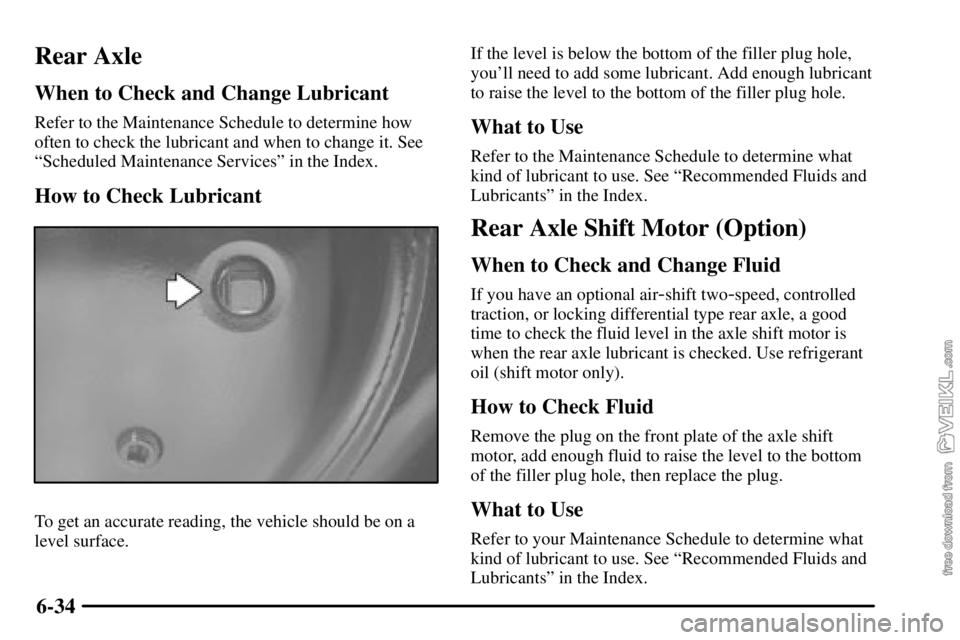
How to Check Lubricant
To get an accurate reading, the vehicle should be on a
level surface.If the level is below the bottom of the filler plug hole,
you'll need to add some lubricant. Add enough lubricant
to raise the level to the bottom of the filler plug hole.
What to Use
Refer to the Maintenance Schedule to determine what
kind of lubricant to use. See ªRecommended Fluids and
Lubricantsº in the Index.
Rear Axle Shift Motor (Option)
When to Check and Change Fluid
If you have an optional air-shift two-speed, controlled
traction, or locking differential type rear axle, a good
time to check the fluid level in the axle shift motor is
when the rear axle lubricant is checked. Use refrigerant
oil (shift motor only).
How to Check Fluid
Remove the plug on the front plate of the axle shift
motor, add enough fluid to raise the level to the bottom
of the filler plug hole, then replace the plug.
What to Use
Refer to your Maintenance Schedule to determine what
kind of lubricant to use. See ªRecommended Fluids and
Lubricantsº in the Index.
Page 289 of 386

6-35
Engine Coolant
If your vehicle has a Caterpillar diesel engine, the
Caterpillar� Operation & Maintenance Manual provided
with your vehicle has information regarding the proper
coolant to use.
The cooling system in your vehicle is filled with
DEX
-COOL� engine coolant. This coolant is designed
to remain in your vehicle for 5 years or 150,000 miles
(240 000 km), whichever occurs first, if you add only
DEX
-COOL� extended life coolant.
The following explains your cooling system and how
to add coolant when it is low. If you have a problem
with engine overheating, see ªEngine Overheatingº in
the Index.A 50/50 mixture of clean, drinkable water and
DEX
-COOL� coolant will:
�Give freezing protection down to
-34�F (-37�C).
�Give boiling protection up to 252�F (122�C).
�Protect against rust and corrosion.
�Help keep the proper engine temperature.
�Let the warning lights and gages work as
they should.
NOTICE:
When adding coolant, it is important that you use
only DEX
-COOL� (silicate-free) coolant.
If coolant other than DEX-COOL is added to the
system, premature engine, heater core or
radiator corrosion may result. In addition, the
engine coolant will require change sooner
-- at
30,000 miles (50 000 km) or 24 months,
whichever occurs first. Damage caused by the use
of coolant other than DEX
-COOL� is not
covered by your new vehicle warranty.
Page 292 of 386

6-38
Adding Coolant
If you need more coolant, add the proper DEX
-COOL�
coolant mixture at the surge tank, but only when the
engine is cool.
CAUTION:
You can be burned if you spill coolant on hot
engine parts. Coolant contains ethylene glycol,
and it will burn if the engine parts are hot
enough. Don't spill coolant on a hot engine.
When replacing the pressure cap, make sure it is
hand
-tight.
Engine Coolant (Caterpillar�
Diesel Engine)
If your vehicle has a Caterpillar diesel engine, see the
Caterpillar� Diesel Engine Operation & Maintenance
Manual provided with your vehicle to find out what to
add, also when and how to service your cooling system.
Surge Tank Pressure Cap
The surge tank pressure cap
is located in the engine
compartment, on the
driver's side of the vehicle.
The surge tank pressure cap must be tightly installed.
NOTICE:
Your surge tank pressure cap is a 15 psi (103kPa)
pressure
-type cap for use with medium duty
cooling systems only. It must be tightly installed
to prevent coolant loss and possible engine
damage from overheating.
Page 293 of 386

6-39
Power Steering Fluid
See your Maintenance Schedule for when to check your
power steering fluid.
How To Check Power Steering Fluid
Check your power steering fluid only when the engine is
warm. If the engine isn't warm, you probably won't get
an accurate reading.
If the fluid level is
between the MIN and
MAX marks, you have
enough. If you need
fluid, add only enough
of the proper fluid to
bring it into view in
the sight glass.If your power steering fluid level is low, this can cause
the BRAKE or service brake soon warning lights to
come on. If either light remains on after you have added
power steering fluid to the proper level, then shut off the
engine for 10 seconds. This should reset the brake
warning lights. If one or both lights stay on though, see
ªHydraulic Brake Warning Lightsº in the Index.
What to Use
To determine what kind of fluid to use, see
ªRecommended Fluids and Lubricantsº in the Index.
NOTICE:
When adding power steering fluid or making a
complete fluid change, always use the proper
fluid. Failure to use the proper fluid can cause
leaks and damage hoses and seals.

